Saturday, 18 March 2023

Orchids of Algonquin Provincial Park

Orchids (Orchidaceae) are a particularly enchanting group of plants that delight many botanists. There are over 60 species that inhabit Ontario, 36 of which can be found in Algonquin Provincial Park, located in Central Ontario. Algonquin Park is home to a variety of different habitats, which helps explain its orchid diversity. 

While I am not nearly as orchid obsessed as some, I do enjoy seeing these beautiful and unique wildflowers, so I have made it a point of seeking out the species that occur in Algonquin Park. I have only managed to see a little over half of them within the park boundaries, and have seen several more of the species elsewhere. In this post, I will attempt to highlight and provide a brief overview the species that can be found in the Park, in alphabetic order as they appear in the Checklist of Vascular Plants of Algonquin Provincial Park (2020) by Sean Blaney et al. I will make reference to the West and East Sides of Algonquin Park in this post. The West Side is higher in elevation, comprised mostly of upland sugar maple-beech forests on glacial till. The East Side is lower in elevation, comprised largely of pine forests on sandy glacial deposits. Of course, there is some overlap in the habitat types.   

Dragon's-mouth (Arethusa bulbosa) is a particularly charming little species of orchid that hits peak bloom in late May into early June. This is a rather rare species in Algonquin Park, with most of the records coming from the Park's East Side. Despite it's apparent rarity, it is likely widespread, albeit in low densities, and just under detected. It is often found growing on bog mats. 

Dragon's-mouth (Arethusa bulbosa)

Sort of looks like a dragon!

I'm not entirely sure what the mechanisms are behind the species' distribution in the Park. The above individuals were photographed in a location with some unique associates, Meagre Sedge (Carex exilis) and Buckbean (Menyanthes trifoliata). 

Tuberous Grass Pink (Calopogon tuberosus) is a fairly familiar orchid to those who many find themselves in a bog during early summer. This orchid is special in that its flowers are upside down. It is not particularly common in Algonquin Park, but is widespread. 

Tuberous Grass Pink (Calopogon tuberosus)

Frog Orchid (Coeloglossum viride) is not common anywhere in Ontario, and is considered rare in Algonquin Park. The only record(s) are from the West Side. I have not seen this species in the Park.

The coralroots are always fun. By far the most abundant is Spotted Coralroot (Corallorhiza maculata), and both the western (var. occidentalis) and eastern (var. maculata) varieties can be found. Early Coralroot (Corallorhiza trifida) and Striped Coralroot (Corallorhiza striata) are also known, but are not as commonly encountered. The latter is rare and only known from the East Side. Coralroots are well known to be mycoheterotrophic orchids

Spotted Coralroot (C. maculata var. maculata)

Spotted Coralroot (C. maculata var. maculata)

Probably the most well known of Algonquin's orchids are the lady's-slippers. Only one, Pink Lady's-slipper (Cypripedium acaule) is common. You are more than likely than not to encounter this species somewhere in your travels during June and early July in the Park. 

Pink Lady's Slipper (C. acuale) (London, ON)

Ram's-head Lady's-slipper (Cypripedium arietinum) also had records from Algonquin Park, on the East Side. The last record was in 1982. Last June I embarked on a backcountry journey to check out where they were last seen, but came up empty. I thought for sure that they must be extirpated...that was until late August. No, I did not find Ram's-head, but I did have a conversation with Dan Brunton over a lunch break during a day of botanizing. He indicated that the area I had checked for the species was, although suitable, not where the records had come from. So maybe we shouldn't say the population is gone just yet. That being said, this species is particularly sensitive to disturbance, and is apt to disappear, so the optimism may be in vain. Perhaps this will be a goal of 2023. 

The only non-native species of orchid in Algonquin Park, and one of very few in Ontario, is Broad-leaved Helleborine (Epipactis helleborine). In Algonquin, it is most often seen in areas of human disturbance, although it was growing was commonly along the Bonnechere River floodplain last Summer (not directly beside development, although quite close). It is increasing in abundance, although I don't think necessarily poses a risk to native flora.

Broad-leaved Helleborine (E. helleborine)

The rattlesnake-plantains are another group of interest. All four of Ontario's species are known from the Park. Checkered Rattlesnake-plantain (Goodyera tesselata) is likely the most abundant, followed by Dwarf Rattlesnake-plantain (Goodyera repens). Downy Rattlesnake-plantain (Goodyera pubescens) is rare and only known from the West Side. Western Rattlesnake-plantain (Goodyera oblongifolia) is only known from three or so West Side records. 

Checkered Rattlesnake Plantain (G. tesselata)

Lesser Rattlesnake Plantain (G.repens)

Downy Rattlesnake Plantain (G. pubescens)

Western Rattlesnake-plantain (G. oblongifolia) (Bruce Peninsula, ON)

Fen Orchid (Liparis loeselii) is another rarity in Algonquin Park, although there are records throughout. I have not seen this species in the Park. I have to wonder if its habitat requirements are particular, and perhaps the required nutrients just are not common in Algonquin Park. 

Fen Orchid (L. loeselii) (Puslinch, ON)

There are two species of adder's-mouth that are found in Algonquin Park. The first is Green Adder's-mouth (Malaxis unifolia), which, while not common, is found throughout. This is a tiny, delicate orchid that is always a delight to see. The second is White Adder's-mouth (Malaxis brachypoda). This species appears to be a calciphile (likes calcium-rich substrates), so it is not found widely in Algonquin Park. In fact, the only area it is known, to my knowledge, is in the Brent Crater on the East Side. The Brent Crater is unique in that it hosts the only visible limestone (a calcium-rich rock) in the park, so there are a few floristic elements that reflect this. I haven't seen this species in the Park, but have photographed it in the Ottawa Valley, growing in a cedar swamp, similar habitat to which it would occur in Algonquin . 

Green Adder's-mouth (M. unifolia)

White Adder's-mouth (M. brachypoda) (Arnprior, ON)

The twayblades are a favourite group of mine. None of them are common. Heart-leaved Twayblade (Neottia cordata) is the only species found on both the West and East Sides. It grows in shaded bogs. Broad-lip Twayblade (Neottia convallarioides) is found in a few spots on the West Side, and Auricled Twayblade (Neottia auriculata) is found in a few spots on the East Side, both in riparian habitats. Southern Twayblade (Neottia bifolia) is the real crown jewel, and is likely the rarest species of plant in the Park, ranked S1 in Ontario. It is found on the East Side. There's so much more I could say and speculate about the ecology of Southern Twayblade, however I'll omit it here in fear of saying too much :)

Auricled Twayblade (N. auriculata)

Southern Twayblade (N. bifolia)

Southern Twayblade (N. bifolia) — "bifolia"

Now into the bog orchids, buckle up. 

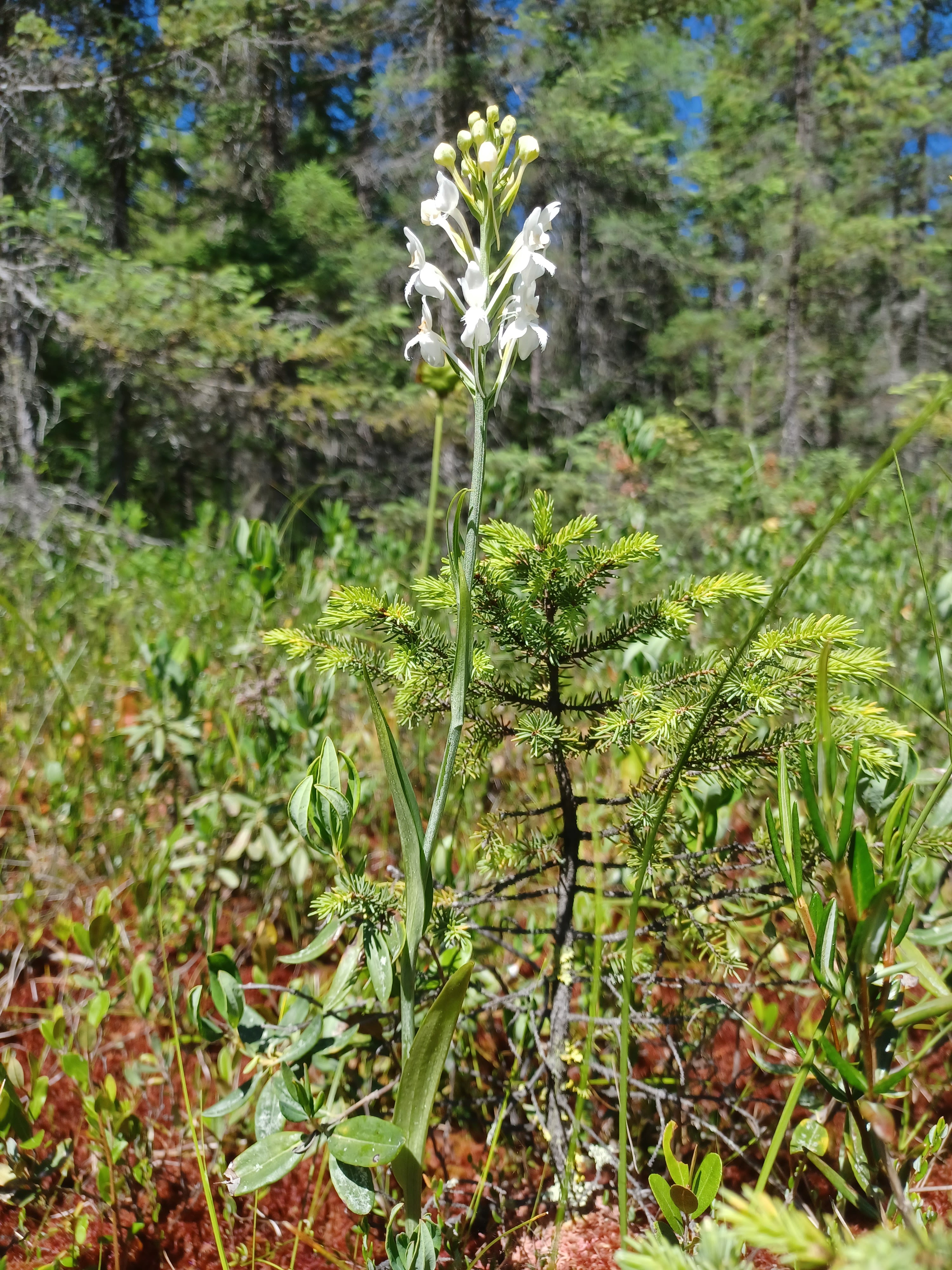
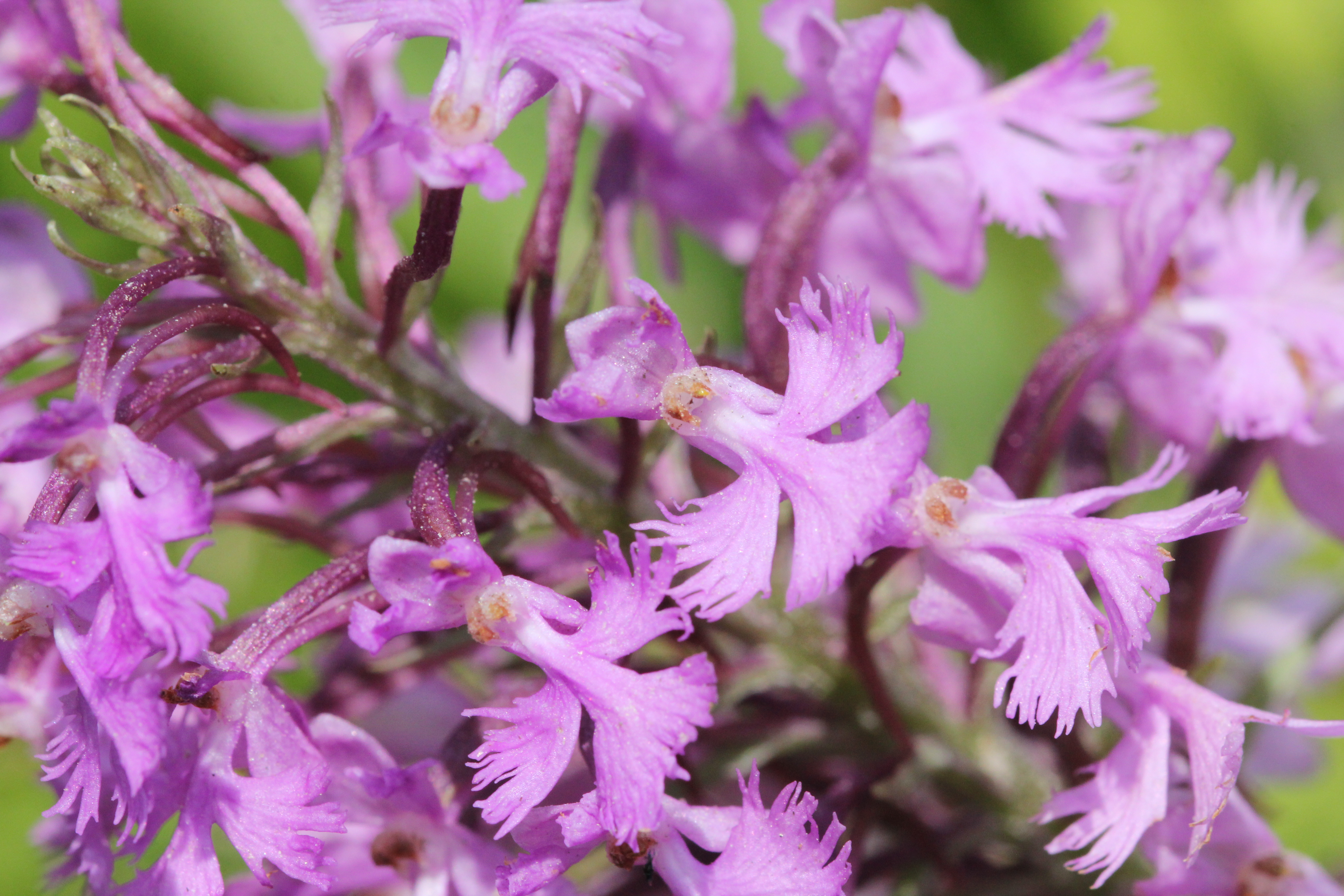
Tall Northern Green Orchid (Platanthera aquilonis) is rare throughout the Park. White-fringed Orchid (Platanthera blephariglottis) is another mega rarity in the Park. It is only known to be extant in one location, and is considered historical from the West Side. Truly a special species. The most common of the bog orchids is Club-spur Orchid (Platanthera clavellata) is is found in most suitable habitats. Tall White Bog Orchid (Platanthera dilata) is quite rare in the Park, only known from one location on the East Side. Northern Tubercled Orchid (Platanthera flava var. herbiola) is rare, but can be found locally abundant along the Petawawa River system on the East Side of the Park. Hooker's Orchid (Platanthera hookeri) has earned the designation of "common" in the checklist, however I doubt this is actually the case. All the records are from the East Side of the Park. Ragged Fringed Orchid (Platanthera lacera) is rare, but can be found in the right habitat, often fens or bogs. Blunt-leaved Orchid (Platanthera obtusata) is quite uncommon and widespread. Lesser Round-leaved Orchid (Platanthera orbiculata) is the species of bog orchid you are most likely to encounter in the forests, where it is uncommon. Finally, Small Purple Fringed Orchid (Platanthera psycodes) is only known from the East Side, where it is not particularly uncommon. 

White-fringed Orchid (P. blephariglottis)

White-fringed Orchid (P. blephariglottis)

Club-spur Orchid (P. blephariglottis)

Tall White Bog Orchid (P. dilatata) (Ottawa Valley, ON)

Northern Tubercled Orchid (P. flava var. herbiola)

Hooker's Orchid (P. hookeri) (Arnprior, ON)

Ragged Fringed Orchid (P. lacera)

Blunt-leaved Orchid (P. obtusata) (Longridge Point, ON)

Lesser Round-leaved Orchid (P. orbiculata)

Small Purple-fringed Orchid (P. psycodes)

Likely the most abundant bog dwelling orchid is the Rose Pogonia (Pogonia ophioglossoides). This species adorns bog mats in shades of pink during the early summer, and is often quite numerous. 

Rose Pogonia (P. ophioglossoides)

Lastly, we have the ladies'-tresses, which made late summer exciting for the botanist. Four species can be found in Algonquin Park. The most abundant is Sphinx's Ladies'-tresses (Spiranthes incurva), part of the Nodding Ladie's-tresses (Spiranthes cernua) complex—it was formally known under this name. This species can be found quite readily in the latter half of August, often growing abundantly in wet areas, including the ditches of Highway 60. The most impressive showing I have seen of this species is along the shore of Lake Travers. Northern Slender Ladies-tresses (Spiranthes lacera) are locally common. This species seems to like dry, open areas. I have seen this species in good numbers the the Old Airfield. Hooded Ladies'-tresses (Spiranthes romanzoffiana) is only known from the West Side, but must certainly occur on the East Side too. This species likes wet areas, so is most likely to be seen in fens. Finally, Cases' Ladies-tresses (Spiranthes casei), which bit of an enigma for me. It is considered quite uncommon in Algonquin Park. I have spent a fair amount of time looking for the species in suitable habitat (dry, open areas), but have so far come up empty. Supposedly, it flowers the latest of these four species. 

Sphinx's Ladies'-tresses (S. incurva)

Hooded Ladies'-tresses (S. romanzoffiana)

Hooded Ladies'-tresses (S. romanzoffiana) — note "fiddle-shaped" lip

Northern Slender Ladies'-tresses (S. lacera)

Northern Slender Ladies'-tresses (S. lacera)

Of course, part of the fun of botany is finding new things. There are a few species that could still be found in Algonquin Park, and I will highlight some here.

Two species that very well may already have been observed in the Park, but have not been confirmed via adequate photos and/or specimen are Green Bog Orchid (Planathera huronensis) and Large-leaved Bog Orchid (Platanthera macrophylla). In just the last couple of years, for example, I know that a likely individual of the former has been seen in Basin Depot, and the latter, a good candidate individual comes from near Galeairy Lake. Green Bog Orchid in particular is a glaring hole in the list, as it is likely one of the more abundant bog orchids in the province.

Green Bog Orchid (P. huronensis) (Cochrane, ON)

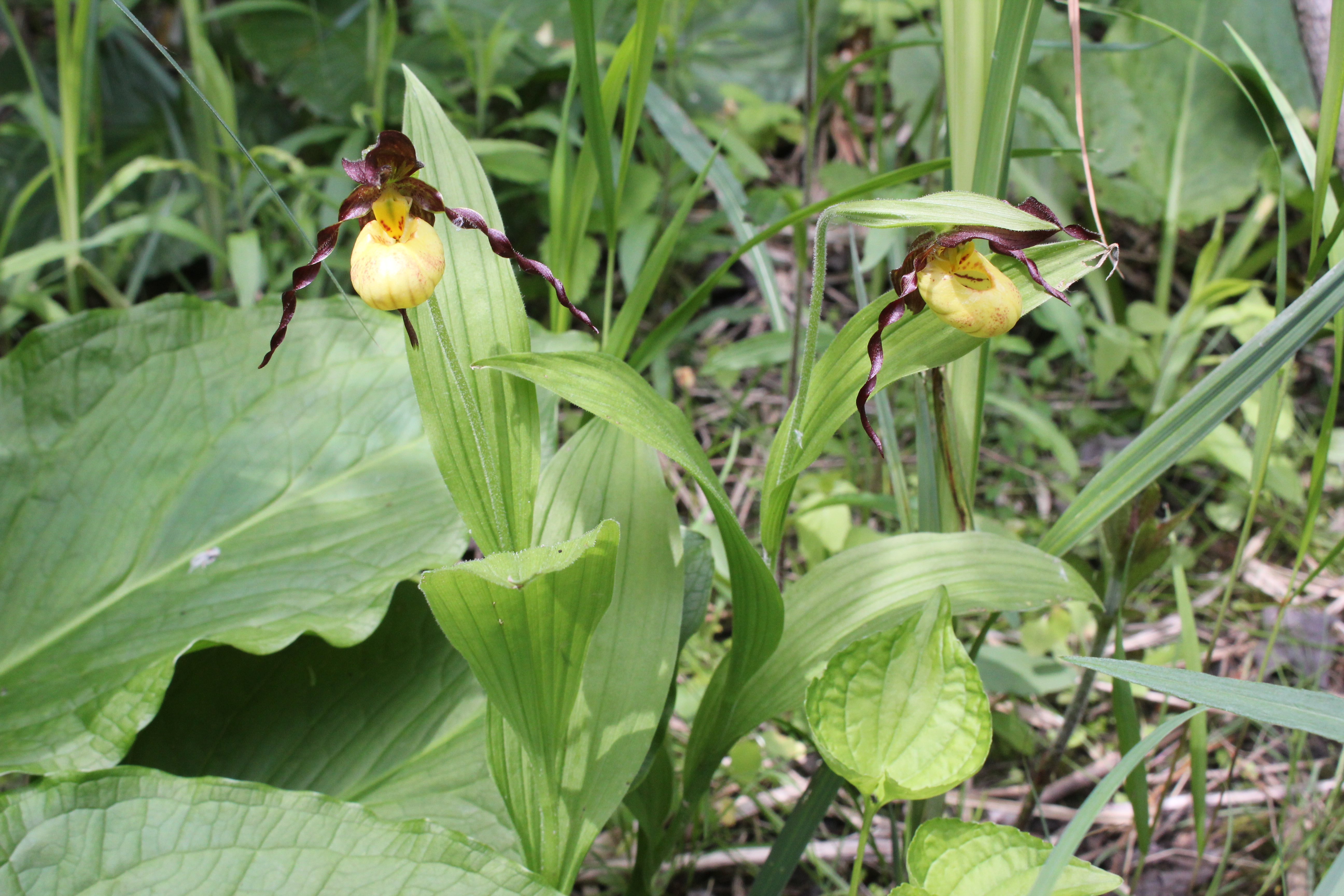
Now for some other potential additions—there aren't many! Starting with the most far-fetched...Yellow Lady's-slipper (Cypripedium parviflorum). This species prefers calcium-rich environments, which are lacking in Algonquin Park. Despite the low possibility of its occurrence, I include it simply because of how distinct and conspicuous it is—if its there, it will be seen. Like the White Adder's-mouth, if it is anywhere, it would probably be in the Brent Crater. That being said, I don't think that the Bonnechere River Valley in Basin Depot should be excluded from the list of possibilities. This is a good segue into the next species, Showy Lady's-slipper (Cypripedium reginae). I suspect this is another species with calciphilic tendencies. There is an iNaturalist record from Round Lake, which is tantalizingly close to Algonquin, and in particular, where I suspect it could occur—Basin Depot. In conversation with Dan Brunton, Basin Depot seems to have some sort of calcaerous element to it (the two of us found Bromus kalmii there last August, only the second record for the park, and a species associated with more nutrient rich environments), and it is largely unexplored by botanists, so who knows! As the name would suggest, the species is quite noticeable, so it won't be a matter of overlooking it. Lastly, I have my top pick for most likely addition, Shining Ladies'-tresses (Spiranthes lucida). This species stays true to the common theme here of prefering calcareous habitats, which does slightly hurt the chances of it being in the Park. That being said, it is fairly small, and easy to overlook. I observed this species fairly abundantly along the Ottawa River last June (it is the earliest flowering Spiranthes), and it sort of planted the seed in my mind that it could occur along one of the East Side rivers in Algonquin Park. The two places that immediately come to mind are the Barron and Petawawa Rivers, tributaries of the Ottawa River. These rivers also reside along geologic fault lines, which may mean there is a bit of calcium here and there (while not super common, there are a few calciphilic plants along these rivers). A fun thought, anyways! 

Yellow Lady's-slipper (C. parviflorum) (London, ON)

Showy Lady's-slipper (C. reginae) (Ottawa Valley, ON)

Shining Lady's-tresses (S. lucida) (Arnprior, ON)

And just so I can say "I told you so" when one of these randomly pops up out of the blue in true Algonquin Park fashion, keep an eye out for Fairy-slipper (Calypso bulbosa) and Small Round-leaved Orchis (Galeris rotundifolia). Both have historic records from the Ottawa Valley, so why not...one can dream.

So there you have it, the Orchids of Algonquin Provincial Park. What a wonderful place to observe these wonderful plants that provide endless joy in discovering, as well as crucial information on the habitats in which they occur. 

Sunday, 29 January 2023

A Good Day in the Month of May

It has been quite awhile since I last posted something to this blog. Since my last post in June (!!!), a lot has happened in my life, including finishing up my contract working in Algonquin Park (ending an amazing 14 months of my life), and starting my undergraduate degree at the University of Guelph. Understandably, with that latter thing, the time I have had for naturalizing has decreased significantly, although I must assure you, I still get out from time to time.

I wanted to come back and write a post on something I am surprised I never mentioned here—the story of one morning in late May, back when I was working in Algonquin. If nothing else, it will be good to immortalize the story here, even if it is eight months late!

The date was May 22, 2022. It was a Sunday of the May long weekend, and I was scheduled to work a later shift that day (we were going to be leading a night hike with the interpretive program). It was a rather cool and drizzly day, with winds coming out of the northwest, as they had been all night (and I believe it even rained overnight), so generally things didn't look like it would be a great day to go out an observe migrant birds. However, as had been my routine for the past month or so, I pulled myself out of bed, and made my almost-daily pilgrimage to the Old Airfield in the morning. I was thinking it would just be a quick morning walk, just going through the motions, you know? I wasn't properly dressed at all. I think I may have even been in my uniform. The quicker I get this walk over with, the quicker I can go back home and be dry, I thought to myself.

I walked the edge of the airfield, and was quite pleased when I spotted a Wilson's Warbler working the edge. There had been one reported the day prior, so it was one I was hoping to encounter. This was a new Park bird for me, as I hadn't seen any the fall previous. It was surely going to be the highlight of my day!


I snapped a couple mediocre photos, and continued on my way. I was sort of absent mindedly sauntering along, when I heard it. What was it that I heard? A very weird sounding Northern Flicker. But no, that wasn't quite right. There is goes again. Certainly not flicker. What was it? It sounded very mimid-y. The phrases were repeated ~6 times. Hmmm...that's what mockingbirds are supposed to do. Must be my Park bird Northern Mockingbird then! Cool! I walked towards the alder thicket, expecting it see the culprit, but...nothing. Playing hard to get, I see. I bushwhacked a little bit, the bird singing the whole time, but I just couldn't lay eyes on it. I knew that mockingbirds could be skulky, but this was getting ridiculous. It moved further down the edge, and I followed in hot pursuit, wanting to see what the heck I was dealing with. What could possibly be making that sound, but also be so hard to see? I racked my brain, trying to place it. A thought crossed my mind, and on a whim I decided that maybe just a little bit of playback wouldn't hurt. So I pulled out my phone, and played a small snippet of song of my far fetched idea...and wouldn't you know it, a couple seconds later, my far fetched idea wasn't looking so far fetched. Up popped a Yellow-breasted Chat. I saw it for approximately two seconds before it disappeared and shut up.

Oh. My. Goodness.

I frantically tried to re-find it over the next few minutes, but it wasn't turning back up. At this point I put out the alert to the community, and made a few phone calls. Jeff Skevington was just packing up his car in Ottawa, two hours away, when I called him. My friend and colleague Henrique Pacheco (who, it should be noted, I invited to come out with me that morning, but had opted to sleep in), finally picked up on about the sixth call. He would later tell me that he thought, in his sleepy state, that he was being bombarded with spam calls. I also called Algonquin Park legend Ron Tozer, who famously missed the only other park record of Yellow-breasted Chat in October 1981, by only a matter of seconds. You can read his account on this in his 2012 Birds of Algonquin Park (A.K.A The Bible). Unfortunately for Ron, when he picked up the phone he was at Big Creek NWA down near Long Point. It appeared that he would be missing another chat in the Park! 

What followed will probably go down as the most intense twenty minutes of my life. Finally (finally!), the bird popped up again, not to far from where it was first seen, and began to sing. I was very happy to be able to finally document this sighting photographically, and with an audio recording.

The first ever photo of a Yellow-breasted Chat in Algonquin Park

The chat soon moved to a more unobstructed perch, and gave me some great views—the best views anyone got of this bird. As a side note, this was only the second Yellow-breasted Chat that I have ever seen—and frankly it may as well be the first, as my experience with the other individual was very brief and largely unmemorable. 


The bird flew back over to the alders beside Lake of Two Rivers. This photo isn't great, but I kind of like it—a Yellow-breasted Chat in the Old Airfield!


Henrique, who had been asleep only moments ago in the staff house not too far away, arrived on the scene at this time, and thankfully the bird was cooperative enough for him to see it. Those who arrived after Henrique, not so lucky...

A few more observers had arrived by this point, however we had lost the chat. We spent the next hour or so scouring the airfield, but I could tell that hope was waning. On a whim I walked over to the southeast corner overlooking the Madawaska River, and paused to look at the water. Wouldn't you know it...the chat popped up basically at my feet. Somehow, we had lost the bird on one side of the airfield, and it had managed to move undetected to the other side! I called over the others, and after another few minutes of intensity, managed to get those present on the bird. I feel not only lucky and overjoyed to have been able to find this bird to begin with, but also that I was able to share it successfully with others. Almost everybody who came out that morning, some as far away as Ottawa and Arnprior, were able to eventually see or at least hear this incredible bird—a species nobody thought would ever be likely to occur in Algonquin Park again. 

It turned out to be a great morning of birding, chat aside. It was drizzly the whole time, which seemingly "knocked down" some other birds. The highlights for me were two new species of swallow for my Park list, Cliff Swallow and Bank Swallow. Both of these species have become rather rare in Algonquin. 

Cliff Swallow

Bank Swallow


There were a couple other nice birds as well, such as a group of four White-winged Scoters flying off the lake, and a few Bobolink. As there always are in Algonquin Park birding, there were a couple that "got away"; a flyover pair of Calidris sandpipers, and a couple of scaup sp. (hopefully not Greaters, as I missed that in 2022 for the Park). 


It was an absolutely spectacular morning of birding, and just another example of why late May birding is so magical in Algonquin Park. 

------

Fast forward a week, and I had my "grand finale" of Spring birding in the Park (see my blog posts from back in June that detail the climax of the week). I was just out for a pretty lowkey morning of birding on my day off at the Old Airfield, and I paused to stop and listen at the northeast corner, overlooking the airfield marsh when I heard something that I could hardly believe...the song of a Least Bittern. Although I was pretty confident in the ID, it was a bit distant and I wanted to rule out the very small possibility that it was another birder, unseen to me, playing a tape, so I went over to the Lake of Two Rivers Campground beach and launched my canoe (I knew it was a good thing I didn't take it off after my adventure a couple days prior on Lake Travers!). After paddling around for over an hour, myself, and Sarah Lamond (who had arrived on the scene) were able to locate the Least Bittern. Super exciting! Later that evening, we got several more of the Park Naturalist staff on the bird—except for Henrique, who was back home for the weekend. Sorry buddy!


I think this is the seventh (?) record for Algonquin Park, and only the second time one has ever been actually seen and photographed. This is a species that is probably annual in the Park, but very under detected—although that being said, proper breeding habitat is rather limited. 

Well, that's all for now folks! I have soooo many more stories about my time in Algonquin. One just has to wonder how many I'll actually get around to writing about, before I'm right back up there again making more memories! 

Tuesday, 14 June 2022

I Love This Park: Part 2

Click here to read Part 1.

Before I went out on Lake Travers, I decided to try and air out my feet a little bit. I learned at this point that not only did I forget to bring my boots, but for the first time ever, I apparently also neglected to bring a surplus of extra socks! This was going to be a rough 24 hours, especially if it rained as much as it was forecasted to do.

As I sat in my car doing so, I noticed something scrambling over the rocks on the other side of the river. It took me a second to figure out what it was...a baby moose!

Finally, I figured my feet were about as dry as they were going to be, so I put them back into my damp boots, loaded up the canoe, and launched. 

I'm not sure if I have really introduced Lake Travers before. This lake is arguably my favourite one that I have visited in the Park. It is part of the Petawawa River system, located in the northeastern part of Algonquin. Because of its location, it is a great spot to look for birds, especially during periods of bad weather, that otherwise are very rare in the Park. Over the years, a number of rarities have been found here, and on this trip, I was hoping to get to add to that impressive list.

The campsite I like on this lake is not a very far paddle, so I got there in quick fashion and set up camp. It was mid-afternoon and sunny...not really much for me to do, so I took a nap. After that short siesta, I headed out on the lake for an evening paddle. 

There was a White-winged Scoter, which is always nice to see. I would have preferred one of the other scoter species however :)

I also had one of my most memorable mammal encounters that evening. A (presumably different) baby moose was on the shore, and I was able to get quite close in the canoe without disturbing it. This was my first time seeing a moose this young. I will admit to becoming a bit complacent in regards to seeing moose—after all, I see them almost daily—but it is always nice to get to enjoy one by yourself for a prolonged period of time in a "natural" setting (i.e. not the shoulder of Highway 60).


Other than those sightings, no real highlights. It is just nice to get out on a calm lake sometimes!

Just as I was going to bed, the rain began to start softly. I hoped that with the rain, some goodies would drop down...

The next morning, I woke up around 4am to try and listen for any birds calling in the dark as first light approached, but it was quit hard to do with the rain pounding the tent. Had I made a mistake coming here? I could be sitting at home, warm and dry. Then, right around 4:30am, I heard a Black-bellied Plover calling as it flew overhead. This was a new bird for my park list. I scrambled out of the sleeping bag, threw on some clothes and my rain gear, and ran down to the lake's edge (not very far). The light was still dim, but I could hear Black-bellied Plovers, Semipalmated Plovers, and Least Sandpipers calling as they flew around. I couldn't believe it...it was actually happening.

I was in the canoe by 5am, and began to make the rounds, checking the little marshes and bays on the lake. The rain had sort of subsided by this point, and the shorebirds gone quiet, so I was getting a bit worried that the show was over. I persevered nonetheless. 

After a bit over and hour of paddling around, the rain had begun to fall again, and in the distance I noticed a couple birds that ended up being Brant, also new for me in the Park. Not too long after those two, a small flock flew low down the lake. 


So cool to see in this context! Being from Southwestern Ontario, and not really travelling too far very much, I had only ever seen this species on one occasion prior. 

It was raining pretty steady by this point. I continued north up the lake, picking up species here and there, but noting too crazy. I looped around a small island at the north end of the lake, and began to make my way back south. 

When I got to the south end of the lake, shorebirds started to fly around a bit more. Black-bellied Plover, Semipalmated Plover, Least Sandpiper, and Dunlin were tallied. Unfortunately, no mega rarities were mixed in! It was really fun to encounter these species in these numbers regardless.

Black-bellied Plovers

Least Sandpipers and Semipalmated Plovers

Dunlin

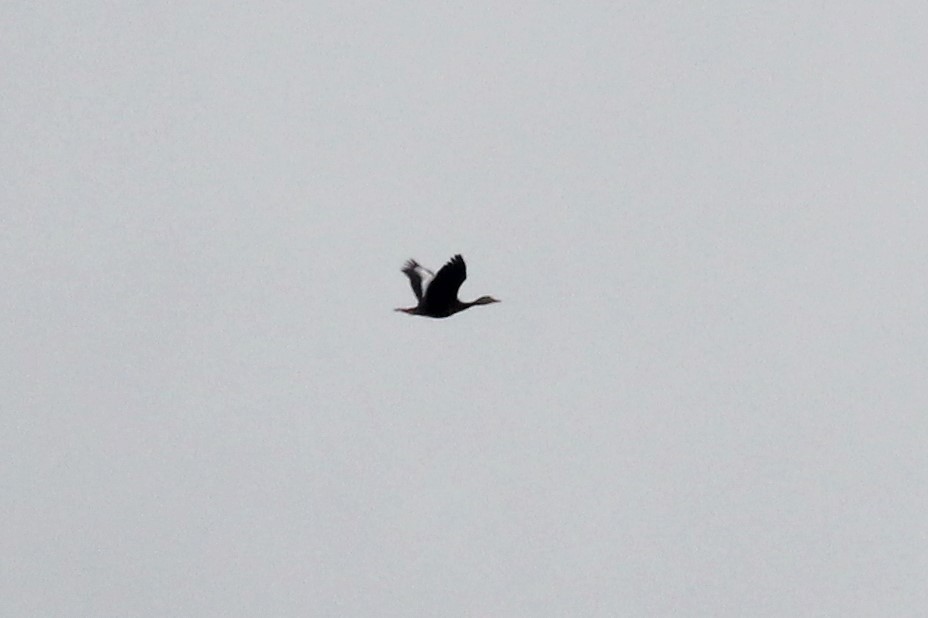
There were a number of Canada Geese moving on this day as well. I figure they are molt migrants. Around 8:30am, over the southern marsh, a large flock of geese approached. I snapped a couple of photos to count the flock later, and then turned my attention back to the shorebirds that were flying around. Just a minute or two later, I heard a very odd wheezy whistle vocalization that I did not recognize. Was it some sort of shorebird call I was unfamiliar with? Unlikely. I looked around frantically, and spotted something smaller with the flock of Canada Geese that were flying up river. Perhaps that was the source of the call. I snapped a few photos, and zoomed in. The first photo I looked at didn't show much. I scrolled to the next photo, and instantly felt my stomach drop. No. Freaking. Way.


It all clicked. The wheezy whistle belonged to none other than a Black-bellied Whistling Duck. This is a rare vagrant in Ontario, let along the middle of Algonquin Park. 

I tried to get some more photos of it as it flew away, now that I knew what it was, but was unsuccessful. It was gone, never to be seen or heard of again. 

The adrenaline rush that followed nearly made me tip the canoe. I couldn't even fathom that I had just seen a whistling duck in Algonquin Park, of all places. Needless to say, it is a first record for the Park. It also happened to be a lifer for me, and just like the Black-legged Kittiwake in October, seemingly the least likely place for me to see my first one. Although I sure hope I do, I very well may never find a better bird in Algonquin Park.

I'll be the first to admit that my photos aren't great, but they are diagnostic, showing the large striking white wing pattern, pink feet, and a bright red bill. Here is another photo, lightened, colour enhanced, and extra cropped to show these features. 


So yeah. Make sure you check those flocks of migrant geese for whistling ducks, I guess.


I wasn't really sure what to do after that. It was still early in the morning, and there was no way to top that! Every bit of me wanted to hop in my car and get back to cell service to share the sighting with everyone, but I told myself I must carry on and see what else I could find!

The goose flight continued. A couple flocks of Brant went over. I didn't end up with a huge number of these geese, but I would have been happy with one!


This photo is one of my favourites from the day, despite maybe not being the best quality. I think it really captured the spirit of Lake Travers that day. This was part of a flock of 160+ Canada Geese that put down to rest on the lake.


I stopped in at the campsite for breakfast/to let my heart calm down, and then went back out for another lap of the lake. There were a few different species of ducks that appeared. I'm not sure exactly where they came from! Perhaps dropped in when I wasn't looking.

Long-tailed Ducks

White-winged Scoter

Red-breasted Mergansers

Lesser Scaup

The rain cleared, and the wind started to pick up, so I decided to try and make my way back south. I was paddling into the wind, so it was really slow going, but I made progress. 

As I was still a kilometer or more from camp, I noticed a few white birds swooping around the marsh directly beside the site. Oh crap. I was sure they were terns, all of which are rare in the Park. I picked up the paddling a little bit. They moved over a creek mouth. No, no, no, no, no. I opted to snap a few photos as I got tossed around in the wind and waves. Soon after I did that, the three terns built altitude and left the lake, heading south and out of sight. I checked my photos...Caspian Terns!


There are surprisingly few (less than ten?) records of Caspian Terns from the Park. The only one that would be rarer I think is Arctic Tern (one record). This excludes Forster's Tern, of which there are no records. 

I arrived back at the campsite, feeling quite accomplished. I packed up camp, loaded the canoe, and headed back to the access point. It was mid-afternoon by this point, and I was ready to get back home (I still had a three hour drive). Perhaps I should have stuck it out longer, but I doubt I could have topped the best sighting of the day! My eBird checklist for the day can be seen here.

That day cemented my belief that Lake Travers is a truly magical place. Algonquin Park is such an incredible place once you get to know it...and the truth is, I really don't even know it very well! I am looking forward to a lifetime of exploration and similarly exciting discoveries. I love this park. 

Sunday, 12 June 2022

I Love This Park: Part 1

I've spent too much time exploring Algonquin Park, and not enough time writing about it! I'll have to play some catch-up. Today's post will be about a three day trip I did on the East Side of the Park in Late May.

Back on May 23, I met up with Jeff Skevington and Vince Fyson for a couple days of Breeding Bird Atlassing in the interior of the Park (Jeff had an interior access permit to use logging roads). Our destination was Odenback on Radiant Lake, but also planned to do a bit of exploring along Bissett Creek Road, Shirley Lake Road, and Hogan Lake Road.

We met at Achray in the evening, and after a night of listening to Long-tailed Ducks migrating overhead, we left in the wee hours of the morning for Radiant Lake. The drive was pretty uneventful, although we did encounter a couple Whip-poor-wills along the way.

We arrived around 5:30, and got right to it. It was pretty cold out, and with nights of north winds in the days before, there weren't very many migrants to look at (Odenback has hosted a number of rarities over the years that we were keen to try and find). Overall, not really anything to write home about, other than a Brown Thrasher, which are very uncommon in the Park. We still garnered a decent list though: https://ebird.org/canada/checklist/S111264330

We got back into the car and went for a drive, stopping along the way whenever something piqued our interest. One of our first stops of the day was at an interesting looking wetland that the Little Madawaska River meanders through. Jeff wanted to put up a song recorder, so we got closer to investigate and scope out possible locations. As I approached, I heard a pair of Virginia Rails, which are always a great bird to encounter in Algonquin Park. There were also a number of Yellow Warblers, another very uncommon breeder in the Park. Then, as we were talking, off in the distance, I heard it. It stopped me dead in my tracks. A simple, but beautiful, "Fitz-bew!".

I couldn't believe it. A few tense seconds passed, and then it sang again.

"Fitz-bew!"

Could it be? Jeff heard it when it sang for the third time, and his heart rate must of spiked to the same dangerous levels that mine had. We took off running in the direction of the vocalization.

"Fitz-bew!"

We found ourselves in the presence of the Holy Grail of Algonquin Park birds. It was a Willow Flycatcher. But not just any Willow Flycatcher, the first Willow Flycatcher to ever be observed in Algonquin Provincial Park. 

This species is a true enigma. It has left Algonquin Park birders scratching their heads for the better part of the last century, wondering why this species had never been recorded in the Park. It is a species that I have long dreamed about finding, and now, there it was, in front of me.

I should mention, I forgot my rubber boots at the office, so my only pair of footwear for the entire three days was my steel-toe work boots. There was a wet sedge-y area between me and the flycatcher, so I did what any reasonable person would do—I took off my boots and socks, and cut my feet to pieces on the sharp edges (scabrous, for those who are botanically inclined) of the Carex stricta leaves in order to get closer to the quarry. Jeff had done the same, although he left his boots on. 

Willow Flycatcher habitat, apparently

We managed to get great looks and audio records of this flycatcher. You can see some photos and recordings taken by Jeff here: https://ebird.org/canada/checklist/S111264301

I didn't have my camera...

Needless to say, that was the highlight of the day. We did some more exploring, but didn't find any more new park birds. In the evening, we went back into that wetland by canoe to try for Yellow Rails, but had no success. Not super surprising, I suppose!

The nest morning we were back at Odenback, and it was COLD. There was frost on the ground, so it was right around zero degrees. Again, it seemed as though there were no new migrants which was a bit discouraging. We looked regardless. At one point, Jeff and I were on the far side of the field, and spotted Vince waving us over. What could it be? Well, it turns out we got at least one migrant—Vince had found a singing male  Golden-winged Warbler. This is an excellent bird for the Park, and one I was very happy to get to see. He was moving around quite a lot. Habitat is decent, so in the unlikely case a female shows up, perhaps he has a chance.

It was another decent morning, but again not a ton of movement. A pair of Green-winged Teal were a bit odd. https://ebird.org/canada/checklist/S111264124

We left Odenback and started to make our way back to Lake Travers, were my car was, and we would part ways (Jeff and Vince were on their way out to Saskatchewan). We stopped at a bridge over the Petawawa River at Radiant Lake to look at a pair of Barn Swallows (a nest was found), and decided to bird around a bit. It paid off, as we soon found a Blackpoll Warbler (new for my Park List), and got very brief looks at a Northern Mockingbird, a rarity. A stop that was worthwhile! My feet were also killing me at this point due to the dampness and the sedge scratches, but no pain, no gain...

The rest of the drive back to my car was uneventful. We said our good-byes, and then went our separate ways. Although, I didn't have to go very far, as I would be spending the night on Lake Travers...and there was rain in the forecast.

Part 2

Thursday, 5 May 2022

Marsh Madness

If you are connected to the birding world in any way, by now you have likely heard about the absolute mindboggling bird that is the Marsh Sandpiper in Thedford, Ontario.

On Saturday evening (April 30), I was texting back and forth with Jeff Skevington, planning a day trip to the north part of Algonquin Park (Brent, on Cedar Lake). We were all content and set for the next day (which included a 4:30 am meet-up in Pembroke), when he called me with an absolute bombshell: James Holdsworth, birder extraordinaire, had found the first Canadian, and Eastern North American, record of Marsh Sandpiper. Pretty crazy. Unfortunately, Jeff went on, there would be no access, and we couldn't very well go sneaking in. Alas, we would continue with our plans the next day. I wasn't bummed out, I was much looking forward to birding in an area of the Park I hadn't been in several months! 

About 30 minutes later I get another call from Jeff. He had managed to arrange access for birders the following day. To make a long story short, I made a split second descion, and agreed to meet him in Belleville at 10pm. 

A couple hours later, I left my Jeep in a parking lot (after taking a couple photos, as I expected I would have to report it stolen), and was in a car with Jeff and Paul Lagasi on the 401 headed west. The Marsh Sandpiper had been seen flying away to the northwest earlier that evening, so our hopes weren't high ("5% chance its there"), but at least it would be a fun trip, and we would be able to reconnect with some people we haven't seen in some time.

We arrived at Jeff's parents house near Woodstock around 2am, and quickly settled in for a few hours of sleep. While I'm sure many birders were not sleeping well that night because of the prospect of the bird the next day, I had trouble falling asleep thinking about my Jeep that was probably on some cargo ship halfway across the Atlantic by now. I did, eventually, drift off to sleep, and, not a word of a lie, dreamt of birders trespassing in sewage lagoons (which for the record, we were NOT doing the next day). 

5am came early, especially since we had set our alarms for 5:45am. I guess the coffee pot had other plans for us, and decided to beep, rousing us from our short slumber. After a quick breakfast, we were on the road towards the Thedford Sewage Lagoons. We got there shortly before the gates were set to open, but dozens of birders had already beat us.

The municipal worker with the key wasn't there at 8am sharp, but that was no problem for the nearly 100 birders there. When he finally arrived at 8:05am, he was met by the sight of everyone already scoping the sewage lagoons from the middle berm. Jeff and I had remained at the gate (I was in no hurry to not see the bird that had definitely already left the night before), and he seemed pretty chill with it. Or maybe he was just too stunned to speak. 

Jeff and I sauntered up to the crowd, and figured that the bird had not been seen as there didn't seem to be any direction to where people were pointing their optics. However, just a couple minutes later, miraculously, the Marsh Sandpiper was spotted. It wasn't long before everyone got on it. A collective sigh of relief was breathed. 


Over the course of the next few hours I think I spent more time looking at birders than the bird. This will be my one Southwestern Ontario birding trip of the spring, so certainly nice to see so many familiar faces, and to meet some new ones! All in all, I'd say close to 400 people saw this bird over the course of the day.

Our group left mid-day to go explore some other local areas. Not too much of note to speak of, but I was kind of shell shocked seeing so many birds! I think I forgot that it was spring...

We got back on the road after 4pm, and made our way east. It was around 9:30pm that we got back to Belleville, and I was relieved to see that my Jeep had somehow survived the time I was away from it. 

Three hours, two deer, many cookies, and one quick nap in Bancroft later, I arrived back home at the East Gate in Algonquin Park, all in time for work Monday morning. What a crazy day it had been. I'm sure we missed a Great Crested Grebe up on Cedar Lake, but hey, what we don't know can't hurt us?