Showing posts with label Spring Migration. Show all posts

Wednesday, 27 April 2022

The Perfect Storm

If you've been keeping your finger on the pulse of Ontario birding, you'll know that earlier this week we saw some of the best migration of the year to date. Ontario saw a massive influx of early migrants, and localities along Lake Erie recorded 20+ species of warblers (including such gems as multiple Yellow-throated, Kentucky, Prairie, Golden-winged, and Worm-eating), multiple species of flycatchers, tanagers (all three!), orioles, and lots of special sparrows. 

Back at the beginning of April I was planning out my work schedule, and decided to take Sunday, Monday, and Tuesday (April 24-26) off, and then hope for the best. Well, I guess I know how to pick time off, as these days perfectly coincided with the "best" days for bird action! Three days off, good weather for birding...any birder in their right mind would make a beeline for Point Pelee or Rondeau, but I opted for something much closer—the Old Airfield in Algonquin Park. 

There were lots of birds in the air Saturday night heading into Sunday, and I could barely sleep just thinking of what was going to be found the next day. Still, my alarm seemed to go off much too soon. After some stumbling around and throwing a couple of sandwiches together (see Mom? I'm feeding myself), I was out the door and in my car heading towards the best birding location Highway 60 has to offer. I soon met up with Jeff and Angela Skevington, and we spent the day birding together.

One of my first birds of the day was a new one for the year, a Palm Warbler. A good sign.

As we continued to walk around the airfield, we flushed up a pretty exciting bird: a Vesper Sparrow! This is the second one reported in the Park this spring, but I had missed the first one. It was a new park bird for me, ending a dry spell of a couple weeks. This is a very uncommon bird in Algonquin Park, and appears to be on the decline. 

After that nice little flurry of activity, we set up shop in the east end of the airfield and waited to see what would fly by us. I wish I could tell stories of flyover Red-bellied Woodpeckers and House Sparrows, but alas, it was fairly quiet overall. We did, however, see one very good bird...a Cooper's Hawk! It was pretty distant, but unmistakeable. This is another rarity in Algonquin Park, and a new one for my list. 

In terms of year birds, the first Chipping Sparrows and Savannah Sparrows were seen. Another large flight of 3330 Common Redpolls was observed. Why these birds are moving in such large numbers, and why this movement is really only being seen in Algonquin Park, is unknown. We ended up with just over 50 species for the day at the airfield, my first time breaking that threshold this season. You can see the eBird checklist here.

We spent the rest of the day birding around the Hwy 60 corridor. We found the first Barn Swallow of the year at the Opeongo Docks, and then some more of them at East Gate. It was a great day.

Now, while Sunday was a great day, looking at the forecast, I was sure that Monday would be not quite as good. Sure, the winds were south, but rain was going to hit during the night, shutting down migration, and the temperatures were going to drop. Oh boy, I was wrong.

I actually got a slightly later start at the airfield than usual (I wouldn't see much, I told myself). I opted to do my usual loop backwards to get to the marsh/river mouth first, just in case the rain grounded any ducks (a fairly rare occurrence in Algonquin Park). As I approached, in the distance I saw a group of three American Wigeon flying with some Mallards over Lake of Two Rivers. Nice, I thought, but I was half expecting the species (which is very uncommon in the Park) today with the rain. I continued on my way, and spotted a male Blue-winged Teal in the distance all by his lonesome. Huh, things were getting good. I then rounded the corner and nearly dropped to my knees as I spotted as many as ninety Ring-necked Ducks all huddled together in the river mouth. By far the most I have seen along Hwy 60, this could only mean one thing: fallout. I scanned that group of Ring-necks, and came up with several more Blue-winged Teal, as well as some Northern Pintails. A few flocks of ducks started flying around, and I got on some more pintails and wigeon and teal. There actually seemed to be too many birds! I couldn't get on all of them, and it haunts me thinking about what I could have missed.

Northern Pintails

As the fog lifted, I spotted something even crazier: a large raft of scaup in the middle of Lake of Two Rivers. I would later count as many as sixty Lesser Scaup, a very high count (if not a new high count) for the spring in Algonquin. The duck raft was a bit too far to see all of it from the airfield, so I made the decision to pry myself away and go over to the picnic area, which would hopefully get me closer. 

I arrived at the picnic area beach, and soon was sorting through the flock. Unfortunately, nothing super crazy (I wanted a Redhead), but a small group of Red-breasted Mergansers was nice. As I scanned, I spotted a Pied-billed Grebe, which was a new (and slightly overdue) park bird for me. What a day it was turning into. 14 species of ducks for the day already by this point. 

Pied-billed Grebe

I returned to the Old Airfield and carried on with the rest of my day. Birds were in constant motion, despite the rain. My best birds of the day was a pure flock of eight Cackling Geese that flew by, another rarity in Algonquin Park. I ended with 64 species of birds at the airfield. I had other places I wanted to check, so I decided to leave around 3pm. You can see the eBird checklist here.

I had gotten word of some ducks down on Smoke Lake, so I went over that way to investigate. Along the way, I noticed a few ducks flying out of Cache Lake, so I quickly turned into there. Right from the parking lot, I found two pretty nice birds—a pair of Long-tailed Ducks and my park bird Horned Grebe. Nobody quite likes the rain like an Algonquin Park birder! 

Long-tailed Duck

The ducks were gone off Smoke by the time I got there, so I turned back around and headed east. I checked the PLE Pond near East Gate before calling it a day. I was dead tired, but had seen nearly 80 species of birds, including three park birds. It was the kind of day that I have long dreamed about having, and is right up there with the most fun and rewarding birding days that I have ever had.

Tuesday I figured would be a bit more subdued, and I was right to a degree. Because the rain continued into the night, many of the waterfowl lingered into the next day (which is fairly unusual), so that bolstered the day list. As the weather cleared, many had left by mid-morning. Because of the rain, very few new birds arrived overnight, and I got the impression that many of the same birds I had seen the day before were still around.

American Wigeon getting outta there

I spent the whole day in the airfield, and had a few highlights.

As I sat in my chair freezing my butt off, I noticed a bird come flying out of the small trees on the north side of the airfield. It took me a second, but...

"HOLY [I'll let you fill in the blank, be imaginative]!!!"

I was looking at a Short-eared Owl. Sure, not the rarest of rare birds, but for Algonquin Park, this is a very, very tricky bird to nail down, and not a ton of people have seen one in the park before. This is subject to revision, but I believe this is around the 20th record for Algonquin Park. As is typical of Algonquin Short-eared Owls, it continued on its way, never to be seen again. Lucky for me, I managed to get off one good record shot in my excitement/panic. 

Well, hard to top that, and it was only 8:30 am. I spent a good chunk of the rest of the day telling myself "just another little bit" fighting off the uncomfortable cold. The next most interesting thing to happen was spotting some grebes on the lake, both Red-necked and Horned. I had seen one Red-necked in the park prior, but it was certainly still nice to see. 

Red-necked Grebe

Horned Grebes

Other than that, I wouldn't say there was really anything else to write home about, so I'll just let the eBird checklist do the talking. I ended with 72 species, which I thought was pretty cool. I probably could have turned up a few more if I had put a bit more effort in seeking out certain species earlier in the day (I would've had I known I'd tally so many!).

In all, over my three days off I tallied 94 species, including 15 year birds and six new birds for my park list. I would chalk that up to being a success! Sure, we didn't get anything super flashy like Point Pelee or Rondeau or Long Point, but hey, it's early yet ;) 

Tuesday, 12 April 2022

More Algonquin April Birding

Last Thursday, there was a little bit of rain in the forecast, but with the south winds, I figured I should head out birding at the Old Airfield in Algonquin Park anyways. Lucky for me, the rain subsided early in the day, and I ended up having my best day of birding of the year thus far.

Not a ton of new arrivals per se, but certainly a good number of species on the move. The day started off well with an Eastern Phoebe soon after the rain stopped, the first of the year. 

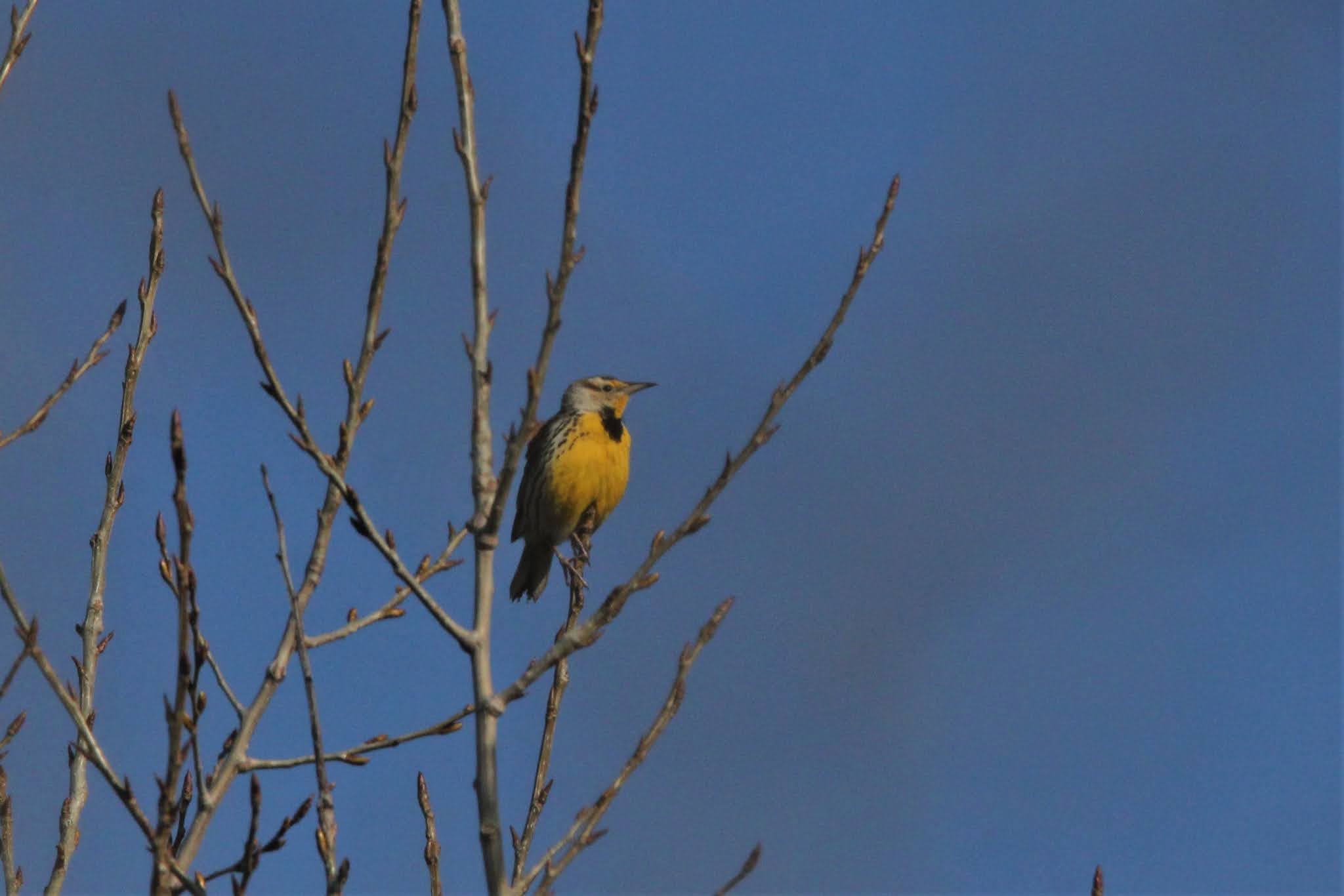
In late morning, an Eastern Meadowlark dropped in, which was great to see. I believe this is a different bird than the one from a couple of days prior. 

I saw two Sandhill Cranes fly over, which are pretty scarce migrants and breeders in the Park.

A short while later, a lone Double-crested Cormorant flew by, far away and high up. I think this ties the early record.

And just five minutes after that, I spied an immature Golden Eagle migrating in the distance. No (conclusive) photos of that one though! 

A nice male American Kestrel also visited in the early afternoon.

The headliner for the day were Common Redpolls. I counted an incredible 3740 individuals migrating southbound. Why they were headed that way, is beyond me. Here is a portion of a flock of 500+ that I saw.

Here is my eBird checklist.

In some other Algonquin birding odds and ends, Winter Wren was a new one for the year on April 8. April 9 brought two new birds: Northern Flicker and Blue-winged Teal. The teal are of particular excitement, as they are a very uncommon spring migrant and were a new species for my park list.


Yesterday yielded no new year birds, despite spending most of the day birding on good winds. Perhaps driving from London and getting back at 3am was not the best idea after all! That's just how it goes sometimes! This morning I found a little bit of movement had occurred, as I found Hermit Thrush, Green-winged Teal, Bufflehead, and Wilson's Snipe in the Old Airfield. 

I've been quite happy with what I've been seeing so far (it somewhat offsets my sour feelings about missing a Black-necked Stilt back home), and am quite excited to see what else is to come. The beauty of Algonquin Park birding...it doesn't take much to make us happy! 

Wednesday, 6 April 2022

April in Algonquin Update

 A title I just may reuse later if I feel so inclined...

Spring migration is well underway here in Algonquin Park. After months of seeing the same species day in and day out, it is nice to see some new arrivals.

With it being spring once again, I have made it my goal to bird the Old Airfield as much as possible. It makes a good place for a walk before work, even if I do have to back track to get back to the Visitor Centre! The Old Airfield has hosted many rarities over the years, and with any luck, I will add some to that list. 

The first Turkey Vultures and Great Blue Heron of the year showed up at the airfield on Sunday, which were lovely to see.

Yesterday, Jeff Skevington found an Eastern Meadowlark in the airfield. This is an almost annual migrant in the park, but very hit and miss, and was a big target of mine this spring. I was really hoping to find my own, so it was with reluctance I decided to twitch it after work. I might not get another chance to see one this spring, after all. It wasn't long before I heard its song, and located it in a tree. 

This is an extra special sighting for me, because it marked my 170th species of bird seen in Algonquin Park. As of writing, this is the threshold species count to get on the "short list" of Algonquin bird listers. I still have quite the long way to go, but it was nice to finally reach that milestone. 

I decided to hang around the rest of the evening and see what else was moving. As it turned out, not much. I had a Killdeer fly over, only my second in the park (and my first since being on contract), which was nice to see. After sunset, the first woodcocks of the year were displaying.

This morning, the weather looked like it might be a good day, so I, of course, headed to the airfield. 

The river mouth was pretty productive in terms of waterfowl, with the first Ring-necked Duck and Wood Ducks of the year. There were also a number of black ducks, a Common Merganser, and Hooded Mergansers. 

Ring-necked Duck

Lots of robins were on the move, by the end of the day I counted nearly 80. Probably more that I missed.

American Crows were moving in small numbers. I only saw a few ravens.

After I walked around for a bit, I picked a spot to sit down and just watched. It wasn't really a hawkwatching day as it would turn out (took 8 hours to spot my first hawk), but it was neat seeing a few birds drop in. Nothing too crazy, and no new park birds, but there were some spring migrants that were on the early side. These included a Yellow-bellied Sapsucker, Eastern Bluebird, Belted Kingfisher, American Kestrel and a Tree Swallow.

Belted Kingfisher

Eastern Bluebird

The "best" bird of the day was probably an American Pipit, which appears to be record early by about two weeks. I am sure Ron Tozer will confirm or deny this statement before long!

I ended my 10.5 hour day tired, wind burnt, and with 39 species. I just couldn't keep going and find that 40th! Woodcock would have been guaranteed, but as I push "publish" on this post, they would have only just started to display!  Here is my eBird checklist.

Tomorrow is supposed to be wet. Rain means one of two things to the Algonquin birder: good birds or a bad time! Will be interesting to see how it plays out.

Monday, 31 May 2021

Middlesex Biggish Year: May Update

At what point does a "biggish year" become a "big year"?

May has just come to a close on my "Middlesex Biggish Year", and behind us we leave one of the busiest months of the year bird wise. And busy it was. In an absolute whirlwind of a month I saw SEVENTY (that's seven - zero) year birds. Maybe not a super crazy number on a provincial scale, but for Middlesex, and considering I had already seen over 80% of the birds reported in Middlesex at the end of April, I think it is quite exceptional. My year list now stands at 224 (over 90% of birds recorded in the county so far this year), which just so happens to be what I finished with at the end of last year. I have had a few misses this past month, including migrants such as Orange-crowned Warbler and Gray-cheeked Thrush, as well as some good rarities like Connecticut Warbler (not too torn up about that one, would rather self find my lifer anyways!), Kentucky Warbler (shows up the first morning in a week I don't go to Kilally), and Prairie Warbler. Never did get out to try for Whimbrel (would be a long shot, but doable), maybe next year. 

I should make a quick note about the weather: it sucked. Or rather, it sucked for birders. There were a few "good" days here and there, but nothing compared to what we had last year with "fallouts" of birds. The weather was conducive for migration the first few days of May, then we hit a patch of north winds with not much happening, followed by summer like temperatures with virtually no rain for a couple of weeks. Finally in the past few days we have had winds switch back to north, with temps down to the single digits. The clear nights coupled with south winds meant that birds got going...and just kept going. Although we had a pretty good diversity of birds this spring, we really had to work hard, and the case for many species was fewer individuals than normal (for example, I saw less than 20 individuals of Swainson's Thrush in the whole of May...what the heck??). 

The breakdown: 

Code 1: 129 (26 new)

Code 2: 60 (26 new)

Code 3: 22 (10 new)

Code 4: 8 (5 new)

Code 5: 4 (2 new)

A bunch of loose ends tied up with code 1s this month. In fact, 129 species marks every single one of the code 1s there are to see! It only gets harder from here. Flycatchers, warblers, vireos, gnatcatcher, a few thrushes...you know, the usual stuff.

Bay-breasted Warbler

Big increase in my code 2 list as well, leaving only three remaining (Marsh Wren, Gray-cheeked Thrush, and Orange-crowned Warbler). Quite a few shorebirds added here, as well as some of the more uncommon flycatchers, warblers, vireos etc. I worked pretty hard to get Yellow-bellied Flycatcher and Olive-sided Flycatcher, and it eventually paid off—I saw Yellow-bellied twice in the last week of May, and saw an Olive-sided yesterday in Skunks Misery! 

Yellow-bellied Flycatcher

Code 3s consist of mostly annual rarities, as well as scarce breeders. Up to 22/34, which I don't think is too shabby. A few good shorebirds such as Black-bellied Plover, Short-billed Dowitcher and White-rumped Sandpiper, as well as some rarer migrants like Common Gallinule and Golden-winged Warbler. The scarce breeders were made up of Acadian Flycatcher (seen both on migration and territory), Clay-colored Sparrow (which I actually saw as a migrant in my neighbourhood, a new patch bird!), and Cerulean Warbler. 

Common Gallinule

Acadian Flycatcher

Clay-colored Sparrow

What a crazy month for code 4s! More good shorebirds in the form of Ruddy Turnstone, Wilson's Phalarope and Red-necked Phalarope. Black Tern and Evening Grosbeak made up the other ones.

Evening Grosbeak

Phalaropes

One of my code 5s for the month was the Blue Grosbeak in Kilally Meadows. You can read more about that here. I also had a Western Meadowlark in early May.

So what's next going forward? Well, I think I will scale way back on my birding until the fall. Still a few birds to keep an eye out for over the late spring and summer months, so I guess we will have to wait and see what happens! For now, I think it is time to pay attention to insects and plants :) I have had an amazing time so far this year, and look forward to picking it up again! I guess I can actually sleep in now...

Monday, 3 May 2021

An Accidental Big Day

I did not set out to do a big day today, but it sort of turned into one.

I had a few hours before I had class today, so I decided to head out and bird the Kilally Meadows ESA. Figured I'd shake it up! This park is situated along the Thames River, and as such is a corridor for migrating birds. 

I got there shortly before 6:00, and was immediately greeted by the songs of Yellow Warblers, of which there would be dozens, and my first Ovenbird of the year. As I continued on my walk, I got the feeling it would be quieter than I had expected it to be. I walked for quite awhile, and the only other warblers I managed to pick up were Common Yellowthroat and a Black-throated Green. Finally, my first Great Crested Flycatcher of the year started calling, which at least spiced it up a bit.

On my way back from the furthest reaches of the park, I came across my first Chestnut-sided Warbler of the year. Perhaps a tad earlier than when I normally see them, but certainly not unexpected. Was nice to see! Not too long after, I added a couple more FOYs in the form of an Indigo Bunting and Lincoln's Sparrow. 

Lincoln's Sparrow

At one point I came across a group of finches feeding, represented by four species: Purple Finch, House Finch, goldfinch, and siskin. Nice to see the Purple Finches coming back—will the Evening Grosbeaks be next??

Purple Finch

I walked around a bit more (it had started to rain by this point as well), but the only other year bird I could find was an American Redstart. I finished my outing with 62 species, not too bad! To see the eBird checklist, click here

After class, I was debating on what to do. I thought about going to the Strathroy Sewage Lagoons, but decided against it. That is, until I saw a report of a Common Gallinule. This is a decent bird for Middlesex, and I had only ever seen one previously. That changed my mind! Soon I was on route.

I arrived at the lagoons a short while later, and then began the task of finding the bird. A couple American Coots were posing nicely.

I was beginning to become discouraged, but then it occurred to me that I had been looking in the wrong area! Once I went to where I thought the right area would be, the gallinule made an appearance.

A gorgeous bird. 

With my target acquired, I decided to walk around the lagoons. What followed next was a fun couple of hours! I nailed several species of shorebirds, including Wilson's Snipe, Solitary Sandpipers, both yellowlegs, Pectoral Sandpipers, and Least Sandpipers. There were a few ducks around as well. Plenty of Soras (I counted eight) and a Virginia Rail rounded out the rallids. Along the backside of the cells, the forest was hopping with migrants, especially Yellow-rumped and Yellow Warblers. As I picked through them, I found a Black-and-white Warbler, Nashville Warbler, Common Yellowthroats, Palm Warblers, a Chestnut-sided Warbler, and my FOY Blackburnian Warbler. There was also a Wood Thrush singing, another FOY. 

I tallied 65 species at the lagoons, quite a nice total! Click here to see the eBird checklist.

On my way home, I decided to take a detour to Komoka Provincial Park. There were a few birds around, including Eastern Meadowlark, Eastern Bluebird, and Brown Thrasher, all of which I hadn't seen yet that day. There was also a Grasshopper Sparrow, my main target, singing back in its usual spot.

The biggest highlight though was spotting my first ever Eastern Milksnake! 

And just to throw a bit of botany in here...

Leafcup (Polymnia canadensis)

After I got home and entered my eBird checklists for the day, I was shocked to see that my day list stood at 97 species! This surpassed my previous best for Middlesex County of 94, which I did last year on the eBird Global Big Day (which is coming up this Saturday by the way). Since I was so close to 100, after supper I decided to go out in the pouring rain and try to hit triple digits.

I first went and scoped Fanshawe Lake. Here I only was able to add Common Merganser, but I wasn't really expecting much else.

I then went up to Thorndale in hopes of getting Pine Warbler, but they remained silent. I did however hear a singing Golden-crowned Kinglet. The habitat isn't too bad here, so I will keep an eye on it for the atlas. 

I went and checked some gravel pits, but found them pretty much devoid of birds. As I was driving back, I spied number 100: a Bald Eagle sitting in a dead tree! 

I decided to try for one more bird, so I went and scoped out an Osprey nest. There was one sitting there! 

All in all, a great day. I definitely did not wake up today and expect to see over 100 species. Gotta love spring birding!  

Wednesday, 28 April 2021

It is Slowly Starting...

The last few days have seen us starting to get some of our most anticipated spring migrants in Southern Ontario. I have gotten out as often as I can, and as the weather allows.

Up until yesterday, first of year (FOY) birds were becoming hard to come by. One bird I finally was able to cross paths with was a Rusty Blackbird in my neighbourhood. They definitely seem to be much more uncommon in the spring as opposed to the fall, but I had half expected to come across several by that point! 

Stakes were looking high going into yesterday (Tuesday). A good south wind with very limited to no precipitation overnight—it was shaping up to be a good looking day!

My game plan for the morning was to walk around Fanshawe CA, which is what I did for five hours. Ultimately, it seemed that all the birds that showed up on the radar were White-throated Sparrows, Ruby-crowned Kinglets and Yellow-rumped Warblers! I only managed to see two FOYs: Purple Finch (my first since November) and a Chimney Swift. I managed to rack up 69 species at Fanshawe—I just couldn't find a 70th! Find the morning's eBird checklist here.

Broad-winged Hawk

Today, my original plan was to go to the Strathroy Sewage Lagoons first thing in the morning, as I had hoped the forecasted thunderstorms would push down some good shorebirds. When I woke up, however, I found that there was no rain in the immediate forecast! Since I had limited time, I just opted to go birding in the neighbourhood.

It was fairly slow, but I can't complain too much considering it is April 28th! By any means, it seemed clear that today had more potential than the day prior! My first stop was Northbrook Park.

I flushed a Wilson's Snipe in the wetland, a first for this location. I was unable to turn up any rails. Virginia Rails had been present here for over a month last spring, but the habitat had been changed dramatically since last year due to phragmites management. 

I made my way through the ravine, and came across a few warblers, most notably my first Black-and-white Warbler and Black-throated Green Warbler of the year.

Black-throated Green Warbler

Long-spurred Violet (Viola rostrata) is starting to flower.


Next up I went up to the Uplands North Wetland, always a good stop. My most notable bird was a Baltimore Oriole, which was of course a first for this year. There were also a couple Green Herons flying around, and some Common Loons and Double-crested Cormorants were migrating overhead.

As I was leaving the wetland and walking back home, I saw that I had a text from Reuven Martin. He had found an Eastern Whip-poor-will (a would be county bird for me) in Kilally Meadows ESA. It was 8:30. I had class at 9:00. 

I weighed my options, and decided that it would have to wait, so I told Reuven I would pop out after class. He told me that it was being mobbed by robins, and might not stick around. I reconsidered my choices. I had to go. So at 8:35, I was pulling out of my driveway.

I arrived at Kilally at 8:42, and found that I had gone to the wrong access point, which added another half kilometer of unnecessary running. By the time I had found the right spot and met up with Reuven it was 8:45. 

Reuven took me to the spot and pointed it out. Good thing he did, I probably would have had one heck of a time trying to find it otherwise! I snapped a few photos.


It was now 8:50. 

I pulled back into my driveway at 8:59, and managed to sprint up stairs in time to log into class at 9am. Not a minute to spare. 

It is a good thing I took the chance, because it seemingly disappeared later that morning! 

After class, there was rain in the forecast, so I opted to go to the Strathroy lagoons. Unfortunately, the rain was short lived, and it cleared up pretty fast :(  No rare shorebirds today.

I still had an okay shorebird count, with around 25 Pectorals, both yellowlegs, Solitary Sandpipers, Killdeer, Spotted Sandpipers, and a slightly early Least Sandpiper (although not too unexpected). 

Pectoral Sandpipers

There were several warblers along the edges of the cells as well, the best being a Northern Parula. The first time I have seen this species in April.

I also found my first Rose-breasted Grosbeak of the year.


I had a pretty good species count at the lagoons, which included several species of ducks, a Caspian Tern, and both the rails: Virginia Rails and Sora. 

It was a splendid day of late April birding, and I ended up with 80 species, not too shabby since I wasn't trying for a high species count. Looking forward to the days ahead (although I don't think we'll see a ton of movement until next week)! 

Tuesday, 19 January 2021

2020: A Neighbourhood Year in Review

As much as I love to bird in areas further afield, my neighbourhood is where I do the bulk of my birding. While this is mostly because of its convenience, the birding isn't actually half bad. At the beginning of 2020 I had pretty much zero intention of doing much birding. Sure, I would do some spring birding in my usual haunts like Rondeau and Point Pelee (which as we all know, wasn't to be!), but I wanted to focus mostly on field botany, a hobby that was quickly growing on me! 

After my birding trip to Cochrane at the start of March Break, and the start of the pandemic, I found myself stuck at home without much to do except look for birds. Having such a successful northern trip definitely helped "rekindle" my excitement for birding just enough to make me muster up the energy to go outside (which admittedly, didn't happen sometimes for days on end!). Other than a few trips a bit further afield (COVID aware of course), I pretty much spent the entirety of spring migration in my neighbourhood! I typically don't do much birding during the summer (too many plants and insects to see!), but by the time the first fall migrants started to arrive, it was time again for almost daily pilgrimages out to my neighbourhood. Nearer to the end of fall, I was spending most of my free mornings out at Fanshawe CA, but I still got out every once in a while. My grand total for for my neighborhood in 2020 was 164 species out of the 179 species I have seen all time. I know of at least a few other species seen by others that I missed. Hopefully this year I can find some of those species!

I'll walk through some highlights in chronological order.

Even before the start of the pandemic and I started to bird more, something I look forward to each spring is the arrival of the blackbirds. They arrived pretty much on time on February 24th. Soon after, I recorded my first Turkey Vulture and American Woodcock on March 7th. Also that same day, March 7th, I was elated to find my first ever Eastern Screech-Owl for my neighbourhood list, a species I had been hoping to come across for awhile. It was my first "patch bird" of the year! I found another Screech-owl later in a different woodlot.

Throughout the end of March and into early April I continued to go out to my patch with some regularity. I saw several notable species including American Wigeon (March 21), Sandhill Cranes (March 26), Eastern Phoebe (March 26, a bit early), and Blue-winged Teal (April 6). April 18th was a big day, and perhaps the turning point for my patch birding in 2020. I was super happy to find my first Lesser Scaup for my neighborhood list at one of the local ponds. That same day, I managed to turn up a Virginia Rail, which would soon turn into two Virginia Rails. These rails were fairly cooperative and reliable, and remained in this wetland into mid May.

Lesser Scaup


On April 19th, I did my first yard watch of the year. I would complete several more of these stationary counts in the early mornings in my yard over the next few weeks. I saw my first Common Loons and cormorants of the year. The next day, I did another yard watch, and came up with my first Broad-winged Hawks of the year.

Common Loon


On April 24, I got a message that there was an American Bittern in a local wetland, the same place I had found one in 2018. I went over and saw it. I saw this elusive bird several more times into the beginning of May. 

April 25th was a pretty good day for a yard watch. I saw my first Eastern Meadowlark for my patch list, which landed in a tree for a moment. It was also my first big loon day of the year, with 124 recorded.

The first of year birds kept coming throughout the end of April, with highlights being Fox Sparrow, Wood Thrush, Eastern Towhee, Blue-headed Vireo, Warbling Vireo, Black-throated Green Warbler, Yellow Warbler, Rose-breasted Grosbeak, Brown Thrasher, and my first Great Black-backed Gulls for my neighbourhood, which flew over my yard on April 28th. April 28th also marked the first day of my daily early morning (starting before sunrise) walks of the spring, which I continued for the better part of three weeks. I certainly got my exercise in with these walks, and I estimated I walked a total of 10-15km every morning!

Fox Sparrow


Finally it was May, but unseasonably cold weather was really putting a damper on the arrival of spring migrants. I had a high count of migrating loons with 299 on May 5. We got a thin trickle of birds, including Sora (May 2), Great Egret, Savannah Sparrow, Lincoln's Sparrow, Baltimore Oriole, Ovenbird, and Palm Warbler (all May 3, the first "good" day), and Solitary Sandpiper (May 6). On May 9th, the global eBird big day, we got snow! It wasn't until May 10th I got my first Blackburnian Warbler and Least Flycatcher. May 12th brought Lesser Yellowlegs.

Palm Warbler

Lincoln's Sparrow


Then, on May 14th, the weather changed, and the floodgates opened. Warblers! Thrushes! WARBLERS! I found my first  Yellow-throated Vireo and Scarlet Tanager for my neighbourhood list. The vireo in particular was quite awesome, as it completed my set of all the regularly occurring vireos in Ontario for my patch. In the evening, I found a Gambel's White-crowned Sparrow in my yard, a somewhat rare subspecies in this area of Ontario. I had made it my goal to find one that spring!


Black-throated Blue Warbler

Yellow-throated Vireo

Gambel's White-crowned Sparrow


I spent May 15th in Rondeau, the first day it was open to the public after being closed all spring. Although apparently it was a great day for birds in London, I am glad I spent it here!

I didn't seem to go out in the patch on May 16th, I assume it was because of rain. I remember hearing about the Kirtland's Warblers that had been found at Rondeau that day, but being quit bummed as I wouldn't be able to go down to see them! 

When my alarm went off on May 17th, I was hoping it was raining outside so I would have an excuse to go back to bed. I looked out my window, and found it dry. I debated about going back to bed anyways, but I reasoned that if I didn't go out, I wouldn't find anything. I was outside by 5:30am to begin my 10 minute walk to the place I started in the morning. I thought of all the rarities I could see, including Kirtland's Warbler, which was on my mind after the ones in Rondeau the day prior. When I arrived to the park, I began to regret my decision to go outside, as there were basically no birds. I had seen one warbler. As I was walking along, I heard a chip note, and saw a warbler at the top of a tree. I raised my binoculars and my jaw hit the ground. Now, I can't repeat here exactly what came out of my mouth, but bottom line, not only was it a patch bird, but my full out lifer Kirtland's Warbler. My observation lasted for no more than two minutes, and the bird wasn't very cooperative, but it was undoubtedly the highlight of my year.

Kirtland's Warbler


Oh, and I saw my first Cliff Swallows and Eastern Kingbird of the year that day too, but they are but a footnote...

That day was the last of my almost daily morning walks. I was feeling quite tired, and my other interests like bugs and plants were starting to get the best of me! I added six more species to my neighbourhood year list over the rest of May, bringing my total up to 124 species.

The summer months are often quiet, but I added a few more species here and there. My biggest highlight of the summer was a pair of Black Vultures on June 6th, a new neighborhood and Middlesex bird for me. I was out looking for dragonflies, so I didn't have a good camera lens or even my binoculars! Thankfully, I managed to get some record photos that managed to confirm the identification. 

Black Vultures


July came around, and with it some of the first southbound shorebirds. I was pretty excited to find that I had good shorebird habitat this year, however this excitement was short-lived, and with a period of heavy rain, it all flooded and was useless by early August, before the bulk of the "good" shorebirds would come through. I never had anything crazy, but Least Sandpiper and Lesser Yellowlegs were highlights.

Also during July, while out counting dragonflies, I found my first Marsh Wrens for the neighbourhood. 

At the end of August, I began once again to make near daily visits out to one of my favourite migrant traps. In short order I added Olive-sided Flycatcher, Eastern Wood-Pewee, Blue-gray Gnatcatcher, and several warblers to my year list. I added one new patch bird, Black-billed Cuckoo. Purple Finches began to move through, a sign of things to come.

Olive-sided Flycatcher


I did a couple hawk watches in early September, with my best day topping 600 Broad-winged Hawks.

By late September, many of the neotropical passerines had passed through. I found some Wilson's Snipes, a species that I hadn't seen for a couple years in the neighborhood. After being strangely absent for awhile, the Green-winged Teals finally showed up.

Wilson's Snipe


Late September gave way to early October, and with that, Winter Wrens, American Pipits, and more ducks showed up. Pine Siskins arrived, and I finally saw some Greater Yellowlegs. Later on in the month, I did a lot of hawk watching, and scored a Red-shouldered Hawk. I never could get a Golden Eagle though!

Northern Pintail and Green-winged Teal


Early November came around. A highlight in the first few days was a Vesper Sparrow, a new neighbourhood bird. Number 160 for the year was a Common Redpoll on the same day, the first of many. By mid November, we were getting crossbills, and I had both Red Crossbill and White-winged Crossbill fly over my yard. I never could connect with an Evening Grosbeak, although someone else did spot some!

My last two new birds of the year came just a few days apart, Snow Bunting (November 16) and Rough-legged Hawk (November 23). Although I did go out some more here and there over the next month, the quiet of winter had settled in.

So there you have it, a short(ish) recap of some of the highlights of my year in my neighbourhood. I certainly wrote a lot (I have been plugging away at writing this post for three days!), but there was so much more I could have included! For an area that is mostly subdivision with only a few greenspaces, I think I did pretty good! Just goes to show what can be seen once you look for it!