This is part two of my Bruce Birding Weekend blog post. I will be highlighting the birding from Saturday afternoon until our departure Sunday evening. As usual, I will list my life birds in
bold print.
After lunch, the group headed (slowly) up Warner Bay Road. Our first stop was near a little quarry with ponds. Here we saw Spotted Sandpipers, a Greater Yellowlegs, Orioles, and a pair of Eastern Phoebes.
A pair of Sandhill Cranes flew over, but part of the group didn't see them. While going over to alert the leader about our find, an Eastern Bluebird flew over. It didn't stick around for the rest of the group though. A Sandhill Crane was found in a field just seconds after, allowing for great views.
Further up the road, a pair of American Kestrels were patrolling a small grassy field.
An Eastern Meadowlark was singing on a telephone wire, a little bit too far for decent photos.
We stopped along the road often, and almost each time we would get out to observe a bird, a car would pull up and ask if we were looking for bears! Later, a motorist suggested that we start telling people that there is a bear just "Behind that bush".
For about the fifteenth time, we stopped because the leader thought she heard some sort of mimic (like a Gray Catbird or Brown Thrasher). We looked but could not find one. I got bored looking at nothing, so I wandered away from the group and walked down the road a bit. I nearly had a heart attack when a bird flushed from the ditch! Without thinking, I raised the bins to my eyes and instantly knew what it was. I had just scored another lifer
, Wilson's Snipe. I yelled "Snipe!" down to the rest of the group and they quickly made their way toward me. I gave the general area of where I think it landed. We tried playing calls to lure it out/have it call on it's own, but with no avail. The bird was quickly forgotten though when a male
Canada Warbler was spotted in a tree just to the right of the snipe. I managed to get a quick glance before it few off into a thicket. We couldn't locate the bird again. It was the only one all weekend. We did find another bird while trying to find the warbler,
Bobolink. I can't believe that I got
three lifers in only a span of 10 minutes. What makes it even more special is that Canada Warbler and Bobolink are both threatened species in Ontario!
One of the few Yellow Warblers seen that weekend was photographed here. Warner Bay Rd. had the highest count (4) of Yellows of all the places we visited during the time we were there. I think this might actually be the only time I got a photo of this species all weekend.
On the way back to the car, we got beautiful views of a male Blue-winged Teal. These are one of my favourite species of waterfowl.
I like to think that if I hadn't taken a little wander, we wouldn't have seen those birds :)
The only other birds of interest seen before turning around were Rose-breasted Grosbeak and Broad-winged Hawk.
Next stop, Little Cove Nature Preserve. As soon as we stepped out of the car, a Great-crested Flycatcher allowed for some decent views. This was the first bird of the weekend for much of the group.
Walking into the preserve, I noticed a lot of Ontario's provincial flower, the White Trillium
(Trillium grandiflorum) and butterflies called the Red Admiral.
Bird-wise, we got awesome looks at an Ovenbird, which I thought was a thrush until seeing its orange crown and hearing its repeated
teacher-teacher-teacher song. Red-eyed Vireos were singing, and Least Flycatchers were flitting around.
There were a couple of these Wood Frogs hopping around.
One of the highlights of the trail for most was a pair of Pileated Woodpeckers.
There was a Black Bear cub footprint that looked fairly fresh in the mud. This put us on guard, but we kept going.
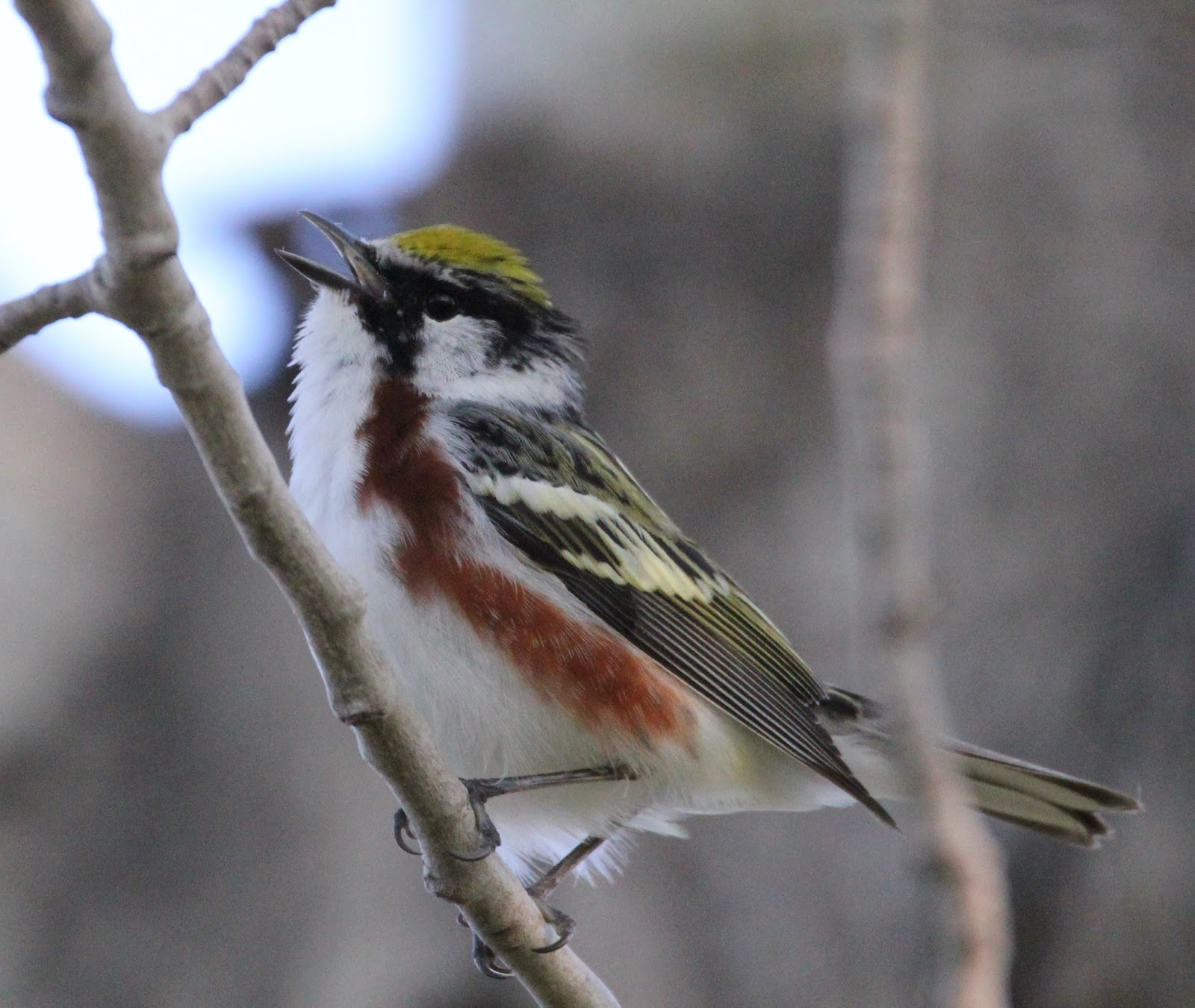
We came across a nice little pocket of warblers where Magnolia, Black-throated Blue, Blackburnian, Black-throated Green, Black-and-white, Yellow-rumped, Chestnut-sided, and the ever-present American Redstart were observed.
We walked a tad bit further, then came across this.....
We put two-and-two together, and decided that it was probably not the best idea to go on with both Mama and Baby bear in the area.
The way out was fairly quiet, and nothing new was observed besides a Yellow-bellied Sapsucker. This was the only one seen all weekend.
 |
| As usual, the bird is obscured by foliage |
We were all getting a little bit tired by this point (It was around 4:30 pm), but we pulled one more stop before meeting for supper. Dunks Bay Road turned out to be a really good spot to end a day of birding (though, a few of us continue later). As soon as we pulled up, I spotted a Red-headed Woodpecker. I went to tell the leader, and with us all looking, we were able to find a presumed breeding pair of this threatened species.
A number of Blue Jays were present as well.
Heading into the woods, we were able to find six species of warbler, including (you guessed it) American Redstart. I'd say the highlight of the walk was a
Blue-headed Vireo, also known as Solitary Vireo.
This female Merlin was quite content and allowed us to get quite close....too bad my friend's camera battery died just as he had the bird in his viewfinder.
After Dunk's Bay, we headed back to the campground to freshen up for the nights dinner. We came across this sick-looking Ovenbird sitting in the middle of the road in front of our campsite.
At dinner, we tallied up all the species we saw for the day and the previous night. I contributed a few species (Warbling Vireo, Veery etc.) to the total list. I counted 85 species at the time, but I now know it's closer to 87. Considering that in 16 hours in Point Pelee I only tallied 84 species (May 7th), I was quite amazed!
A few of us decided to go back to Little Cove Rd., where we had the Woodcocks and Whip-poor-wills the previous night. The leader and her friend were also doing the Ballie Bird-a-thon, so they were going to start that night (They started 9:25 pm), and continue until the next night (9:25 pm). But, as they put it, this didn't mean they didn't sleep! I learned the following Wednesday, that they tallied somewhere around (can't remember exact number!) 105 species. Congratulations Guys! Anyway, same as the previous night, we started with one very clear White-throated Sparrow song, then moved on to the Woodcocks and Whip-poor-wills. No bitterns or coyotes joined in, but it was still nice to hear those two birds.
We went back to the campsite and sat around the campfire for a little bit, then decided to go to bed. But, the zipper on the tent broke and we couldn't fix it there, so we slept in the car.
The next morning was a lot like the day before, a lone Veery sang some where in the woods and a bunch of warblers were singing. We checked Lighthouse Point again, but the bay was much rougher than the day before. It was really windy as well. There were a few Herring Gulls swimming around.
A few species of warblers were flitting around and singing. American Redstart was one of them.
We met once again for a hike at 7:00 am at the same location as the previous day. We managed to see 6 species of warbler and a Rose-breasted Grosbeak within the first ten minutes. Our first Northern Cardinals of the trip were seen as well.
 |
| Chestnut-sided |
I won't go too much into detail about every bird we saw (46 species were recorded), but I'll cover some of the highlights. There was an amazing number of warblers, and you literally couldn't look at a tree or bush and not see at least 3 species of these small birds! Some of the better warblers seen were Blackpoll, Bay-breasted, Blackburnian and Northern Parula.
 |
| Palm |
 |
| Black-throated Green |
 |
| Fire Throat (Blackburnian) |
 |
| Camera Shy Bay-breasted |
Our first Scarlet Tanager of the trip was observed flying past, but we couldn't re-find it. There wasn't as many Redstarts as the previous day, but still a high number.
 |
| First year male Redstart |
I didn't capture this behavior with the camera, but the Redstarts were doing their characteristic fanning of their tail to disturb insects before going to gobble them up.
On our way back, five of us found a tan-morph White-throated Sparrow. The sparrows was accompanied by a
Lincoln's Sparrow. I didn't get a good photo, but it is what it is.
When we continued down the road, we saw the leader cupped her hands around her mouth and yelled "Virginia Rail!" We quickly went to the little marsh area, and was told that we had just missed it walk into the reeds. We had to wait quite a while, and play a lot of rail calls, but it eventually called, then walked into the open! I managed to get some decent photos of the
Virginia Rail.
After breakfast, I saw some Cliff Swallows, which was a new species for the group trip list.
The group headed over to Singing Sands, where we saw a Caspian Tern and our first Killdeer of the trip.
Someone let off a fire cracker, which promptly sent the tern into the air, the geese to flap around like chickens with their heads cut off, a pair of Sandhill Cranes to go crazy, and a Merlin to start calling like mad.
We walked around in the little marshy area, where Indian Paintbrush
(Castilleja coccinea) and Pitcher Plant
(Sarracenia purpurea) were abundant. A couple of Mallards were seen. Further into the woods, a small flock of Pine Siskins was observed. The Merlin from earlier was seen as well.
 |
| Pine Siskin |
 |
| Merlin |
Dwarf Lake Iris (Iris lacustris), which is an S1, meaning that it is rare in Ontario, was seen in a small patch.
Eastern Bluebird, Nashville Warbler, and Blue-headed Vireo were seen along the trail.
In the parking lot, I found a Savannah Sparrow, the first one that weekend.
After Singing Sands, we drove down Dyer's Bay Road. Eastern Meadowlarks and White-crowned Sparrows were seen. A Scarlet Tanager male was also observed, but only half the group got to see it.
Sandhill Cranes seemed to be everywhere, but it was probably just the same ones flying up and down the road.
We stopped in this wetland type area to look for bitterns. There were a lot of Canada Geese and Red-winged Blackbirds. A goose was sitting on a nest.
I found a Snipe, which called constantly. A Green Heron, first one of the weekend for most of the group, flew over.
Finally, an American Bittern was spotted in some reeds. It was hard to spot at first, but stayed out in the open for the most part.
A couple Common Ravens flew over, showing us one of their field marks, a wedge-shaped tail. Blue-winged Teal flew in as well.
 |
| Blurry BW Teal |
We were getting hungry, so we decided to go to the Crane River picnic area. Just as we were getting into the cars, a
Sora called.
On the way out, a few of us were lucky enough to get good looks at a male Bobolink.
The picnic area was quite quiet other then an Eastern Phoebe, Blackburnian Warbler, and
Alder Flycatcher.
 |
| Eastern Phoebe |
After lunch, we went to Britain Lake Road, were we were treated to an Eastern Towhee,
Blue-winged Warbler, and
Ruffed Grouse. The Ruffed Grouse was drumming (beating his wings really fast to create a loud "drumming" sound), and let me say, you could feel it in your chest more then you could hear it. You could look up a hundred recordings, but it isn't the same as witnessing it in person.
After, we drove around some more, until we reached Sky Lake. The first birds I saw were
Black Terns. Now, I've seen these bird before, but it was in my pre-birding days, so I didn't count them. Black Terns aren't at risk or threatened, but they are uncommon, and only occur in a few places. You just have to be at the right place at the right time to see them. Common Terns and Caspian Terns completed the mixture.
 |
| Black Tern |
Our first and only Bald Eagles (I'm surprised we didn't encounter more) were seen here too. They seemed to have a nest.
Further down the road, we heard at least 3
Marsh Wrens. We saw some Sandhill Cranes as well. I couldn't get a photo because the camera was acting up, but a large Bowfish swam by.
On our way out, I saw a
Brewer's Blackbird sitting on a wire.
The last stop of the day and the trip was Isaac Lake. As soon as we arrived, Great Egrets and Tree Swallows were everywhere.
 |
| Tree Swallow |
 |
| Great Egret in breeding plumage |
This blob is actually a Raccoon hanging upside down.
Eastern Kingbird and the first Hooded Merganser of the trip were seen as well.
Moving on, we checked out the actual lake and observed a Common Loon on nest.
The last new bird for the trip list was a Northern Rough-winged Swallow that I found sitting in a snag (dead tree).
We said good bye and thank-you to the leader and the remaining portion of the group (most had left by this point) then set off for home.
I had a lot of fun that weekend, and a lot of fun revisiting my adventures while writing this post. Hopefully next year, we'll go on this trip again. Then every year after that.
Thank-you for reading this (very) long post about my weekend, and make sure to read part one if you haven't already done so. Thanks again, and good birding!