Showing posts with label Common Raven. Show all posts

Saturday, 19 June 2021

Sydenham Saturday

Today I was down in the Alvinston area for an odonate (dragonfly and damselfly) survey on the Sydenham River Nature Reserve (SRNR) for Ontario Nature arranged by Blake Mann. This reserve is one of my favourite sites in the area, and its a shame I am unable to visit it more often! For the past couple of years, I have partaken in a breeding bird survey on SRNR, and each year we have spotted some cool odes along the way. 

I got up early to head down and do some birding before starting the survey. My first stop was the Strathroy Sewage Lagoons. There was not much of note here in my loop of the south lagoon. I did count over 90 Wood Ducks, several broods, which is always great to see. Another interesting find was a pair of Northern Shovelers. It is likely nothing will come out of it, but you never know. On Tuesday I had a pair of Green-winged Teals here, but they were nowhere to be found this morning. 

Digiscope

I decided to get some point counts done in my Lambton atlas square (17TMH34), and succeeded in completing twelve over the course of a couple hours. Point counts happy pretty fast, so no photos! I recorded over 50 species of birds from these counts. One of my best stops was in the field near the corner of Calvert Drive and Kerwood Drive. Here I had a couple singing Dickcissels on territory (one had been present for about a week now, and a second one seems to have joined it), a pair of Upland Sandpipers, and perhaps most exciting, a family group of Common Ravens which flew over just as I started the point count. Pretty eventful five minutes! 

I eventually got to the SRNR around quarter to ten. The area I was to cover was the Buttonwood Drive side, which is on the east side of the river. This is typically not the most "ode-y" side, but I was more than happy to do it—someone has to! 

I began by walking the field to the south of the parking area, skirting the forest edge. It was not nearly as eventful as I had imagined it to be, and for the longest time, I only came across a few Common Whitetails, a pair of Twelve-spotted Skimmers, and of course several Midland Clubtails. It wasn't until I got down to the river I added Powdered and Blue-tipped Dancer, as well as several Stream Bluets and more Midland Clubtails, to my list. 


I was a bit surprised to see some Banded Hairstreaks, my first this year. There were tons of Hackberry Emperors, as well as a few Tawny Emperors, as well. 


Quite a few of these Haploa moths as well. I think they are LeConte's Haploa moths.


While walking at the far end of the field, I was somewhat surprised to hear a Hooded Warbler, the first time I have encountered one at SRNR. Other breeding birds here included Mourning Warbler, Yellow-throated Vireo, Red-headed Woodpecker, Wood Thrush, Scarlet Tanager, and Blue-grey Gnatcatcher. A couple weeks ago I had a Cerulean Warbler here as well. 

I decided it was time to cut into the forest and head towards the river. As I did so, I came across a fairly fresh Black-shouldered Spinyleg, my first for this property. 


I bushwhacked to the river through seemingly endless patches of stinging nettle, a reoccurring theme for the day. As much as I like SRNR, the one thing I am not a fan of is all of the stinging nettle! Although you can't get "zapped" through jeans, today I was wearing my quick-dry field pants, which apparently offer no protection! I found minimal success with side-stepping through the patches, being careful to flatten the plants down before your legs made contact. 

There was less than expected by the river, just a bunch of Ebony Jewelwings and American Rubyspots. I did have a single female Swift River Cruiser and a Fragile Forktail, but that was it for new species. I continued quite a ways upriver, before crossing over and going to the other side. I walked downriver for a bit, and ended up almost to the other entrance for the reserve. Not much to report on ode wise! A long walk in the hot and humid conditions with an abundance of stinging nettle—fun times! (I actually did quite enjoy myself, doing this beats sitting around at home)

I found myself turning my attention to plants quite a bit on the quiet stretches, although I didn't stop to take very many photos. This is the first time I have seen Broad-leaved Waterleaf (Hydrophyllum canadense) in flower. 


Michigan Lily (Lilium michiganense) is always a fun one to come across.


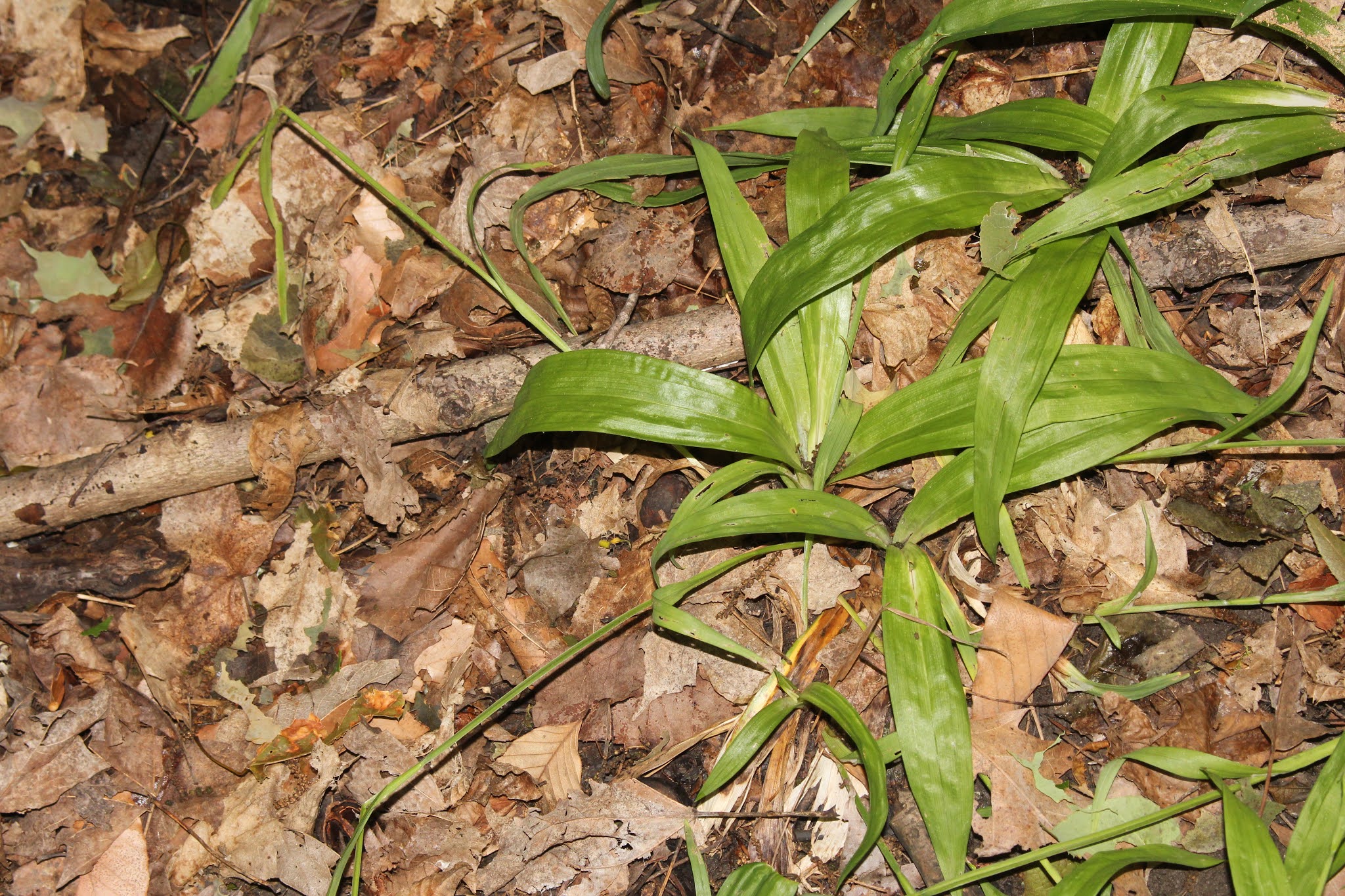
I saw a number of sedges as well. Since this is such a rich forest, I was hoping to come across some rare species, but it was not to be. Nevertheless, I still came across some high quality species. The diversity of sedges you can find in any given area is something that really appeals to me.

Hitchcock's Sedge (Carex hitchcockiana)

Sprengel's Sedge (C. sprengellii)

White Bear Sedge (C. albursina)

Nerveless Woodland Sedge (C. leptonervia)

Inflated Narrow-leaved Sedge (C. grisea)

Eastern Rough Sedge (C. scabrata)

Drooping Sedge (C. prasina)

Smooth-sheathed Sedge (C. laevivaginata)

Fringed Sedge (C. crinita)

The walk back to the car was largely uneventful. I was quite happy to get back and out of the stinging nettle! 

I had planned to go to Reid CA near Wallaceburg afterwards to look for Oak Hairstreaks, but the sky was threatening rain, so I opted to head back home. Perhaps some other day I will go look for this rare butterfly. 

Overall, a very productive day, even if odonate diversity was lower than I had imagined it would be. I expect to get the results of the survey soon, and will update this post once they come out! 

Thursday, 15 April 2021

Mid-April Along the Ausable

On Tuesday I went up for a hike on the Ausable River Valley Trail near Sylvan, off Elm Tree Drive. This trail takes you into some of the best Carolinian habitat that Middlesex has to offer. It is still rather early for most of the notable stuff, but I wanted to take advantage of the good weather.

On my way in, I made a quick stop and checked in on the nesting Common Ravens. Both were present at the nest site. They also nested here last year, which I believe was the first nesting record for Middlesex County.

After I parked the car, I was greeted with the songs of Vesper Sparrows. Before this year, I don't think I had ever (knowingly) heard this species sing, weirdly enough. I tracked down a couple individuals, and photographed one.

I made my way into the forest, flushing a pair of Wood Ducks from a flooded section of the trail along the way. One of the first plants of note I saw was this American Gromwell (Lithospermum latifolium). This is very uncommon species in Ontario, although is to be expected in the right habitats. 

I was a bit surprised to see Yellow Downy Violet (Viola pubescens). Lots of things are early this year! 


American Bladdernut (Staphylea trifolia) was occasionally seen, especially closer to the river. 


Black Maple (Acer nigrum) with the distinctive pubescent leaves was common.


 Pennsylvania Sedge (Carex pensylvanica) is a common colony forming sedge in forests. It can be separated from other members of its taxonomic section, Acrocystis, by its round perigynia (when present, in this photo they still aren't developed), narrow leaves, and the presence of rhizomes, which are modified stems which run underground, which give this species its colonial forming tendency. 

When I spotted this sedge, I had Acrocytis on the mind, so I tried to key it out to that, which didn't really end up working. That is because as it turned out, it wasn't in that section at all! It was actually Peduncled Sedge (Carex pedunculata), another common species. This particular plant wasn't very lax in appearance, as this species typically is, and its peduncles (stalks with the flowers) were very short, to the point I didn't even notice them in the field.


I continued on my merry way, and ended up coming across a cool cedar seepage area. I was getting limited on time by this point, so I'll have to go back to explore it further (it'd probably be best later in the growing season anyways). Ebony Sedge (Carex eburnea) was somewhat common, my first time seeing this species in Middlesex County.

Plantain-leaved Sedge (Carex plantaginea) was also pretty common. I will never tire of seeing this species.

I kept a sharp eye out, and as I expected, I was able to locate some Carey's Sedge (Carex careyana). Now that I have a search image, it is getting pretty easy to pick out. I am not sure if it is known from this exact location, but it is definitely known from the area. 


Pretty Sedge (Carex woodii) was also seen. Another species that now that I have a search image for, I am picking out all over the place.


Hairy Sedge (Carex hirtifolia) was also seen. This particular plant was further along than most of the others, which were still just vegetative. 


As for interesting wildflowers, this Purple Cress (Cardamine douglassii) was just starting to bloom.


Red Columbine (Aquilegia canadensis) was also coming up, although no sign of any flowers yet.


On my way back home, I stopped along Fossil Road for a few minutes. Not too much of note, other than super early Seneca Snakeroot (Polygala senega). Usually, I don't think this species pops up until May. I did a double take when I spotted it!


And I'll throw this one in, Labrador Violet (Viola labradorica) from yesterday a site here in London. The fourth species of violet I have seen this week! 

Saturday, 28 November 2020

A Good Week of Birding

 This past week has been quite good for birding here in Middlesex County. Although the pretty much non-stop action of late October and early November has slowed down, still plenty to be seen.

The week started off with a bang. Late Sunday evening, I saw a Summer Tanager posted to iNaturalist from London. I was able to get in contact with the homeowner, and arrange for myself and Bill Lindley to go see it the next day. So on Monday morning, Bill and I staked out the feeder. It had been seen five minutes before we got there, but was a no show for the next three hours we stood there. We decided to go home to warm up, then come back a couple hours later. Not 20 minutes after being home, I got a call from the homeowner that said the bird was back! About 25 minutes later, we were on it!


 Certainly makes up for missing all the ones in the spring!

Later that night, a White-winged Dove was reported in Lambton, about 500 meters from the Middlesex county line. Bill and I made plans to head out and try to see if we could find it within the county the next day.

On Tuesday afternoon, we went out, but were ultimately unsuccessful in finding the dove. Since we were nearby, we opted to head down to Newbury. Although there were no Golden Eagles to be seen, we did end up having some great birding along Argyll Drive, highlighted by a couple White-crowned Sparrows, a Northern Shrike, and nearly 300 Common Redpolls.

Wednesday was a washout (literally), and Thursday wasn't much better. I just did some local birding. One thing that has been pretty good is the duck diversity in the neighbourhood. This week I have had the usual Mallards, as well as American Black Ducks (and a hybrid), American Wigeon, Northern Shoveler, Northern Pintail, Hooded Merganser, and Green-winged Teal. 

On Friday, Bill and I were out again, looking for Hoary Redpolls and Pine Grosbeaks. 

We drove through the Strathroy area, and ended up finding a couple Snowy Owls, the first of the season. This is the first time I have seen this species in November.

Our first stop was Argyll Drive in Newbury. It was not quite as birdy as it was on Tuesday, but we did see a pair of Common Ravens, quite the oddity.


Next up, we tried going up Oilfield Drive. It was pretty quiet at first, but we pulled over at one point after seeing a couple sparrows flitting around the bushes. As we were stopped a single redpoll flew over, not really unexpected anymore. I pointed my binoculars out to the field and saw a few more flitting around the corn stubble, still not unexpected. Then, a few hundred lifted up! We scrambled to get our scopes, and set them up, scanning for a whiter redpoll. After a few "oh that's a white one", but nothing definitive, we noticed three redpolls sitting on the hydro wire, and wouldn't you know it, one of them was a Hoary! We got brief, but satisfactory, scope views. Splendid! I still need one for my neighbourhood (flushed a good candidate from underfoot today, but I lost it!), but at least I can stop worrying about it for Middlesex! Just need a Pine Grosbeak (and Bohemian Waxwing) now!

We traversed a few more concessions, but nothing more to report. We stopped into the landfill for a bit to look for gulls, but it was mostly just Herrings and Ring-billeds. We did manage to find a couple Great Black-backs and a single Lesser Black-backed though.

It was a very fun week! Onward to December, hopefully we can end the year with a bang!

Tuesday, 3 October 2017

Algonquin Adventures

This past weekend, my family made the trip up to Algonquin Provincial Park for a weekend of exploring one of my favourite places. Due to the recent weather, bird life was at a minimum, but I still managed to find over 45 species, which is decent given the time of year.

We drove up on Friday, so Saturday morning I awoke in Dwight at the hotel (Mom doesn't like it when there is no running water readily available!) I did a little bit of birding around the property, and I came up with a decent list.

Rusty Blackbird

Once in the park, we stopped by the Old Railway Bed first. We didn't bother to walk very far as there were just too many people using the trail!

There was a tame Common Raven near the parking lot (if you can call it that!) One would wonder if it is the same bird as the one hanging around the Art Centre in July.


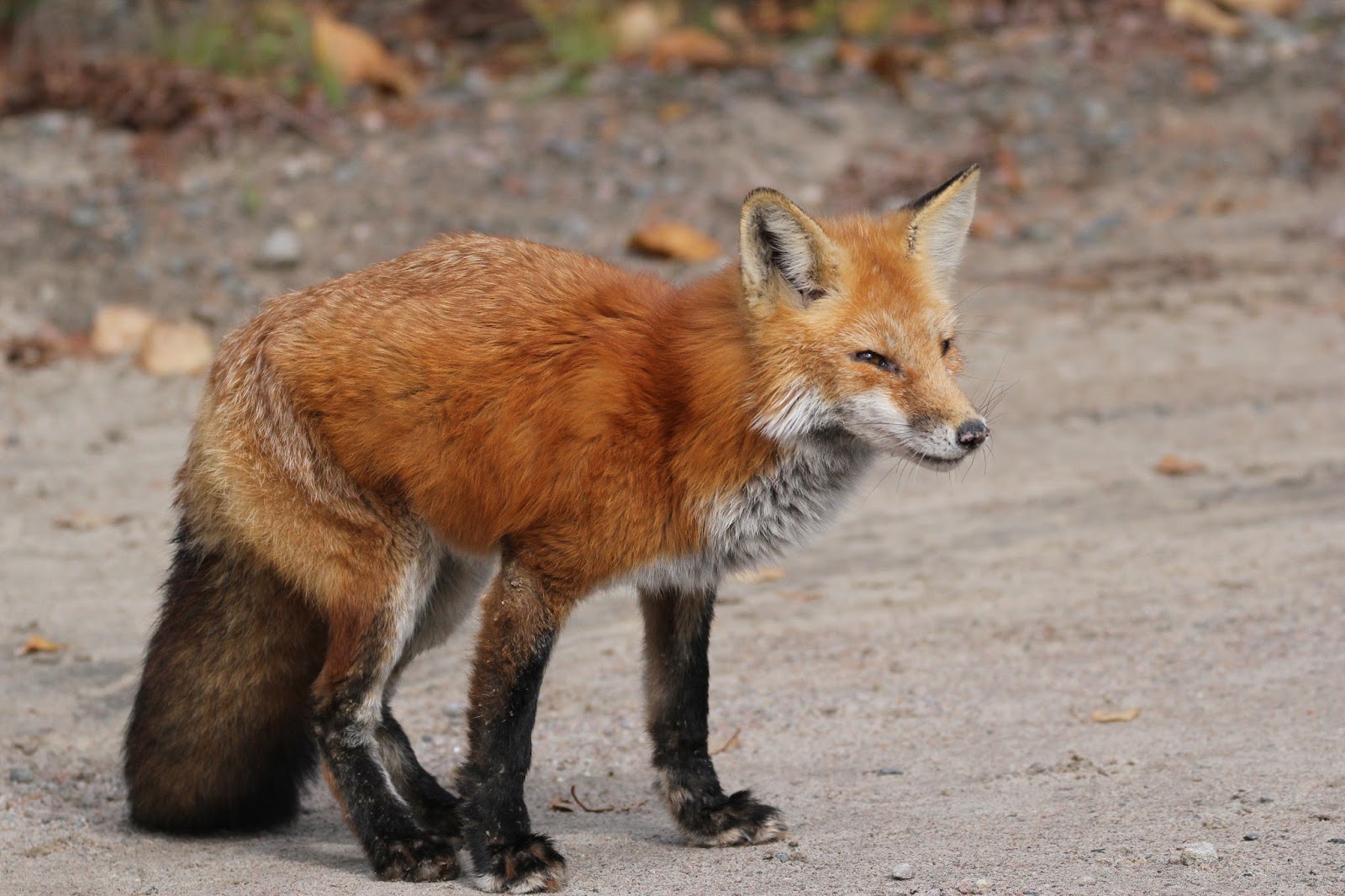
There was also a tame Red Fox along the road. Apparently he is over 12 years old!


The ONLY Gray Jay of the weekend was seen along the road near the fox. It was the only Algonquin speciality I saw all weekend. Quite ironic actually, as last fall it was the only one I DIDN'T see!


We stopped by the Visitor Centre after the railway bed. It was packed! The line for the restroom was out the front door, there was a 30 minute wait time for the restaurant, and the observation deck was shoulder to shoulder if you even wanted to attempt to look off of it. It certainly was not fun!


The only good things reported in the sightings log was a Yellow-bellied Sapsucker seen by Blake, and a Red Squirrel seen at someone's campsite.

Birds were far and few between at the VC, but I did see a late Eastern Phoebe and some Pine Siskins.

Beaver Pond Trail was perhaps the most eventful trail walked.


Although it started out slow, it wasn't long until birds starting popping up, including Red-breasted Nuthatches and my first Rusty Blackbirds for the park.

Red-breasted Nuthatch

American Pipits covered the exposed mud, and I counted over 50.


A single Green-winged Teal caused some confusion, but I was eventually able to ID it from photos.


Crossbills weren't as plentiful as I thought they would be, but they were present. There was a pair of Red Crossbills that allowed for close study. White-winged Crossbills flew over at one point as well.

Red Crossbill


Later in the evening, I went to the Old Airfield. It was quite quiet except for an American Woodcock.


Wolf Track

I birded the hotel property again the next morning. I found a few more species than the previous day.

Palm Warbler

Yellow-rumped Warbler

Driving in the park to our next location, there was a Great Blue Heron on a rock in Lake of Two Rivers. It was quite a spectacular sight.


Opeongo Road was more or less disappointing. I hiked back into a spruce bog along the road hoping for a Spruce Grouse, but one never materialized. I did however find a trio of late Yellow-bellied Sapsuckers. They were the only birds here that would pose for a photo!


After Opeongo, we visited the Spruce Bog trail. Red-breasted Nuthatches were common.


I gave up on finding grouse, and decided to focus on finding sparrows in the grass. I walked to the edge of the open bog, and then started slowly making my way through the grass, stopping to pish every so often. Swamp Sparrows responded immediately.


I heard some insect-like chips, and my mind instantly went to Le Conte's Sparrow. So for about 15 minutes I stood shin deep in water and mud, pishing and wading through the grass hoping to flush something. That I did...a grasshopper!

I guess I must have disturbed this Great Blue Heron.


After Spruce Bog, it was time to head home, but not before spotted my only Common Loon of the weekend!


It is always a thrill and an adventure to visit Algonquin. I hopefully will be back soon!