Since getting back from my trip up north, I have made a couple jaunts down to Elgin county.
Last Thursday, I went to Port Stanley in hopes of finding the reported Black Vultures, as I have never seen one actually in Ontario. I have seen the ones in Niagara on the American side from Canada, but I took them off my Ontario list awhile back since it'd be easy enough just to see them in the province.
When I arrived, the fog was quite low, and it was looking grim, but on my second pass through the town, I found a gathering of vultures sitting in a tree, and with them was the target bird.
Today, I had Eurasian Wigeon on the mind, so I decided to check out the Aylmer Sewage Lagoons. No dice on a Eurasian though...will have to keep looking!
When I first arrived, there was no waterfowl visible. Thankfully, it seemed that they were all just hunkered down in the furthest cell. They were disturbed by my presence but soon settled down again.
Oh yeah, saw this Coyote.
There was a good assortment of waterfowl to sort through. Nothing rare, but plenty of Common Mergansers, Ring-necked Ducks, Lesser Scaup, Bufflehead, and Redhead. There were lesser numbers of American Wigeon, Gadwall, Hooded Merganser, Ruddy Duck, Canvasback, and Northern Shoveler, to name a few.
Common Merganser
American Wigeon
Redhead
Gadwall
Lesser Scaup
There were a few Great Blue Herons.
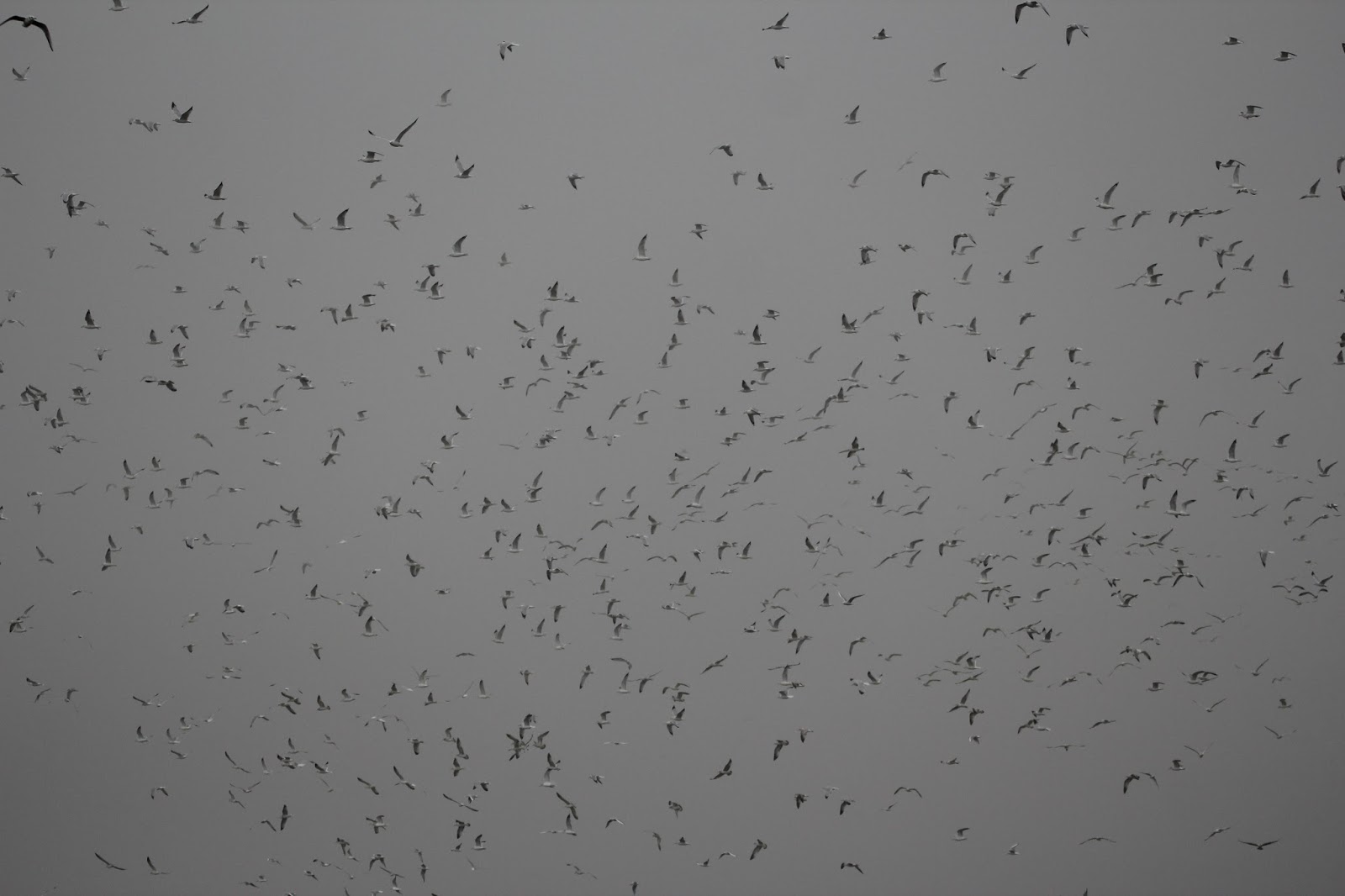
A few Ring-billed Gulls were flying around, so they seem to be migrating back. A few Bonaparte's Gulls as well.
From what I have heard, the Tundra Swans moved through quite quickly. There were a few stragglers.
Some Horned Larks landed closeby. This one was in a plumage I don't see too often.
Best birds were a couple of Trumpeter Swans. This is a species that is still quite uncommon in the southwest of the province away from the GTA (though those birds are a whole other matter). They are probably overlooked though.
Onward with Spring...
Bonus: I found a nice Eastern Screech-Owl in my neighborhood a couple weeks ago. Here is a photo.
Today I went on the annual Nature London trip to the Kettle Point area. I didn't go last year, but in 2015 it was very successful...and this year it was no different!
We stopped in at the Forest Sewage Lagoons first. This spot often yields numerous ducks that are hard to get on the lake. We had numerous Green-winged Teal, Ruddy Ducks, American Wigeon, Gadwall, Bufflehead, Mallard, Northern Shoveler, and Long-tailed Duck.
One of the highlights was a White-winged Scoter.
Ruddy Ducks and White-winged Scoter (2nd from R)
Many gulls, mostly Ring-billed and Bonaparte's, were present.
We managed to hear a late Common Gallinule in the reeds along the side of the cell.
Kettle Point was next. We immediately were off to a great start with a few dozen ducks, including Surf Scoter, Black Scoter, Bufflehead, Greater Scaup, Ring-necked Duck, Redhead, and Red-breasted Merganser.
Surf Scoter
There were a few Pied-billed and Horned Grebes as well. At one point, I thought I spotted a Red-necked Grebe way off in the distance, but I couldn't rule out it being a merganser.
At one point, a Great Blue Heron flew in.
Many blackbirds were present, including these Rusties.
There were also a couple Double-crested Cormorants and Mute Swans.
Near the point, at the little park with the gazebo, we managed to find a nice group of Common Mergansers some Bonaparte's Gulls.
There was also a single Long-tailed Duck.
We drove along the beach, which resulted in a few additions to the day list, including the first Turkey Vultures I've seen in a few days. We couldn't find anything within the dozens of Canada Geese, but the Bonaparte's Gulls kept us happy.
Moving toward the Pinery, we finally found a couple Bald Eagles. They didn't care to be photographed, so my only picture is quite bad!
The feeders at the Pinery VC were quite active. Tufted Titmice (Titmouses?) were quite regular, which was nice to see. American Goldfinches, Dark-eyed Juncos, Black-capped Chickadees, and White-breasted Nuthatches were present as well.
The lighting was very bad, and the camera didn't want to cooperate!
Tufted Titmouse
American Goldfinch
We walked Riverside Trail, where we found a number of Cedar Waxwings, robins, nuthatches, and a Tufted Titmouse.
The highlight of the trip was found soon after...a pair of Red-headed Woodpeckers!
Although Red-headed Woodpeckers are expected, they are definitely are very uncommon. The pair seen here are my first for Lambton county.
After Riverside, we drove out of the park, but not before checking out the beaches. Nothing much except a large-ish raft of Greater Scaup.
The real excitement was on the opposite side of the road, on the forest side. After a little bit of scanning, we were able to find dozens of Cedar Waxwings, American Robins, and even a pair of Purple Finches!
After this, we decided to call it a day and head back home.
Huge thanks to Paul for driving me around (and sharing your lunch!) Sorry we couldn't find you a Cackling Goose (or Pine Siskins!)
On Saturday, my dad and I headed up to the Bruce Peninsula to join the group from Nature London. They had gotten up there on Friday, but we were unable to get up until the following evening. Despite missing out a couple good birds (they had a beautiful Golden-winged Warbler), it was still worth the trip.
Driving up, we came across a Red Fox den with some fairly young cubs.
Then, a couple hours later, we came across this...
That's right, a Black Bear! This was a lifer for me, and I was excited to be able to see one.
We soon arrived at Little Cove road were a couple of the group members were waiting. Around eleven Common Nighthawks made an appearance, which were nice to see. Note the white bars under the wings.
Grasshopper Sparrow, Eastern Towhee, and Black-billed Cuckoo were also seen. Coyotes were heard giving some weird vocalizations, and at first we thought they were a loon.
BB Cuckoo
We managed to hear and see American Woodcocks and Eastern Whip-poor-wills. The whips were quite close to the road, and at one point we actually saw two of them jump up and sort of attack each other. We counted five, but there very well could have been more. It would be interesting to return in late June and see if there are any successful nests.
The next morning the two of us hit Dyer's Bay and Crane Rd. before joining the group.
American Bitterns, Ring-necked Pheasant, and a Sora were calling. The bitterns in particular were quite cool as I've never heard them before this trip.
American Bittern
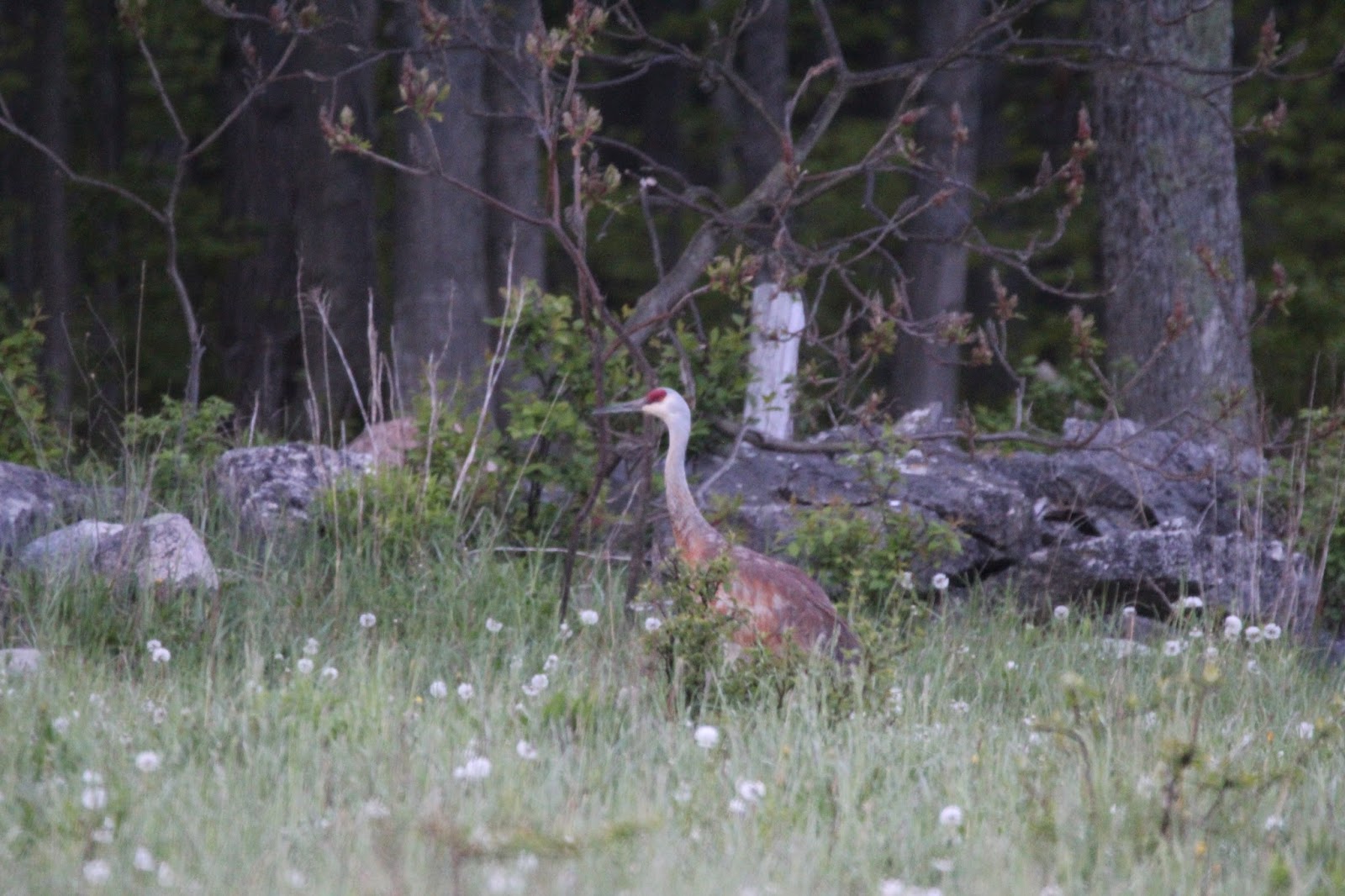
A few Sandhill Cranes, as usual, were found.
I'm sure we would have heard more had it not been for the cows making a racket.
Grasshopper and Swamp Sparrows were present, along with Yellow Warbler and some Eastern Kingbirds.
Eastern Kingbird
We met up with the group in Tobermory. We walked around a bit and ate some breakfast, stopping to look at birds when we found them.
Double-crested Cormorant
Black-and-white Warbler
Ring-billed Gull
Hooded Merganser
There wasn't really all to much to be seen...except....American Redstarts.
The Bruce seems to be the place to get redstarts, and it isn't uncommon to hear someone exclaim "oh, it's a.....(discouraged noises) redstart"
After breakfast, it was off to Cape Hurd road. There was a bit of excitement as we first turned onto it, with a small group of warblers containing Chestnut-sided, Wilson's, and, of course, redstarts.
American Redstart
Some more excitement when we found a nice low kettle of Broad-winged Hawks and a Ruby-crowned Kinglet, the first and only of the trip. Winter Wrens created a stir as well.
Broad-winged Hawk
We stopped into Sunset Park. This is a great spot for Indian Paintbrush.
You can get some great looks at Common Yellowthroats here as well.
Moving onward to the dump, we quickly located a few Common Ravens, the target species.
Distinguishing Field Mark: Wedge Shaped Tail
Also seen were Eastern Pheobe, American Kestrel, Black Bear, Ruby-throated Hum-, wait a BLACK BEAR?!?!? My second one of the weekend and the first for the rest of the group. It ambled out of the forest into the field then commenced to head toward us.
It soon broke out in a run...but not before a few of the group members had already gotten back into their cars a couple hundred meters away.
We were (mostly) calmly returning to our vehicles when we heard the loud bang of one of the garbage bin lids. After a couple explosive obscenities, we realized that it was just the wind.
Continuing on to Warner Bay road, we came across an Alder Flycatcher, Eastern Bluebird, and a Clay-colored Sparrow.
Eastern Bluebird
Then came another lifer...a Massasauga Rattlesnake. Only thing was that it was being eaten by a Great Blue Heron...it was still alive so it technically counts, right?
The rattlesnake had somehow wrapped it's way around the heron's head, and the bird soon flew away with the snake still tangled up in it's bill. We can only wonder who won (my money is on the heron).
Singing Sands revealed our first terns of the trip.
Common Tern
It was quite nice to be able to take a little break from hiking and walk in the water.
While in the woods, we came across a nice little grouping of warblers including Nashville, Canada, and a Blackpoll.
There were a couple other flowers around, including the Dwarf Lake Iris, which is only reliably found in this part of Ontario.
Fringed Polygala (Gaywings)
Dwarf Lake Iris
Star-flowered Solomon's Seal
Indian Paintbrush
After Singing Sands, we headed toward Sky Lake, but not before checking out a spot known for Brewer's Blackbirds. It was here we found numerous Savannah Sparrows, Bobolinks, and our first Warbling Vireos.
Savannah Sparrow
Warbling Vireo
We did eventually find a couple Brewer's Blackbirds. The distinguishing white eye is visible.
The lake was not as busy as we would have liked, but a few Great Egrets and Marsh Wrens kept us more or less entertained.
A few Bullfrogs and fish as well.
Rock Bass
Isaac Lake was next on the agenda, but this cow didn't really want us to go.
Blue-winged Teal was quickly found, as were Caspian Tern, Tree Swallow, and American Wigeon.
BW Teal
Caspian Tern
Tree Swallow
The star of the show was a Sedge Wren that appeared to be building a nest. It took me awhile, but I eventually scored some decent photos of it. Photos of this bird are nearly impossible to get at they seem to never come out into the open. I got lucky and the bird came out for about 20 seconds.
A few new birds were added to the trip list here including Wilson's Snipe, Mute Swan, and Common Loon. The swans were new for my county list.
The last stop of the Nature London trip was the Wiarton Sewage Lagoons. Here we saw our first Spotted Sandpiper, Northern Shovelers, and Lesser Scaup. According to eBird, the Lesser Scaup are uncommon/rare at this time of the year in the Bruce.
After breaking off from the group, we headed down to Sauble Beach for the Piping Plovers. We found a pair, including an unbanded male, which I thought was interesting. Hopefully their nest succeeds this year.
It was a pretty good trip, and I can't wait until my next excursion northward.