Showing posts with label Plants That Do Weird Things. Show all posts

Tuesday, 18 January 2022

Plants That Do Weird Things: Part 3 (Carnivorous Plants)

Plants are a very diverse group of organisms, so as one could expect, there are a number of them that do "weird" things. There is no shortage of fascinating techniques that plants employ in order to survive in their environment. This is part 3 of my little series "Plants That Do Weird Things". Check out part 1, where we look at myco-heterotrophy, and part two on haustorial parasites if you haven't already, as they will explain certain concepts that I refer to here.

In this post, I want to look at a group of plants that may be much more familiar to even the casual observer: carnivorous plants. Carnivorous plants are a plant which are able to catch, kill, and digest prey, and then use the nutrients from said prey to grow. 

Recall in part 2, I mention that we were done looking at the heterotrophic plants. You may be wondering, since a heterotrophic plant is one that feeds off other organisms, then is that statement still true? Yes it is. Despite having the ability to intake nutrients from digesting other organisms, carnivorous plants would be considered autotrophic, as they are perfectly able to grow and survive by creating their own energy through photosynthesis. That being said, the extra nutrients from prey items helps the plant to not just survive, but thrive, often growing larger and producing more seeds. 

In order to capture their prey, carnivorous plants employ one (or in some cases, several) of five trap mechanisms: flypaper traps, pitfall traps, bladder traps, snap traps, and "lobster-pot" traps. All of these traps are derived from highly specialised leaves. Carnivorous plants in Ontario utilize one of the first three methods. 

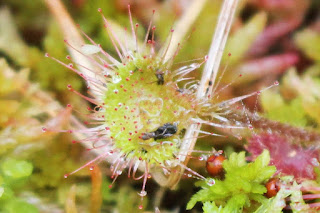
Plants with flypaper traps simply use a sticky glue-like substance, known as mucilage. The leaves of these plants have many glands that secrete mucilage, and these glands may be short or long. Once a prey item (almost always an insect) is trapped, then these plants respond by actually growing or moving their parts in response, which not only helps ensnare it further, but also digestion. This is called thigmotropism, which simply put, is directional growth in response to touch. To digest their prey, these glands will release a series of enzymes, which break down the insect, and this is true regardless of the trap type. 

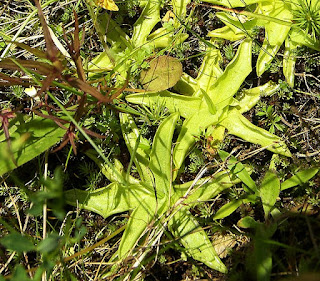
In Ontario, there are two genera from two families that would be classified as using flypaper traps. Perhaps the most well known are the sundews (Drosera, Droseraceae). Sundews have many long "tentacles", which are tipped in mucilage. Many species also have short glands, which are sessile (attached at the base without a stalk). When an insect is trapped, these tentacles are mobile, and move into the centre of the leaf so the insect is in contact with as many of these tentacles as possible. 

There are four species known from Ontario, as well as a couple of hybrids. Round-leaved Sundew (D. rotundifolia) is likely the best known. Spoon-leaf Sundew (D. intermedia) is another common species that tends in inhabit a slightly different habitat than Round-leaved.
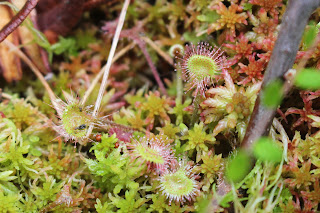
Round-leaved Sundew

Despite having seen all of the sundew species in Ontario, I have never made a point of actually taking good pictures of the mucilage glands. A reoccurring issue in this project is finding I don't have adequate photos for quite a few of the things I want to illustrate—sounds like something to tackle this year! In this cropped image of the above picture, you can see a couple of prey items (insects), as well how the tentacles have moved to contact these unlucky critters.
The other genus in Ontario with flypaper traps is Pinguicula, the butterworts (Lentibulariaceae). This is a bit more of an inconspicuous genus, and not one I have personally seen in situ (a bit hard to believe, I know!). Much like the sundew, this plant has mucilage-secreting glands. However, unlike the sundew, these glands are very short and close to the surface of the leaf, so there are no obvious tentacles. When an insect is captured, thigmotrophic growth occurs, and the leaf may curl over, or form a shallow "pit" for digestion to occur in. 

Two species occur in Ontario. Common Butterwort (P. vulgaris) is more widespread than Hairy Butterwort (P. villosa). Common Butterwort is portrayed below.
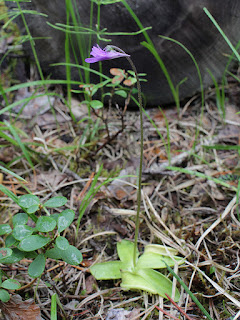
From Wikimedia

From Wikimedia

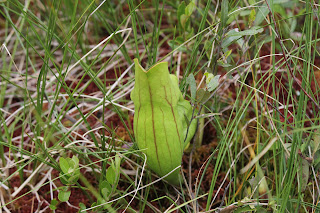
The second type of trap which occurs in Ontario genera is the pitfall trap. There is but one species in the province that uses this method, the Purple Pitcher Plant (Sarracenia purpurea, Sarraceniaceae). As one can imagine, the pitfall works when a prey item falls into the fluid-filled "pitcher", where it is digested. In the case of pitcher plants, although newer plants secrete and use enzymes, as the plant ages, it tends to utilize the bacterial community and microorganisms (mutualistic species) that live within the pitcher to break down the prey into a form that the plant can absorb nutrients from. In order to lure the prey to enter the trap, a series of methods may be employed, including use of scent and colour. On the inside of the pitcher, there is often a number of red venations, and there is evidence to show the bolder these are, the more prey items that are attracted.  From there, it is gravity that does the rest of the work!
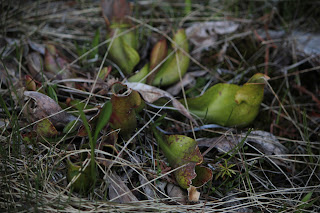

On the inside of the lip, there are downward facing hairs (yet another thing I wish I had a better photo of!) These act to stop insects from being able to crawl back up and out of the pitcher. 
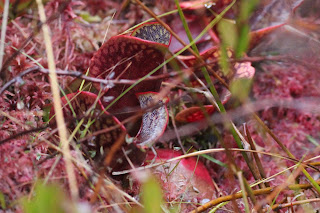
You can see the hairs in this image

And its not just insects that pitcher plants consume! A few years ago in Algonquin Park it was discovered that pitcher plants around Bat Lake (a well studied area of wildlife research) were catching recently metamorphosed Spotted Salamanders as they emerged from their breeding pools. These prey items are of course rather large, but there is some evidence that the plants are at least partially digesting them. I haven't seen this bog in person, but from what I have heard, many of the pitcher plants are larger than average, likely from the extra nutrients they are receiving. This story was all over the news, and you can read a little more about it and see some pictures here.
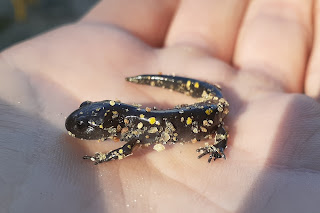
Lucky for this little guy, no Sarracenia nearby...

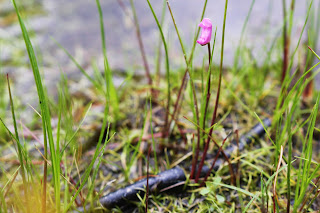
The last kind of trap found in Ontario are the bladder traps. There is only one genus in the world with this design, Utricularia, the bladderworts. These are in the same family as the butterworts, Lentibulariaceae. Nine species are found in Ontario, and they range from being aquatic to nearly terrestrial.
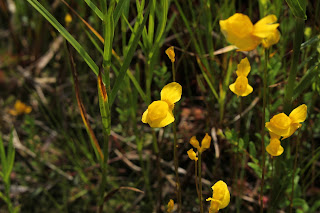
Horned Bladderwort (U. cornuta)

Northeastern Bladderwort (U. resupinata)

The bladder traps are typically submerged, at least in most of our species. To put it in the simplest terms, these bladder traps work as a vacuum. Through osmosis (the diffusion of water, or flow of water from an area of high concentration to low concentration, across a membrane), the bladder traps are "primed" when water is pumped out of the bladder. The walls of the bladder are sucked inwards with the negative pressure created from this. The traps are triggered when a prey item (which are very small aquatic invertebrates) touches a "trigger hair" near the entrance or door of the trap, which then breaks the seal, and water flows back into the bladder, and with it the prey item. 
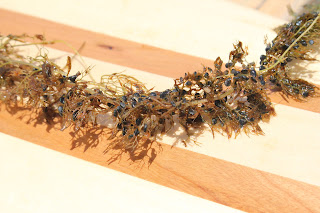
"Bladders" of Common Bladderwort (U. macrorhiza)

Much like the pitcher plant, a community of microorganisms may in part help the bladderwort break down and digest its prey. 

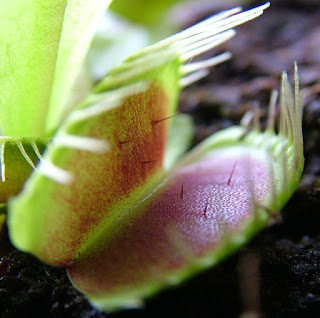
The other two trap mechanisms, snap traps and "lobster-pot" traps, do not occur in Ontario, but are still worth a mention. Only two plants in the world use snap traps, one of which is the poster child for carnivorous plants—the Venus Flytrap (Dionaea muscipula), which is endemic to the southeastern United States, found in wetlands in North and South Carolina, and are introduced to Florida. This plant is related to the sundews, both being in family Droseraceae. The "snap trap" likely needs very little explanation. There are a series of trigger hairs on the specialised leaf, which when triggered, causes them to shut close around the prey item. In order to avoid closing unnecessarily, such as if a raindrop were to hit a trigger hair, the Venus Flytrap will only close if there are two or more touch stimuli a certain length of time apart. 
From Wikimedia

"Lobster-pot" traps are found in a tropical group of plants, the corkscrew plants (Genlisea, Lentibulariaceae). This trap works much like a lobster pot or a minnow trap. It is easy to get in, but part to get out due to downward facing hairs, which force prey deeper into the trap. 

You may have noticed that Lentibulariaceae was mentioned three times. Quite neat that within one family, which only include the three genera detailed here, all employ different trap styles! 

On a similar note, if we take a step back and look at how these plants are all related to one another, we would likely be quite surprised. You might assume that since these are all carnivores they would be closely related, as we saw with several of the heterotrophs. However, each of the three families mentioned here, Droseraceae, Lentibulariaceae, and Sarraceniaceae all belong to different orders, Caryophyllales, Lamiales, and Ericales respectively. Because of this, carnivorous plants are an excellent example of convergent evolution, which is when distantly related organisms independently evolve similar traits, in this case carnivory, to adapt to similar situations. 

But, why carnivory? We have already established that carnivorous plants are autotrophs—they are able to photosynthesise their own energy. Why would a plant that can produce its own food adapt to be able to digest prey items?  If you were to stand over and observe a carnivorous plant in its natural habitat, the answer would likely lie directly beneath your feet. For many of our carnivorous plants, especially in the Ontario context, they live in very nutrient poor habitats. Take things like the sundews and pitcher plants for examples, which often grow amongst Sphagnum moss in fens and bogs. Sphagnum moss actually lowers the pH of the soil, making it more acidic. Acidic soil tends to be quite nutrient poor. Since there is a lack of nutrients, in particular nitrogen, then these plants had to look elsewhere, and that was to carnivory. By being able to get energy from an additional source, these plants have that much more of an edge in this harsh environment. 

Carnivory is not without a cost, however. By developing these specialised leaves, such as in the sundews and pitchers, the plant will sacrifice some of its photosynthetic ability. A pitcher plant with a pitcher that is roughly vertically inclined (so that it can catch prey) is not photosynthesizing to the same extent that a leaf that is broad and flat, facing the sun, would. Is it worth it? Evolutionarily speaking, it must for for the plant if it continues engage in this behaviour. That being said, a study done on pitcher plants found that each pitcher only has a prey capture efficiency rate of 0.83% - 2.1%, depending on how you wish to calculate it. This is quite low, but an insect once every couple of weeks must be better than trying to live in acidic soil on just your own photosynthetic processes alone!   

Carnivorous plants are certainly some of the oddest members of the plant family, employing a number of different methods of capturing and digesting their prey, as well as being able to survive in some the harshest conditions a plant can live in. Carnivores have a fascinating evolutionary history (which I largely didn't touch on here!), and have long been of interest to naturalists. Even Charles Darwin, considered by many to be the father of evolution (perhaps contested by Wallace), had a strong attraction to these plants, writing in 1860, "I care more about Drosera than the origin of all species in the world". 

While I believe this will conclude (unless I dig up something else) the look at plants that get their nutrients in unique ways, whether through heterotrophy or carnivory, there are still plenty of special things that plants do I wish to cover! Plants do weird things, and I want to talk about them.

Sunday, 9 January 2022

Plants That Do Weird Things: Part 2 (Haustorial Parasites)

Plants are a very diverse group of organisms, so as one could expect, there are a number of them that do "weird" things. There is no shortage of fascinating techniques that plants employ in order to survive in their environment. This is part 2 of my little series "Plants That Do Weird Things". Check out part 1, where we look at myco-heterotrophy, if you haven't already, as it will explain certain concepts that I refer to here.

With this post, we will dive into haustorial parasites. In plants, there are two types of heterotrophs: myco-heterotrophs and haustorial parasites. The term "haustorial parasite", henceforth referred to simply as parasite or parasitic plant, comes from the organ all parasitic plants possess, the haustorium, which is a root-like structure. Fungi also have this structure, but for our purposes, we will be focusing on haustoria in parasitic plants. 

Parasitic plants get some or all of their nutrients from other plants. These parasites use their haustorium to penetrate the host plant, and they may either attach themselves to the root or the stem. In order to extract the required water and nutrients, the parasite connects with the conductive tissue of the plant, either the xylem (transports water and nutrients from the roots to the stem and leaves), the phloem (transports products of organic materials made during photosynthesis, such as sugars, to other parts of the plant), or both. 

Much like myco-heterotrophs, there are both "full" and "partial" parasites. In regards to parasitic plants, these are typically referred to as either hemiparasites (both parasitic, and able to complete photosynthesis), or holoparasites (obtains all nutrients from a host plant, often lacks chlorophyll). It is important to note that neither hemiparasites or holoparasites are inherently more parasitic than the other, they just are able to perform different functions. 

Another important distinction is whether a parasite is obligate or facultative. With obligate parasites, they require a host plant to complete their life cycle. On the contrary, with a facultative parasite, it is not imperative that a host plant is present, as it is able to complete its life cycle regardless, taking advantage of a host if the opportunity arises. A hemiparasite can be either obligate or facultative, but a holoparasite can only be obligate. 

As one can imagine, parasitic plants needs to germinate close to their host plant, especially in the case of obligate parasites. Parasitic plants can germinate either using chemical or mechanical mechanisms, and is often dependant on which part of the plant it parasitizes—the root or the stem. In the case of root parasites, seeds must land very close to the host, as they receive a chemical signal from said host, leached from the root system into the surrounding soil, which initiates germination. Unlike root parasites, stem parasites are able to germinate and then survive for some time as they try to find a host using resources from the seed endosperm (tissue inside the seed that is able to provide nutrients to the embryo).

While worldwide there are approximately 4500 species of parasitic plants spanning 20 families, in Ontario, where our focus lies, there are only three families that have parasitic members. 

Perhaps the most well known family is the broomrapes (Orobanchaceae). This is a unique family in that it features both hemiparasites and holoparasites. It also has a few non-parasitic genera, but these do not occur in Ontario.

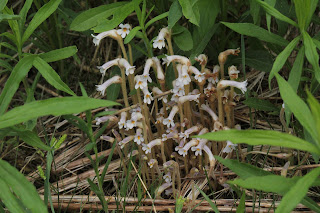
One-flowered Cancer-Root (Aphyllon uniflorum) is the more widespread of the two Aphyllon species (formally Orobanche) in Ontario. It is an uncommon species that is always a joy to come across. This is a holoparasite, with its host being the aster family (Asteraceae), saxifrage family (Saxifragaceae), and the stonecrops (Sedum).  In the below photo, you will see an abundance of goldenrod (Solidago spp) leaves, which are likely hosting this particular plant. 

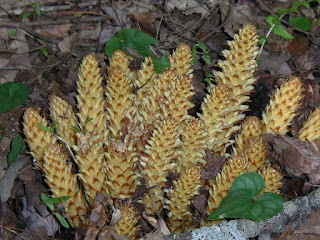
Another holoparasite in the broomrape family is Bear Corn (Conopholis americana). This is a root parasite of woody plants, in particular oaks (Quercus spp) and beeches (Fagus spp). 

From Wikimedia

The last holoparasite broomrape from Ontario is Beechdrops (Epifagus virginiana). As the name suggests, this plant is parasitic of the American Beech (Fagus grandifolia). This is a root parasite, so chemical signals from the host is what triggers germination. There is not really any negative effects on the beech tree from this parasite, and its absence may be indicative of deteriorating forest health. 


As mentioned above, the broomrape family features many hemiparasites. A number of the Ontario species parasitize the roots of graminoids, particularly sedges (Cyperaceae) and grasses (Poaceae). Some of these are found below:

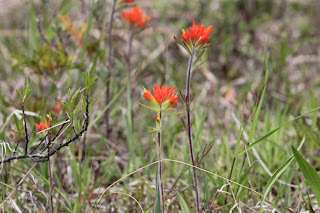
Scarlet Painted-cup (Castilleja coccinea)

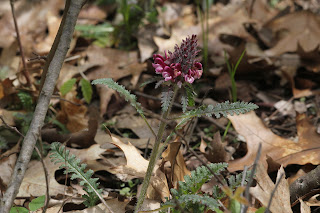
Canadian Wood Betony (Pedicularis canadensis)

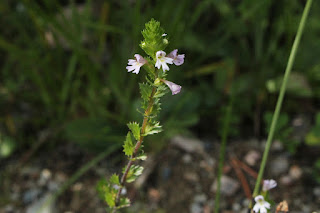
Eyebright (Euphrasia spp)

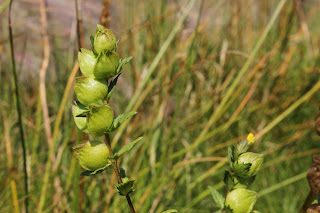
Yellow Rattle (Rhinanthus minor)

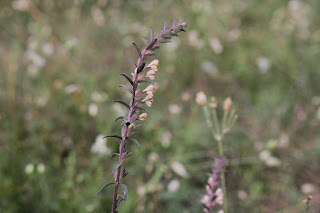
Red Bartsia (Odontites vernus) NOTE: non-native

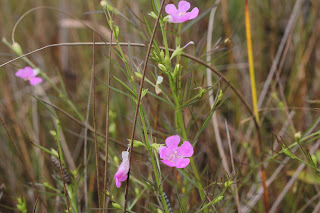
Purple False Foxglove (Agalinis purpurea)

Narrow-leaf Cow-wheat (Melampyrum lineare) parasitizes much different host plants than the above species. This root hemiparasite has a wide variety of hosts, including blueberry (Vaccinium), pines (Pinus spp), poplars (Populus spp), Sugar Maple (Acer saccharum), and Northern Red Oak (Quercus rubra). As one can imagine, this species thrives in a number of different habitats.


The second family of parasitic plants in Ontario are the sandalwoods (Santalaceae). Genera in this family are all hemiparasites.
 
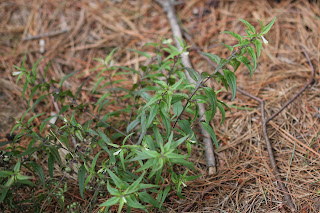
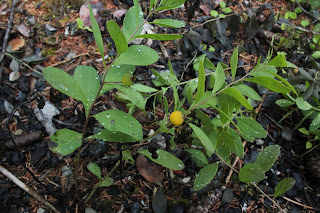
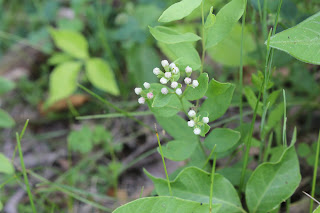
Three species are found in Ontario. The first is Northern Comandra (Geocaulon lividum). This is a species with a more northerly distribution in Ontario, with occurrences on the Bruce Peninsula. This root parasite attacks many different plants, such as asters (Asteraceae), spruce (Picea spp), pines, alders (Alnus spp), willows (Salix spp), birches (Betula spp), Bearberry (Arctostaphylos uva-ursi), and Twinflower (Linnaea borealis), to name a few. You can see some Twinflower in the background of this photo, and it is quite possible that is what this individual plant is taking advantage of. 


Bastard Toadflax (Comandra umbellata) is the southern counterpart of Northern Comandra. It has a bit of a wider variety of known hosts than the aforementioned species as well—over 200 different hosts. These include many of the ones mentioned under Northern Comandra, in addition to oaks, true sedges (Carex spp), roses (Rosa spp), blackberries (Rubus spp), and grasses. 

The last member of this family is a bit more of a cryptic species (I have never seen it in the flesh, aside from one very poor herbarium specimen), but may have a familiar name. That species is Eastern Dwarf Mistletoe (Arceuthobium pusillum). Its hosts are a variety of conifers: Black Spruce (Picea mariana), White Spruce (Picea glauca), Red Spruce (Picea rubens), Norway Spruce (Picea abies), Blue Spruce (Picea pungens), Jack Pine (Pinus banksiana), Eastern White Pine (Pinus strobus), Red Pine (Pinus resinosa), Balsam Fir (Abies balsamea), and Tamarack (Larix laricina). While this is a hemiparasite, it is obligate, and borders on being a holoparasite. Once the seed lands on the host branch, it germinates and is completely dependant on the host for nutrients. It is not until the mistletoe grows stems that it is able to photosynthesize. Even then, this plant possess very little photosynthetic ability, and draws heavily on its host. Because of this, dwarf mistletoe is considered a pest and can be very damaging to forests. That being said, it does not spread very fast, so is not invasive. 

 Arceuthobium pusillum by Joesph O'Brien

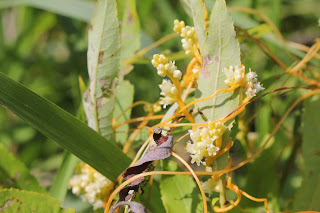
The last parasitic plant family in Ontario is the morning glory family (Convolvulaceae), however there is only once genus in that family, dodder (Cuscuta), that demonstrates parasitic behaviours. There are several species of dodder in Ontario, but Common Dodder (Cuscuta gronovii) is by far the most common. Dodders are stem holoparasites, and are often quite specialized in their hosts. In the case of Common Dodder, it is not super limited with its hosts, with species such as jewelweeds (Impatiens spp), Wood Nettle (Laportea canadensis), and willows. Since dodder is an obligate parasite, it must germinate very close to its host. Dodder seedlings are able to live for as long as a week, and are able to grow around 30cm in their search for a host, living off the nutrients from their endosperm, before dying. If the dodder finds a host, it will tap into the phloem, and then its roots will wither away—a mature plant is not rooted to the ground when it is growing around a host.

Common Dodder

With myco-heterotrophy and haustorial parasitism, that concludes our look at the heterotrophic plants, but fret not! Still plenty of weird things to look at. 

Thursday, 6 January 2022

Plants That Do Weird Things: Part 1 (Myco-heterotrophy)

Plants are a very diverse group of organisms, so as one could expect, there are a number of them that do "weird" things. There is no shortage of fascinating techniques that plants employ in order to survive in their environment.

Today, I want to look at some of the myco-heterotrophs. There are a number of these species worldwide, especially in more tropical regions, but I will be focusing on species found in Ontario.

"Myco-heterotroph" sure looks like a scary word, but once you break it down, it becomes much more digestible."Myco" comes from the Greek mýkÄ“s, which means "fungus". "Heterotroph" means an organism that gets its nutrients from another organism, but can be further broken down into "hetero", meaning different, and "troph", coming from the Greek trophḗ, meaning "nutrition".

Putting it all together, you get an organism (in this case, a plant) that gets nutrients from parasitism upon a fungus rather than through the conventional method of photosynthesis. Recall that in essence, photosynthesis is the process in which a plant with chlorophyll (the pigment which makes plants green) makes its own energy using the sun's energy. Photosynthetic plants are for the most part autotrophs (the opposite of heterotroph, organisms that produce their own energy)

This is a somewhat complicated process, but in the simplest terms, it goes a little something like this:

First, to set the scene: A fungus colonizes the root tissue of a host plant, to which it has a symbiotic relationship (long-term interaction between two organisms). The host plant gives the fungi nutrients from photosynthesis (e.g., sugars), and in return, the fungi gives the host plant nutrients from the soil (e.g., phosphorus). This relationship is known as a mycorrhizal association. Mycorrhiza can be broken down into "Myco" (fungus) and "rhiza", Greek for "root". 

In most myco-heterophic relationships, the myco-heterotophs will capitalize off this mycorrhizal association (which would occur regardless of whether a myco-heterotroph is present or not). The myco-heterotroph's roots interact with the fungus' mycellium (the thread-like, vegetative part of the fungus, for further reading click here), and this is where the flow of nutrients takes place. Note that unlike a mycorrhizal association, there are no nutrients leaving the myco-heterotroph and going to the fungus—it is a true parasite.

So bottom line, the flow of nutrients is as follows:

Host autotrophic plant  Mycorrhizal fungus → Myco-heterotroph 

In the past, myco-heterotrophs were mistakenly classified as saprotrophs. Saprotrophy is the process in which an organism breaks down organic material and turns it into usable nutrients ("sapro" means "rotten material"). It is now largely accepted that no vascular plants are saprotrophs, and that this is a process largely restricted to fungi. 

There are both partial and full myco-heterotrophs. Partial myco-heterotrophs (also called mixotrophs) are able both to utilize nutrients from mycorrhizal fungi, as well as complete photosynthetic processes. Full myco-heterotrophs are unable to complete photosynthesis due to a lack of chlorophyll, so are dependant on nutrients from fungi. It is important to keep in mind, however, that just because a plant lacks chlorophyll, does not automatically make it a myco-heterotroph! While I do not believe this is an Ontario example of this, it is possible for a species to have individuals that are both partial and full myco-heterotrophs.  

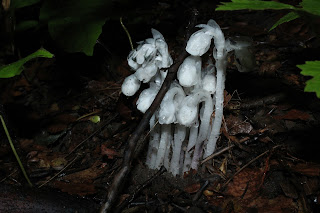
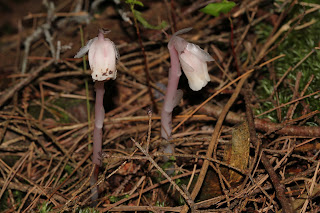
There are several examples of each type from Ontario. Perhaps the most well known is Ghost Pipes (Monotropa uniflora). A common misconception is that this is a fungus, but it is a plant! This is a full myco-heterotroph. This plant is well adapted to life in shady places, such as sugar maple forests (a whole post in itself), as it does not require sunlight, since it does not undergo photosynthesis. Ghost Pipes gets its name from his ghostly appearance, as a result of it not having chlorophyll. Ghost Pipes is parasitic of the fungi family Russulaceae. 


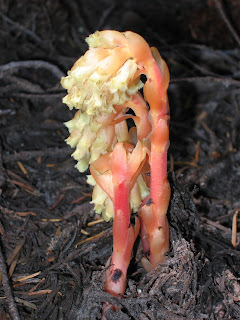
A similar plant is Pinesap (Monotropa hypopitys syn. Hypopitys monotropa). It is, in my experience, nowhere near as common as Ghost Pipes. I have only ever seen this plant in fruit, so I have used a photo off of Wikimedia. The main difference between this plant and Ghost Pipes is that it has multiple flowers on the same stem, whereas the latter only has one. Pinesap parasitizes the family Tricholomataceae, which may have something to do with its abundance, but that is something I will have to look into more. 

From Wikimedia

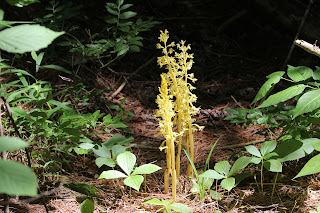
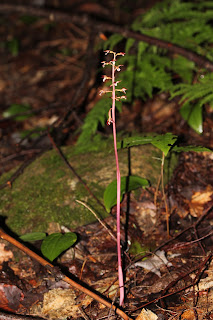
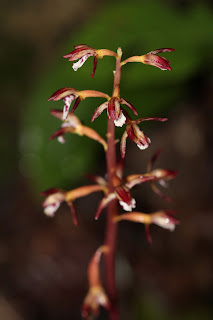
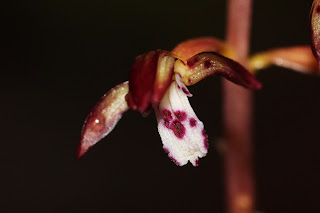
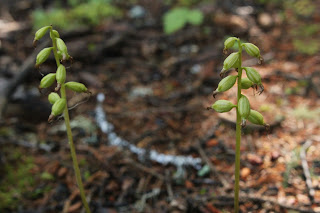
A somewhat surprising group of myco-heterotrophs are the coralroots, a type of orchid. Spotted Coralroot (Corallorhiza maculata) is a species found throughout Ontario, and like Ghost Pipes, it is a parasite of Russulaceae. There are two varieties found in Ontario, Western (var. occidentalis) and Eastern (var. maculata). The Western variety tends to flower several weeks earlier than the Eastern variety.

var. occidentalis f. flavida

var. maculata


There is an exception however. Early Coralroot (Corallorhiza trifida) is considered partially myco-heterotrophic, as it contains some chlorophyll and is able to produce its own nutrients through autotrophic processes. Early Coralroot's choice of fungus to parasitize is the genus Tomentella (Thelephoraceae). 


There are other examples of partial myco-heterotrophs as well, perhaps species that one would not immediately associate with such an unusual process! First, take a look at some of the taxonomy. The Ghost Pipes and Pinesap mentioned above are part of the heath family (Ericaceae). This contains many familiar plants, such as blueberries, cranberries, and laurels. These two species are part of the subfamily Monotropoideae, which are myco-heterotrophs. Within this subfamily, there are three tribes; Pyroleae, Montropeae, and Pterosporae. The latter two are full myco-heterotropic, whereas Pyroleae is partial myco-heterotrophic. Ghost Pipes and Pinesap, as you may have guessed, are part of Monotropeae. There is one species of Pterosporae in Ontario, the rare Woodland Pinedrops (Pterospora andromedea). (NOTE: some treatments list Pyroleae as its own subfamily, Pyroloideae)

Monotropoideae have very small seeds, known as "dust seeds". These dust seeds require a mycorrhizal fungi to germinate (to begin to grow), however in the case of plants in the tribe Pyroleae, they develop the ability to photosynthesize as they mature. 

There are four genera in Pyroleae, all of which are found in Ontario.

Pipsissewa (Chimaphila umbellata) is the more widespread member of its genus. Striped Wintergreen (C. maculata) is limited to only two or three areas of occurrence in Ontario. 

Pipsissewa

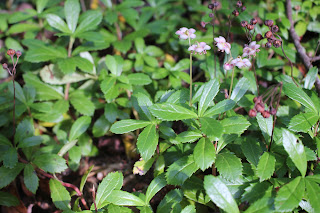
Pyrola is the largest genus in Pyroleae in Ontario. They are commonly referred to as "wintergreens" or "shinleaf". 

Shinleaf (P. elliptica

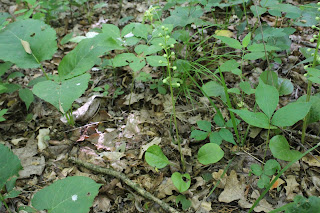
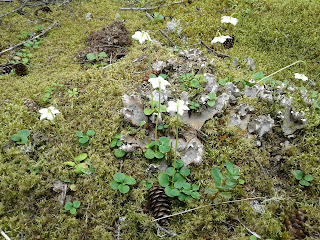
Moneses is represented by a single species, known as Single Delight or One-flowered Wintergreen (M. uniflora). 


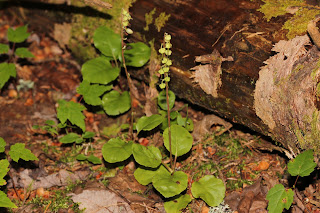
And finally, Orthilia. One-sided Wintergreen (O. secunda) is the monotypic member of this genus. 


Myco-heterotrophy is just one of the many unique and crazy things that plants do to both survive and thrive. This is one of the several weird things that plants do that I hope to highlight in this series in an effort to shine some light on these incredible organisms!