Showing posts with label Sydenham River. Show all posts

Saturday, 19 June 2021

Sydenham Saturday

Today I was down in the Alvinston area for an odonate (dragonfly and damselfly) survey on the Sydenham River Nature Reserve (SRNR) for Ontario Nature arranged by Blake Mann. This reserve is one of my favourite sites in the area, and its a shame I am unable to visit it more often! For the past couple of years, I have partaken in a breeding bird survey on SRNR, and each year we have spotted some cool odes along the way. 

I got up early to head down and do some birding before starting the survey. My first stop was the Strathroy Sewage Lagoons. There was not much of note here in my loop of the south lagoon. I did count over 90 Wood Ducks, several broods, which is always great to see. Another interesting find was a pair of Northern Shovelers. It is likely nothing will come out of it, but you never know. On Tuesday I had a pair of Green-winged Teals here, but they were nowhere to be found this morning. 

Digiscope

I decided to get some point counts done in my Lambton atlas square (17TMH34), and succeeded in completing twelve over the course of a couple hours. Point counts happy pretty fast, so no photos! I recorded over 50 species of birds from these counts. One of my best stops was in the field near the corner of Calvert Drive and Kerwood Drive. Here I had a couple singing Dickcissels on territory (one had been present for about a week now, and a second one seems to have joined it), a pair of Upland Sandpipers, and perhaps most exciting, a family group of Common Ravens which flew over just as I started the point count. Pretty eventful five minutes! 

I eventually got to the SRNR around quarter to ten. The area I was to cover was the Buttonwood Drive side, which is on the east side of the river. This is typically not the most "ode-y" side, but I was more than happy to do it—someone has to! 

I began by walking the field to the south of the parking area, skirting the forest edge. It was not nearly as eventful as I had imagined it to be, and for the longest time, I only came across a few Common Whitetails, a pair of Twelve-spotted Skimmers, and of course several Midland Clubtails. It wasn't until I got down to the river I added Powdered and Blue-tipped Dancer, as well as several Stream Bluets and more Midland Clubtails, to my list. 


I was a bit surprised to see some Banded Hairstreaks, my first this year. There were tons of Hackberry Emperors, as well as a few Tawny Emperors, as well. 


Quite a few of these Haploa moths as well. I think they are LeConte's Haploa moths.


While walking at the far end of the field, I was somewhat surprised to hear a Hooded Warbler, the first time I have encountered one at SRNR. Other breeding birds here included Mourning Warbler, Yellow-throated Vireo, Red-headed Woodpecker, Wood Thrush, Scarlet Tanager, and Blue-grey Gnatcatcher. A couple weeks ago I had a Cerulean Warbler here as well. 

I decided it was time to cut into the forest and head towards the river. As I did so, I came across a fairly fresh Black-shouldered Spinyleg, my first for this property. 


I bushwhacked to the river through seemingly endless patches of stinging nettle, a reoccurring theme for the day. As much as I like SRNR, the one thing I am not a fan of is all of the stinging nettle! Although you can't get "zapped" through jeans, today I was wearing my quick-dry field pants, which apparently offer no protection! I found minimal success with side-stepping through the patches, being careful to flatten the plants down before your legs made contact. 

There was less than expected by the river, just a bunch of Ebony Jewelwings and American Rubyspots. I did have a single female Swift River Cruiser and a Fragile Forktail, but that was it for new species. I continued quite a ways upriver, before crossing over and going to the other side. I walked downriver for a bit, and ended up almost to the other entrance for the reserve. Not much to report on ode wise! A long walk in the hot and humid conditions with an abundance of stinging nettle—fun times! (I actually did quite enjoy myself, doing this beats sitting around at home)

I found myself turning my attention to plants quite a bit on the quiet stretches, although I didn't stop to take very many photos. This is the first time I have seen Broad-leaved Waterleaf (Hydrophyllum canadense) in flower. 


Michigan Lily (Lilium michiganense) is always a fun one to come across.


I saw a number of sedges as well. Since this is such a rich forest, I was hoping to come across some rare species, but it was not to be. Nevertheless, I still came across some high quality species. The diversity of sedges you can find in any given area is something that really appeals to me.

Hitchcock's Sedge (Carex hitchcockiana)

Sprengel's Sedge (C. sprengellii)

White Bear Sedge (C. albursina)

Nerveless Woodland Sedge (C. leptonervia)

Inflated Narrow-leaved Sedge (C. grisea)

Eastern Rough Sedge (C. scabrata)

Drooping Sedge (C. prasina)

Smooth-sheathed Sedge (C. laevivaginata)

Fringed Sedge (C. crinita)

The walk back to the car was largely uneventful. I was quite happy to get back and out of the stinging nettle! 

I had planned to go to Reid CA near Wallaceburg afterwards to look for Oak Hairstreaks, but the sky was threatening rain, so I opted to head back home. Perhaps some other day I will go look for this rare butterfly. 

Overall, a very productive day, even if odonate diversity was lower than I had imagined it would be. I expect to get the results of the survey soon, and will update this post once they come out! 

Saturday, 6 June 2020

Sydenham River Breeding Bird Blitz

Today was the breeding bird blitz at the Sydenham River Nature Reserve, organized by Larry Cornelis. I believe that this is the fourth year of the survey, this being my second time doing it. The Sydenham River Nature Reserve is a piece of property owned by Ontario Nature near Glencoe, right on the Middlesex/Lambton border. It is a very unique property with special plants, breeding birds, and the river, which harbours many aquatic species at risk, including freshwater mussels and fish,


I went early, in hopes of finding a Vesper Sparrow, which breed in the area. I got to Buttonwood Drive, one of the entrances to the reserve, around 6:30. I drove the first bit, but a large tree down in the road halted any progress, so I got out and walked. I tallied 40 species on the road, including Yellow-billed Cuckoo, Wood Thrush, and a Scarlet Tanager. At one point I am almost positive I heard an Acadian Flycatcher calling, and it very well may have been, but with a bird like that I want to be sure. The habitat is basically perfect. 

After Buttonwood, we made our way down Old Airport Road for a bit. A singing Pine Warbler was a bit of a surprise. After several Savannah Sparrows, and a Grasshopper Sparrow, I finally found a Vesper Sparrow! This was actually a new Middlesex bird for me, and a long awaited on at that!


After that success, I went to meet up with a couple other of the surveyors. Larry, as well as Ed Lavender, and I did a section on the east side of the river, the same one we did that year.

Overall, it was a fairly quiet morning in our section. Highlights including several Eastern Wood-pewees, three Scarlet Tanagers, a couple of Yellow-throated Vireos, a Mourning Warbler, and lots of Indigo Buntings. 

As usual, when the going gets slow, you look at other things.

The vegetative communities were quite rich. Several species of sedges can be found in the floodplains.

James' Sedge (Carex jamesii)

Gray's Sedge (Carex grayii)

Longbeak Sedge (Carex sprengelii)

Foxtail Sedge (Carex alopecoidea)

Inflated Narrow-leaved Sedge (Carex grisea)

After a couple hours, we finished up our area, and went back to our cars. Larry and Ed headed out, but I opted to grab my net and head back in. There were a fair number of odonates around. I had a few nice nice species, and by the looks of it, Blake had some nice stuff on his side of the river! I'm thinking a return trip is in order...

I added a few new species to the area on my journey back into the reserve, including a second Mourning Warbler, Blue-grey Gnatcatcher, American Redstart, Bald Eagle, and a Wood Duck.

Swift River Cruiser was pretty common in Algonquin Park last summer, but seems to be quite uncommon down here. I saw a few. New for my Middlesex ode list (I had one in Lambton too!) Check out the legs on that thing! All the crusiers have very long legs. Perhaps later this summer Royal River Crusier will be a possibility. It has never been recorded in Middlesex county.


My lifer dragonfly for the day was Midland Clubtail. There were several of them out over the river.


As mentioned earlier, the river is good for freshwater mussels. This next one, Threeridge (Amblema plicata), was quite common along that section.


On my way back I passed by an opening in the floodplain and noticed a large colony of sedges. They looked quite messy in appearance, and as I approached them, I realized it was Hairy-fruited Sedge (Carex trichocarpa). Originally I thought this may have been the first Lambton county record, but I just became aware of a recent one from 2019. I actually think that recent record may have been this exact clump! Oh well, still nice to see.


Another rare species that calls the floodplain home is Beak Grass (Diarrhena obovata). This is ranked S1 in Ontario, with only two known populations of it in the province, here and the Ausable River Valley. 


I'll finish off with this Southern Blue Flag (Iris virginica).


A good day in good (socially distanced) company. Should be interesting to see the results!

Wednesday, 3 June 2020

Hairy-fruited Sedge—Keep an eye out!

Hairy-fruited Sedge (Carex trichocarpa) is an uncommon sedge in Ontario, ranked S3, meaning there are between 21 and 80 locations for it in the province. All photos here are from a population in London (not sure if it was known previously, but I stumbled across it last June).


This is a species of wet meadows, sedge marshes, and floodplains in the Northeast, seldom found far from a river or stream. It is rare throughout most of its range.

Carex trichocarpa distribuition (map from FNA)

In Ontario, most records of the species are from along larger rivers, such as the Thames, Sydenham, Grand, and the Don. Smaller watercourses, such as Big Otter Creek and Talbot Creek, also have records. It is apparently widespread along the Thames River especially, and is listed as 'uncommon' in Middlesex county.

While sedges (Carex spp) are often considered pretty difficult to identify (and that's not necessarily wrong!), Hairy-fruited Sedge is somewhat easily recognizable. To start, look for a sedge where the clumps of leaves look 'messy'. 


Scattered clumps of Carex trichocarpa

One of the clinching identification features is the burgundy leaf sheath apex. This is where the leaves meet the stem (also called the culm). This feature is sometimes described as a 'burgundy snake's tongue'. There are several species that may look similar, but this feature is pretty diagnostic.


This sedge often forms colonies of mostly vegetative plants (ie not reproductive), with a few flowering plants. When present, the fruits, which are called perigynia, are pubescent, or hairy, which is where this plants common name comes from. The perigynia are quite large. The female (with the perigynia) spikes are called 'pistillate spikes', and are widely separated from the male spikes, called 'staminate spikes'. Pistillate spikes are typically found below the staminate spikes in sedges.

 
This is a species that is likely quite easily overlooked, and is bound to show up in many new places. From the 2017 Oldham list to the Vascular Plants of Ontario's Carolinian Zone, Hairy-fruited Sedge is listed as uncommon in Middlesex, and rare in Chatham-Kent, Elgin, Oxford, Haldimand-Norfolk, Brant, and the Ecodistrict 7E-4 (parts of Toronto, York, Peel, and Halton). 

This species is currently not listed from Essex, Lambton, Hamilton, or Niagara, but could very well be found there. In particular, Lambton county has lots of potential for this species, since the Sydenham River runs through part of it. Perhaps the Ausable River may have potential for this species as well. EDIT: I just became aware of a recent 2019 Lambton record

Keep an eye out while on your travels through floodplains and meadows near rivers!, streams, and creeks! Perhaps more populations of this species will turn up!

Sunday, 9 June 2019

Bird Blitzin'

Yesterday was the Breeding Bird Blitz of the Sydenham River Nature Reserve, a property of Ontario Nature. The count was coordinated by Larry Cornelis, and the property, which is about 200 acres, was split in 4 areas, with a team of two or three people per area. The purpose of the count was to establish an idea of what birds were using the property.

Myself and Larry did the northern area of the property. Started off with a bang with a couple Black-billed Cuckoos, a couple "winged warblers", a Blue-winged Warbler and a bird that looked quite like a Blue-winged, but had the oddest song of one that I'd ever heard. We were thinking it could have been a hybrid. (Golden-winged and Blue-winged are a genetic mess!) We also had a Mourning Warbler singing from the parking lot. Throughout our travels we would tally two more, and combined with the other group who did the area directly south of ours, we had a grand total of six singing Mourning Warblers in the northern end of the property! Despite our best efforts however, we never were able to turn up a Cerulean Warbler...

The Sydenham River Nature Reserve is not only a great place for birds, but also plants. One of my favorites of the day was Gray's Sedge (Carex grayi).


Quite a few species at risk can be found on the reserve. Likely the rarest plant there is Beak Grass (Diarrhena americana). It is ranked S1 in Ontario, as the only two known sites in Ontario are at the reserve and up in the Ausable River area.


Another rare plant is American Gromwell (Lithospermum latifolium). I've seen this species before, but never in flower.


Green Dragon (Arisaema dracontium) was seen here and there throughout. It is another sensitive species.


One of the most signature plants of the reserve is Virginia Bluebells (Mertensia virginica). I'm a couple weeks late to see them in full bloom, but there was the odd flower hanging on.


A couple other plants I thought were cool...

Cockspur Hawthorn (Crataegus crus-galli)

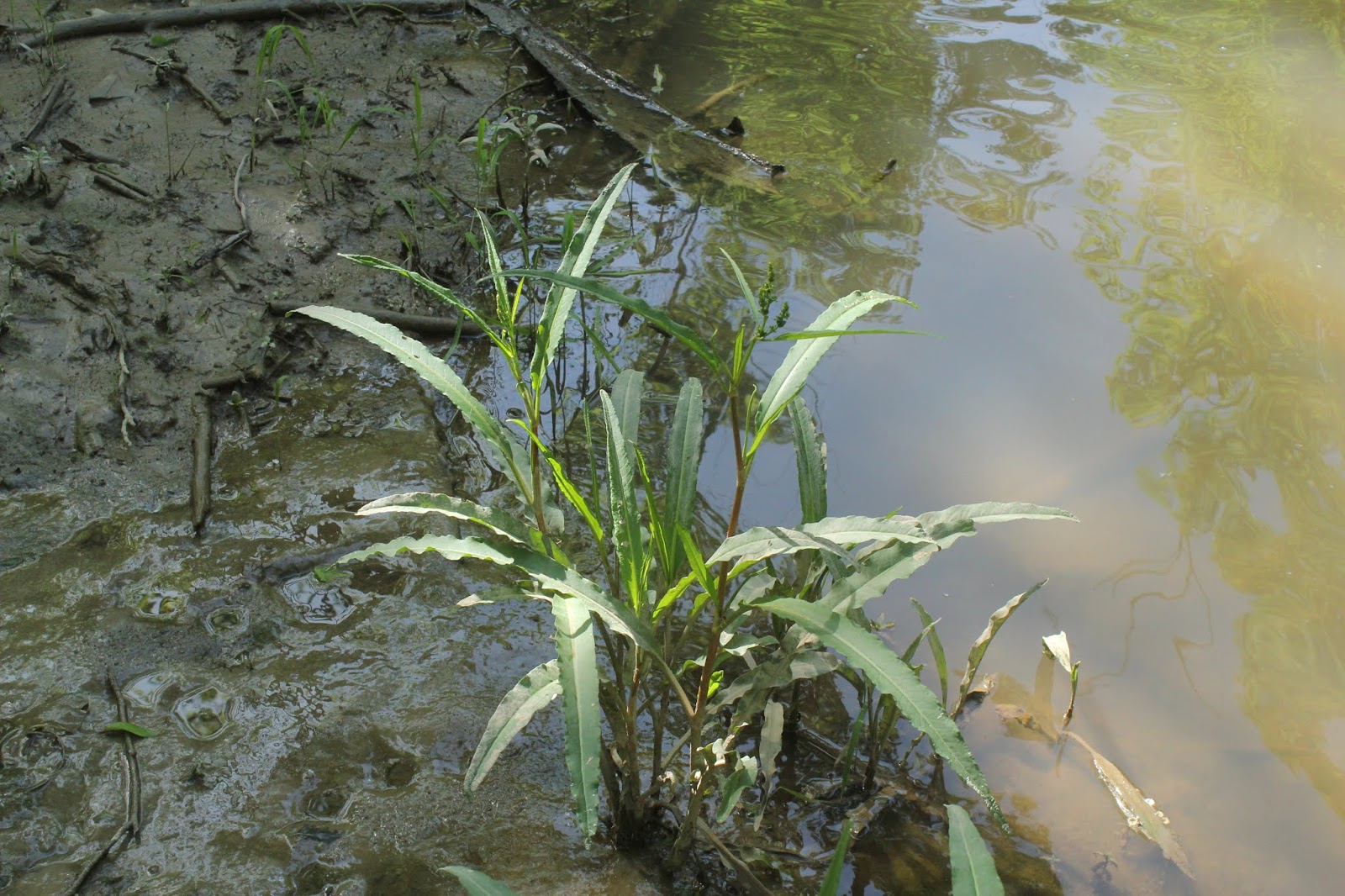
Swamp Dock (Rumex verticillatus)

In his posting, Blake mentioned seeing a very large American Sycamore (Platanus occidentalis). It is truly impressive, and very likely one of the largest, if not the largest, sycamores in the province. I look tiny next to it (and I'm not a small person!)

Photo by Larry Cornelis
After the we finished up our area (eBird checklist), I ventured over to a grassy area where we had had the Blue-winged Warbler(s) earlier in the day. I was very pleased to find a Rusty Snaketail!


If I'm not mistaken, this represents the first record of this species for Middlesex county. It was less than 100 meters, if that, from the county line!

It was a great count, and I got to spend some time with some great people. A nice way to spend the morning!

On a side note, I made a quick trip this afternoon to a local natural area in London, and it came up fairly productive. Highlights below.

Chalk-fronted Corporal (my first for the county)

Fringed Sedge (Carex crinita)

Red Penny Moss (Rhizomnium punctatum)

Crome Sphagnum (Sphagnum squarrosum)

Pink Lady's Slipper (Cypripedium acaule)