Showing posts with label Dickcissel. Show all posts

Saturday, 19 June 2021

Sydenham Saturday

Today I was down in the Alvinston area for an odonate (dragonfly and damselfly) survey on the Sydenham River Nature Reserve (SRNR) for Ontario Nature arranged by Blake Mann. This reserve is one of my favourite sites in the area, and its a shame I am unable to visit it more often! For the past couple of years, I have partaken in a breeding bird survey on SRNR, and each year we have spotted some cool odes along the way. 

I got up early to head down and do some birding before starting the survey. My first stop was the Strathroy Sewage Lagoons. There was not much of note here in my loop of the south lagoon. I did count over 90 Wood Ducks, several broods, which is always great to see. Another interesting find was a pair of Northern Shovelers. It is likely nothing will come out of it, but you never know. On Tuesday I had a pair of Green-winged Teals here, but they were nowhere to be found this morning. 

Digiscope

I decided to get some point counts done in my Lambton atlas square (17TMH34), and succeeded in completing twelve over the course of a couple hours. Point counts happy pretty fast, so no photos! I recorded over 50 species of birds from these counts. One of my best stops was in the field near the corner of Calvert Drive and Kerwood Drive. Here I had a couple singing Dickcissels on territory (one had been present for about a week now, and a second one seems to have joined it), a pair of Upland Sandpipers, and perhaps most exciting, a family group of Common Ravens which flew over just as I started the point count. Pretty eventful five minutes! 

I eventually got to the SRNR around quarter to ten. The area I was to cover was the Buttonwood Drive side, which is on the east side of the river. This is typically not the most "ode-y" side, but I was more than happy to do it—someone has to! 

I began by walking the field to the south of the parking area, skirting the forest edge. It was not nearly as eventful as I had imagined it to be, and for the longest time, I only came across a few Common Whitetails, a pair of Twelve-spotted Skimmers, and of course several Midland Clubtails. It wasn't until I got down to the river I added Powdered and Blue-tipped Dancer, as well as several Stream Bluets and more Midland Clubtails, to my list. 


I was a bit surprised to see some Banded Hairstreaks, my first this year. There were tons of Hackberry Emperors, as well as a few Tawny Emperors, as well. 


Quite a few of these Haploa moths as well. I think they are LeConte's Haploa moths.


While walking at the far end of the field, I was somewhat surprised to hear a Hooded Warbler, the first time I have encountered one at SRNR. Other breeding birds here included Mourning Warbler, Yellow-throated Vireo, Red-headed Woodpecker, Wood Thrush, Scarlet Tanager, and Blue-grey Gnatcatcher. A couple weeks ago I had a Cerulean Warbler here as well. 

I decided it was time to cut into the forest and head towards the river. As I did so, I came across a fairly fresh Black-shouldered Spinyleg, my first for this property. 


I bushwhacked to the river through seemingly endless patches of stinging nettle, a reoccurring theme for the day. As much as I like SRNR, the one thing I am not a fan of is all of the stinging nettle! Although you can't get "zapped" through jeans, today I was wearing my quick-dry field pants, which apparently offer no protection! I found minimal success with side-stepping through the patches, being careful to flatten the plants down before your legs made contact. 

There was less than expected by the river, just a bunch of Ebony Jewelwings and American Rubyspots. I did have a single female Swift River Cruiser and a Fragile Forktail, but that was it for new species. I continued quite a ways upriver, before crossing over and going to the other side. I walked downriver for a bit, and ended up almost to the other entrance for the reserve. Not much to report on ode wise! A long walk in the hot and humid conditions with an abundance of stinging nettle—fun times! (I actually did quite enjoy myself, doing this beats sitting around at home)

I found myself turning my attention to plants quite a bit on the quiet stretches, although I didn't stop to take very many photos. This is the first time I have seen Broad-leaved Waterleaf (Hydrophyllum canadense) in flower. 


Michigan Lily (Lilium michiganense) is always a fun one to come across.


I saw a number of sedges as well. Since this is such a rich forest, I was hoping to come across some rare species, but it was not to be. Nevertheless, I still came across some high quality species. The diversity of sedges you can find in any given area is something that really appeals to me.

Hitchcock's Sedge (Carex hitchcockiana)

Sprengel's Sedge (C. sprengellii)

White Bear Sedge (C. albursina)

Nerveless Woodland Sedge (C. leptonervia)

Inflated Narrow-leaved Sedge (C. grisea)

Eastern Rough Sedge (C. scabrata)

Drooping Sedge (C. prasina)

Smooth-sheathed Sedge (C. laevivaginata)

Fringed Sedge (C. crinita)

The walk back to the car was largely uneventful. I was quite happy to get back and out of the stinging nettle! 

I had planned to go to Reid CA near Wallaceburg afterwards to look for Oak Hairstreaks, but the sky was threatening rain, so I opted to head back home. Perhaps some other day I will go look for this rare butterfly. 

Overall, a very productive day, even if odonate diversity was lower than I had imagined it would be. I expect to get the results of the survey soon, and will update this post once they come out! 

Sunday, 13 June 2021

Return to Rondeau

It had been way too long since my last visit to Rondeau, so that is where I decided to head yesterday.

Although birding was my main intention, I didn't really take any photos of birds, so you'll have to live with some plants and insects :)

First things first, I went to Keith McLean CA, along the Rondeau causeway. Always worth a stop I find. There had been a Yellow-headed Blackbird seen there the day prior, but no sign of it when I went. Plenty of Marsh Wrens however, as well as some more unusual birds for the time of year, like Blue-winged Teal, Ruddy Duck, and Semipalmated Sandpiper. In the group of gulls sitting in the field, I found a single adult Lesser Black-backed Gull. 

It was time to head into Rondeau. My first stop was the South Point Trail. Not too much bird song, other than the usual suspects, but a pair of Blue-grey Gnatcatchers and a Least Flycatcher (a species I often don't encounter in the summer, oddly enough) was nice. I went out to the beach at the light beacon, and found a new species of sedge for me, Sand Sedge or Mulhenberg's Sedge (Carex muehlenbergii). Much more robust and impressive than I imagined it being!


There were some loafing gulls further down the beach, so I decided to keep going. Nothing special among them however, only Bonaparte's, Ring-billed, and Herrings. I continued until I hit the washout, then headed back along the trail.

There were a few Painted Skimmers along the way.

I encountered this grass as well, which I have tentatively called Schribner's Grass (Dichanthelium oligosanthes var. scribnerianum).


I had originally keyed it out to Common's Grass (Dichanthelium commonsianum) using Michigan Flora, but have since revised my identification (this genus is hard!). While we're on the topic, the genus Dichanthelium is a real mess. It used to be the genus Panicum, however Panicum was then split into several more genera (while some species retained the genus name). Even within Dichanthelium, things are confusing. It seems every species name is a synonym for something else! Not to mention the numerous varieties. With some authorities, such as in the checklist of plants for Ontario's Carolinian zone, D. commonsianum is included under D. ovale ssp. pseudopubescens

Next, I decided to go to the Tulip Tree Trail. Largely had the place to myself, which was nice. Almost immediately, I heard an Acadian Flycatcher, soon followed by two more. This was my main target for the day, as it was a species I had never seen in Rondeau before. A couple other goodies rounded out the bird list here, including a Wood Thrush carrying food, a Prothonotary Warbler, and a singing Black-throated Green Warbler. Maybe it is just a very late migrant, but I guess it isn't out of reason for a Black-throated Green to attempt to breed here. 

Another Dichanthelium for you, this one a bit more straightforward: Broad-leaved Panic Grass (Dichanthelium latifolium).

I then intended to go to the Marsh Trail, but on the way passed Spicebush Trail. Last minute I decided to turn in and give it a go, because why not? Glad I did!

Nothing really of note bird wise, but as I was walking along I noticed this sedge (Carex).

I recognized it immediately as something in Section Griseae, and felt as though it was something I hadn't seen before. I had a sneaking suspicion it was Eastern Narrow-leaved Sedge (Carex amphibola), which is somewhat similar to the common Inflated Narrow-leaved Sedge (Carex grisea). I consulted a key, and found that my initial thought seemed to be correct, it appeared to in fact be Eastern Narrow-leaved Sedge, a rare species in Ontario, ranking S2 (between 5-20 known occurrences, I believe). Despite its rarity in Ontario, it is actually considered to be the most common species in its section further south of us. The perigynia of this species is triangular in cross section, and seems to be relatively a bit narrower and longer than in Inflated Narrow-leaved Sedge. 

Compare to Inflated Narrow-leaved Sedge. I took this photo back in late May in London. The perigynia aren't completely mature here, but they are mature enough to see the difference. 

I saw another member of the section Griseae along the same trail. Hitchcock's Sedge (Carex hitchcockiana) is a fairly distinct species, with hairy lower stems. 


My last stop in the park was the first little bit of the Marsh Trail. Not really much of note.

Flowering Rush (Butomus umbellatus)

Silverweed (Argentina anserina)

Swamp Rose Mallow (Hibiscus moscheutos)

Hairy Beardtongue (Penstemon hirsutus)

Greater Straw Sedge (Carex normalis)

My eBird checklist for the day: https://ebird.org/checklist/S90074662

I went to Shrewsbury after and drove around looking for the Eurasian Collared-Dove, but no luck. Only saw a few Mourning Doves!

I went to Stefina Line east of Blenheim, and saw the reported Dickcissels just before heading back home. Always a nice one to see!

I took some backroads home, but didn't see too much. I had debated about going to check a field that gets Dickcissels each year, but opted to just go home. One was found there this morning! Oh well. 

Gotta love this time of year!

Sunday, 9 May 2021

eBird Global Big Day 2021

Yesterday was eBird's annual Global Big Day, which coincides with World Migratory Bird Day. As per usual, I like to do what I can and see how many species I can see. While in a normal year I would have likely gone down to Rondeau or Pelee, in this day and age, I decided to stick right around Middlesex County, like I did last year. Throughout this pandemic I have had an increasing interest in Middlesex birding, so I figured it would be fun! My camera was acting up unfortunately, so not many photos today. 

I threw together a rough plan for the day before I went to bed on Friday, and went to sleep dreaming of the success I was hoping to find. 

I woke up around 5:00am, and after throwing some stuff in the car, was on my way. My first stop was Fanshawe Lake to get Common Merganser. I only stayed for a few minutes, but was successful with my quarry! 

By 6:00am, I arrived at Kilally Meadows in North London, which has been in the birding news as of late for a rare visitor! It has also been one of the best birding locations in the city this spring, likely in part because of its proximity to the river. 

As soon as I got out of the car, I heard a Northern Waterthrush, an excellent bird to start the day. It was one of three I found here. Several other species of birds were vocalizing, and my day list was growing by the minute!

I stopped to check a tree in which a Whip-poor-will had been hanging out for a few days, and was pleased to find it in the same spot! Day tick.

I continued on my way hiking the trails, picking up many of the typical spring birds, although it seemed much quieter than previous days. It wasn't until a couple hours in did I get my first Palm and Yellow-rumped Warblers! In all, I ended up with 15 species of warblers here, a respectable count, with highlights including Magnolia, Tennessee, Blue-winged, Black-throated Green, and American Redstart.

As for some other miscellaneous highlights, there were several Least and Great Crested Flycatchers, Warbling and Blue-headed Vireos, Veery, Hermit Thrush, Tufted Titmouse (I've had at least four in London this year so far, pretty crazy), Merlin, Common Loon, and Purple Finch. 

On my way back, I came across a group of birders, and they had the Blue Grosbeak which has been around since at least Tuesday (I'll get around to writing a post about that soon). This bird has been pretty tricky to nail down because of its secretive habits, so I was quite happy to see it on this day! I got a couple record shots, nothing to write home about.

I stuck around a bit longer to help others see the grosbeak (some of which this was their fourth attempt trying to see it—that's how elusive it is!), but was eager to carry on my way. Just as I was pulling out of the parking lot, with my sights set on heading up Thorndale way to check out some ponds, I got a call from Pete Read...he had a Black Tern at the ponds at Komoka Provincial Park! This a rare species in Middlesex County nowadays, although a few decades ago it was a bit more expected. Needless to say, plans changed, and I zipped over there about as fast as I could go without getting pulled over. 

I pulled into the parking lot at Komoka, and made my way to the back pond, where it was last seen. On the way, a pair of Trumpeter Swans flew over. This pair has been seen with some regularity in the Komoka area for the past couple months, and they appear to be attempting to breed. This may be the first breeding record for Middlesex, but don't quote me on that.

I met up with Pete, and the two of us scanned the ponds, but were unable to come up with the tern. Darn. He mentioned that perhaps it has gone over to one of the other gravel pits in the area. I didn't really feel like driving around searching them all, so out of desperation, I pointed my spotting scope towards the nearest pit, which you could just barely see from where we were standing. There was a Bonaparte's Gull flying around. Nice. Then, a couple seconds later, I saw the Black Tern! Pretty sweet county bird! It ended up sticking around all day for everyone else to enjoy.

I took a more leisurely walk back to the car, and picked up such birds like Eastern Bluebird, Grasshopper Sparrow, Mute Swan, Double-crested Cormorant, and Eastern Meadowlark. By the time I finished up in Komoka, I was sitting around 90 species for my day list. 

My next stop was Skunk's Misery. Along the way I picked up Savannah Sparrow, Horned Lark, and a Bobolink. I took a drive down Centreville Drive, but overall it was pretty quiet. I did come across a group of warblers, which included my first Pine, Black-throated Blue (actually a FOY), and Chestnut-sided Warblers of the day, as well as a couple Yellow-bellied Sapsuckers. I didn't get any Hooded Warblers, but it was midday and overcast/cool, so perhaps they just weren't singing. 

I saw a lot of Flowering Dogwood (Cornus florida). The "petals" aren't actually petals at all, but are bracts! The genus Cornus has undergone a taxonomic shift, so perhaps the more proper name for this species is Benthamidia florida

I began my way back towards Strathroy along some of the backroads. I had originally intended to take highway 80 up to Calvert Drive, but opted last minute to take Old Airport Road. Glad I did! As I stopped at the stop sign at Carolinian Drive, I noticed a sparrow-like bird fly into a dead tree. I snapped a few (terrible) photos, and was shocked to see it looked like a Dickcissel! After a moment, it flew down towards the abandoned house, and I couldn't find it again. Shame that pesky branch was in the way.

Not a bad bird for #100.

I stopped into the Sydenham River Nature Reserve for a brief moment. Not too many birds, but I did hear a Yellow-throated Vireo. 

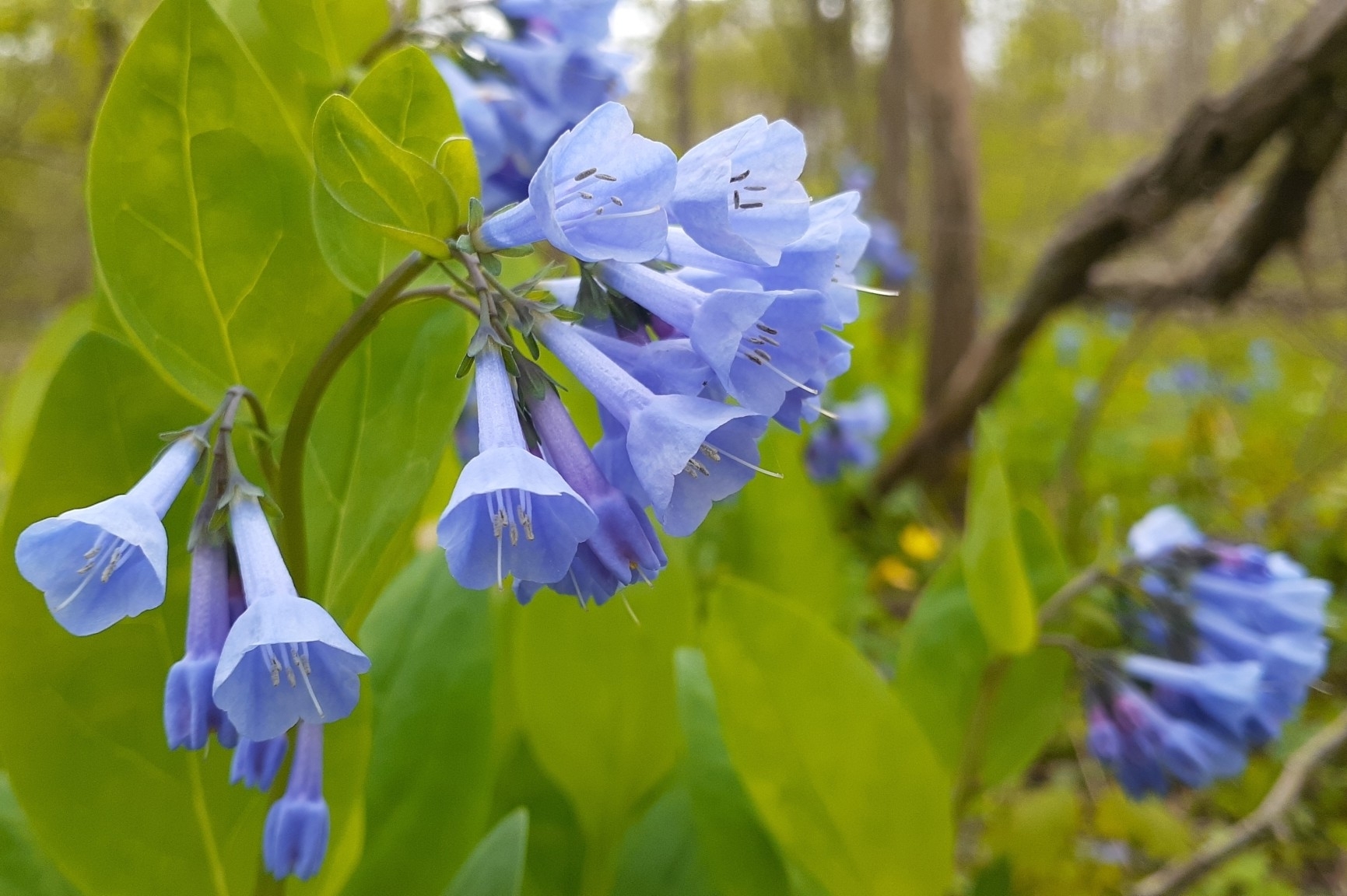
Lots of Virginia Bluebells (Mertensia virginica) in bloom. I'd be lying if I denied that part of the reason I made this detour was to see these plants. 


I made a quick stop at a spot for Upland Sandpiper (which I didn't see), before continuing onto the Strathroy Sewage Lagoons. Here I added such birds like Sora and Virginia Rail, American Coot, Common Gallinule (stuck around!), Cliff Swallow, Purple Martin (a FOY), and a variety of ducks and shorebirds. Seems I missed a Dunlin and Semipalmated Plover, but can't get them all I guess. 

It was time to head up to the northern part of the county. Along Sylvan Road, I found the pair of nesting Common Ravens, a nice addition to the day list. I then went to the Ausable River Valley Trail, which proved to be rather quiet, although I did get Eastern Phoebe, Pileated Woodpecker, and my main target here, Vesper Sparrows. They weren't new for the day list, but I also had a pair of Yellow-throated Vireos It was a nice walk anyways, and I saw a great variety of plants. Hopefully I can try to get my camera back in working order and come back to properly photograph them. 

I opted to skip out on Parkhill CA to try for Ruffed Grouse (partially because of running out of time, and partially because my phone battery died), so I made a beeline for Thorndale to check out those ponds I had not gotten a chance to go to earlier in the day. 

Birds were getting harder and harder to add, and when I arrived at one of the ponds, I saw they were doing work with heavy machinery on one of the hedgerows in which I had a variety of would be new birds for the day list the night before. All I managed to add at that one spot was Hooded Merganser. 

At the next spot, a gravel pit, I scoped for ducks, but was only able to find a single new bird, a lingering black duck. As I tried to find a place to turn around, I had my first and only White-crowned Sparrow of the day fly across the road. I let out a whoop when I saw that one. 

I stopped briefly at a spot where I had a singing Golden-crowned Kinglet earlier in the week, but I didn't find it. I then went out of my way to get an Osprey by scoping a known nest. A bit later one would fly over me, so I guess that was for naught...

I finished my diurnal birding by hitting a spot in the neighbourhood, which is where I got Green Heron, Cooper's Hawk, and Swamp Sparrow (good thing I know that spot well, I had to go to a pretty out of the way place to get that sparrow!). 

A couple hours later, I went out for woodcocks, but for the first time in pretty much all of my spring big days, I couldn't for the life of me find one! Over the course of an hour I checked five or six locations, each one of them coming up empty. Very strange, perhaps all the new development in the area made them move on. As a consolation, I still added two last birds to the day list: Great Horned Owl and an Eastern Screech-Owl.

At the end of the very tiring day, I ended up with 128 species all within the borders of Middlesex County. Sure beats last year's total of 94, and my total of 101 from earlier in the week. Had it been a bit later in May, and we were seeing more migrants move through (overall it was a pretty cold, windy, overcast day, and it hadn't been great for migration in the days leading up), I probably could have even tallied a few more! Of course, there were some quite notable misses, excluding woodcock, such as Eastern Kingbird, Brown Thrasher, Chimney Swift, Indigo Bunting, Northern Parula, Ruby-throated Hummingbird, Cedar Waxwing, and Herring Gull.

It was a really fun day, and I saw some great birds. I live for this kind of stuff! 

Thursday, 17 May 2018

Pelee Big Day

Last Saturday I joined up with some friends and we did a Point Pelee Area big day. I thought it was a huge success! Due to the rain/cold/lots of action, I didn't take too many photos, so visuals may be lacking, but I'll try to get into as much detail as I can!

We started around 5:30 am. At the Visitor Centre we picked up a few early birds, including American Woodcock, a target of ours for the VC.

Our first stop was the Tip of Point Pelee. It was quite miserable at first, especially with the wind, rain, and lack of birds, but soon it picked up. One of our first highlights of the morning were the groups of terns flying by. While the majority were Common Terns, early on we managed to pick out four Black Terns in with the Commons. Certainly a nice bird to "get out of the way".

We managed to pick out both Common and Red-throated Loon. The Red-throated in particular was a nice surprise, and personally my first bird that I have seen in the spring.

Red-throated Loon

Plenty of small birds, especially warblers, were around. There was actually what some people were calling a mini-fallout. I didn't take any photos, but we managed to see probably close to 12 species of warblers, including Chestnut-sided, Black-throated Green, Black-throated Blue, Bay-breasted, Black-and-white, and Wilson's. Plenty of Baltimore Orioles and a female Scarlet Tanager also made an appearance.

After spending some time at the Tip, we made our back to the VC via some trails through Sparrow Field and Post Woods. We came across a few birds of note, including Warbling Vireo, Scarlet Tanager, Lincoln's Sparrow, and Spotted Sandpipers. Plenty of warblers and Least Flycatchers were around as well.

Black-throated Blue Warbler

We walked a little bit of Woodland Nature Trail on our way back, and were rewarded with a flyover Great Egret and a roosting Common Nighthawk.

After a quick stop for a break at the VC, and quickly tallying our total thus far (90 species or so in the first few hours!) we went back out to Woodland to have a look for Prothonotary Warblers. Although we missed the Prothons (in fact, despite trying again later, we missed them for the day!) we managed to see a few new birds for the day list. There was a Northern Waterthrush singing, as well as our first and only Red-headed Woodpecker of the day. It is a miracle we even saw the Red-headed, as I had been looking at a Black-and-white Warbler, and in behind the warbler I managed to spot the woodpecker through a tiny opening in the branches!

Horrible picture of a Northern Parula

There was a nice Canada Warbler on Redbud trail.


 There was also a very cooperative Chestnut-sided Warbler, which entertained us for a bit.


Despite the pouring rain, we did a quick run of Tilden's, where we managed to pick up a Solitary Sandpiper. We also found an active Carolina Wren nest with four young birds.

We got a message about a cooperative Hooded Warbler behind the VC, so we went over to check it out. There was no crowd (very strange for Pelee), so we almost walked right past her. She was all wet, and the lighting was horrible, but thankfully the white outer tail feathers were obvious, which sealed the identification.


Just as we were about to leave the park for Wheatley, we got another message about a cooperative Mourning Warbler on Woodland, so we took a little jog for it. Unfortunately, by the time we got there it had hunkered down, but we managed to see a White-eyed Vireo and a Cooper's Hawk, which were decent consolation prize.

I saw my 100th species for the day, Field Sparrow, behind the Visitor Centre. Pretty convenient to go and claim my 100 species challenge pin!

We headed out to Wheatley, picking up Red-tailed Hawk, Short-billed Dowitcher, American Golden Plover, and Black-bellied Plover along the way. When we arrived in Wheatley we were soaked to the skin, but happy, because as soon as we pulled up the Dickcissel, the rare bird we had driven to see, was singing.

Ruby-throated Hummingbird

Satisfied, we moved on to the harbour, which was just down the road. There were a few birds, including Sanderling, Ruddy Turnstone, and Chipping Sparrow. Just as we were about to leave, a Whimbrel flew by, definitely a highlight of the day.

We took a drive down Mersea Road 21, where we managed to find a few good things. Highlights included Short-billed Dowitcher, Least Sandpiper, Semipalmated Plover, Savannah Sparrow, American Pipit, Horned Lark, and Lesser Black-backed Gull.

Short-billed Dowitchers

Semipalmated Plovers

Great Black-backed Gull

Hillman was pretty quiet, but we managed to find Forster's and Caspian Terns. Just outside the marsh, as couple of us managed to pick up Trumpeter Swans and a Green Heron.

We returned to the park, where a couple of us managed to find Indigo Bunting and Yellow-throated Vireo. Also a few more warblers were around.

Northern Parula

Our last trail of the day was Woodland Nature Trail. The highlight here was definitely seeing a Mourning Warbler (we'll just disregard the whole "is that a Connecticut?!?!" thing) This was the first time I have been able to get some photos of this elusive warbler.


And with the light fading, we called it a day. As a group we saw just over 130 species, myself personally seeing 127 of them. It was certainly a big day!

It is going to be another busy weekend...I will be birding the Bruce Peninsula!

eBird checklists:

Point Pelee National Park (morning)

Onion Fields

Wheatley Harbour

Mersea Road 21

Hillman Conservation Area

Point Pelee National Park (evening)