As much as I love to bird in areas further afield, my neighbourhood is where I do the bulk of my birding. While this is mostly because of its convenience, the birding isn't actually half bad. At the beginning of 2020 I had pretty much zero intention of doing much birding. Sure, I would do some spring birding in my usual haunts like Rondeau and Point Pelee (which as we all know, wasn't to be!), but I wanted to focus mostly on field botany, a hobby that was quickly growing on me!
After my birding trip to Cochrane at the start of March Break, and the start of the pandemic, I found myself stuck at home without much to do except look for birds. Having such a successful northern trip definitely helped "rekindle" my excitement for birding just enough to make me muster up the energy to go outside (which admittedly, didn't happen sometimes for days on end!). Other than a few trips a bit further afield (COVID aware of course), I pretty much spent the entirety of spring migration in my neighbourhood! I typically don't do much birding during the summer (too many plants and insects to see!), but by the time the first fall migrants started to arrive, it was time again for almost daily pilgrimages out to my neighbourhood. Nearer to the end of fall, I was spending most of my free mornings out at Fanshawe CA, but I still got out every once in a while. My grand total for for my neighborhood in 2020 was 164 species out of the 179 species I have seen all time. I know of at least a few other species seen by others that I missed. Hopefully this year I can find some of those species!
I'll walk through some highlights in chronological order.
Even before the start of the pandemic and I started to bird more, something I look forward to each spring is the arrival of the blackbirds. They arrived pretty much on time on February 24th. Soon after, I recorded my first Turkey Vulture and American Woodcock on March 7th. Also that same day, March 7th, I was elated to find my first ever Eastern Screech-Owl for my neighbourhood list, a species I had been hoping to come across for awhile. It was my first "patch bird" of the year! I found another Screech-owl later in a different woodlot.

Throughout the end of March and into early April I continued to go out to my patch with some regularity. I saw several notable species including American Wigeon (March 21), Sandhill Cranes (March 26), Eastern Phoebe (March 26, a bit early), and Blue-winged Teal (April 6). April 18th was a big day, and perhaps the turning point for my patch birding in 2020. I was super happy to find my first Lesser Scaup for my neighborhood list at one of the local ponds. That same day, I managed to turn up a Virginia Rail, which would soon turn into two Virginia Rails. These rails were fairly cooperative and reliable, and remained in this wetland into mid May.
 |
| Lesser Scaup |
On April 19th, I did my first yard watch of the year. I would complete several more of these stationary counts in the early mornings in my yard over the next few weeks. I saw my first Common Loons and cormorants of the year. The next day, I did another yard watch, and came up with my first Broad-winged Hawks of the year.
 |
| Common Loon |
On April 24, I got a message that there was an American Bittern in a local wetland, the same place I had found one in 2018. I went over and saw it. I saw this elusive bird several more times into the beginning of May.

April 25th was a pretty good day for a yard watch. I saw my first Eastern Meadowlark for my patch list, which landed in a tree for a moment. It was also my first big loon day of the year, with 124 recorded.
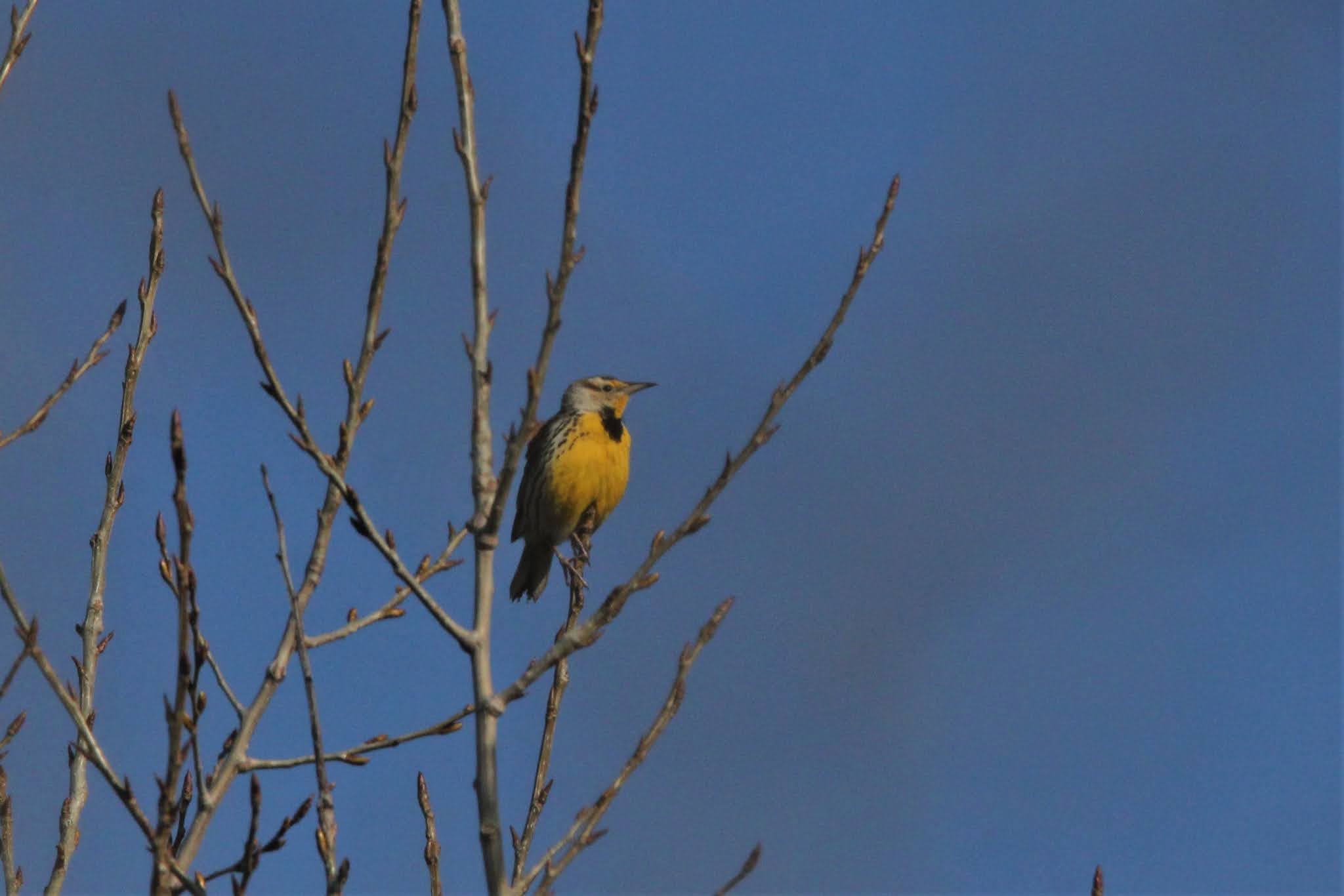
The first of year birds kept coming throughout the end of April, with highlights being Fox Sparrow, Wood Thrush, Eastern Towhee, Blue-headed Vireo, Warbling Vireo, Black-throated Green Warbler, Yellow Warbler, Rose-breasted Grosbeak, Brown Thrasher, and my first Great Black-backed Gulls for my neighbourhood, which flew over my yard on April 28th. April 28th also marked the first day of my daily early morning (starting before sunrise) walks of the spring, which I continued for the better part of three weeks. I certainly got my exercise in with these walks, and I estimated I walked a total of 10-15km every morning!
 |
| Fox Sparrow |
Finally it was May, but unseasonably cold weather was really putting a damper on the arrival of spring migrants. I had a high count of migrating loons with 299 on May 5. We got a thin trickle of birds, including Sora (May 2), Great Egret, Savannah Sparrow, Lincoln's Sparrow, Baltimore Oriole, Ovenbird, and Palm Warbler (all May 3, the first "good" day), and Solitary Sandpiper (May 6). On May 9th, the global eBird big day, we got snow! It wasn't until May 10th I got my first Blackburnian Warbler and Least Flycatcher. May 12th brought Lesser Yellowlegs.
 |
| Palm Warbler |
 |
| Lincoln's Sparrow |
Then, on May 14th, the weather changed, and the floodgates opened. Warblers! Thrushes! WARBLERS! I found my first Yellow-throated Vireo and Scarlet Tanager for my neighbourhood list. The vireo in particular was quite awesome, as it completed my set of all the regularly occurring vireos in Ontario for my patch. In the evening, I found a Gambel's White-crowned Sparrow in my yard, a somewhat rare subspecies in this area of Ontario. I had made it my goal to find one that spring!
 |
| Black-throated Blue Warbler |
 |
| Yellow-throated Vireo |
 |
| Gambel's White-crowned Sparrow |
I spent May 15th in Rondeau, the first day it was open to the public after being closed all spring. Although apparently it was a great day for birds in London, I am glad I spent it here!
I didn't seem to go out in the patch on May 16th, I assume it was because of rain. I remember hearing about the Kirtland's Warblers that had been found at Rondeau that day, but being quit bummed as I wouldn't be able to go down to see them!
When my alarm went off on May 17th, I was hoping it was raining outside so I would have an excuse to go back to bed. I looked out my window, and found it dry. I debated about going back to bed anyways, but I reasoned that if I didn't go out, I wouldn't find anything. I was outside by 5:30am to begin my 10 minute walk to the place I started in the morning. I thought of all the rarities I could see, including Kirtland's Warbler, which was on my mind after the ones in Rondeau the day prior. When I arrived to the park, I began to regret my decision to go outside, as there were basically no birds. I had seen one warbler. As I was walking along, I heard a chip note, and saw a warbler at the top of a tree. I raised my binoculars and my jaw hit the ground. Now, I can't repeat here exactly what came out of my mouth, but bottom line, not only was it a patch bird, but my full out lifer Kirtland's Warbler. My observation lasted for no more than two minutes, and the bird wasn't very cooperative, but it was undoubtedly the highlight of my year.
 |
| Kirtland's Warbler |
Oh, and I saw my first Cliff Swallows and Eastern Kingbird of the year that day too, but they are but a footnote...
That day was the last of my almost daily morning walks. I was feeling quite tired, and my other interests like bugs and plants were starting to get the best of me! I added six more species to my neighbourhood year list over the rest of May, bringing my total up to 124 species.
The summer months are often quiet, but I added a few more species here and there. My biggest highlight of the summer was a pair of Black Vultures on June 6th, a new neighborhood and Middlesex bird for me. I was out looking for dragonflies, so I didn't have a good camera lens or even my binoculars! Thankfully, I managed to get some record photos that managed to confirm the identification.
 |
| Black Vultures |
July came around, and with it some of the first southbound shorebirds. I was pretty excited to find that I had good shorebird habitat this year, however this excitement was short-lived, and with a period of heavy rain, it all flooded and was useless by early August, before the bulk of the "good" shorebirds would come through. I never had anything crazy, but Least Sandpiper and Lesser Yellowlegs were highlights.
Also during July, while out counting dragonflies, I found my first Marsh Wrens for the neighbourhood.
At the end of August, I began once again to make near daily visits out to one of my favourite migrant traps. In short order I added Olive-sided Flycatcher, Eastern Wood-Pewee, Blue-gray Gnatcatcher, and several warblers to my year list. I added one new patch bird, Black-billed Cuckoo. Purple Finches began to move through, a sign of things to come.
 |
| Olive-sided Flycatcher |
I did a couple hawk watches in early September, with my best day topping 600 Broad-winged Hawks.

By late September, many of the neotropical passerines had passed through. I found some Wilson's Snipes, a species that I hadn't seen for a couple years in the neighborhood. After being strangely absent for awhile, the Green-winged Teals finally showed up.
 |
| Wilson's Snipe |
Late September gave way to early October, and with that, Winter Wrens, American Pipits, and more ducks showed up. Pine Siskins arrived, and I finally saw some Greater Yellowlegs. Later on in the month, I did a lot of hawk watching, and scored a Red-shouldered Hawk. I never could get a Golden Eagle though!
 |
| Northern Pintail and Green-winged Teal |
Early November came around. A highlight in the first few days was a Vesper Sparrow, a new neighbourhood bird. Number 160 for the year was a Common Redpoll on the same day, the first of many. By mid November, we were getting crossbills, and I had both Red Crossbill and White-winged Crossbill fly over my yard. I never could connect with an Evening Grosbeak, although someone else did spot some!
My last two new birds of the year came just a few days apart, Snow Bunting (November 16) and Rough-legged Hawk (November 23). Although I did go out some more here and there over the next month, the quiet of winter had settled in.
So there you have it, a short(ish) recap of some of the highlights of my year in my neighbourhood. I certainly wrote a lot (I have been plugging away at writing this post for three days!), but there was so much more I could have included! For an area that is mostly subdivision with only a few greenspaces, I think I did pretty good! Just goes to show what can be seen once you look for it!


