Showing posts with label Old Airfield. Show all posts

Sunday, 29 January 2023

A Good Day in the Month of May

It has been quite awhile since I last posted something to this blog. Since my last post in June (!!!), a lot has happened in my life, including finishing up my contract working in Algonquin Park (ending an amazing 14 months of my life), and starting my undergraduate degree at the University of Guelph. Understandably, with that latter thing, the time I have had for naturalizing has decreased significantly, although I must assure you, I still get out from time to time.

I wanted to come back and write a post on something I am surprised I never mentioned here—the story of one morning in late May, back when I was working in Algonquin. If nothing else, it will be good to immortalize the story here, even if it is eight months late!

The date was May 22, 2022. It was a Sunday of the May long weekend, and I was scheduled to work a later shift that day (we were going to be leading a night hike with the interpretive program). It was a rather cool and drizzly day, with winds coming out of the northwest, as they had been all night (and I believe it even rained overnight), so generally things didn't look like it would be a great day to go out an observe migrant birds. However, as had been my routine for the past month or so, I pulled myself out of bed, and made my almost-daily pilgrimage to the Old Airfield in the morning. I was thinking it would just be a quick morning walk, just going through the motions, you know? I wasn't properly dressed at all. I think I may have even been in my uniform. The quicker I get this walk over with, the quicker I can go back home and be dry, I thought to myself.

I walked the edge of the airfield, and was quite pleased when I spotted a Wilson's Warbler working the edge. There had been one reported the day prior, so it was one I was hoping to encounter. This was a new Park bird for me, as I hadn't seen any the fall previous. It was surely going to be the highlight of my day!


I snapped a couple mediocre photos, and continued on my way. I was sort of absent mindedly sauntering along, when I heard it. What was it that I heard? A very weird sounding Northern Flicker. But no, that wasn't quite right. There is goes again. Certainly not flicker. What was it? It sounded very mimid-y. The phrases were repeated ~6 times. Hmmm...that's what mockingbirds are supposed to do. Must be my Park bird Northern Mockingbird then! Cool! I walked towards the alder thicket, expecting it see the culprit, but...nothing. Playing hard to get, I see. I bushwhacked a little bit, the bird singing the whole time, but I just couldn't lay eyes on it. I knew that mockingbirds could be skulky, but this was getting ridiculous. It moved further down the edge, and I followed in hot pursuit, wanting to see what the heck I was dealing with. What could possibly be making that sound, but also be so hard to see? I racked my brain, trying to place it. A thought crossed my mind, and on a whim I decided that maybe just a little bit of playback wouldn't hurt. So I pulled out my phone, and played a small snippet of song of my far fetched idea...and wouldn't you know it, a couple seconds later, my far fetched idea wasn't looking so far fetched. Up popped a Yellow-breasted Chat. I saw it for approximately two seconds before it disappeared and shut up.

Oh. My. Goodness.

I frantically tried to re-find it over the next few minutes, but it wasn't turning back up. At this point I put out the alert to the community, and made a few phone calls. Jeff Skevington was just packing up his car in Ottawa, two hours away, when I called him. My friend and colleague Henrique Pacheco (who, it should be noted, I invited to come out with me that morning, but had opted to sleep in), finally picked up on about the sixth call. He would later tell me that he thought, in his sleepy state, that he was being bombarded with spam calls. I also called Algonquin Park legend Ron Tozer, who famously missed the only other park record of Yellow-breasted Chat in October 1981, by only a matter of seconds. You can read his account on this in his 2012 Birds of Algonquin Park (A.K.A The Bible). Unfortunately for Ron, when he picked up the phone he was at Big Creek NWA down near Long Point. It appeared that he would be missing another chat in the Park! 

What followed will probably go down as the most intense twenty minutes of my life. Finally (finally!), the bird popped up again, not to far from where it was first seen, and began to sing. I was very happy to be able to finally document this sighting photographically, and with an audio recording.

The first ever photo of a Yellow-breasted Chat in Algonquin Park

The chat soon moved to a more unobstructed perch, and gave me some great views—the best views anyone got of this bird. As a side note, this was only the second Yellow-breasted Chat that I have ever seen—and frankly it may as well be the first, as my experience with the other individual was very brief and largely unmemorable. 


The bird flew back over to the alders beside Lake of Two Rivers. This photo isn't great, but I kind of like it—a Yellow-breasted Chat in the Old Airfield!


Henrique, who had been asleep only moments ago in the staff house not too far away, arrived on the scene at this time, and thankfully the bird was cooperative enough for him to see it. Those who arrived after Henrique, not so lucky...

A few more observers had arrived by this point, however we had lost the chat. We spent the next hour or so scouring the airfield, but I could tell that hope was waning. On a whim I walked over to the southeast corner overlooking the Madawaska River, and paused to look at the water. Wouldn't you know it...the chat popped up basically at my feet. Somehow, we had lost the bird on one side of the airfield, and it had managed to move undetected to the other side! I called over the others, and after another few minutes of intensity, managed to get those present on the bird. I feel not only lucky and overjoyed to have been able to find this bird to begin with, but also that I was able to share it successfully with others. Almost everybody who came out that morning, some as far away as Ottawa and Arnprior, were able to eventually see or at least hear this incredible bird—a species nobody thought would ever be likely to occur in Algonquin Park again. 

It turned out to be a great morning of birding, chat aside. It was drizzly the whole time, which seemingly "knocked down" some other birds. The highlights for me were two new species of swallow for my Park list, Cliff Swallow and Bank Swallow. Both of these species have become rather rare in Algonquin. 

Cliff Swallow

Bank Swallow


There were a couple other nice birds as well, such as a group of four White-winged Scoters flying off the lake, and a few Bobolink. As there always are in Algonquin Park birding, there were a couple that "got away"; a flyover pair of Calidris sandpipers, and a couple of scaup sp. (hopefully not Greaters, as I missed that in 2022 for the Park). 


It was an absolutely spectacular morning of birding, and just another example of why late May birding is so magical in Algonquin Park. 

------

Fast forward a week, and I had my "grand finale" of Spring birding in the Park (see my blog posts from back in June that detail the climax of the week). I was just out for a pretty lowkey morning of birding on my day off at the Old Airfield, and I paused to stop and listen at the northeast corner, overlooking the airfield marsh when I heard something that I could hardly believe...the song of a Least Bittern. Although I was pretty confident in the ID, it was a bit distant and I wanted to rule out the very small possibility that it was another birder, unseen to me, playing a tape, so I went over to the Lake of Two Rivers Campground beach and launched my canoe (I knew it was a good thing I didn't take it off after my adventure a couple days prior on Lake Travers!). After paddling around for over an hour, myself, and Sarah Lamond (who had arrived on the scene) were able to locate the Least Bittern. Super exciting! Later that evening, we got several more of the Park Naturalist staff on the bird—except for Henrique, who was back home for the weekend. Sorry buddy!


I think this is the seventh (?) record for Algonquin Park, and only the second time one has ever been actually seen and photographed. This is a species that is probably annual in the Park, but very under detected—although that being said, proper breeding habitat is rather limited. 

Well, that's all for now folks! I have soooo many more stories about my time in Algonquin. One just has to wonder how many I'll actually get around to writing about, before I'm right back up there again making more memories! 

Wednesday, 27 April 2022

The Perfect Storm

If you've been keeping your finger on the pulse of Ontario birding, you'll know that earlier this week we saw some of the best migration of the year to date. Ontario saw a massive influx of early migrants, and localities along Lake Erie recorded 20+ species of warblers (including such gems as multiple Yellow-throated, Kentucky, Prairie, Golden-winged, and Worm-eating), multiple species of flycatchers, tanagers (all three!), orioles, and lots of special sparrows. 

Back at the beginning of April I was planning out my work schedule, and decided to take Sunday, Monday, and Tuesday (April 24-26) off, and then hope for the best. Well, I guess I know how to pick time off, as these days perfectly coincided with the "best" days for bird action! Three days off, good weather for birding...any birder in their right mind would make a beeline for Point Pelee or Rondeau, but I opted for something much closer—the Old Airfield in Algonquin Park. 

There were lots of birds in the air Saturday night heading into Sunday, and I could barely sleep just thinking of what was going to be found the next day. Still, my alarm seemed to go off much too soon. After some stumbling around and throwing a couple of sandwiches together (see Mom? I'm feeding myself), I was out the door and in my car heading towards the best birding location Highway 60 has to offer. I soon met up with Jeff and Angela Skevington, and we spent the day birding together.

One of my first birds of the day was a new one for the year, a Palm Warbler. A good sign.

As we continued to walk around the airfield, we flushed up a pretty exciting bird: a Vesper Sparrow! This is the second one reported in the Park this spring, but I had missed the first one. It was a new park bird for me, ending a dry spell of a couple weeks. This is a very uncommon bird in Algonquin Park, and appears to be on the decline. 

After that nice little flurry of activity, we set up shop in the east end of the airfield and waited to see what would fly by us. I wish I could tell stories of flyover Red-bellied Woodpeckers and House Sparrows, but alas, it was fairly quiet overall. We did, however, see one very good bird...a Cooper's Hawk! It was pretty distant, but unmistakeable. This is another rarity in Algonquin Park, and a new one for my list. 

In terms of year birds, the first Chipping Sparrows and Savannah Sparrows were seen. Another large flight of 3330 Common Redpolls was observed. Why these birds are moving in such large numbers, and why this movement is really only being seen in Algonquin Park, is unknown. We ended up with just over 50 species for the day at the airfield, my first time breaking that threshold this season. You can see the eBird checklist here.

We spent the rest of the day birding around the Hwy 60 corridor. We found the first Barn Swallow of the year at the Opeongo Docks, and then some more of them at East Gate. It was a great day.

Now, while Sunday was a great day, looking at the forecast, I was sure that Monday would be not quite as good. Sure, the winds were south, but rain was going to hit during the night, shutting down migration, and the temperatures were going to drop. Oh boy, I was wrong.

I actually got a slightly later start at the airfield than usual (I wouldn't see much, I told myself). I opted to do my usual loop backwards to get to the marsh/river mouth first, just in case the rain grounded any ducks (a fairly rare occurrence in Algonquin Park). As I approached, in the distance I saw a group of three American Wigeon flying with some Mallards over Lake of Two Rivers. Nice, I thought, but I was half expecting the species (which is very uncommon in the Park) today with the rain. I continued on my way, and spotted a male Blue-winged Teal in the distance all by his lonesome. Huh, things were getting good. I then rounded the corner and nearly dropped to my knees as I spotted as many as ninety Ring-necked Ducks all huddled together in the river mouth. By far the most I have seen along Hwy 60, this could only mean one thing: fallout. I scanned that group of Ring-necks, and came up with several more Blue-winged Teal, as well as some Northern Pintails. A few flocks of ducks started flying around, and I got on some more pintails and wigeon and teal. There actually seemed to be too many birds! I couldn't get on all of them, and it haunts me thinking about what I could have missed.

Northern Pintails

As the fog lifted, I spotted something even crazier: a large raft of scaup in the middle of Lake of Two Rivers. I would later count as many as sixty Lesser Scaup, a very high count (if not a new high count) for the spring in Algonquin. The duck raft was a bit too far to see all of it from the airfield, so I made the decision to pry myself away and go over to the picnic area, which would hopefully get me closer. 

I arrived at the picnic area beach, and soon was sorting through the flock. Unfortunately, nothing super crazy (I wanted a Redhead), but a small group of Red-breasted Mergansers was nice. As I scanned, I spotted a Pied-billed Grebe, which was a new (and slightly overdue) park bird for me. What a day it was turning into. 14 species of ducks for the day already by this point. 

Pied-billed Grebe

I returned to the Old Airfield and carried on with the rest of my day. Birds were in constant motion, despite the rain. My best birds of the day was a pure flock of eight Cackling Geese that flew by, another rarity in Algonquin Park. I ended with 64 species of birds at the airfield. I had other places I wanted to check, so I decided to leave around 3pm. You can see the eBird checklist here.

I had gotten word of some ducks down on Smoke Lake, so I went over that way to investigate. Along the way, I noticed a few ducks flying out of Cache Lake, so I quickly turned into there. Right from the parking lot, I found two pretty nice birds—a pair of Long-tailed Ducks and my park bird Horned Grebe. Nobody quite likes the rain like an Algonquin Park birder! 
Long-tailed Duck

The ducks were gone off Smoke by the time I got there, so I turned back around and headed east. I checked the PLE Pond near East Gate before calling it a day. I was dead tired, but had seen nearly 80 species of birds, including three park birds. It was the kind of day that I have long dreamed about having, and is right up there with the most fun and rewarding birding days that I have ever had.

Tuesday I figured would be a bit more subdued, and I was right to a degree. Because the rain continued into the night, many of the waterfowl lingered into the next day (which is fairly unusual), so that bolstered the day list. As the weather cleared, many had left by mid-morning. Because of the rain, very few new birds arrived overnight, and I got the impression that many of the same birds I had seen the day before were still around.

American Wigeon getting outta there

I spent the whole day in the airfield, and had a few highlights.

As I sat in my chair freezing my butt off, I noticed a bird come flying out of the small trees on the north side of the airfield. It took me a second, but...

"HOLY [I'll let you fill in the blank, be imaginative]!!!"

I was looking at a Short-eared Owl. Sure, not the rarest of rare birds, but for Algonquin Park, this is a very, very tricky bird to nail down, and not a ton of people have seen one in the park before. This is subject to revision, but I believe this is around the 20th record for Algonquin Park. As is typical of Algonquin Short-eared Owls, it continued on its way, never to be seen again. Lucky for me, I managed to get off one good record shot in my excitement/panic. 

Well, hard to top that, and it was only 8:30 am. I spent a good chunk of the rest of the day telling myself "just another little bit" fighting off the uncomfortable cold. The next most interesting thing to happen was spotting some grebes on the lake, both Red-necked and Horned. I had seen one Red-necked in the park prior, but it was certainly still nice to see. 

Red-necked Grebe

Horned Grebes

Other than that, I wouldn't say there was really anything else to write home about, so I'll just let the eBird checklist do the talking. I ended with 72 species, which I thought was pretty cool. I probably could have turned up a few more if I had put a bit more effort in seeking out certain species earlier in the day (I would've had I known I'd tally so many!).

In all, over my three days off I tallied 94 species, including 15 year birds and six new birds for my park list. I would chalk that up to being a success! Sure, we didn't get anything super flashy like Point Pelee or Rondeau or Long Point, but hey, it's early yet ;) 

Tuesday, 12 April 2022

More Algonquin April Birding

Last Thursday, there was a little bit of rain in the forecast, but with the south winds, I figured I should head out birding at the Old Airfield in Algonquin Park anyways. Lucky for me, the rain subsided early in the day, and I ended up having my best day of birding of the year thus far.

Not a ton of new arrivals per se, but certainly a good number of species on the move. The day started off well with an Eastern Phoebe soon after the rain stopped, the first of the year. 

In late morning, an Eastern Meadowlark dropped in, which was great to see. I believe this is a different bird than the one from a couple of days prior. 

I saw two Sandhill Cranes fly over, which are pretty scarce migrants and breeders in the Park.

A short while later, a lone Double-crested Cormorant flew by, far away and high up. I think this ties the early record.

And just five minutes after that, I spied an immature Golden Eagle migrating in the distance. No (conclusive) photos of that one though! 

A nice male American Kestrel also visited in the early afternoon.

The headliner for the day were Common Redpolls. I counted an incredible 3740 individuals migrating southbound. Why they were headed that way, is beyond me. Here is a portion of a flock of 500+ that I saw.

Here is my eBird checklist.

In some other Algonquin birding odds and ends, Winter Wren was a new one for the year on April 8. April 9 brought two new birds: Northern Flicker and Blue-winged Teal. The teal are of particular excitement, as they are a very uncommon spring migrant and were a new species for my park list.


Yesterday yielded no new year birds, despite spending most of the day birding on good winds. Perhaps driving from London and getting back at 3am was not the best idea after all! That's just how it goes sometimes! This morning I found a little bit of movement had occurred, as I found Hermit Thrush, Green-winged Teal, Bufflehead, and Wilson's Snipe in the Old Airfield. 

I've been quite happy with what I've been seeing so far (it somewhat offsets my sour feelings about missing a Black-necked Stilt back home), and am quite excited to see what else is to come. The beauty of Algonquin Park birding...it doesn't take much to make us happy! 

Wednesday, 6 April 2022

April in Algonquin Update

 A title I just may reuse later if I feel so inclined...

Spring migration is well underway here in Algonquin Park. After months of seeing the same species day in and day out, it is nice to see some new arrivals.

With it being spring once again, I have made it my goal to bird the Old Airfield as much as possible. It makes a good place for a walk before work, even if I do have to back track to get back to the Visitor Centre! The Old Airfield has hosted many rarities over the years, and with any luck, I will add some to that list. 

The first Turkey Vultures and Great Blue Heron of the year showed up at the airfield on Sunday, which were lovely to see.

Yesterday, Jeff Skevington found an Eastern Meadowlark in the airfield. This is an almost annual migrant in the park, but very hit and miss, and was a big target of mine this spring. I was really hoping to find my own, so it was with reluctance I decided to twitch it after work. I might not get another chance to see one this spring, after all. It wasn't long before I heard its song, and located it in a tree. 

This is an extra special sighting for me, because it marked my 170th species of bird seen in Algonquin Park. As of writing, this is the threshold species count to get on the "short list" of Algonquin bird listers. I still have quite the long way to go, but it was nice to finally reach that milestone. 

I decided to hang around the rest of the evening and see what else was moving. As it turned out, not much. I had a Killdeer fly over, only my second in the park (and my first since being on contract), which was nice to see. After sunset, the first woodcocks of the year were displaying.

This morning, the weather looked like it might be a good day, so I, of course, headed to the airfield. 

The river mouth was pretty productive in terms of waterfowl, with the first Ring-necked Duck and Wood Ducks of the year. There were also a number of black ducks, a Common Merganser, and Hooded Mergansers. 

Ring-necked Duck

Lots of robins were on the move, by the end of the day I counted nearly 80. Probably more that I missed.

American Crows were moving in small numbers. I only saw a few ravens.

After I walked around for a bit, I picked a spot to sit down and just watched. It wasn't really a hawkwatching day as it would turn out (took 8 hours to spot my first hawk), but it was neat seeing a few birds drop in. Nothing too crazy, and no new park birds, but there were some spring migrants that were on the early side. These included a Yellow-bellied Sapsucker, Eastern Bluebird, Belted Kingfisher, American Kestrel and a Tree Swallow.

Belted Kingfisher

Eastern Bluebird

The "best" bird of the day was probably an American Pipit, which appears to be record early by about two weeks. I am sure Ron Tozer will confirm or deny this statement before long!

I ended my 10.5 hour day tired, wind burnt, and with 39 species. I just couldn't keep going and find that 40th! Woodcock would have been guaranteed, but as I push "publish" on this post, they would have only just started to display!  Here is my eBird checklist.

Tomorrow is supposed to be wet. Rain means one of two things to the Algonquin birder: good birds or a bad time! Will be interesting to see how it plays out.

Monday, 28 September 2020

Algonquin Scenes

This past Saturday, my family and I went to Algonquin Park. They wanted to see some fall colours, and I figured I could see some plants along the way!

After a 4:30am departure from London, we arrived in the park shortly after 10am. The leaves didn't disappoint.


Wanting to avoid the crowds, I suggested we try the Old Railbed, up Arowhon Road. It proved to be relatively quiet, away from the hustle and bustle of the main highway!

Arowhon Road

I hadn't been to the railbed since 2017, so it was nice to be back. Since vascular plants are starting to die down for the year (though there are still plenty to look at!), I have started to look at moss again. Here are the obligatory moss pictures :) 

Ribbed Bog Moss (Aulacomniu palustre)

Knight's Plume Moss (Ptilium crista-castrensis)

Dicranum sp. (tbd)

Red-stemmed Feather Moss (Pleurozium schreberi)

Juniper Haircap Moss (Polytrichum juniperinum)

Bristly Haircap Moss (Polytrichum piliferum)

I liked how this photo of Houghton's Sedge (Carex houghtoniana) turned out.


I didn't really have any special birds. Lots of chickadees and nuthatches, as well as a few warblers (Palm and Myrtle). A single flyover Rusty Blackbird and a young Yellow-bellied Sapsucker were probably the highlights.

We only made it as far as Wolf Howl Pond. Very picturesque. There was a pair of Wood Ducks and a few Ring-necked Ducks present on the pond. I should not I saw a Compton Tortoiseshell, the first I have seen in Algonquin. Good year for them, I have recently even seen some in London!


Next up was lunch. As expected, the lunch areas were crazy, but luckily we were able to find a nice quiet spot in the outdoor theatre parking lot.

Prickly-tree Clubmoss (Dendrolycopodium dendroideum)

Fringed Brome (Bromus ciliatus)

After a stop at the VC (picked up a book on ferns and an Algonquin bryophyte checklist), we went to the logging museum. It is a neat little place.

Bebb's Willow (Salix bebbiana)

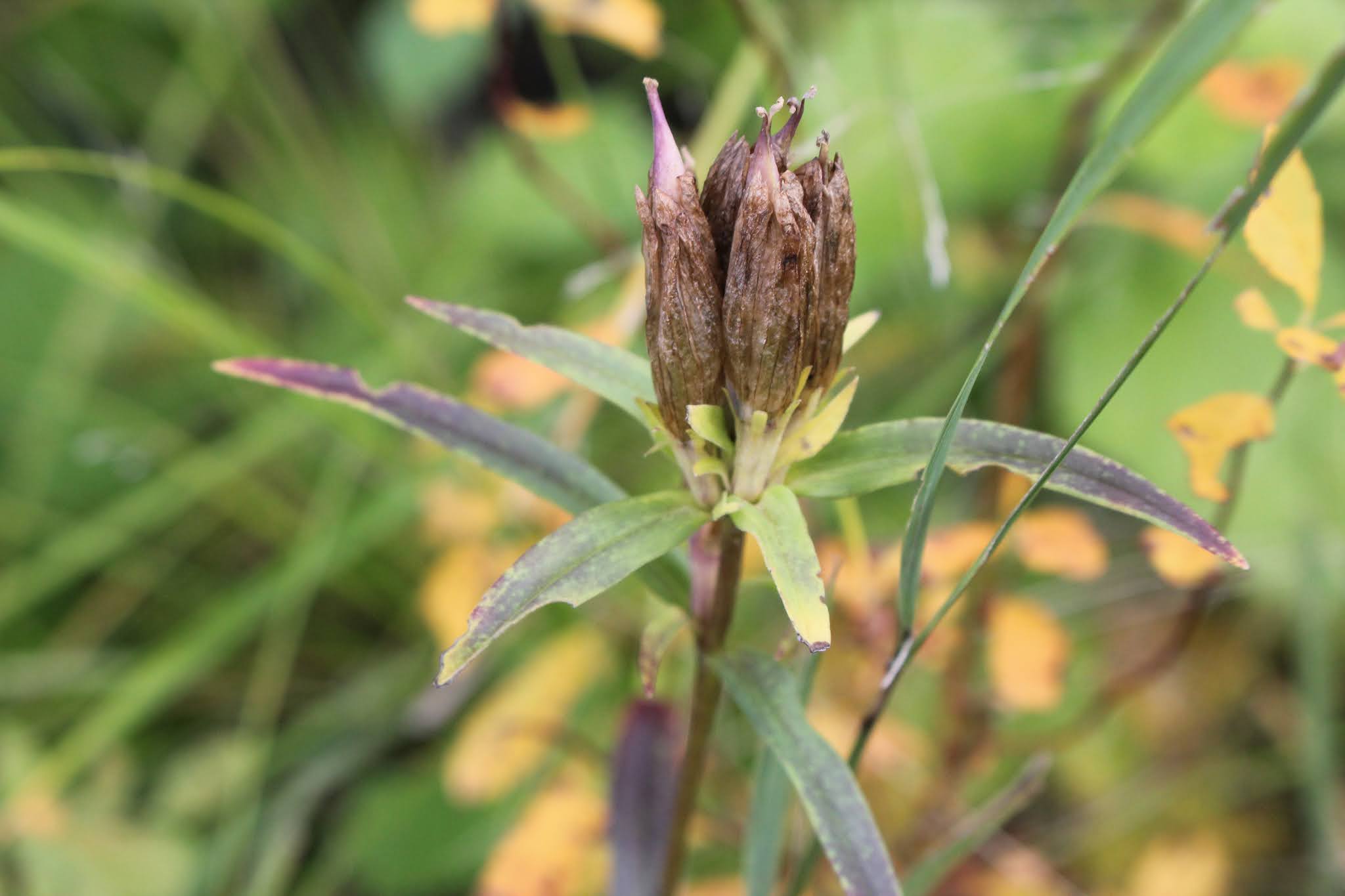
Narrow-leaved Gentian (Gentiana linearis)

We went to Spruce Bog next. Not much to report on there, but it always a nice place to stop.


Last stop was the Old Airfield. I had the place to myself! 

Leathery Grapefern (Sceptridium multifidum) was a new one for me.


A good end to a great day! The crowds can be a little ridiculous at times, especially with the current situation, but we managed to avoid them for the most part. Algonquin remains one of my favourite places to explore.