2016 was an amazing year for rarities (check out my post on a 2016 Ontario Big Year for a list of rare birds). I didn't get to see all of them (Common Ringed Plover and Crested Caracara being the most painful not to see), but I caught up with a few of them.
The first rarity I was successful in seeing was a Greater White-fronted Goose in London.
This is typically more a "western goose", however large numbers showed throughout 2016. This individual was somewhat tame, and many birders got close enough to take decent photos. The bird that showed up in London appeared to be a "Greenland" type.
Nearly a month later a Gyrfalcon showed up in Warwick, Lambton.
The bird stayed for at least a month, and offered great views. This Gyrfalcon was a gray morph, and appeared to be male. Great bird for Southern Ontario!
A week after the Gyr, an Eurasian Wigeon showed up in Lambton as well. I didn't get a picture, nor did I get a good look at the bird, but it was a Euro Wigeon nonetheless, so it was a great find.
The next rare bird I was able to lay my eyes on were Loggerhead Shrikes.
While a regular breeder in Ontario, they are only about a dozen pairs in the province. Carden Alvar boasts over half of these pairs, and this is where I found the Shrikes.
Piping Plovers aren't really "rarities" in Ontario, but finding a successful nesting pair sure is!
Darlington Provincial Park hosted two successful broods in 2016, the first in over 80 years! I'm not alone in hoping for their return this year.
An Eurasian Collared-Dove the next week was a great bird in Guelph.
The Eurasian Collared-Dove is making it's way northward, and I'm sure it won't be long before they regularly breed in the province.
Marbled Godwit was next almost a month later in Hamilton.
Marbled Godwits are hard to come across in Ontario, with only a few records, if any, each year.
I saw a Red Knot the same evening as the Marbled Godwit in Hamilton.
The light was fading fast, but I managed to find the bird and get a some record shots. Red Knots migrate in the thousands through Ontario way up north along Hudson and James bay, but we usually only find around a dozen down here in southern Ontario.
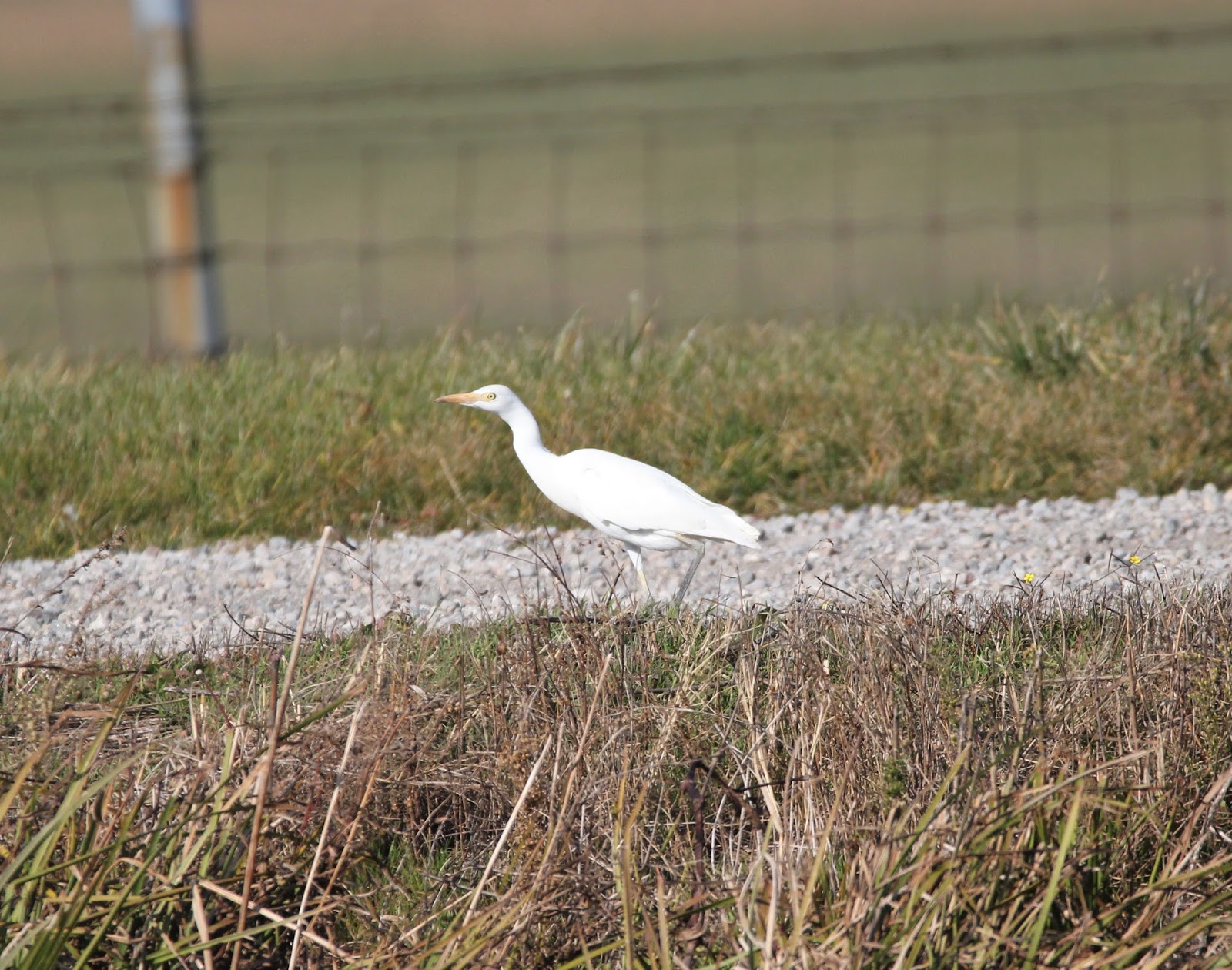
Two months later I catch up with another rarity...Cattle Egret in Blenheim.
Like the Greater White-fronted Goose, 2016 was a great year for Cattle Egrets in the province as well, and there could have been as many as two dozen, maybe even more.
November was highlighted by a Western Sandpiper at the Blenheim Sewage Lagoons. This bird sure made people confused. Originally identified as a Semipalmated Sandpiper, It wasn't until a couple weeks into it's visit that the possibility of it being a Western really got going. After a few days of debate and examining pictures, we reached the conclusion of it being a WESA. I would have attempted for a photo if I knew it was a WESA, but I figured that I've seen lots of Semis, so I don't need any photos. I'm kicking myself now!
A Red-headed Woodpecker was a great local rarity that I found (with the assistance of some companions) on the London CBC4Kids.
RHWO are hard to come across during the breeding season, and even harder to find in the Winter. The bird this past December was a juvenile.
A female King Eider in Hamilton was a great bird.
King Eiders are regular but usually hard to find. So far this winter has been a good one for this duck. I'm sure it's just a matter of time before an adult male is found.
Black Vultures are a Niagara specialty.
Black Vultures are becoming increasingly more common in Ontario, especially along the shores of Lake Ontario and Lake Erie. They can be separated from Turkey Vultures by the silvery spot on the tips of their wings.
My last rarity of 2016 was a Little Gull.
I've been searching for Little Gulls since I first learned about this species in July, 2015 (not all that far back, but I started birding in March, 2015). 2016 wasn't the best year for this rare gull species, but those who do a little birding in Niagara are usually successful. They can be separated from a Bonaparte's Gull by their dark underwing.
Well their you have it. All the rare birds I saw in 2016. Hopefully 2017 will be even better, and I'm already off to a great start!
Showing posts with label Cattle Egret. Show all posts
Wednesday, 4 January 2017
Monday, 21 November 2016
Let it Snow, Let it Snow, Let it Snow!
Over the past couple days it has gotten quite cooler, and on Saturday night it started to snow. By yesterday morning, the ground was covered in a carpet of white.
I'm amazed that just three days ago it was a record high setting temperature and I was observing Cattle Egrets and Monarchs. I'm sure the Cattle Egret is regretting it's choice to come back to the lagoons.
Yesterday there was a Nature London outing at Weldon Park in Arva, so that's where I went for an hour and a half. The leader wasn't expecting many bird species to be around due to the wind, but we managed to spot an impressive 20 species, such as Black-capped Chickadee, Red-breasted Nuthatch, Dark-eyed Junco, Mallard, and House Finch. Other birds included the following:
This tree has been used by a White-tailed Deer to rub the velvet off it's antlers.
Trees were covered with snow, creating a very pretty woodland sight.
I wonder how much longer the snow will stick around?
(Update November 22) On a side note, the "Semipalmated Sandpiper" I saw in Blenheim on Friday turned out to be in fact a first winter Western Sandpiper. This sighting is exciting as this bird is quite rare in Ontario, and only a few, if any, show up each year. I didn't take any photos, but you can view some nice shots here and here (note: on this page you can find photos of the WESA, however they are listed as a Semi. These photos will likely soon go over to the WESA page).
| Photo from last year |
| Downy Woodpecker |
| White-breasted Nuthatch |
| Red-bellied Woodpecker |
| See the Red Belly? |
| Hairy Woodpecker |
| Cedar Waxwing |
| Canada Geese |
| American Goldfinch |
This tree has been used by a White-tailed Deer to rub the velvet off it's antlers.
Trees were covered with snow, creating a very pretty woodland sight.
I wonder how much longer the snow will stick around?
(Update November 22) On a side note, the "Semipalmated Sandpiper" I saw in Blenheim on Friday turned out to be in fact a first winter Western Sandpiper. This sighting is exciting as this bird is quite rare in Ontario, and only a few, if any, show up each year. I didn't take any photos, but you can view some nice shots here and here (note: on this page you can find photos of the WESA, however they are listed as a Semi. These photos will likely soon go over to the WESA page).
Friday, 18 November 2016
Rondeau Rarites and Some Other Birds
Today I took advantage of my Friday off and went down to the Rondeau are to see what was around. The temperature reached over 20 degrees Celsius, which broke the record high temperature for November 18th, which was 17.8 degrees Celsius which was set back over 70 years ago in 1941!
I arrived at Rondeau with my birding partner (aka my father) around 8 this morning, and we were treated to the sight of hundreds of ducks out in the bay. It was peaceful until shotguns started going off further south.
I heard the Eurasian Wigeon that has been hanging around, but I didn't find it. Quite a few of the American variety were around.
There were a of couple Tundra Swans flying around.
Gulls consisted of Ring-billed, Herring, Bonaparte's, and Great Black-backed.
We went to the dog beach first, but all we found was a group of Red-breasted Mergansers and six Snow Buntings.
We walked down the South Point trail a couple kilometers where we saw Downy Woodpeckers, Snow Buntings, a Common Loon, and a group of scoters.
I find the relationship between gulls and grebes/loons interesting. The grebe or loon will bring up food, and the gull will swoop in to grab the morsel from the bird! There was a Bonaparte's Gull following two Horned Grebes today.
There are a few odes still flying around, such as this White-faced (?) Meadowhawk.
After Rondeau, we headed to Blenheim Sewage Lagoons. There were a lot of gulls when I first walked in.
I was walking along the main berm, thinking about how it would be neat to find the Cattle Egret that had been gone for a week, when I looked up and saw a small white heron standing in the middle of the road 150 meters in front of me!
I managed to get quite a bit closer before it spooked.
I wonder if I can say that I "found" it? :-)
Another birder, who is in the top three on eBird for Chatham-Kent, came about 10 minutes later, and he was treated to it having fly directly over him! He also helped me find the continuing Semipalmated Sandpiper (Update: later identified as a Western Sandpiper).
I found that the Bonaparte's Gulls really enjoy the back "bubbler" cell.
The birder pointed us in the direction of the 5 Greater White-fronted Geese he found yesterday, so that is where we went next. When we arrived, it was a little hard to find them a first, but we eventually located them at the back of the pond with a group of Canada Geese.
We drove down Erieau Road, and made a stop at McGeachy Pond CA, where we discovered that we have totally underestimated the Cerulean Warbler population in Ontario, and actually tens of thousands migrate overhead each fall.
A very late Monarch was flying around. It should be in Mexico by now!
There wasn't much on the pier, however I managed to find the adult male Harlequin Duck first spotted on the sixteenth. It was much more brightly coloured than the one in London earlier this year.
A few gulls and cormorants were in the area as well.
The last stop of the day was the Erieau Rail/Marsh Trail.
I heard a late Blue-gray Gnatcatcher here, no doubt the same one that has been hanging around for the past few weeks. A number of Buffleheads could be seen from here as well.
It was a amazing day, and I met a few new birders along the way. I hope to be back soon!
I arrived at Rondeau with my birding partner (aka my father) around 8 this morning, and we were treated to the sight of hundreds of ducks out in the bay. It was peaceful until shotguns started going off further south.
I heard the Eurasian Wigeon that has been hanging around, but I didn't find it. Quite a few of the American variety were around.
There were a of couple Tundra Swans flying around.
Gulls consisted of Ring-billed, Herring, Bonaparte's, and Great Black-backed.
We went to the dog beach first, but all we found was a group of Red-breasted Mergansers and six Snow Buntings.
We walked down the South Point trail a couple kilometers where we saw Downy Woodpeckers, Snow Buntings, a Common Loon, and a group of scoters.
I find the relationship between gulls and grebes/loons interesting. The grebe or loon will bring up food, and the gull will swoop in to grab the morsel from the bird! There was a Bonaparte's Gull following two Horned Grebes today.
There are a few odes still flying around, such as this White-faced (?) Meadowhawk.
After Rondeau, we headed to Blenheim Sewage Lagoons. There were a lot of gulls when I first walked in.
I was walking along the main berm, thinking about how it would be neat to find the Cattle Egret that had been gone for a week, when I looked up and saw a small white heron standing in the middle of the road 150 meters in front of me!
I managed to get quite a bit closer before it spooked.
I wonder if I can say that I "found" it? :-)
Another birder, who is in the top three on eBird for Chatham-Kent, came about 10 minutes later, and he was treated to it having fly directly over him! He also helped me find the continuing Semipalmated Sandpiper (Update: later identified as a Western Sandpiper).
I found that the Bonaparte's Gulls really enjoy the back "bubbler" cell.
The birder pointed us in the direction of the 5 Greater White-fronted Geese he found yesterday, so that is where we went next. When we arrived, it was a little hard to find them a first, but we eventually located them at the back of the pond with a group of Canada Geese.
We drove down Erieau Road, and made a stop at McGeachy Pond CA, where we discovered that we have totally underestimated the Cerulean Warbler population in Ontario, and actually tens of thousands migrate overhead each fall.
A very late Monarch was flying around. It should be in Mexico by now!
There wasn't much on the pier, however I managed to find the adult male Harlequin Duck first spotted on the sixteenth. It was much more brightly coloured than the one in London earlier this year.
A few gulls and cormorants were in the area as well.
The last stop of the day was the Erieau Rail/Marsh Trail.
I heard a late Blue-gray Gnatcatcher here, no doubt the same one that has been hanging around for the past few weeks. A number of Buffleheads could be seen from here as well.
It was a amazing day, and I met a few new birders along the way. I hope to be back soon!
Monday, 31 October 2016
Two Lakes in Two Days
When a birder thinks of late October, they think of ducks. Ducks were my primary target this weekend, and I was hoping to add all three scoter species to my life list (I did!). Also on my mind was Golden Eagles (nope), Red-shouldered Hawks (nope) and a rarity that you'll have to read on to find out what it was.
The trip started Friday, and the first location my dad (he wanted to come too) and I visited was Hawk Cliff in Elgin.
I was hoping some GOEA would fly through, but none appeared. The weather system on the shores of Lake Ontario has cut off many of the raptors coming in from Quebec. Despite no migratory birds of prey, there was quite the variety of smaller birds including Purple Finch (trip lifer #1), Yellow-rumped Warbler, Fox Sparrow, kinglets, Cedar Waxwings, White-breasted Nuthatches, sparrows, and Downy Woodpeckers.
We drove about an hour to our next stop, Morpeth Cliffs. There were a number of ducks here including Greater Scaup, Redhead, White-winged Scoter (trip lifer #2), and Red-breasted Merganser.
Next up was Blenheim Sewage Lagoons. We stopped in at the post office to get a permit and the code for the gate (you can't get in without them). This was my first time visiting the lagoons, and I know that I'll be back!
All the cells were covered with hundreds of Ruddy Ducks and over a thousand Bonaparte's Gulls.
A few other ducks could be found as well.
Shorebirds are still present, and there were about 80 dunlin, along with yellowlegs, Killdeer, and a Wilson's Snipe, which I flushed while walking along the berm.
You haven't really lived until you've been swarmed by Bonies!
You may have heard about the recent "invasion" of Cattle Egrets in southern Ontario. I was lucky enough to catch up with one of the four that have been spotted at the lagoons in the last week.
It was quite flighty, and the only way I could get any good photos was by hiding in a ditch or behind a pile of junk...I'm pretty sure I got my tetanus shot. A Rusty Blackbird (trip lifer #4) flew over head at this point as well.
At one point the egret got between me and my dad.
Awesome (trip lifer #3)!
Erieau was next, and I managed to pick out five species of gulls on the pier.
Horned Grebes are now in their winter plumage. It's quite the opposite of their breeding plumage!
Can you spot the Great Blue Heron? (hint: it's beside the Red-breasted Merganser)
The next day, we started in Sarnia.
There really wasn't all too much to look at other than a large raft of Redhead/Scaup and a Black Scoter (trip lifer #5) off Canatara Park.
Since there wasn't anything else to look at, it was off to Kettle Point!
Immediately I managed to find a small group of about 8 scoters with White-winged, Black, and Surf (trip lifer #6).
Pied-billed and Horned Grebes were abundant. I found a Common Loon as well.
There was some hunting going on, so there wasn't too many ducks.
Forest Sewage Lagoons was the last stop. A number of Mallards, Green-winged Teal, and Black Ducks were flying around.
Common Milkweed is pretty much done for the season.
South-western Ontario residents may have noticed the large flocks of migrating crows lately.
Sparrows were abundant, and I saw several FOS American Tree Sparrows.
I also added a new shorebird species to the trip list, Black-bellied Plover, a Dunlin was with them.
A few Sulphurs were flying around, including this Clouded Sulphur.
It was quite the couple of days, and I'm sure that I'll be out again soon!
On a side note, my life list is now at 233, only 17 off from my goal of 250 by the end of 2016.
Birds that I still have a chance to see:
1. Red-throated Loon
2. Black Vulture
3. Red-shouldered Hawk
4. Golden Eagle
5. White-rumped Sandpiper
6. Little Gull
7. Thayer's Gull
8. Long-eared Owl
9. Short-eared Owl
10. Northern Saw-whet Owl
11. American Pipit
12. Common Redpoll
13. Lapland Longspur
14. Yellow-headed Blackbird
15. Bohemian Waxwing
plus maybe a few rarities will show up!
The trip started Friday, and the first location my dad (he wanted to come too) and I visited was Hawk Cliff in Elgin.
| the cliff |
I was hoping some GOEA would fly through, but none appeared. The weather system on the shores of Lake Ontario has cut off many of the raptors coming in from Quebec. Despite no migratory birds of prey, there was quite the variety of smaller birds including Purple Finch (trip lifer #1), Yellow-rumped Warbler, Fox Sparrow, kinglets, Cedar Waxwings, White-breasted Nuthatches, sparrows, and Downy Woodpeckers.
| Purple Finch |
| YR Warbler |
| WB Nuthatch |
| White-crowned Sparrow |
We drove about an hour to our next stop, Morpeth Cliffs. There were a number of ducks here including Greater Scaup, Redhead, White-winged Scoter (trip lifer #2), and Red-breasted Merganser.
| WW Scoter |
Next up was Blenheim Sewage Lagoons. We stopped in at the post office to get a permit and the code for the gate (you can't get in without them). This was my first time visiting the lagoons, and I know that I'll be back!
All the cells were covered with hundreds of Ruddy Ducks and over a thousand Bonaparte's Gulls.
A few other ducks could be found as well.
| Northern Shoveler |
Shorebirds are still present, and there were about 80 dunlin, along with yellowlegs, Killdeer, and a Wilson's Snipe, which I flushed while walking along the berm.
| Dunlin |
You haven't really lived until you've been swarmed by Bonies!
You may have heard about the recent "invasion" of Cattle Egrets in southern Ontario. I was lucky enough to catch up with one of the four that have been spotted at the lagoons in the last week.
It was quite flighty, and the only way I could get any good photos was by hiding in a ditch or behind a pile of junk...I'm pretty sure I got my tetanus shot. A Rusty Blackbird (trip lifer #4) flew over head at this point as well.
At one point the egret got between me and my dad.
Awesome (trip lifer #3)!
Erieau was next, and I managed to pick out five species of gulls on the pier.
| This Herring Gull kind of scares me. |
Horned Grebes are now in their winter plumage. It's quite the opposite of their breeding plumage!
Can you spot the Great Blue Heron? (hint: it's beside the Red-breasted Merganser)
The next day, we started in Sarnia.
There really wasn't all too much to look at other than a large raft of Redhead/Scaup and a Black Scoter (trip lifer #5) off Canatara Park.
Since there wasn't anything else to look at, it was off to Kettle Point!
Immediately I managed to find a small group of about 8 scoters with White-winged, Black, and Surf (trip lifer #6).
Pied-billed and Horned Grebes were abundant. I found a Common Loon as well.
There was some hunting going on, so there wasn't too many ducks.
Forest Sewage Lagoons was the last stop. A number of Mallards, Green-winged Teal, and Black Ducks were flying around.
| GW Teal |
Common Milkweed is pretty much done for the season.
South-western Ontario residents may have noticed the large flocks of migrating crows lately.
| Happy Halloween! |
Sparrows were abundant, and I saw several FOS American Tree Sparrows.
I also added a new shorebird species to the trip list, Black-bellied Plover, a Dunlin was with them.
A few Sulphurs were flying around, including this Clouded Sulphur.
It was quite the couple of days, and I'm sure that I'll be out again soon!
----------
On a side note, my life list is now at 233, only 17 off from my goal of 250 by the end of 2016.
Birds that I still have a chance to see:
1. Red-throated Loon
2. Black Vulture
3. Red-shouldered Hawk
4. Golden Eagle
5. White-rumped Sandpiper
6. Little Gull
7. Thayer's Gull
8. Long-eared Owl
9. Short-eared Owl
10. Northern Saw-whet Owl
11. American Pipit
12. Common Redpoll
13. Lapland Longspur
14. Yellow-headed Blackbird
15. Bohemian Waxwing
plus maybe a few rarities will show up!
Labels:
Black Scoter,
Blenheim Sewage Lagoons,
Bonaparte's Gull,
Cattle Egret,
Dunlin,
Erieau,
Gull,
Hawk Cliff,
Kettle Point,
Lake Erie,
Lake Huron,
Redhead,
Sarnia,
Scaup,
Scoter,
sparrow,
White-winged Scoter
Subscribe to:
Posts (Atom)