Last Thursday, there was a little bit of rain in the forecast, but with the south winds, I figured I should head out birding at the Old Airfield in Algonquin Park anyways. Lucky for me, the rain subsided early in the day, and I ended up having my best day of birding of the year thus far.
Not a ton of new arrivals per se, but certainly a good number of species on the move. The day started off well with an Eastern Phoebe soon after the rain stopped, the first of the year.
In late morning, an Eastern Meadowlark dropped in, which was great to see. I believe this is a different bird than the one from a couple of days prior.
I saw two Sandhill Cranes fly over, which are pretty scarce migrants and breeders in the Park.
A short while later, a lone Double-crested Cormorant flew by, far away and high up. I think this ties the early record.
And just five minutes after that, I spied an immature Golden Eagle migrating in the distance. No (conclusive) photos of that one though!
A nice male American Kestrel also visited in the early afternoon.
The headliner for the day were Common Redpolls. I counted an incredible 3740 individuals migrating southbound. Why they were headed that way, is beyond me. Here is a portion of a flock of 500+ that I saw.
In some other Algonquin birding odds and ends, Winter Wren was a new one for the year on April 8. April 9 brought two new birds: Northern Flicker and Blue-winged Teal. The teal are of particular excitement, as they are a very uncommon spring migrant and were a new species for my park list.
Yesterday yielded no new year birds, despite spending most of the day birding on good winds. Perhaps driving from London and getting back at 3am was not the best idea after all! That's just how it goes sometimes! This morning I found a little bit of movement had occurred, as I found Hermit Thrush, Green-winged Teal, Bufflehead, and Wilson's Snipe in the Old Airfield.
I've been quite happy with what I've been seeing so far (it somewhat offsets my sour feelings about missing a Black-necked Stilt back home), and am quite excited to see what else is to come. The beauty of Algonquin Park birding...it doesn't take much to make us happy!
Migrants have been slow to trickle through, but when they are moving, we don't have to go far to see them!
I have much enjoyed spending time around home looking for birds. On clear mornings, I like to sit in my backyard and count birds as they fly over. The highlight is always Common Loons. In the past week I have counted a total of over 180 loons migrating over my house, 124 in one day!
All the loons have been northbound, except one, which was in basic (non-breeding) plumage. That one was heading south. A bit odd if I do say so myself!
Loon going the wrong way
With the loons, there are occasionally small flocks of Double-crested Cormorants that go by.
I've even mananged to get a couple yard birds out of it! The most surprising was probably Eastern Meadowlark (I live in a subdivsion), which was also a new neighbourhood bird. I also had a couple American Wigeons this evening.
Broad-winged Hawks are moving through in small numbers. I have had a few over my yard.
As well as in one of the local woodlots.
After the morning watches are over, I try to go on a walk around the neighbourhood. A few days ago an American Bittern was found at a wetland near me. This is the second bittern I have seen there, the first being one I found in 2018. American Bitterns are surprisingly rare in the county! I saw it again today.
The Virginia Rail I found last weekend now has a friend. The habitat isn't great, but is sufficent, so one has to wonder just how long they'll stick around. Other wetland birds are moving in, such as this Green Heron.
Odds and ends include my first of year Northern Rough-winged, Barn and Bank Swallows, as well as my first Fox Sparrow of the year. Funny enough I has just been thinking about Fox Sparrows when this one popped up!
Word is on the street that tomorrow is looking good for birds...we shall see.
Today I joined Owen and a couple other young birders for a few hours of birding along the Hamilton waterfront. The winds were not on our side, and we saw NO pelagic birds, however there were a few quality birds to be seen, but we had to work hard for them!
We started at Windermere Basin, where sparrows, especially White-throated, were plentiful.
Other sparrows included White-crowned, Song, Dark-eyed Junco, American Tree, and an Eastern Towhee.
We couldn't find the Hudsonian Godwit, but there were a few shorebirds to be found such as both the yellowlegs, a group of peeps, and three Black-bellied Plover.
Ducks were fairly easy to find, the most common being Green-winged Teal and Northern Shoveler. Blue-winged Teal, Gadwall, Mallard, Wood Duck, Ruddy Duck, and Northern Pintail were also present, although in smaller numbers.
We checked out Van Wagner's beach after, but the only thing of note here were Surf Scoters and a Peregrine Falcon! If the winds has been blowing the right way, I'm sure we would have seen something!
The canal was next, but other than a Merlin is was pretty quiet. The ever present Double-crested Cormorant was there as well.
The others had to go grab a jacket that was forgotten at Windermere, so my dad and I waited in the canal parking lot for them to come back so we could got to our next destination. After about 5 minutes I got a text that said "There is a Brant here!"
After my dad and I got to the spot, we were told that the Brant was hiding, so we began looking for a vantage point to spot it. After some struggle (which is a story for another time) we finally saw it. It was a lifer for me, and my 250th bird this year in Ontario. Jeremy is only beating me by 80-ish species :-)
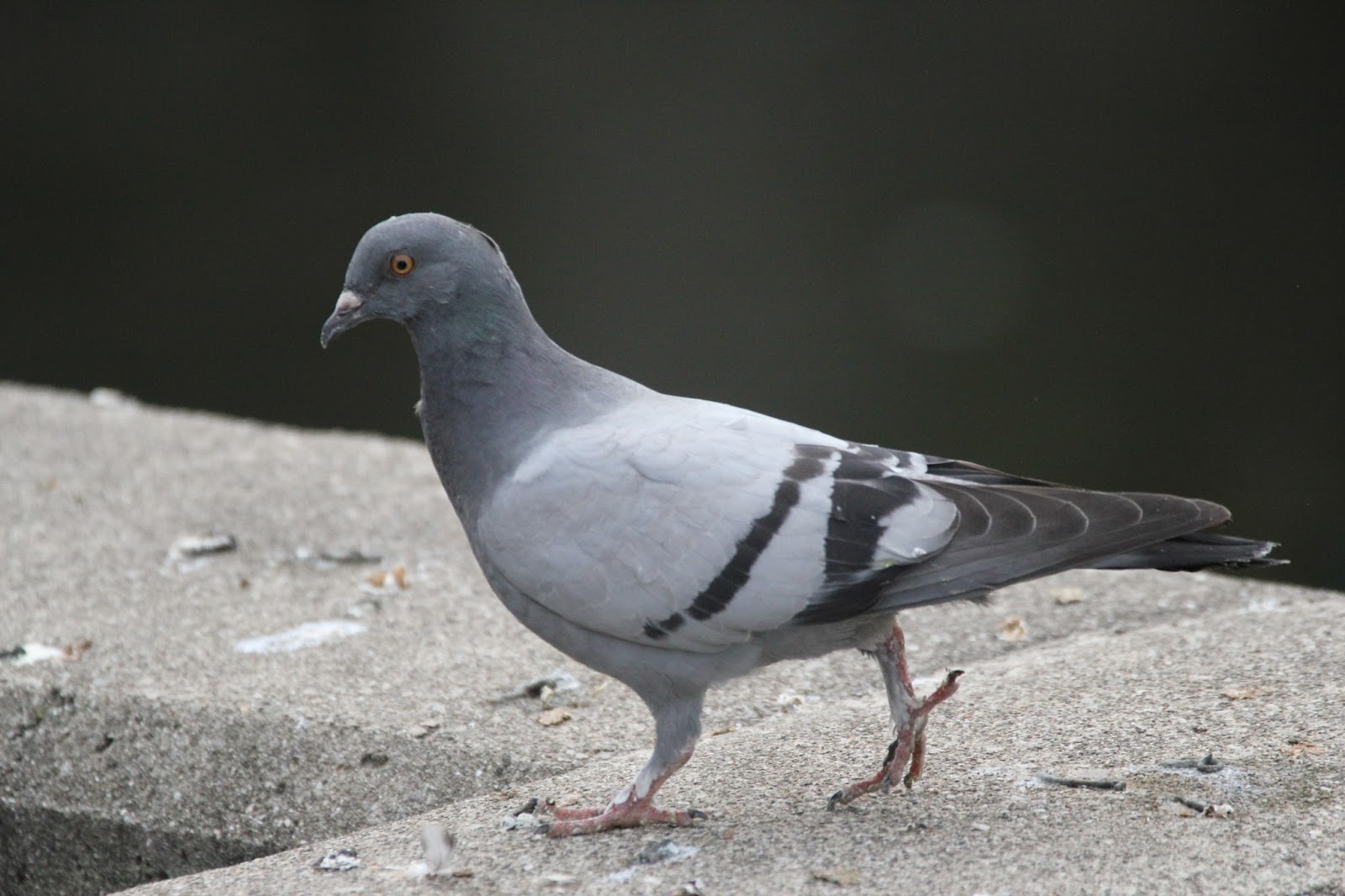
Also present was a few pigeons. This is actually the first time I've bothered to photograph them! I guess you could call it a photographic lifer!
The same ducks as earlier were there, including this (blurry) Gadwall.
Just before we said our good-byes, this Leopard Frog was spotted by Owen. They are my favourite species of frog!
Although it was a very slow day, the "Great Brant Chase" (again, a story for another time...maybe in six months) made up for it. Who said birding can't be exciting?!?!
After two weeks at cadet camp, it was great to get my binoculars back around my neck and the camera in my hands. Since Presqu'ile Provincial Park was on the way back home, we stopped there for a few hours of birding.
But not before stopping at McDonald's, where we were rewarded with an Osprey.
When we got to the park, we were met with off-and-on rain, flooding (many closures), and mosquitos. Not the most fun conditions, but you just have to deal with it! Owen Point trail looked like this in some sections.
At one point, a C-177 Globemaster flew over. I was lucky enough to be one of the chosen cadets to go up in this plane. The one pictured here is the exact one that I went up in.
This Cherry-faced Meadowhawk was cooperative, however the angle it was perching at was not the best for photos.
There were a few Summer Azures flying around, along with Painted Ladies, Viceroys, and Monarchs (which I will start tagging soon).
Summer Azure
Numerous birds were fliting about, such as chickadees, woodpeckers, robins, Eastern Kingbirds, and a Brown Thrasher.
Black-capped Chickadee
Pileated Woodpecker
Along the shoreline, gulls and terns were quite numerous.
Caspian Tern
This Bonaparte's Gull got me a bit excited when I first saw it from a far. Upon closer inspection I couldn't turn it into a Franklin's Gull.
Shorebirds were hard to find, but I did eventually find a nice little pocket of seven species. Least Sandpipers (note the diagnostic yellow legs) were the most numerous, followed by Semipalmated Sandpipers, Semipalmated Plovers, Baird's Sandpipers, and singles of Black-bellied Plover, Spotted Sandpiper, and Sanderling.
Least Sandpiper
Spotted Sandpiper
Semipalmated Plover
Double-crested Cormorants were everywhere, as they nest on Gull Island.
The Marsh Boardwalk was closed due to flooding, but from the observation tower we saw a Great Egret and heard a few Marsh Wrens.
Great Egret
We finished off the day at the lighthouse. By this point the weather was turning quite bad.
Double-crested Cormorant
Considering the conditions it was a pretty good outing, and I recorded 47 species. I can only imagine what the park is like during peak migration (it is still a little bit early for a major influx of shorebirds).
On the way home we stopped at the Big Apple. I found this sign a bit funny.
I'm sure it will be a busy next few weeks as I try to get in as much birding as I can before school starts up again. Fall migration has just begun!!!
Sunday morning my mom and I got in the car and drove eastward. There were reports of a Eurasian Collared-Dove hanging around in Guelph for the last few weeks, so we checked that out first.
It was a cloudy day, and as the 'Burg Birder would say..."It's the weekend!"
When we arrived at the location (Elmira Rd. S) the bird was nowhere to be seen. So we turned onto Stephanie Dr., then typed "Cherrywood Drive" into the GPS (we call her Lady Nav), as I had remembered reading about Cherrywood some where along the line. As soon as we pushed "Go" the voice said "Arriving at Cherywood Drive on right". We pulled forward 5 feet and revealed the street sign that was concealed by a pine. Not 15 feet away from where we entered the street, I spotted the dove on top of one of those vent thingies.
We left in less than 10 minutes because it's a residential area, and the occupants probably wouldn't like me looking at their homes with binoculars. It's bad enough that on Nature London trips we usually find ourselves looking at people's feeders!
A shortish drive later, we find ourselves in Hamilton. There are a lot of Double-crested Cormorants, and I saw a nesting colony close to the highway.
I haven't seen this many since Pelee Island last fall.
They were perched on lampposts above the road, and there was even a sigh that said "caution: low flying birds"
Windermere Basin was home to a Snowy Egret for a few days, but it wasn't there when we went. There were however tons of Caspian and Common Terns, as both breed in the area. I'm still kicking myself for not getting a decent shot of the terns, as they flew right over!
Some others birds seen were Ring-billed Gulls, DC Cormorants, Mallards, Canada Geese, and a female Rudy Duck.
Shorebirds are starting to arrive, and I saw 5 species. Solitary Sandpiper, Stilt Sandpiper, Least Sandpiper, Short-billed Dowitcher, and Killdeer.
After the basin, we went down to Queenston Heights park in the Niagara region. I was hoping for Black Vultures, but I found out they don't hang around during the summer months. All I saw were Turkey Vultures.
And now some information for history buffs like me...
The Battle of Queenston Heights was fought on October 13, 1812. This is perhaps one of the best known battles of the War of 1812. The Americans decided to cross at Queenston, so they sent a small militia group on the 12th. General Sir Isaac Brock thought that the militia was a distraction, as crossing the Niagara currents isn't easy, and it would be much easier to cross at Fort George. So, Brock kept most of his men at the fort, but sent a few to Queenston.
It turned out that the Americans were intent on taken Queenston, so on the morning of the 13th, Brock woke to the sound of guns. He rode his horse all the way there, organized his troops, then personally lead the charge down the hill with his sword drawn. Unlike other generals, Brock liked to lead his men and not just direct them. His bravery lead to the victory of the British, but he was sadly killed by an unknown sniper. He was one of the 28 non-American causalities.
A monument was erected in his name, 182 feet tall. The monument is found on the longest un-defended border in the entire world. Brock's remains can be found here.
It is kind of neat that 200 years ago, men were running down these paths, fighting for their lives.
Its black, but not a vulture!
I didn't find anything out of the ordinary, but I spotted a lifer butterfly...Red-spotted Purple!
I can only imagine trying to cross this in 1812.
On the way home, we passed an old ship with a whole lot of cormorants.
The clouds cleared up and revealed a rainbow.
A nice ending to a awesome day. I finally tracked down a rare dove! It almost makes up for missing the White-winged Dove by TEN minutes back in June :)
.JPG)
.JPG)
.JPG)
.JPG)

.JPG)