Showing posts with label Red-tailed Hawk. Show all posts

Saturday, 5 January 2019

A hOWLing Good Time at Rondeau

I went on a little bit of an impromptu trip to Rondeau today. My target? Barred Owl. The Barred has apparently been around since December 1st, but went unnoticed to most birders until the Christmas Bird Count in December 16th, which is where I narrowly missed seeing it by leaving the park too early. Thankfully, it has been seen numerous times since then, so I was hoping to luck out today.

I arrived in the late morning, where I quickly met up with others scouring the area. The news they gave me was not good: They'd spent the last three hours looking at every tree with no luck. Not wanting to give up, we continued to search a part of the campground which hadn't been checked too thoroughly. An Eastern Phoebe made an appearance. One wonders what it is eating, but with this weather I'm sure it is finding something.


Basically as soon as I snapped the above photo, I heard Blake yell he had found the owl! I had been in the park for 15 minutes, what luck!

It was perched not too far away in a pine.


Eventually it got up and flew away, however we were able to relocate it, although much further away and much more obstructed. Most birders that were in the area were able to see it.

I was expecting to spend hours looking for the owl, so I was truly at a loss of what to do afterwards! I decided to check the north part of the campground, despite others saying it had been quiet. It was somewhat productive, no Baltimore Oriole (one has been seen for several weeks), but there was a nice group of chickadees, kinglets (Golden-crowned and one Ruby-crowned), Brown Creepers, and a Yellow-rumped Warbler, one of two on this day.

Yellow-rumped Warbler

I went out to the lake, where there was a large raft of Ruddy Ducks.


I walked down the beach a bit afterwards. There were quite a few Canada Geese.


Of interest was this odd looking fellow. I believe it is a Greylag x Canada Goose hybrid. Not entirely sure.


I spent the next little while wandering the campground. It finally paid off with the female Baltimore Oriole flying overhead and landing briefly in a tree.


After wandering a bit more (and missing an Orange-crowned Warbler by the sounds of it!), I finally decided to go quickly check a couple other areas of the park before heading home. First stop was the Visitor Centre, where I scoped a group of four Red-throated Loons out on the lake.


Next up was Maintenance and Pony Barn. Both were quiet bird wise. No White-eyed Vireo today!

Common Script Lichen (not a bird)

Red-tailed Hawk

Finally, I took a quick look at the bay. A few ducks such as Redhead, scaups, and Canvasback.

A successful day!

Saturday, 15 December 2018

London Christmas Bird Count 2018

Today was the London Christmas Bird Count. I did the same route as last year. It is a long walk, but usually a good route! All the snow melted this past week, so it made for easy walking. It even warmed up to 5 degrees Celsius!

Easy walking...

I started about an hour earlier than last year in hopes of an owl, unfortunately that was just not to be, despite trying in three different locations. No doubt they are there, just weren't wanting to call!

We started the roughly 10 kilometer walk around 7am. Almost right away we had some early birds calling, like White-throated Sparrows, Swamp Sparrows, Song Sparrows, and Northern Cardinals.

We picked up two wren species, Winter Wren and Carolina Wren, right after one another. First the Carolina started singing, then it was quickly followed by the singing Winter Wren.

Numbers were down from last year on waterfowl. Only 190 Canada Geese, 39 Mallards, and 2 Common Mergansers! (We had 400+ Canada Geese and 350+ Mallards last year) I believe numbers of some of the songbirds were up however. Highlights include 48 American Goldfinches, 18 Pine Siskins, 24 Northern Cardinals, 13 Brown Creepers, 5 Song Sparrows, 5 White-throated Sparrows, 4 Swamp Sparrows, and 4 Carolina Wrens, to name a few! We also had a couple unexpected birds, such as a Yellow-rumped Warbler, Red-winged Blackbird, and Peregrine Falcon.


In the raptor department, we had 2 Red-tailed Hawks, a Cooper's Hawk, and a Bald Eagle. Somehow, we missed an eagle last year on the route!


Four species of woodpeckers include 8 Downy Woodpeckers, 3 Hairy Woodpeckers, 3 Red-bellied Woodpeckers, and a Northern Flicker.


We completed the route in a few hours, and managed to find 36 species, two more than last year.

After the route, we went down to check the landfill just south of the city. Although we were not assigned that area, there were a few cool things there as of late that I wanted to see, in particular gulls.

There were gulls.


The majority were Herring Gulls.


 There were some Ring-billed and Great Black-backed Gulls mixed in as well.


We also managed to pick out two other species, a couple Lesser Black-backed Gull and a couple of Iceland Gulls.

World's worst photo of an Iceland Gull...

A flock of 30 Tundra Swans also flew over.


Overall, I'd say that I had a good day, and managed to see a few cool things! I even managed to reach my goal of 200 species for Middlesex county this year (#199 Great Black-backed Gull, #200 Iceland Gull) I'll see what I can come across at the Rondeau/Blenheim Christmas Bird Count tomorrow!

In addition, after the CBC compilation, I went out ad found two Eastern Screech-owls!

Highlights of the 2018 London Christmas Bird Count (of the results that are currently in):

Tundra Swan (30)

Eastern Phoebe (1)

Common Redpoll (10)

Yellow-rumped Warbler (1)

Red-winged Blackbird (2)

Peregrine Falcon (1)

Swamp Sparrow (many!)

Great Black-backed Gull (25)

Lesser Black-backed Gull (2)

Iceland Gull (2)

Thursday, 29 December 2016

Big December Day

Yesterday in an effort to brighten up the last few days of December, I did a "Big Day" in Hamilton and along the Niagara river. I set a goal of 50 species, and I ended with 52. We started with looking at the Burlington Bay area, where 19 Greater Black-backed Gulls were found.


Next was the canal under the lift bridge that crosses the Halton/Hamilton county line. Hundreds of Long-tailed Ducks inhabited the area.

From Front to Back: Adult Male, First-winter Male, Adult Female

A few scoters and mergansers were with them.

White-winged Scoter

Then came the real prize...a female King Eider.


Windermere Basin yielded some puddle ducks such as American Wigeon and Northern Shovelers. This was also the only place where I found a few Ruddy Ducks among the Buffleheads.


We searched for Black Vultures at Queenston Heights next. Nothing at first but this Red-tail.


But then I noticed some dark blobs on the church...a kilometer and a half away!

I took pictures, but the blobs appeared to be Turkey Vultures, which also winter in the area. But I figured that where there are Turkeys there could be Blacks hidden among them. I ran back to the car to get my scope, and set up. It took 10, maybe 15 minutes before I saw three smaller-than-TV black birds flying at least another 500 meters behind the church. They then sharply dropped beneath the tree line but in the split second before disappearing, I saw the silvery wing tips of the Black Vulture...at two kilometers! We soon re-found at least one on the church.


The Queenston sand docks revealed this funny Long-tailed Duck. She swam quite far down river in this position.


At the whirlpool I found a Thayer's Gull, but no Black-headed! Four Canvasbacks as well.


I got my first real taste of gull-watching (gulling?) above the falls. Thousands of gulls were perched and flying around.


This barge known as "The Old Scow" broke loose from the tug boat up stream while dredging the sand banks almost a century ago on August 6, 1918.  There were two men on board when it got marooned on the rocks just up stream from the Horseshoe falls.  It took the US Army to help with the rescue, and 17 hours later the two men once again stood on solid ground.


We met a group of birders who were just leaving. They told us that there were a few Little Gulls flying around. Little Gulls are quite rare in the ABA area (code 3), but can be reliably found in Ontario. You just need to know where to look.

If Little Gulls didn't have a dark underwing, it would be nearly impossible to pick them out.  I had to be quick to get this shot.  He was hard to keep track of.


It was an awesome day, and I'm four species closer to 250. Eight more to go!

Monday, 12 September 2016

Hawk Cliff and Port Stanley

Yesterday was Nature London's annual field trip to Hawk Cliff and area. I went last year, and it was awesome. Although this year things were a little slow, it was still quite enjoyable.

The day started at Tim Horton's, where all good nature outings begin :) On the way to Hawk Cliff, we found an Eastern Bluebird plus a Broad-winged Hawk.


I didn't take all that many photos because most birds were just too far away (or fast in the case of warblers.) Sharpies (Sharp-shinned Hawks) were the most numerous, I counted around 30 birds throughout.


The Monarch tagging demonstration really piqued my interest. I'm thinking to order a tagging kit so I can get involved next season. You can sort of see the small 9mm wide tag on this male.


There were quite a lot of raptors (9) to be banded during the banding demonstration. Sharpies, kestrels, a Northern Harrier, a Merlin, and a Red-tailed Hawk were banded.


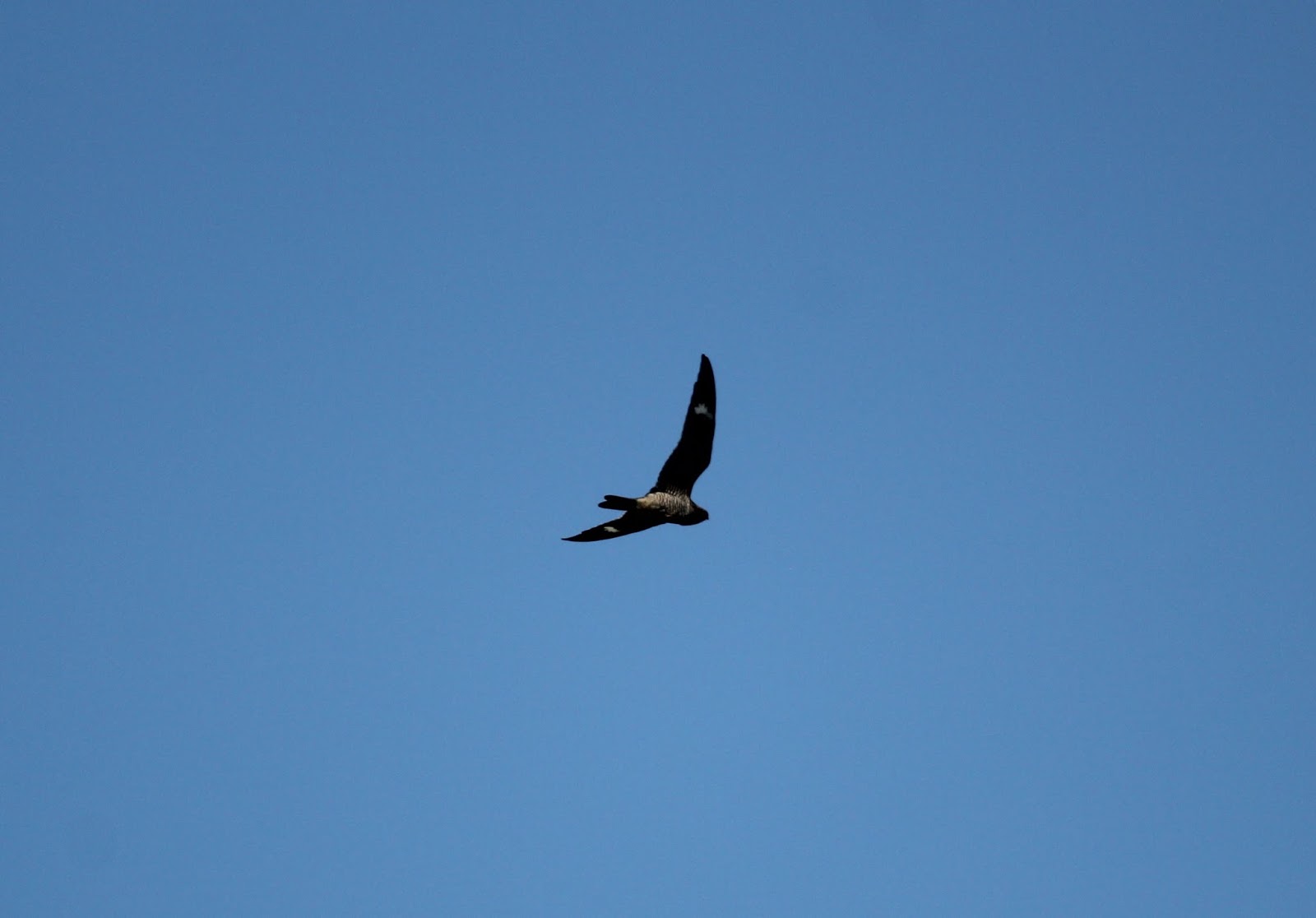
I found a Common Nighthawk which a few members of the groups managed to see. I've been seeing them for the last few weeks, but I finally managed to get a picture!


There were a few passerines observed including Blue-gray Gnatcatcher, Yellow-bellied Sapsucker (immature), Canada Warbler, American Goldfinch, Black-and-White Warbler, Blue Jay, Cedar Waxwing, and American Redstart.


After Hawk Cliff, we went to Port Stanley for lunch (Mackie's). A few of us went to the beach to see what we could find, and weren't disappointed. Although we didn't re-find the Sanderlings that I had seen fly by before we ate (I was the only one to see them), we did find a nice variety of gulls. Ring-billed was the most common, but Bonaparte's and Herring gull could be found with them. I didn't realize this at the time, but there were a couple Lesser Black-backed Gulls with them as well. A Common Tern was seen as well.

The last stop was Port Stanley Sewage Lagoons. I immediately found three Hooded Mergansers.


Greater Yellowlegs was the only shorebird species found, Other ducks include Green-winged Teals, Ruddy Ducks, Wood Ducks, and Mallards. Merlin and Kestrels were numerous at the back of the cells.

Black Saddlebags were quite common today.


There was a family of Pied-billed Grebes with 8 young and 2 (obviously) adults.


It was a great day, with very few photographs taken (sorry). I'll be in Algonquin next weekend, so I'm looking forward to that.


On a side note, I won second in my division at the Western Fair photo contest!

2nd Place!