Showing posts with label SW Ontario. Show all posts

Thursday, 27 July 2017

#myebirdhistory: 5 months later

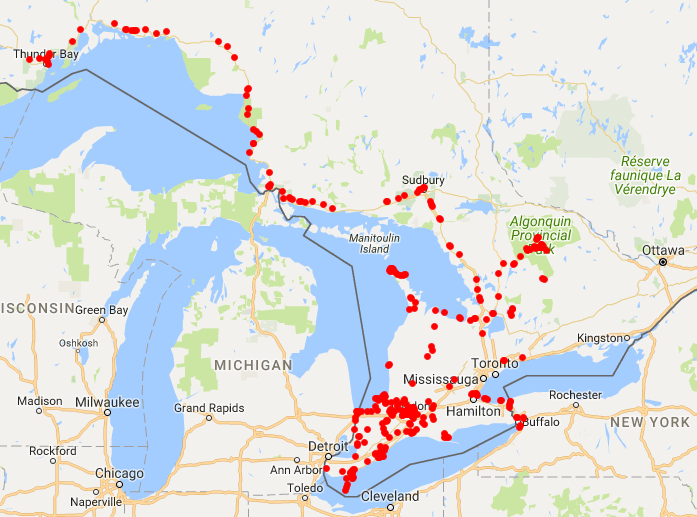
Back in February I heard about a way to map everywhere you've eBirded. It is a cool way to visualize everywhere that you've submitted an eBird checklist. I found is especially interesting to see where on the map I submitted a checklist while travelling using the eBird mobile app.

To learn how to map your data, click here.

Here is my eBird data from last time, 5 months ago.


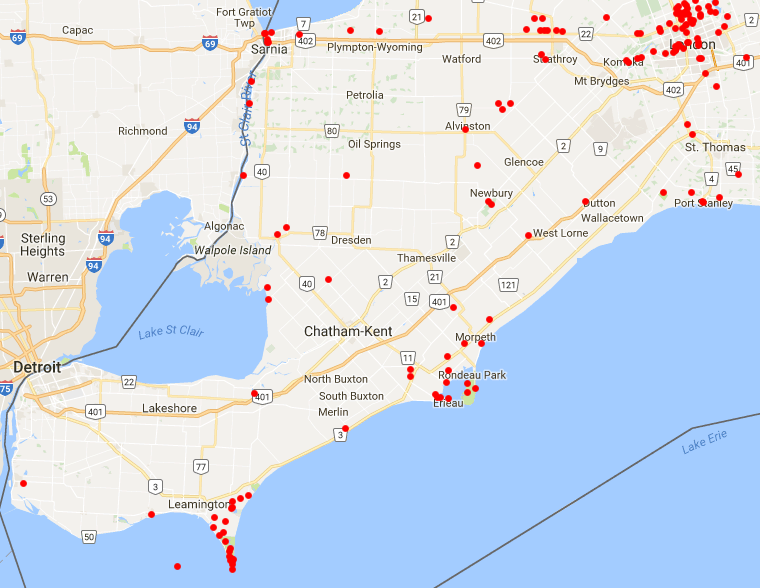
Now, here is my most up to date data.


Quite the difference! I guess I got my parents to drive a lot...

I am most proud of how many more places that explored in Algonquin Park.


I also apparently submitted quite a lot of eBird checklists while up Thunder Bay way.


Here are some of the points from my trip to Virginia in March.


As expected, I birded a lot in Southern Ontario. Many new places were explored.


Another feature of eBird that is cool is the interactive map on the eBird profile page. It is a neat way to see your stats for an area (county, province/state, country, world).


I’m sure that I’ll add many more points before the year is over!

Wednesday, 16 November 2016

It's That Time of the Year Again...

The holidays are just around the corner, and that means family, food and, of course, birds. In a few weeks, thousands of birders and nature enthusiasts will be taking part in one of the oldest birding traditions in the world....the Christmas Bird Count (or CBC for short). The event was founded in 1900, and the idea was that instead of shooting the birds for sport on December 25th like many people did, they would observe and count them instead. 117 years later we are still doing it. Imagine...117 years. In that time frame the RMS Titanic sunk, WWI and WWII raged in Europe, Point Pelee opened it's gates, the Great Depression destroyed countries all over the world in the thirties, Canada has had 17 different Prime Ministers, and our friends down south have had 20 presidents. For over a century people have carried on the tradition, and it is up to us and future generations to continue.

Anyway, there are dozens of counts around southern Ontario. Here's a few from my area:


Bright Blue: London (my home count)  Date: December 17, 2016
Gray: Stratford  Date: TBA
White: West Elgin   Date: TBA
Maroon: Strathroy  Date: Possibly not running this season
Teal: St. Thomas  Date: TBA
Purple: Kettle Point  Date: December 17, 2016
Pink: Skunk's Misery (Newbury)  Date: TBA, however last year it was in early January.
Blue: Wallaceburg  Date: December 27 or 28, 2016
Lime Green: St. Clair NWA  Date: TBA
Red: Blenheim incl. Rondeau  Date: December 18, 2016

Essex County and area also hosts a few counts:


Yellow: Point Pelee  Date: TBA
Gold: Cedar Creek  Date: December 17, 2016
Black: Holiday Beach  Date: December 27, 2016
Green: North Shore  Date: TBA
Dark Blue: Lake Erie Islands  Date: TBA

You may have noticed quite a few dates are 'To Be Announced'. Since it is only early November, many coordinators may not have uploaded the dates to the site I used. You can click here to see when the 'TBA' counts are or to find a Canadian CBC circle in your area.

Another bird count around Christmas is the Christmas Bird Count for Kids (CBC4Kids). This event was founded in 2007, so it isn't quite as old as the regular CBC. There are three CBC4Kids in SW Ontario:


Bright Blue: London  Date: December 3, 2016
Red: Elgin  Date: TBA
Grey: Port Rowan  Date: December 3, 2016

I'll be volunteering as a group leader this year at the 3rd annual London CBC4Kids count (more info can be found here ), and if you are interested in leading a group as well, you can inquire with the count organizer. Find a CBC4Kids near you by clicking here.

By joining a CBC, you are helping researchers know where birds are and if they are increasing or declining in that area. While most counters will take to the road to find birds, you can help by just counting birds at your feeder and reporting your finds to your local coordinator. I hope to see you out there!

London is the 'Cardinal Capital of Canada'

Thursday, 14 July 2016

2016 Life List Goals

Yes, I'm a lister. I'm sitting at 208 species as I write this post (not bad, I started birding Feb. 2015). We are just over halfway through the year, and I think that 250 species is reachable. Obviously, since spring migration is over, I've missed out on a lot of "easy" birds (Prothonatary Warbler, Worm-eating Warbler, Golden-winged Warbler etc.), so I'll have to relay on fall migration and a few trips to help me reach my goal.

I've put together a list of 42 species (208+42=250) that will be fairly easy to observe in the next 5 or so months. These are species that are going to pass through this autumn sometime, and I'll just have to be in the right place at the right time! But, these are birds. Birds don't have calenders, so we could get some pretty weird stuff that I would never imagined we'd get. With El NiƱo, I'm sure some "strays" will show up. Anyway, enough with the chit-chat (Ah, Yellow-breasted Chat. Where are you?), lets take a look at the list!

1. Red-throated Loon - A good number of these birds go through in the fall.
2. American White Pelican - Lake St. Clair maybe an area to check out in august
3. Least Bittern - Chatham-Kent would be a good county to find this species
4. Black-crowned Night-Heron - Peer's Wetland, just outside of Wallaceburg seems great.
5.White-winged Scoter - Still can't believe I don't have any of the scoters! They all move through in fall, and L. Ontario is a good spot in the winter.
6. Surf Scoter - see above
7. Black Scoter  - see above
8. Black Vulture - Niagara-on-the-Lake is a reliable spot.
9. Red-shouldered Hawk - Fall migration at Hawk Cliff should yield some.
10. Golden Eagle - Hawk Cliff in October
11. Spruce Grouse - Algonquin Park in the Fall
12.Common Gallinule - Lake St. Clair area looks good.
13. Ruddy Turnstone - Sewage Lagoons across SW Ontario
14. Sanderling - The Great Lakes
15. Red Knot - The Great Lakes
16. White-rumped Sandpiper - Sewage Lagoons across SW Ontario
17. Baird's Sandpiper - Sewage Lagoons across SW Onatrio
18. Stilt Sandpiper - Sewage Lagoons across SW Onatrio
19. Short-billed Dowitcher - Sewage Lagoons across SW Ontario
20. Wilson's Phalarope - Blenheim Sewage Lagoons has had them in past years
21. Red-necked Phalarope - Blenheim looks promising.
22. Little Gull - Erieau in late November....Niagara in December
23. Thayer's Gull - Niagara in December
24. Lesser Black-backed Gull - Niagara in December
25. Northern Mockingbird - Anywhere in SW Ontario really.
26. Black-billed Cuckoo - Anywhere in SW Ontario really....Skunk's Misery?
27. Long-eared Owl - Tommy Thompson Park in Toronto.
28. Short-eared Owl - Tommy Thompson Park in Toronto
29. Northern Saw-whet Owl - Tommy Thompson Park in Toronto
30. Olive-sided Flycatcher - Migration in SW Ontario.
31. Gray Jay - Algonquin Park
32. Boreal Chickadee - Algonquin Park
33. Gray-cheeked Thrush - Migration in SW Ontario
34. American Pipit - Migration in the fall
35. Tennessee Warbler - Fall Migration (Ugh! Fall warbler plumage!)
36. Common Redpoll - Hopefully this is a good winter for them. Feeders in SW Ontario.
37. Vesper Sparrow - Fall Migration
38. Lapland Longspur - Early Winter
39. Yellow-headed Blackbird - Angler Line in Chatham-Kent. Known Location.
40. Rusty Blackbird - Migration throughout SW Ontario. A few will stick around.
41. Evening Grosbeak - Algonquin? Hopefully it's a good winter.
42. Purple Finch - Winter in SW Ontario. Rondeau feeders seems like a good place to start.

   There are some other birds I have a chance of seeing, but are a tad bit more hard to find. These birds may be very nomadic, meaning they don't stay in one place to long, or the birds many occur in just one or two locations. Some of the species are regular, but few are seen each year. Here it is:

1. Eared Grebe - One may show-up this fall in L.Erie.
2. Ross's Goose - Some should show-up this fall. Will the be chaseable? Hopefully!
3. King Eider - L. Ontario looks like the best place. They usually hang out with Scoters.
4. Piping Plover - Can I get to the nests before they leave?
5. Willet - It was a good spring for them, so hopefully fall is the same.
6. Purple Sandpiper - Niagara is my best bet. They may appear at other locations though.
7. Long-billed Dowitcher - Less common then Short-billed, but may be found in sewage lagoons.
8. Parasitic Jaeger - A lake watch on a good day will have one.
9. Black-legged Kittiwake - Unlikely, but Niagara might have one.
10. Sabine's Gull - L. Ontario on a good day. L. Erie had one last year.
11. Franklin's Gull - L. Erie is the area I should check out.
12. White-winged Dove - Provided the Rondeau one hangs out.
13. Eurasian Collared-Dove - They will start to appear at feeders in the fall and winter.
14. Black-backed Woodpecker - Algonquin
15. Fish Crow - Niagara has a population.
16. Cave Swallow - Hopefully we get some weather that pushes them up here!
17. Bohemian Waxwing - Nomadic but regular.  Pinery is a good spot.
18. Prothonotary Warbler - I'm being hopeful...these have managed to elude me for 2 years!
19. Pine Grosbeak - Algonquin in winter is almost a guarantee...Pinery on a good day.
20. White-winged Crossbill - Almost anywhere in SW Ontario in winter (providing it's a good winter)

Barn Swallow (Not a Cave Swallow!)

Now, of course, keeping a life list, year list, or even trip list is fun, but it isn't why we bird. We bird because it gets us outside and we meet new people. We bird because birds intrigue us, whether it be their plumages - with the exception of fall warblers :) -, their songs, or their behaviours. We bird because it calms us down. Birders bird for moments like this;


Of course, some birders (me) bird because we have no choice. Man...I miss the good ol' days when if a saw a little bit of movement in the top of a tree, or heard a "chip" note, I didn't have to know what it was! (Just kidding...I bird because of all the reasons above too)

Okay...I now have the "wisdom" part of the post :)

As much as I hope I can get 250 species, and as I said earlier, it is possible,  just being outside and listening to a Veery or a Red-eyed Vireo is worth 1000 species (hyperbole).

Veery

Anyway, hopefully I can reach my goals and see some pretty awesome birds. I'll do a post sometime in early January 2017 to re-visit my "wish list' and see if I completed what I set out for.

Horned Grebe (Not an Eared Grebe!)

Good Birding!

Thursday, 23 June 2016

Harlequin Happenings....Was the 2015-2016 Winter the Best ever for Harlequin Ducks in SW Ontario?

A long title, I know, but this is a question that has been on my mind for months.

Now, I've only been birding since March 2015, but I do believe that this winter has been the best! I started paying close attention to Harlequin Ducks when an adult male was observed at Springbank Park (Middlesex) for a couple weeks in the February and early March of 2015. I didn't know about the bird until he was already gone, and ever since it was a bird that I really wanted to lay my eyes on. I finally did on March 20th, 2016. A young male spent a couple months at Springbank Park in London, Ontario. I believe that the last time it was observed was May 20th, exactly two months after I observed it. It was apparently around since the middle of February.

Springbank Park Harlequin (April 9, 2016)

I've spent some time on eBird, pouring over species maps and bar charts. Here are some of my results.

This one is where the species were observed from October 2015 to April 2016. Each purple rectangle means it was seen there, the darker the colour, the more it was reported.


Here is the results from October 2014 to April 2015. You will notice that the southern limit in Ontario seems to be around London (where the duck was observed Feb. 2015).


Now, here is the data from October 1990 to April 2014. You may notice that in 24 years, only a few locations weren't included in the 2015-2016 map. But also note that a few places that weren't included in this map were present in the 2015-2016 data. What this maps also shows is that the observations were made around large bodies of water (Great Lakes). The 2015-2016 map shows sightings inland.


Now, 2015 had one of the earliest fall sightings that I can find. The only one I saw in SW Ontario that was earlier was in Oxford County, September 25th, 1987. On October 10th 2015, the first Harlequins of the year for SW Ontario or possibly the whole province, were observed at Kettle Point (Lambton).


Another duck was spotted near Sarnia on the American side October 18.


The first of the long-staying Harlequins was spotted in Sombra (Lambton) on December 19, 2015. The last it was seen (on eBird) was January 2, 2016. I was told by a local that the female duck sadly died between the 2nd and the 10th.


Another long-staying duck was first spotted January 21, 2016 in Erieau (Chatham-Kent). It was a young male that was joined by a female and another male in time. The three ducks were seen regularly until at least April 29th. There were many observers, but sadly I wasn't one of them.


The ducks in Erieau were the only reliable ones until around March 17th, when one was spotted at Springbank Park. This one hung around until the end of May. This, however, was not the first time this bird was spotted on the Thames River. On February 15th and 21st, a group of three Harlequin Ducks was spotted. Three represents a new county record.


Harlequin on the Thames River (April 9, 2016)

Three birds were also spotted March 13 in Brantford. Their description matches that of the birds seen in London.


On April 24, a male Harlequin was spotted on the west side of Point Pelee National Park. These bird are very rare in the Pelee area, with a surprisingly low amount of records. The funny thing was I was at PPNP just the previous day, and saw no trace of the bird. Well, you get some and miss some.


Meanwhile, although not really included in SW Ontario, the Niagara Falls area was getting Harlequin Ducks galore. On April 23, they reached their peak of 7 individuals. According to eBird, the records high number of these ducks in Ontario is 8. These ducks were seen December 3, 2015.


 As of June 2nd, there were at least 2 ducks remaining, a male and a female.

This data was collected using eBird, and may not reflect all sightings and records in SW Ontario. If you have other data that may be useful, please comment about it below!

Immature Male (April 9, 2016)

From the data I've collected, the period of October 2015 to April 2016 seems to be the best ever for Harlequin Ducks in SW Ontario. Both in numbers and the amount of observers that viewed them reflects that statement.

I'm very happy to have had the chance this year to add Harlequin Duck to my life list, and I'm sure that many more Ontario birders feel the same way. Thank-you for reading this post!

This is the first ever image of a Harlequin that I got! (March 20, 2016)


Note: all the photos are my own, but I didn't go through blogger while downloading them.