Showing posts with label White-rumped Sandpiper. Show all posts

Saturday, 16 October 2021

Shorebirds of Algonquin

Been awhile, eh? 

Alright, I'll say it. Algonquin Park is notoriously bad for birding. Sure, there's some good things to be seen here and there, but you (usually) have to work very, very hard for it. I can't tell you the number of times I have walked around the Old Airfield over the past several weeks and the best bird be an American Pipit. 

However, despite how bad it is, many birders, myself included, absolutely adore birding in the park. Why? Well, when the work you put in pays off, it really pays off. 

Back in the summer I was joking about doing a little naturalist table on the "Shorebirds of Algonquin", which was quickly kyboshed when I realised that we only had like four (4) shorebird specimens. As you can imagine, Algonquin is not exactly the most "productive" place for shorebirds. Rocks? We got em. But we lack many of the sandy beaches and exposed marshes that are required for these migrants to touch down on.

There is however I very special place in the park that sometimes harbours shorebirds, you just have to maybe get rained on (after all, rain drives down the birds). That place is the magical East Side, specifically Radiant Lake and Lake Travers.

I only first set foot on the shores of Lake Travers this past summer, but have since made an effort to get back there as much as possible (which unfortunately, due to certain logistics, hasn't been super often). This is a very special lake in that is has a decent (for Algonquin) sized marsh with decent (for Algonquin) mudflats when the water is low. Many rarities have been found here over the years, and each time I go, I hope to add to that legacy (spoiler: no mind-bogglers yet).

Radiant Lake is another special lake in that it is very sandy, and very shallow. It is possible to wade pretty much right across the lake when the water is low enough. The sandy bottomed lake also translates into expansive sand bars that are sometimes exposed. 

30 species of shorebirds have been recorded in Algonquin Park, and I have seen 13 of them. Anyways, here's a few pictures of the ones I have encountered. 

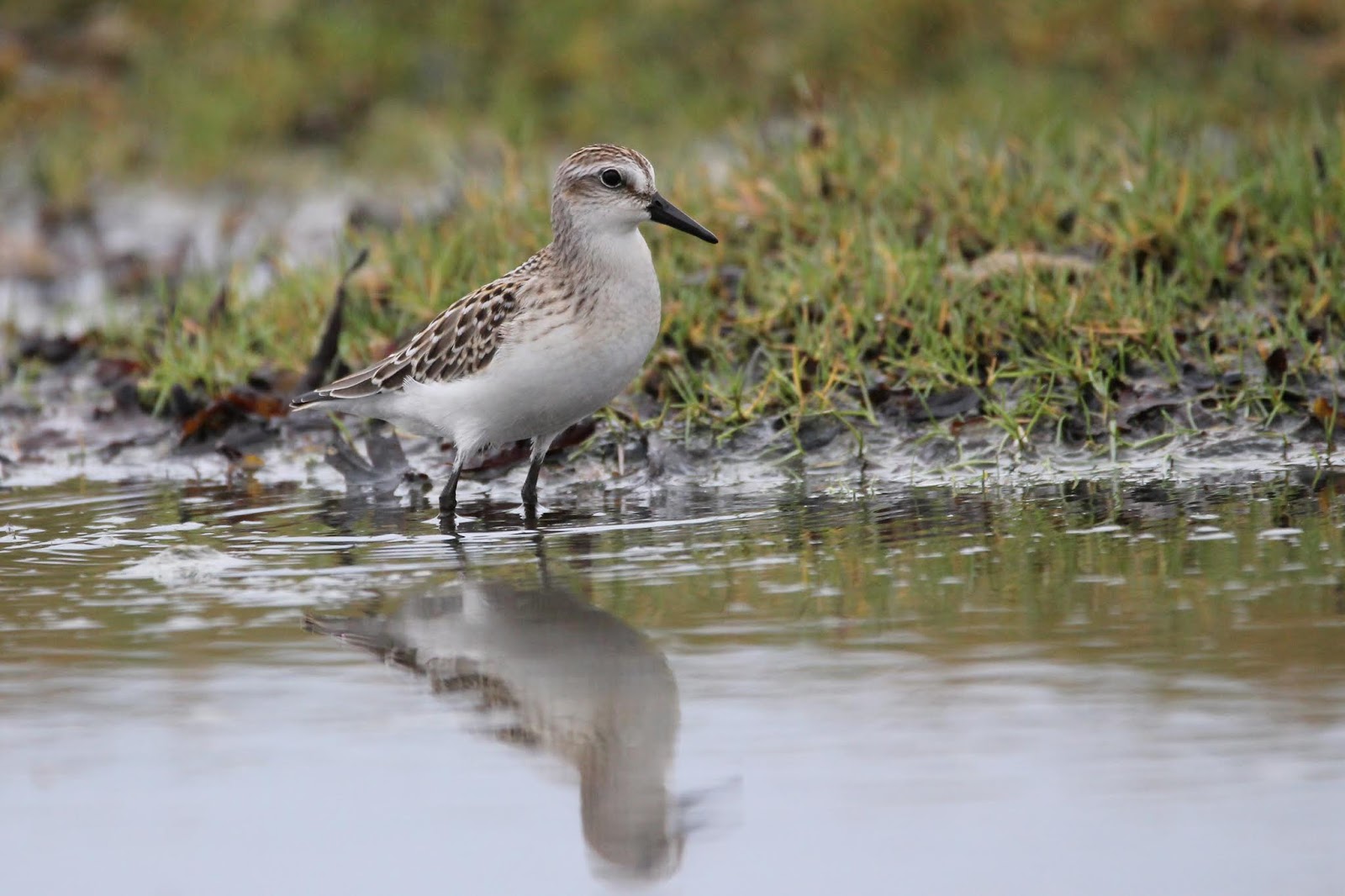
On September 10, I went on a work trip to Lake Travers and Radiant Lake. Our best bird was a White-rumped Sandpiper (something like the 14th record for Algonquin). We also had Least Sandpipers, Semipalmated Sandpipers, Semipalmated Plovers, and a couple Greater Yellowlegs. 

White-rumped Sandpiper

Semipalmated Plovers

Least Sandpiper

A couple weeks later, I was on a camping trip to Lake Travers with Peter Simons, and we had a great time in the rain with a mini (emphasis on mini) shorebird fallout. We each got a few park shorebirds, such as a Lesser Yellowlegs, Pectoral Sandpiper, and Dunlin. 


Our eBird checklist is a sight to behold. At least, I think so :-) 

Annnndddd...that's it. Yup. A couple exciting instances for shorebirds is all you get! No fallouts of Hudsonian Godwits were observed (sadly). Water levels rose very quickly after that late September trip, and when I returned in early October, there were no exposed flats anywhere! A flyover Greater Yellowlegs is all I got...

I suspect my shorebird season is over in the park, but I'll still holding out for a Northern Lapwing in the airfield...

Thursday, 25 October 2018

James Bay 2018: Part Eight, the Finale

This past summer I was given the opportunity to volunteer for the James Bay Shorebird Project on the coast of James Bay, north of Moosonee. For two weeks from August 13th to August 27th, I was stationed at Longridge Point, the most northern of the three survey sites in the project.

James Bay 2018:
Part One
Part Two
Part Three
Part Four
Part Five
Part Six
Part Seven
Part Eight
---------------


August 26, 2018

Our last full day on the James Bay coast.

We woke up to a very rainy last day. I decided to clean up the cabin a bit and start to pack up while I waited for the rain to hopefully stop. Thankfully, after a few hours, it did. I grabbed my camera and my scope and began my solo mission to Paskwatchi Point, which was probably my favourite spot in the whole study area. I planned to do a seawatch, after all, the previous day had been so successful!

There were a couple small mammals noted on the walk, including Meadow Vole and this Meadow Jumping Mouse. 


A couple kilometers later, I made it to the point. I set up my scope, and proceeded to check out the huge flock of Bonaparte's Gulls.

The Sabine's was nowhere to be seen, but I found a couple Little Gulls. One was an adult, with the (almost) full hood and black underwings.


And the other was this juvenile. Not the best photos due to a number of factors, but still really cool!


There was a fairly large number of Common Terns as well.


After a bit, I gave up on my seawatch, and turned my attention to the shorebirds. I spent a couple of hours watching the birds feeding mere feet away from me in the wrack. It was super cool to see how they interacted with one another. One such instance that really stood out was the interaction between an adult and a juvenile Semipalmated Plover. My photos don't truly convey the drama that was going on, but I think you sort of get the picture!


Semi Plovers are one of the cutest shorebirds if I do say.


Also feeding in the wrack were a number of Sanderlings.


Ruddy Turnstones also worked the seaweed. Both adults and juveniles were present. 


Hudsonian Godwits were also feeding relatively close.


After awhile, I decided to get up and go wander around the flats beside the point to see what was around. White-rumped Sandpipers were numerous. This one in particular was cooperative.


White-rumped Sandpipers are named for, you guess it, their white rump! This field mark is easily visible in flight.


While looking at the above White-rumped, this Black-bellied Plover flew by. They can be identified easily in flight by their black "armpits".


In flight, Hudsonian Godwits show black under their wings. I made it my mission to try and capture some in flight photos, especially ones showing this field mark. After a few failed attempts, I got some photos that I am happy with!


There were five Baird's Sandpipers at Paskwatchi. It was an incredible Baird's day, with something like 38 found throughout the site! We had a Baird's, usually multiple, on almost every survey.


After a while, the Red Knots started to fly in. This was likely due to the tide.


Not huge numbers, but there were some individuals that allowed for close study.


I had a couple Whimbrel fly past during my time at Paskwatchi. They are often heard before they are seen!


Waterfowl-wise, a small group of Snow Geese flew over, as well as some Canada Geese and Northern Pintails. Pintails are one of the most common dabbling ducks up there at that time of year.

Snow Geese

Northern Pintail

Another Hudwit picture. My camera seemed to like them a lot (with good reason!)


Here are some miscellaneous shorebird pictures that I liked.

Semipalmated Sandpiper

Semipalmated Sandpiper

Ruddy Turnstone

Lesser Yellowlegs

Sanderling

White-rumped Sandpiper

Ruddy Turnstone

Before I knew it, it was almost dinner time, and I had to start heading back to camp. The final day on the coast was coming to a close.


For the first time in two weeks, I paused to watch the sunset. It would the last one I'd see from where I was for awhile.


August 27, 2018

We woke up just before 7:00, about two hours before the helicopter was scheduled to pick us up.


We finished packing and cleaning up our cabin, then put our stuff out my where the helicopter would land. Time passes super weird up there. It felt like we had all the time in the world to enjoy everything that there was to offer, but now, with less than an hour left at camp, we all realized just how fast it went. It seemed like just yesterday we had been at the airport in Moosonee loading our gear into the helicopter, and eagerly awaiting arriving on the coast.

My "last" bird of the trip was a LeConte's Sparrow. Very fitting, considering it was how I started this great adventure.

It wasn't too long before off in the distance we heard the helicopter. It soon cleared the tree line, and it made it's way to land in the marsh.


I was on the first flight out (we made two flights, the guys got to go on the second one. Of course, as soon as I left they had a Bohemian Waxwing, which would have been a lifer for me!). After saying good-bye to everyone who was going to be sticking around for the final session, the pilot revved up the helicopter, and we were off.

The pilot was nice enough to swing around camp and few times.

Longridge Point and West Bay

Longridge base camp

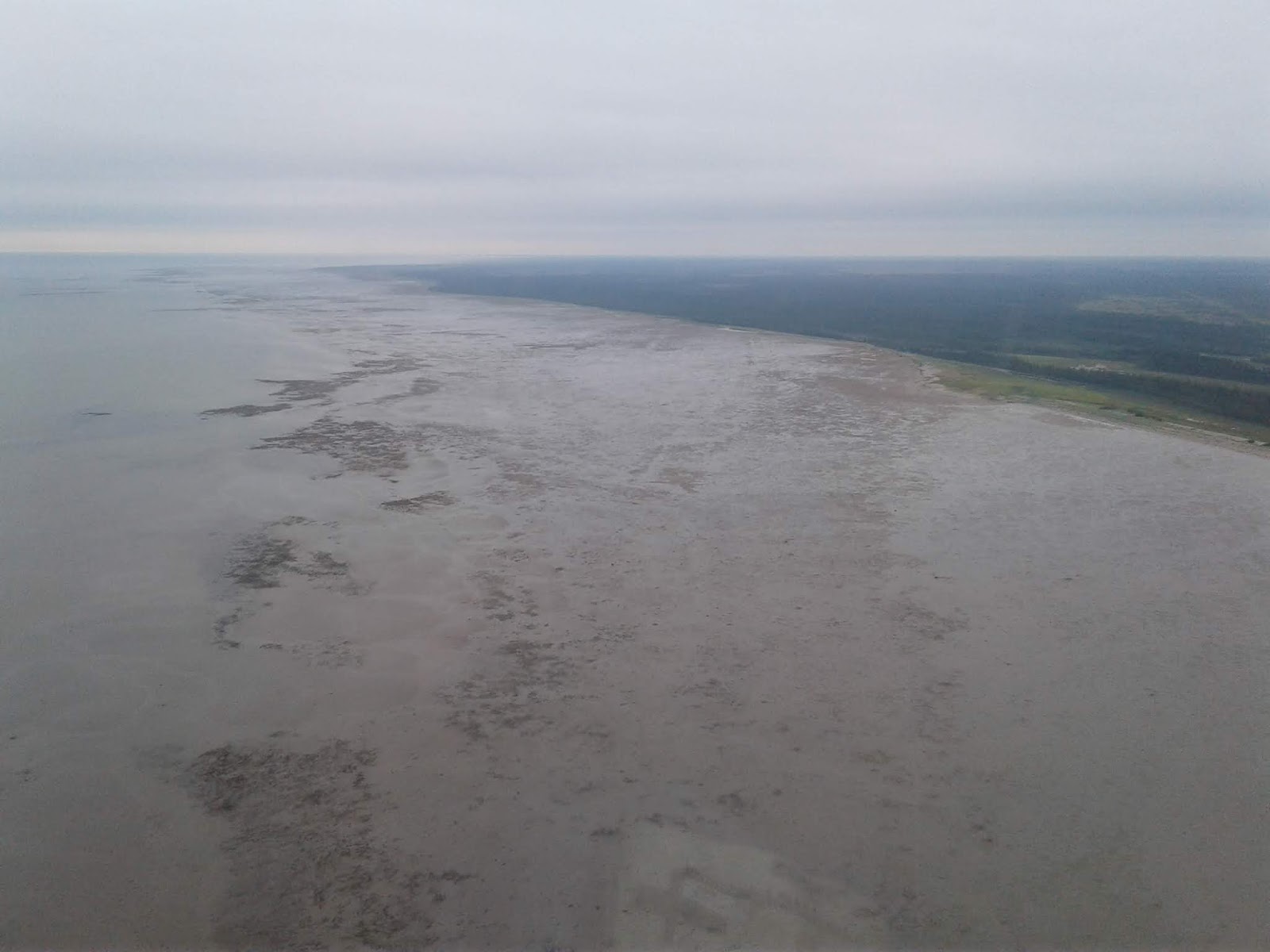
We took the scenic route back along the coast. The study site seemed so large, however from the air you can really see it is just a very small component in the whole landscape.


Soon, we reached the mighty Moose River.


And not too long after that, civilization.


We managed to get on the train that evening.


At 10pm, we pulled into Cochrane. Southern Ontario. Our northern adventure had come to an end.

Volunteering for the James Bay Shorebird Project was one of the coolest things I have ever done. I feel extremely lucky to have had the opportunity to see a part of Ontario that very few will ever have the chance to see. It has definitely made me a better birder, and a better overall naturalist.

I will be back.