Showing posts with label banding. Show all posts

Sunday, 19 April 2020

Some Local Stuff

For obvious reasons, I haven't gone too far. But I have gotten out a couple times just around the neighborhood. There is still a noticeable lack of migrants, but hopefully things will pick up!

Last Sunday, it was quite nice, so I went out for a brief walk. I was pleased to find Virginia Spring Beauty (Claytonia virginica), a native spring wildflower, new for my neighborhood plant list (425 species and growing!).


I was also very happy to stumble across a fox den, with five kits.


With a shrew (Sorex sp)
A couple days later, I went out and found some more plants.

Goblet Moss (Physcomitrium pyriforme)

Yellow Trout Lily (Erythronium americanum)

Family Bryceae (tentatively thinking Ptyschostomum)

Bonfire Moss (Funaria hygrometrica)

Yesterday, I went out hoping for some new birds. It was pretty quiet, but I did come across a few things. One highlight was a Lesser Scaup, a new bird for my neighborhood list (#171).


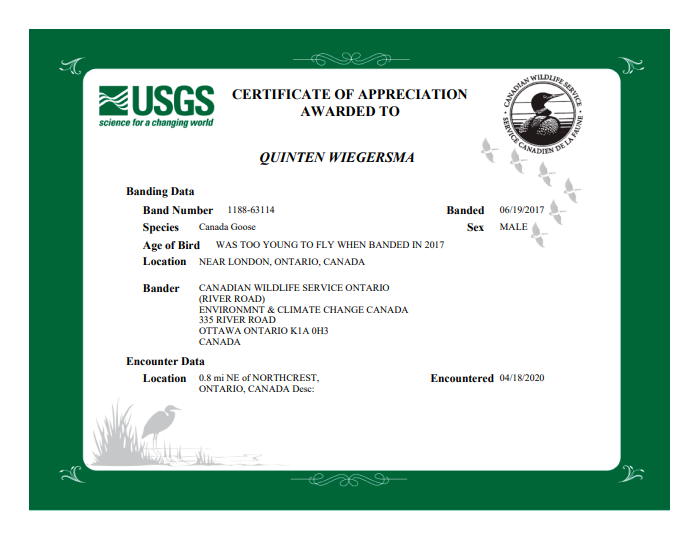
I came across a banded Canada Goose. I managed to get the band number and reported it.


There was a goose on a nest as well. The beavers have once again done a good job at damming up the place. There used to be a grassy field where this bird was nesting!


My efforts of a Virginia Rail finally paid off (I tried in five different spots today!). This is my second record for the neighborhood, and the first visual. I wasn't toting around my big lens today, so he came in quite close!


Stay safe out there, hopefully there are local areas for you to explore!

Thursday, 14 September 2017

Charitable Big Day: Toronto Report

This is the second part to the Charitable Big Day report (You can read part one here). Thanks to Owen for writing this report!

------------

On Sunday, September 10th, I participated in the charitable big day in a joint effort with my good friend Quinten Wiegersma and my father. We had a great time and ended up seeing 103 species, a pretty impressive total! I myself was stuck in one place all day, the Tommy Thompson Bird Banding Station (I was volunteering to assist with banding) but this was no problem, as the migrants were out in full force there. One of the first birds I saw was this Canada Warbler. What a great start to the day!


Other Warblers, such as Black-Throated Blue and Green, Cape May, Nashville and Palm were also numerous.

Tennessee Warbler

Black-and-White Warbler

Blackpoll Warbler

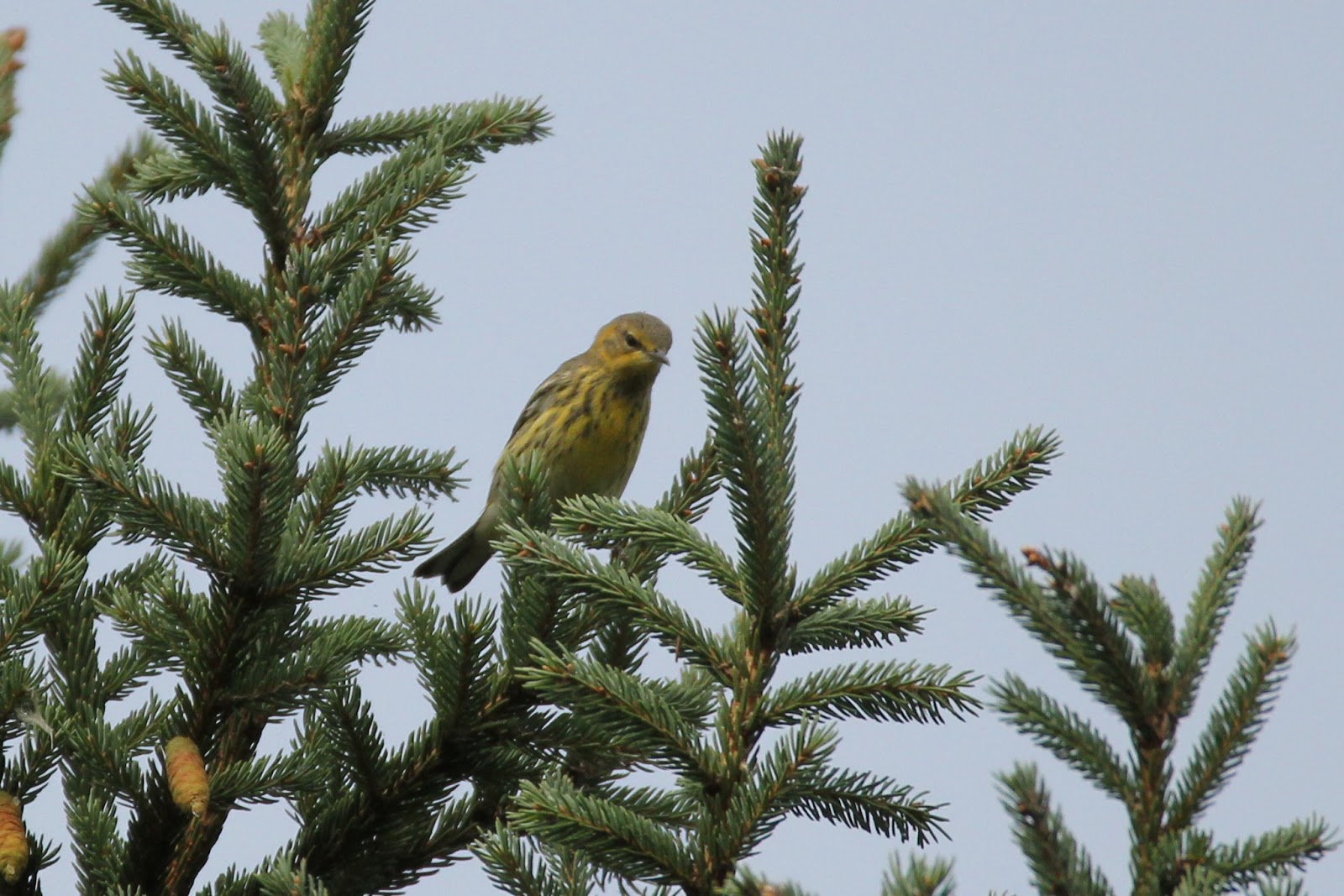
Cape May Warbler

As the day went on, I managed to nab a few of my target birds in between net rounds. I found a Yellow-Bellied Flycatcher along the fish gate road, and saw several Caspian Terns.

Caspian Tern

Great Egret and Lincoln's Sparrow were also nice surprises, as was a close-proximity Great Blue Heron flyby.

Lincoln's Sparrow

Great Blue Heron

On the non-bird side of things, I managed to see one Tiny Dekay's Brownsnake sheltering under a rock and several Mink, one of which was leucistic. In addition, I was able to see my first Leopard Slugs!


The biggest surprise of the day was seen on a net round. While approaching one of the mist nets, I spotted a small sparrow fly in and get itself caught. Upon approaching, I realized that it was a Clay-Coloured Sparrow! This was to be the first banded at the TTP station.


Other interesting finds followed. An Olive-Sided Flycatcher, an Eastern Wood-Pewee and a few Lincoln's Sparrows were seen passing through, and a House Wren was heard chattering.

A few shorebird and waterbird species were added to the list around the same time, as I continually checked the shoreline. There was little diversity, unfortunately, but I could hardly complain with the huge assortment of Passerines around! Soon the nets were closing and, tired, I headed home. But as I was leaving, I had one last parting gift: crippling views of a beautiful nonbreeding plumage Scarlet Tanager (Perhaps better called Sulfur Tanager?). I met up with my dad and combined my list with his, adding several species such as American Coot, Northern Harrier and Rose-Breasted Grosbeak.

Rose-breasted Gosbeak

Black-Crowned Night-Heron

Northern Harrier

American Coot

Overall, we saw 78 species, with most of these being passerines. 
Definitely a successful day! A huge thank you to Quinten for getting me involved in this!

Photos: Owen Ridgen, David Ridgen, Tommy Thompson Park (Clay-colored Sparrow)

Cumulative day list. Bold means that it was recorded only on the Toronto list:
  1. Canada Goose
  2. Mute Swan
  3. Trumpeter Swan
  4. Hooded Merganser
  5. Wood Duck
  6. Gadwall
  7. Blue-winged Teal
  8. Northern Shoveler  
  9. Mallard  
  10. Green-winged Teal  
  11. Canvasback
  12. Redhead
  13. Common Merganser  
  14. Pied-billed Grebe  
  15. Double-crested Cormorant   
  16. Great Blue Heron
  17. Great Egret  
  18. Green Heron
  19. Black-crowned Night-Heron
  20. Cooper’s Hawk
  21. Northern Harrier  
  22. Turkey Vulture  
  23. Osprey
  24. Bald Eagle  
  25. Broad-winged Hawk  
  26. Red-tailed Hawk
  27. American Coot
  28. Killdeer
  29. Spotted Sandpiper
  30. Solitary Sandpiper
  31. Semipalmated Sandpiper  
  32. Greater Yellowlegs   
  33. Lesser Yellowlegs  
  34. Ring-billed Gull   
  35. Herring Gull  
  36. Caspian Tern  
  37. Rock Pigeon  
  38. Mourning Dove  
  39. Common Nighthawk  
  40. Ruby-throated Hummingbird  
  41. Belted Kingfisher
  42. Yellow-bellied Sapsucker
  43. Red-bellied Woodpecker
  44. Downy Woodpecker
  45. Hairy Woodpecker  
  46. Northern Flicker  
  47. Pileated Woodpecker  
  48. Olive-sided Flycatcher  
  49. Eastern Wood-Pewee
  50. Yellow-bellied Flycatcher
  51. Least Flycatcher
  52. Eastern Phoebe
  53. Philadelphia Vireo  
  54. Warbling Vireo  
  55. Red-eyed Vireo  
  56. Blue Jay   
  57. American Crow
  58. Common Raven  
  59. Barn Swallow  
  60. Black-capped Chickadee  
  61. Red-breasted Nuthatch  
  62. House Wren
  63. Winter Wren
  64. Ruby-crowned Kinglet
  65. Swainson's Thrush
  66. American Robin
  67. Gray Catbird
  68. European Starling  
  69. Cedar Waxwing  
  70. Yellow-Rumped Warbler
  71. Black-And-White Warbler
  72. Nashville Warbler
  73. Common Yellowthroat
  74. American Redstart
  75. Cape May Warbler
  76. Northern Parula
  77. Tennessee Warbler
  78. Magnolia Warbler
  79. Bay-Breasted Warbler
  80. Blackburnian Warbler
  81. Yellow Warbler
  82. Chestnut-Sided Warbler
  83. Blackpoll Warbler
  84. Black-Throated Blue Warbler
  85. Palm Warbler
  86. Pine Warbler
  87. Black-Throated Green Warbler
  88. Canada Warbler
  89. Wilson's Warbler
  90. Clay-colored Sparrow
  91. Lincoln’s Sparrow
  92. Chipping Sparrow  
  93. Song Sparrow  
  94. Scarlet Tanager  
  95. Northern Cardinal   
  96. Rose-breasted Grosbeak  
  97. Indigo Bunting
  98. Red-winged Blackbird  
  99. Brown-headed Cowbird
  100. Common Grackle
  101. House Finch
  102. American Goldfinch  
  103. House Sparrow  

Monday, 28 August 2017

Long Point Adventure

Yesterday I took a little trip down to the Long Point area. We started in Old Cut, where it was apparently a slow day for banding. The only birds I saw banded were Baltimore Oriole, Gray Catbird, Veery, and an American Redstart. Bird life around the station was present, but not abundant. A Cape May was the only warbler other than the redstart.

Cape May

There was a family of Green Herons in a Blue Spruce near the Old Cut marsh.


Olive-sided Flycatcher was one of the better birds.


I caught and tagged my first Monarch of the season...although she looks a bit weathered, I am being optimistic. It was great to practice the procedure of tagging.


We spent a couple hours at Old Cut, then went to Big Creek NWA where we found a vocal Virginia Rail.

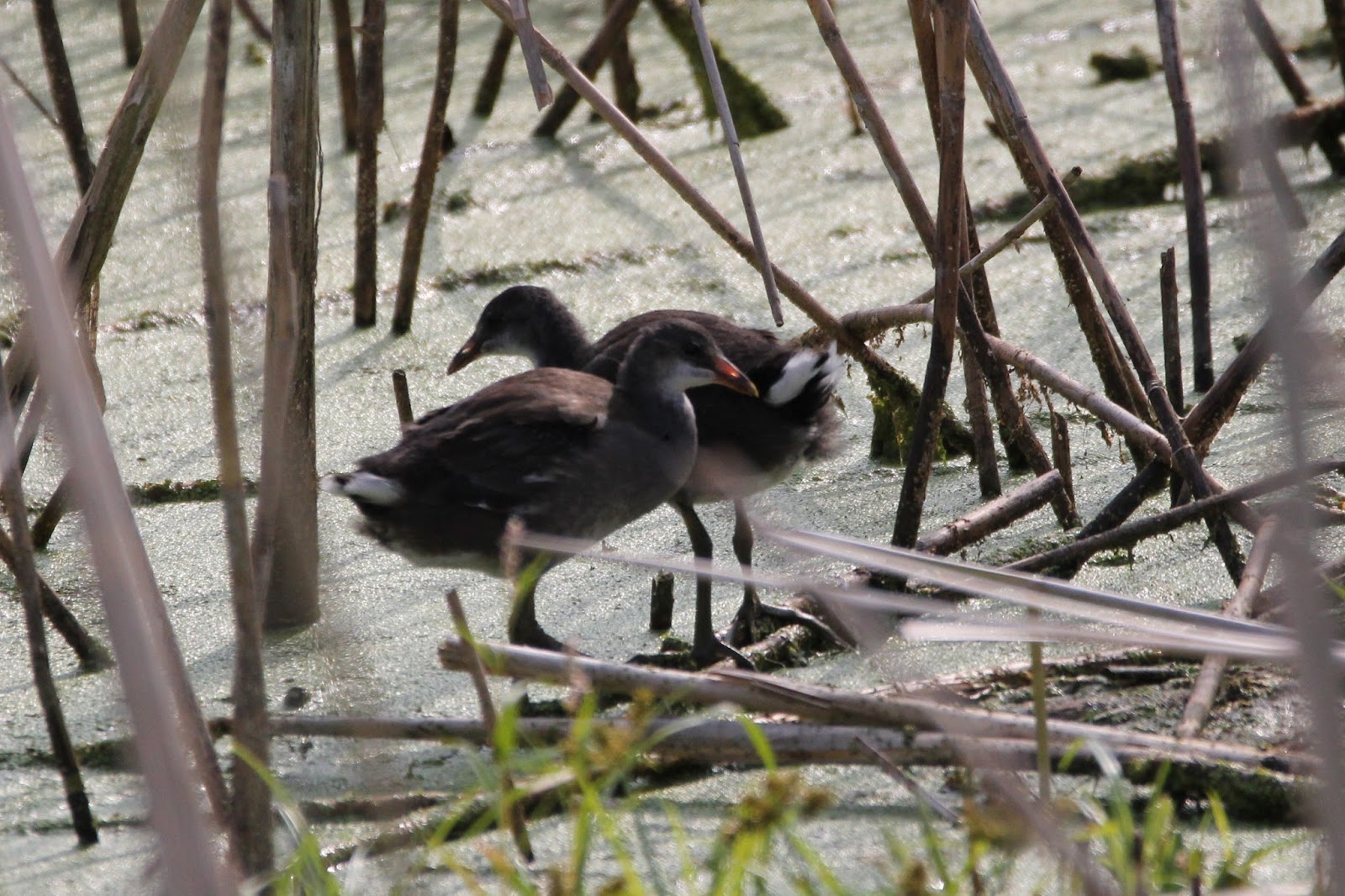
After lunch, we went to the Port Rowan Wetlands. The target here was Common Gallinule (formally known as Common Moorhen), which called as soon as we got there. Pied-billed Grebes and Blue-winged Teal were also present.

Pied-billed Grebe

After about an hour of searching I finally found a group of about 10 gallinules. Many juveniles were with them.


A Least Bittern caught me off guard when it flushed from the side of the wetland. I managed to get one blurry photo as it disappeared into the reeds.


Hahn Marsh was somewhat of a disappointment, however I still managed to find 17 Sandhill Cranes.


I caught this little Eastern Gartersnake at Hahn Marsh as well...quite feisty!


Another visit to Old Cut was due to try for the King Rail. Despite waiting (and waiting, and waiting), it never did vocalize. The 15,000+ swallows made up for it, however. The majority were Bank Swallows, but Barn, Tree, Northern Rough-winged, and Purple Martin were mixed in as well.

At one point a fairly large group of Great Egrets flew over. On eBird, anything over 6 is flagged!


The Green Heron nestlings were equally entertaining.


Despite missing the King Rail, I was still happy with what I saw. It was a great trip (despite being bitten by a Dog Tick)!