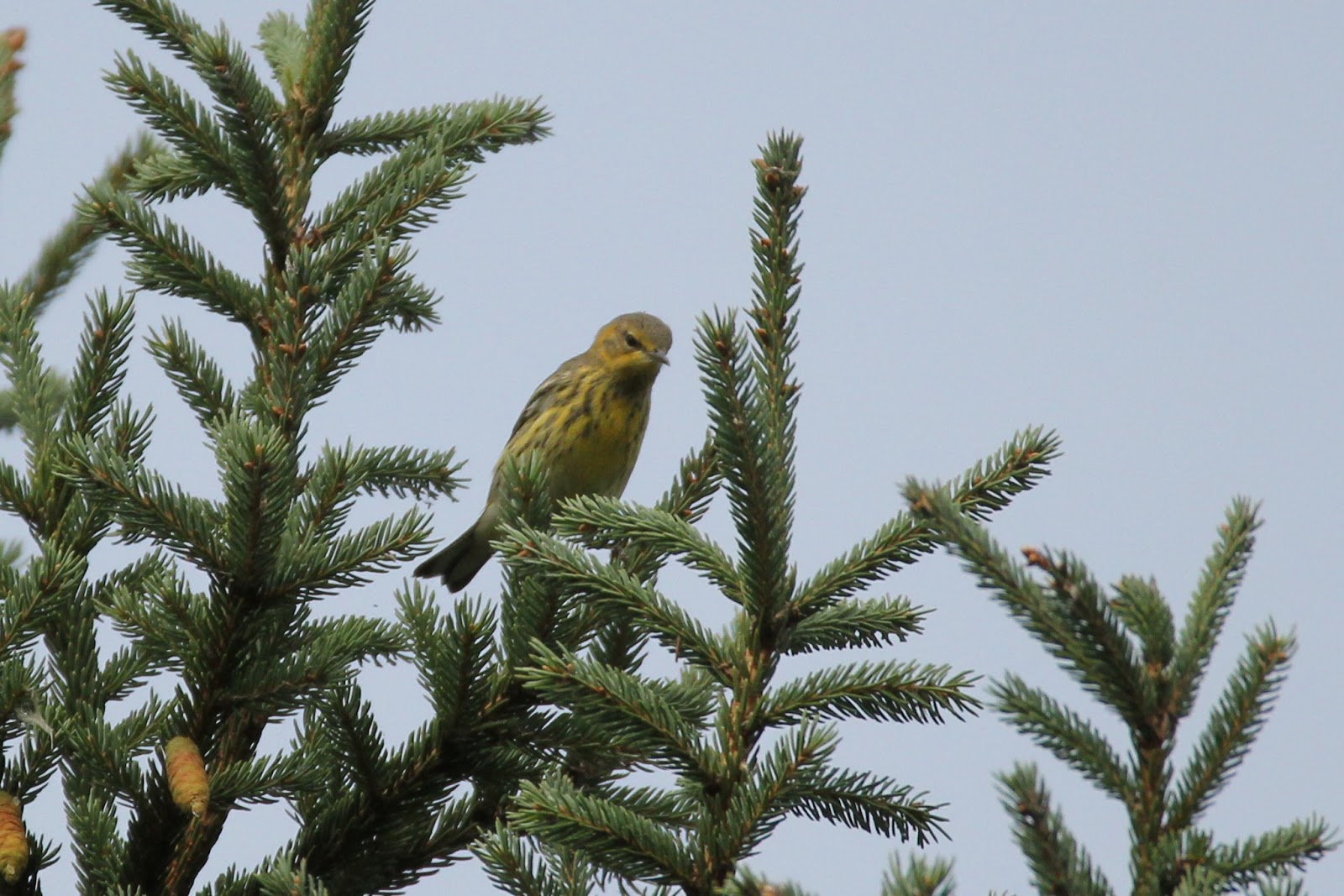
Yesterday I took a little trip down to the Long Point area. We started in Old Cut, where it was apparently a slow day for banding. The only birds I saw banded were Baltimore Oriole, Gray Catbird, Veery, and an American Redstart. Bird life around the station was present, but not abundant. A Cape May was the only warbler other than the redstart.
Cape May
There was a family of Green Herons in a Blue Spruce near the Old Cut marsh.
Olive-sided Flycatcher was one of the better birds.
I caught and tagged my first Monarch of the season...although she looks a bit weathered, I am being optimistic. It was great to practice the procedure of tagging.
We spent a couple hours at Old Cut, then went to Big Creek NWA where we found a vocal Virginia Rail.
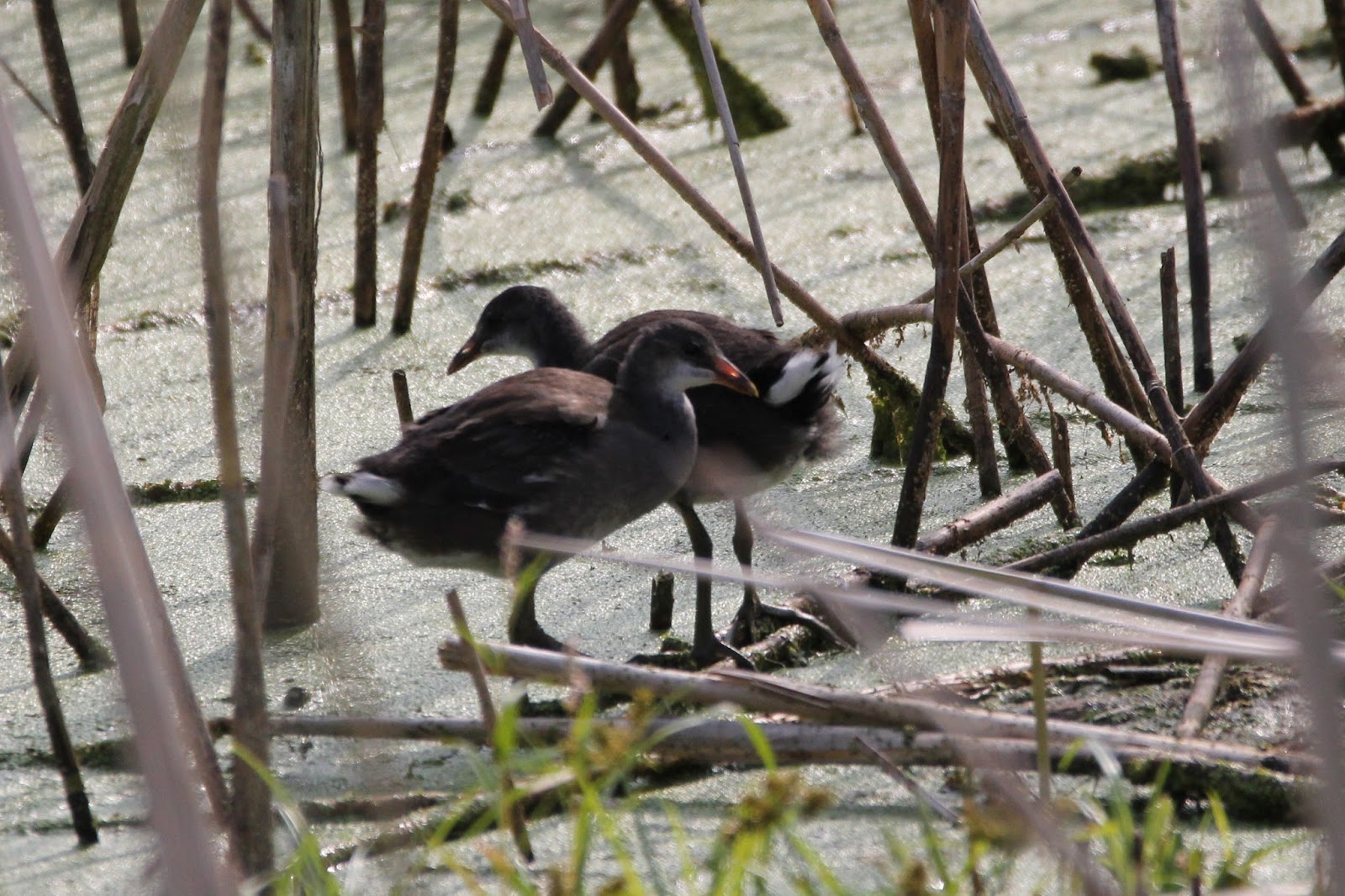
After lunch, we went to the Port Rowan Wetlands. The target here was Common Gallinule (formally known as Common Moorhen), which called as soon as we got there. Pied-billed Grebes and Blue-winged Teal were also present.
Pied-billed Grebe
After about an hour of searching I finally found a group of about 10 gallinules. Many juveniles were with them.
A Least Bittern caught me off guard when it flushed from the side of the wetland. I managed to get one blurry photo as it disappeared into the reeds.
Hahn Marsh was somewhat of a disappointment, however I still managed to find 17 Sandhill Cranes.
I caught this little Eastern Gartersnake at Hahn Marsh as well...quite feisty!
Another visit to Old Cut was due to try for the King Rail. Despite waiting (and waiting, and waiting), it never did vocalize. The 15,000+ swallows made up for it, however. The majority were Bank Swallows, but Barn, Tree, Northern Rough-winged, and Purple Martin were mixed in as well.
At one point a fairly large group of Great Egrets flew over. On eBird, anything over 6 is flagged!
The Green Heron nestlings were equally entertaining.
Despite missing the King Rail, I was still happy with what I saw. It was a great trip (despite being bitten by a Dog Tick)!
But there is hope...this is the time of year that butterflies/moths (leps) and dragonflies/damsels (odes) start to appear in large numbers. These groups will entertain us until fall migration starts in a couple months. Today, I made my first trip of the year to look specifically to find some flying insects.
I started in my favourite spot to look for leps, a large open field adjacent to Sunngingdale Rd. and at the start/end of Uplands Trail. I can often find many skippers here. Today, I only saw a glimpse of one skipper, but there was quite a large number of Common Ringlets.
There was a tagged Monarch, but I was unable to get a photo or the tag number. A Virginia Ctenucha also didn't want it's picture taken.
An Eastern Tailed-Blue made an appearance.
There were a couple bluets, including Eastern Forktail.
Heading into the woods, I saw numerous larger species of dragonfly, such as Common Whitetail and what looked like a meadowhawk of some sort.
Heading deeper in the woods, there was a White-stripped Black moth.
Also see was one of my favourites, the Ebony Jewelwing.
Although things are still a bit slow, hopefully they will soon pick up!
This past Sunday I travelled down to Point Pelee to try for the 150 species challenge. To do so, I would have to find 43 new species, but I was up for it.
The day started around 5:25 am, when we arrived in the park. Just driving along the road produced Swainson's Thrush, which was 108.
I chose to go to the tip first thing, hoping that I would maybe catch a "fallout". It was a mistake, as there was no tip, and the only way to really go anywhere past the washout was by hopping over a couple rocks and logs to stand on a small patch of sand.
I added a few new birds to the list, including Wilson's Warbler, Indigo Bunting, Surf Scoter, Willow Flycatcher, and, surprisingly, Rock Pigeon.
Others observed include orioles, mergansers, Northern Parula, Chestnut-sided Warblers, and a Blue-winged Warbler.
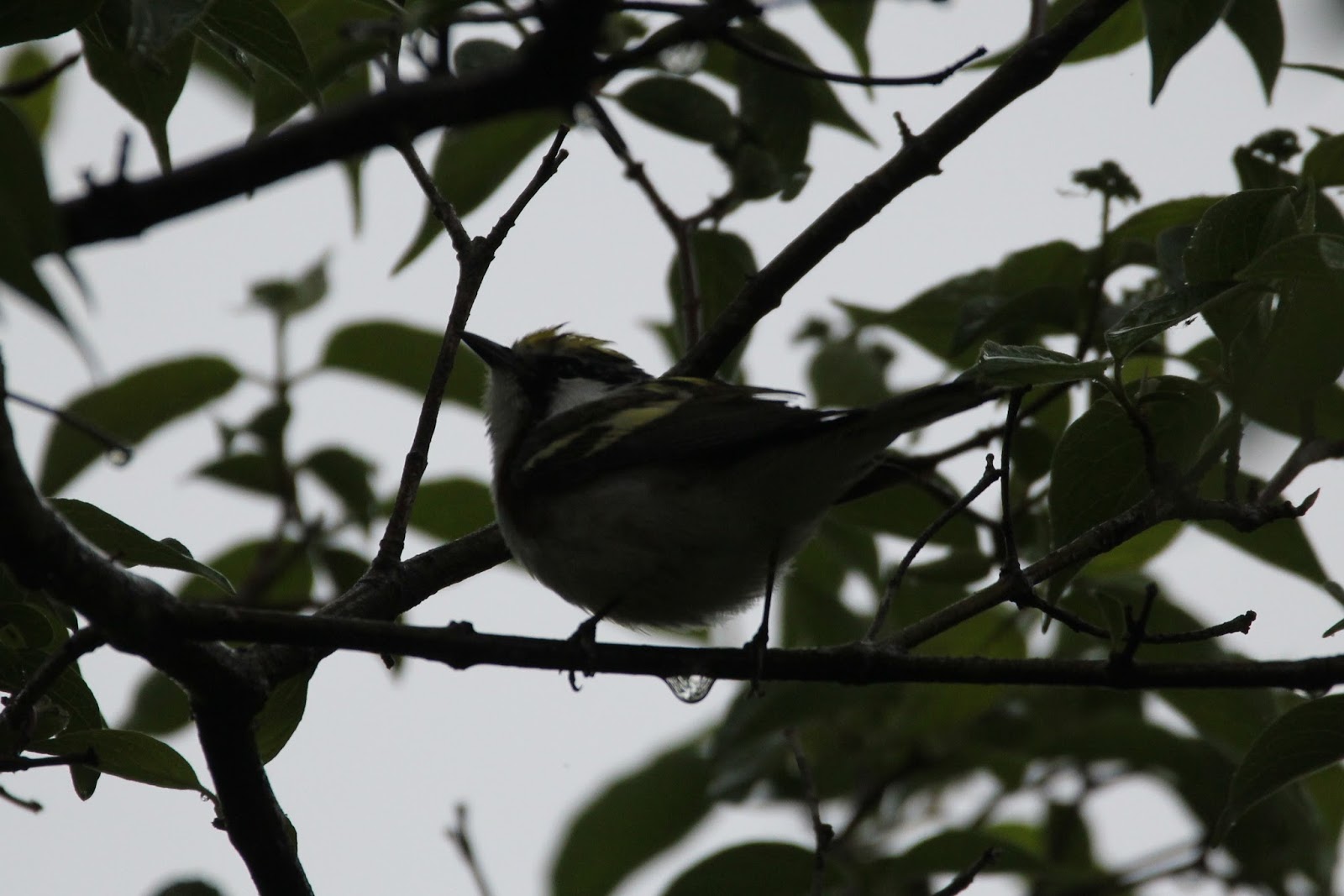
Tilden's was next. It was pretty slow, but we still turned up a few birds. FOY Magnolia Warblers were nice, as were some great looks at Wilson's Warbler, Canada Warbler, and a Yellow Warbler on a nest. A Great-crested Flycatcher was my first visual of the year.
Magnolia Warbler
Wilson's Warbler
By this point it was raining steadily, so we decided to get out of the park and explore the areas to the north, stopping by the Marsh Boardwalk first. The target in the marsh were the Black Terns, which I did end up seeing and getting some great photos of.
We headed through the Onion Fields, where we picked up a Ring-necked Pheasant.
Heading into Hillman, the rain was pretty bad, and by this point I had given up on keeping my equipment dry.
The shorebird cell was productive with a number of Least Sandpipers, Semipalmated Sandpipers, Semipalmated Plovers, Ruddy Turnstones, Lesser Yellowlegs and Whimbrel.
Whimbrel
Woodland birds included Alder Flycatcher, Willow Flycatcher, Ruby-throated Hummingbird, and Chestnut-sided Warbler.
Chestnut-sided Warbler
After Hillman, we went to the Wheatley harbour. Here we found numerous shorebirds such as Ruddy Turnstones, Sanderlings, Least Sandpipers, Semipalmated Sandpipers, and Dunlin.
Dunlin
Least Sandpiper
Sanderling
Ruddy Turnstone
There were a couple gulls and terns too.
Herring Gull
By the time we headed back into the park, it had stopped raining. We decided to check out Woodland Nature Trail next. Here we were greeted by birds like Gray-cheeked and Swainson's Thrushes.
Swainson's Thrush
Also seen was a single male Prothonotary Warbler.
A hike down Redbud produced a FOY Monarch Butterfly.
Many other birds were seen, including a Black-billed Cuckoo that was calling somewhere off to the side of the trail. Baltimore Orioles were abundant.
I decided to walk to Sparrow Field, and as soon as I got there, a small brown bird flew up from the brush out into the open on a branch. Here is what I saw:
My heart was pumping, I had just seen a Henslow's Sparrow, and had gotten some great photos to boot. I high-tailed it back to the VC to alert everyone of my find. It wasn't until I was half way there that I finally clued in...
It was a female Bobolink. Still a decent bird that many birders miss while down in Pelee, but it's not a Henslow's Sparrow.
There were a couple nice flowers along the pathways.
Wild Columbine
Mayapple
Cactus Field didn't produce the Eastern Bluebirds I was hoping for, but we did get some great looks at some Indigo Buntings and nesting Yellow Warblers.
Since the sun had come out, I wanted to have another go at photographing the Black Terns. Unfortunately, there were just too many tourists, and the Marsh Boardwalk was very busy, so the terns weren't coming to close. I did get a couple shots that I'm happy with.
The last stop of the day was Hillman Marsh. It was much drier now, so scoping out the shorebird cell was a bit more enjoyable than earlier. It's a good thing that I took the time to scope, because I soon found two White-rumped Sandpipers. It seems to be a good year for them. I attempted photos, but I'm not sure how they turned out. I'm thinking this is one of the WRSA, but I could very well be one of the SESA.
There were a few White-tailed Deer hanging around.
I headed out toward the marsh, and began to listen for rails and herons. It wasn't long before I found about five or so Marsh Wrens.
Soon, I saw a Least Bittern, which was a lifer, flying over the cattails, then started calling. Not long after that another one came in and perched where is was visible.
An immature Black-crowned Night-heron joined in too.
It wasn't long before an American Bittern was found as well. A great ending to a great day.
While I never did reach 150 species (I still had 9 species to go), I surprisingly did better species wise this trip than last trip, as I finished with 108 species. Considering the conditions, and that almost all of my 141 species were "self found" I'm proud of my accomplishment.
I'll be heading up to the Bruce Saturday evening for the night, so hopefully I can at least get my month list up to 150 species. More on that, and part two of my Pelee Big Day, later.