Showing posts with label Nelson's Sparrow. Show all posts

Sunday, 19 December 2021

Christmas Bird Counts 2021

Time for my annual Christmas Bird Count (CBC) blog post, which shrinks in content and length every year since I hardly carry a camera anymore...that's why I have friends who take pictures! 

I arrived in London late Friday night, and was up early the next morning for the London CBC. This is my fifth year doing this count, and my route covers about a 5km stretch along the river. Some years it can be dynamite, but others, like this year, it can be quite poor.

It was so poor in fact that I got my lowest species total ever on this route with 28 (average 32), and lowest individual total with 323 (average 685). Averages are only based on five years of data, but still...

Highlights? Not much! A couple Winter Wrens, nine Swamp Sparrows, and 47 Northern Cardinals were all nice. Lots of misses though. I did add Great Blue Heron to my all time list for this route. 

eBird checklist here: https://ebird.org/checklist/S99036733

Today I got to do a slightly more exciting count, the Rondeau/Blenheim CBC. This is my sixth year doing this count. This time around, I was joined by Nathan Hood and Ezra Campanelli. 

We started with a lakewatch at the VC beach access (which apparently is beach #10, never noticed the number before). It was slow at first, but quickly picked up. Highlights were Surf Scoters, White-winged Scoter, Long-tailed Duck, and lots of Red-breasted Mergansers. Took a bit for the loons to start, but ended up with 47 Red-throateds and a Common. Although I guess the place to be was off South Point because Blake had 217 Red-throats! I'm happy though, my perfect streak for Red-throated Loon on this count continues!

Eventually we had to pry ourselves away from the lake, and begin walking up Lakeshore towards the campground. Lots of redpolls around (we ended up with 95, a new Rondeau bird for me). Tufted Titmouse and several Carolina Wrens were real treats for me, having not seen either in months. A Fox Sparrow that was pished in was another real highlight for our trio of dedicated counters. 

A quick check of the beach at the traffic circle revealed a Great Black-backed Gull, a new one for our list. 

After walking the maintenance loop, which was pretty birdy, although nothing really of note, we began our way down Harrison. I thought for sure we'd get a Pileated Woodpecker, but it was not to be. What we did get however was a pair of singing Great Horned Owls, the screech-owl along Bennett Ave, and a flyover Eastern Bluebird at the group campground. 

We finished our route with 45 species, which we were quite happy with. Nothing too rare, and plenty of misses, but that is to be expected on a CBC.  

eBird checklist here: https://ebird.org/checklist/S99134628

After finishing our area, we went to walk around the campground for a bit. Although it was covered by others earlier in the day, always a good place to look around. It did not take us long to locate several Yellow-rumped Warblers, and the Blue-grey Gnatcatcher that has been around. The gnatcatcher is new for the Rondeau CBC if I am not mistaken. 

We scoped the bay before leaving the park. A few Canvasback among other ducks were nice to see.

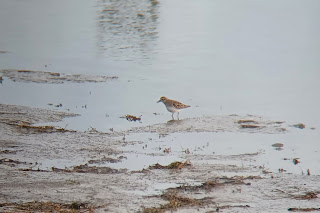
One last stop was Keith McLean's CA to look for a couple lingering birds. After a bit of searching, we spotted the continuing Nelson's Sparrow. As we were in pursuit of the sparrow for a better look (which we got), we also saw the continuing Least Sandpiper, another new species for the count. The sandpiper also has the honour of being the only photo I took all weekend.
Rondeau has so far recorded 117 species this year, a very high total. It is still a developing situation, and will be interesting to see what the finally results are.  Edit: final tally is 124 species, setting a new record for Ontario if I am not mistaken 

And that just about wraps it up! An enjoyable weekend birding back in Southwestern Ontario. As much as I love Algonquin (to which I am just about to begin my journey back to), I sure have missed these locations! Although in past years I have only done these two counts, this year I have the Algonquin CBC coming up on January 3rd.

Today it was Least Sandpiper, Nelson Sparrow, Blue-grey Gnatcatcher, and Red-throated Loons, tomorrow its Evening Grosbeaks, crossbills, Pine Grosbeaks, and Canada Jays...

Sunday, 4 October 2020

Recent Odds and Ends

School has kept me pretty busy over the last few weeks, but I have still managed to get out here and there. 

Last weekend, a Long-billed Dowitcher showed up just south of the city. I hadn't bothered to get the one that showed up last year, so I went. I got brief looks, but it was a new one for me in Middlesex nonetheless. I also saw Amethyst Aster (S.× amethystinum), my first time seeing it. It is a hybrid between White Heath Aster (Symphyotrichum ericoides) and New England Aster (Symphyotrichum novae-angliae).

Amethyst Aster (Symphyotrichum × amethystinum

A few days ago I went to Kilally Meadows in the north part of London. I was mostly looking at plants, but I did flush a Black-billed Cuckoo at one point. I think this is the latest I have ever seen one.
Black-billed Cuckoo

Here are a couple of the plants I saw.

Silky Wild Rye (Elymus villosus)

River Wild Rye (Elymus riparius)

Arrow-leaved Aster (Symphyotrichum urophyllum)

Smooth Blue Aster (Symphyotrichum laeve)

New England Aster (Symphyotrichum novae-angliae)

American Hog-peanut (Amphicarpaea bracteata)

Canada Clearweed (Pilea pumila)

Fast forward to yesterday, I visited one of the most productive places in my neighbourhood for birds. I spend a good two and a half hours there, as there were plenty of birds to sort through. I had several first of season birds including Winter Wren (neighbourhood year bird #150), American Pipit (neighbourhood year bird #151), Blue-headed Vireo, and White-crowned Sparrow. eBird list.

Dotted Knotweed (Persicaria punctata)
American Kestrel


Today, Reuven Martin had some great luck (he has been on fire this fall around here), and found a Nelson's Sparrow and a couple of Hudsonian Godwits in Komoka Provincial Park. I called up Bill Lindley to let him know, and shortly thereafter the two of us were on route. Both of us had had Hudwit on the brain for the last few days, and I always have thoughts of Nelson's Sparrow at this time of year, so we were keen to see these birds!

The godwits had just been a fly by for Reuven, but we checked some nearby ponds to no avail. We arrived in the rain at Komoka, and soon began our search. We were joined by others soon as well in the form of Gord Payne, Pete Read, Mike Cowlard, and Nancy Douglas. We scoured the area, but came up empty, flushing a Sora and a couple snipe in the process. We also had a Long-billed Dowitcher, always a great record for the county. The others left, leaving Bill, Gord, and myself. Bill and I were going to start walking the perimeter of the pond when Gord called us back, saying he had seen a bird skulking around the edge of the water. Soon, the Nelson's Sparrow popped up for some brief looks! It was a new Middlesex bird for all three of us.

Nelson's Sparrow (Longridge Point, August 2018)

Afterwards, Bill and I went to the Strathroy Sewage Lagoons. No godwits there either, but we did have another Long-billed Dowitcher and some Stilt Sandpipers. 

This evening before it got dark I went to check the local wetland. Nothing unusual, but I did score two more neighbourhood year birds, Northern Pintail and American Black Duck. 

It is one of my most favourite times of year! Looking forward to see what else will pop up.

Monday, 15 October 2018

James Bay 2018: Part Six

This past summer I was given the opportunity to volunteer for the James Bay Shorebird Project on the coast of James Bay, north of Moosonee. For two weeks from August 13th to August 27th, I was stationed at Longridge Point, the most northern of the three survey sites in the project.

James Bay 2018:
Part One
Part Two
Part Three
Part Four
Part Five
Part Six
Part Seven
Part Eight
---------------

August 22, 2018

Another Paskwatchi survey day! I went out a bit earlier than the rest of the crew, with intentions of waiting for them at the point, then surveying our way back. Just as I was about to cross the creek, I came across two young Sandhill Cranes and their parents. A nice surprise! 


Flocks of Snow Geese were now regular. A couple flocks went over on the walk to the point.


Paskwatchi Point.


It is a favourite place for gulls and cormorants to sit when the tide is out. Hundreds of Bonaparte's Gulls were there that day. I also managed to pick out a couple Little Gulls, an adult with a full hood (my first in this plumage) and a second summer bird.


The "flats" near Paskwatchi are a favourite place for many shorebirds, in particular Hudwits and Red Knots. You can see Fantasy Island off in the distance.


I was the recorder for this survey, and since I had brought my scope, it made the walk feel like the longest walk ever. No matter how many different strategies I tried for carrying that thing, nothing felt right! 

We got back to camp mid-afternoon, and I went straight out to the marsh to catch some odes, as it was a very nice sunny day. Not too much flying around, but I caught some more meadowhawks. 

Black Meadowhawk

Cherry-faced Meadowhawk

I also saw a Bronze Copper (horrible pic)


While I was out, I came across a very vocal LeConte's Sparrow. I only had my 55mm lens on, so I went back to camp for my other lens, and hope that the sparrow would still be there.

I saw this Gray, I mean Canada, Jay on the path on my way back out. Canada Jays hung around camp. We saw at least three or four family groups throughout our stay.


Coming up to the creek, I decided to pish a little. Up popped a Nelson's Sparrow! You'll notice that she is banded, meaning that it was the same one from the day before!


Lucky for me, the same LeConte's was still in the same area. I came away with some of my favourite photos of birds that I have ever taken. I think LeConte's Sparrow may be my new favourite bird!


Plenty of other sparrows were also present. Many Swamps and Lincoln's, as well as about a gazillion Savannah Sparrows (I had a day where stood in a single spot for about 5 minutes and had 50 or 60 stream by me)

Swamp Sparrow

Savannah Sparrow

A few other birds were making use of the marsh.

Wilson's Snipe

Sandhill Cranes

Harriers were a daily occurence. One day I saw around nine of them in one "swarm". It was the oddest thing!


Common Ringlets are sometimes seen up there. They look at tad darker than the ones down south.


I spotted this skunk while photographing the LeConte's.


This Greater Yellowlegs was feeding in the creek. 


I didn't anticipate such a great evening for photography, so I didn't charge my battery (yes, we had electricity...sort of). My battery died.

That night I got a text via satellite texting from my friend in the south. It simply read "Guess what showed up today?"

So yep. That is how I found out about the Reddish Egret.

August 23, 2018

We woke up to a very calm morning. Almost too calm. Off on the horizon we could see some dark clouds, but it was somewhat sunny and warm where were were, so we weren't worried. We had a Longridge Point survey that day. Our plan was to leave early, walk to the tip (doing the survey along the way) then have lunch while we waited for the tide to be low enough for us to walk back (there are several places that become gravel "islands" when the tide comes in). 

We got to out starting point right on schedule, and then began the survey. Soon after we started, the banders radioed us to say they had a jaeger! Not too long after that, we were looking at a beautiful adult light-morph Parasitic Jaeger with full tail streamers (longer than one would think!). We were ecstatic, we knew it was going to be a good day!

We walked another couple kilometers, seeing things such as White-winged Crossbill and Marbled Godwit along the way. We came across a group of birds, so we stopped to scope them. As we where looking through them, my hat blew off. I turned around to pick it up, and then I heard a "thump", I turned back around to see my scope laying in the ground. And that's when it hit us...a huge gust of wind! We decided to hunker down for a couple minutes to wait it out before we continued on our way. James Bay, however, had different plans for us. The tide came up faster than we had expected, and it was high. Before we knew it, we were stuck. 


Over the next 10 minutes, it must have dropped something like 10 or 15 degrees. Lucky for me, I had grabbed my jacket and gloves and stuffed it in my bag just before we left (I almost forgot it!).

All was not lost however, as there were lots of birds to be seen. We had around eight, nine, or even ten thousand shorebirds stream by the "island" over the course of a couple hours, as the mudflats were they would normally feed (in this case West Bay) flooded. The majority of the birds were White-rumped Sands, but there were also a large numbers of Semipalmated Sands. Hudwits, Red Knots, Baird's Sands, and plovers (mostly Semipalamted) were mixed in as well. We even had a few Red-necked Phalaropes (perhaps not unexpected, but my first time seeing them "on the move" like that!).

We set up a nice little seawatch station to watch the action.


I was curious to see where all the peeps from West Bay were going (the majority where roosting on the gravel, some even touched down on our island) so I got up from the "blind" and fought my way through the wind. Not long into my "journey to the far side of the island" (in reality like 40 or 50 meters), I looked up and was shocked to see a dark morph subadult Parasitic Jaeger directly overhead! It was gone as soon as it arrived it seemed, within seconds it had soared over the rest of the crew and shot out over the bay, headed south.

In short, we were stuck out there for four hours. In an effort to boost morale (and warm up, it was might cold) we built a fire. The brisk wind certainly fueled it with the needed source of oxygen!


Just before I burned it, I found this piece of White Cedar. Like the White Birch, it doesn't grow in the area, so it would have come from farther south.


I got hungry after awhile.


Eventually the tide was low enough (normally the tide goes down in a couple hours, so it stuck around awhile!) for us to "island hop" on some of the grassy islands back to "safety". 

We made it home about an hour later, and were pleased to be met with a nice warm supper (thanks banders!). 

It was certainly an experience, and quite frankly I had a fun time being "stranded". We slept well that night.

Sunday, 7 October 2018

James Bay 2018: Part Five

This past summer I was given the opportunity to volunteer for the James Bay Shorebird Project on the coast of James Bay, north of Moosonee. For two weeks from August 13th to August 27th, I was stationed at Longridge Point, the most northern of the three survey sites in the project.

James Bay 2018:
Part One
Part Two
Part Three
Part Four
Part Five
Part Six
Part Seven
Part Eight
---------------

August 20, 2018

By this point, the days were starting to all blend together, so some of the finer details may be lacking, but I'll try my best :-P 

I do remember that we did the Paskwatchi (or Pasquachi, or Puskwatche...I saw many spellings, so I don't know what is correct) survey that day. I realize I keep naming off all these locations, so here is a rough map of the survey site (I used an "i" instead of an "a" by accident in "Paskwatchi")


Before heading out on the survey I spotted a garter snake out behind the main cabin. This is the most northern extent of their range.

Based on the fact I didn't take any photos, I assume that the survey was pretty average. If I recall correctly the real highlight was a huge flock (~1000 individuals) of something waaaaay out over the bay. Based on their behaviour, we were thinking they were likely Red Knots, but we couldn't be sure...

Hudsonian Godwits are often found in decent numbers at Paskwatchi Point. 


After we finished up the survey, we went into the "Magic Forest", which is a very nice spruce forest that is just covered in mosses and lichens. Quite the sight! There were plenty of cool plants and lichens to be found.

Bunchberry

Northern Red Currant

Grey Reindeer Lichen

Canadian Buffalo-Berry
In the back of the above photo you can see the remains of an old cabin, which nature has taken back.
Black Crowberry

Single Delight

Star-tipped Reindeer Lichen

Cowberry

Wolf Willow

Some parts of the site are littered in this fossil, which is some sort of ancient filter feeding organism.


Blue Mussel shells are quite pretty, and also pretty much completely cover the shoreline.


After having so much fun looking at the flora in the forest, I decided to spend the rest of my day photographing some of the stuff I came across, mostly around camp and in the marsh. Always nice to stop and look at the small things (including the mosquitoes, which attacked every time you bent down to look at something!)

Water Hemlock

Seaside Pea

Tufted Vetch

Northern Bog Aster

American Dune Grass

Sea Sandwort

Common Silverweed

Common Cotton-Grass

Bogbean

Marsh Cinquefoil

August 21, 2018

The day started off with a bang because the banders radioed us early on that they had caught a Nelson's Sparrow! At this point in the trip, we had only had fleeting glimpses of Nelson's Sparrows as they flushed (not the most satisfying lifer), so we were all excited to have an opportunity to view one up close. It was determined it was a female, and she had a nest nearby (they later banded one of the young, and we occasionally flushed them here and there in the following days). Although she looks miserable, don't worry, she was fine. It was just a cool morning.


This morning also brought the much anticipated reopening of the "Forbidden Trail", a "shortcut" if you will, between camp and "The Wrack". It was closed upon our arrival due to a heavy presence of bears, but it was deemed (mostly) safe, as the bears had (mostly) moved on as they had eaten all the berries. Hooded Ladies' Tresses were present along the trail.


Although I spotted the first Snow Geese two day prior, it wasn't until this day when they started to become a daily occurrence. We found a family group with the usual group of Canada Geese. In the following days, small flocks (usually a dozen to about 40 individuals) were regularly flying over.


West Bay, that day's survey, was covered in shorebirds, the majority White-rumped Sandpipers, but also a fair amount of Dunlin and Semipalmated Plovers as well. 


White flag = banded in Canada

We spotted our first juvenile Dunlin of the season. 


This Pectoral Sandpiper was pretty cooperative. 


We finished the survey not long after. While resting, Doug came up to us with something he had found in the wrack line...


A Sabine's Gull wing! It is unlikely that it survived in that condition from last fall, so that means it was either a spring bird or a fall migrant from the current year. They were out there!

I ventured off on my own for the walk back, with plans to walk a straight line from Bear Point to the forested island across the mudflats. The mud is much easier to walk on than the grass along the shore!

Nothing crazy was seen on my trip back, but I did see some more cool plants. Some of the photos are a bit cloudy because I dropped my phone in the water...but don't worry, I fixed it...

Arctic Strawberry

Rattlesnake Fern

Foxtail Barley

Common Arrowgrass

Sea Clubrush

Marsh Grass-of-Parnassus

Labrador Indian-Paintbrush

Northern Comandra

A couple photos showing the landscape...

The forested island


I arrived back at camp in the early evening.


That night, just as we went to bed we heard a sound on our porch. A little alarmed, we looked towards the door when all of a sudden...

"THE BEAR HAS A FLASHLIGHT!"

Alas, it wasn't a bear, but it was one of our fellow surveyors telling us that they were hearing a distant wolf! It seemed like it may have been a young one (it sounded quite wimpy), and we guessed that it was probably in West Bay. Barely within hearing range, but it was there! This was my first time hearing a wolf, and prior to this I only briefly saw the tail end of one run across the road in Algonquin. Currently, Eastern, or Algonquin, Wolf is considered a subspecies of Grey Wolf (which was the species of the individual we were hearing), so it wasn't "officially" a lifer, but who knows, maybe one day I can say I have encountered two species of wolves in Ontario! Quite the awesome end to the day!


Happy Thanksgiving!