James Bay 2018:
Part One
Part Two
Part Three
Part Four
Part Five
Part Six
Part Seven
Part Eight
-----------
August 14, 2018
That morning we awoke to the sounds of James Bay. Pine Siskins flew over calling. There was a buzz of the many bumblebees as they visited the Fireweed that surrounded the cabins. One could hear the Lesser Yellowlegs calling out over the marshes (those things never shut up!).
The guys (Nathan, Ethan, and Jack) and I went for a walk out on the mudflats, eager to get out first real taste of birding the James Bay coast.

Not huge numbers of birds (I say that now, but at the time we thought it was a lot!), but we got to get up close and personal with a flock of White-rumped Sandpipers. Or, at least we tried. They are very skittish, and flushed often. Their flight call is very distinctive. After hearing it for two weeks, I doubt I will ever forget it!


There were a few other species out and about as well.
 |
| Lesser Yellowlegs |
It seemed odd to be seeing seaweed and kelp in Ontario, but there it was. Rockweed (Fucus distichus), a type of bladder wrack, was commonly encountered. I also came across this out on the mudflats, which appears to be of the genus Laminaria. I haven't got a species ID on it.
On our walk back we were met with out first Black Bear of the trip. This was likely the female hanging around with two cubs. They can hunker down well in the Fireweed.

We were almost back to camp when we flushed up this LeConte's Sparrow. This was our first chance to get really good looks at this species.

We went out on our first survey of the crew that afternoon. I didn't take my camera, but we saw many cool things along the way. Lots of Hudwits, Red Knots, and White-rumped Sandpipers. The highlight was an adult Buff-breasted Sandpiper, a lifer for myself and Jack.
As stated in my previous post, some details are a bit fuzzy, but if I recall correctly that night was clear. We saw the James Bay stars in all their glory, and were even treated with the northern lights. An awesome finish to our first full day on the coast.
August 15, 2018
Much like the first day, we went out to explore the mudflats in the morning. Again nothing of note, but it was a nice sunny day. Perhaps one of the most interesting sighting was a White-winged Crossbill that seemed to be flying in off the bay.

I also managed to finally net my first couple adult male Cherry-faced Meadowhawks. Despite the name, this species doesn't always have an obvious Cherry face (although the first male I caught it was very prominent!) It is most similar to Ruby Meadowhawk, but Ruby doesn't occur that far north, so it made for an easy identification.


We did the Longridge Point survey route that afternoon. We didn't find anything too uncommon, but it was a nice walk, and we saw large numbers of shorebirds. We stopped at "The Wrack" (a place where a bunch of seaweed has washed up) on our way back to camp. Since it was the evening, the lighting was pretty decent, so we stopped to take some photos (I brought my camera this time!).
Hudsonian Godwits were the most numerous (and considering their rarity in southern Ontario, they were certainly well loved by our cameras!).


Red Knots are often found in with Hudwit flocks, and that day was no exception.
There were a few other shorebirds milling around.
The project not only counts shorebirds, but also bands them. As such, it was not unusual to see a few banded and flagged birds feeding around the study site.
It was another clear sky that night, and the northern lights put on a show once again.
 |
| Rockweed (Fucus distichus) |
 |
| Laminaria sp. |
On our walk back we were met with out first Black Bear of the trip. This was likely the female hanging around with two cubs. They can hunker down well in the Fireweed.

We were almost back to camp when we flushed up this LeConte's Sparrow. This was our first chance to get really good looks at this species.

We went out on our first survey of the crew that afternoon. I didn't take my camera, but we saw many cool things along the way. Lots of Hudwits, Red Knots, and White-rumped Sandpipers. The highlight was an adult Buff-breasted Sandpiper, a lifer for myself and Jack.
 |
| Buff-breasted Sandpiper |
As stated in my previous post, some details are a bit fuzzy, but if I recall correctly that night was clear. We saw the James Bay stars in all their glory, and were even treated with the northern lights. An awesome finish to our first full day on the coast.
August 15, 2018
Much like the first day, we went out to explore the mudflats in the morning. Again nothing of note, but it was a nice sunny day. Perhaps one of the most interesting sighting was a White-winged Crossbill that seemed to be flying in off the bay.

 |
| Semipalmated Plover |
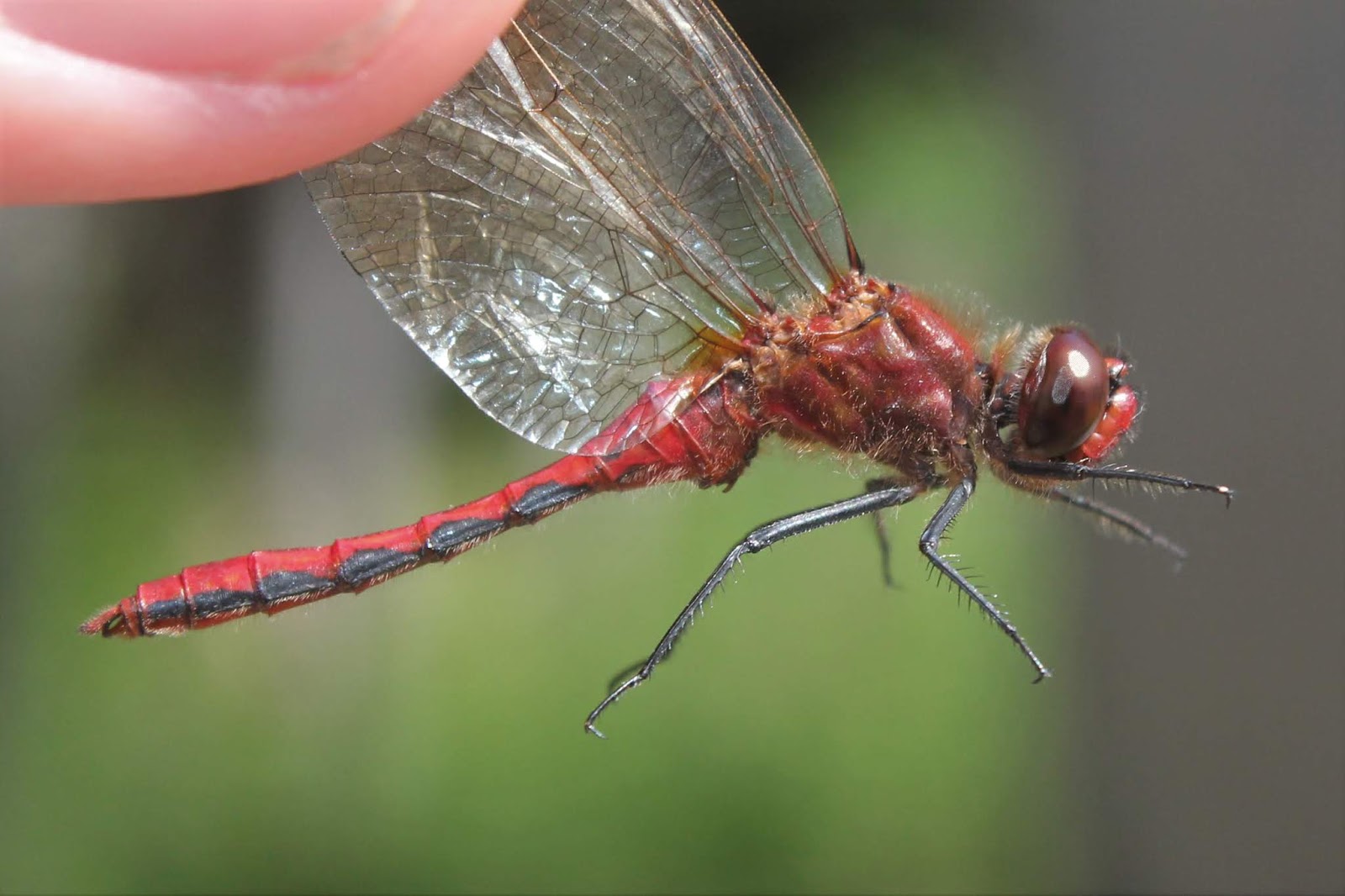
I also managed to finally net my first couple adult male Cherry-faced Meadowhawks. Despite the name, this species doesn't always have an obvious Cherry face (although the first male I caught it was very prominent!) It is most similar to Ruby Meadowhawk, but Ruby doesn't occur that far north, so it made for an easy identification.


We did the Longridge Point survey route that afternoon. We didn't find anything too uncommon, but it was a nice walk, and we saw large numbers of shorebirds. We stopped at "The Wrack" (a place where a bunch of seaweed has washed up) on our way back to camp. Since it was the evening, the lighting was pretty decent, so we stopped to take some photos (I brought my camera this time!).
Hudsonian Godwits were the most numerous (and considering their rarity in southern Ontario, they were certainly well loved by our cameras!).


Red Knots are often found in with Hudwit flocks, and that day was no exception.
 |
| Can you spot the Red Knots? |
There were a few other shorebirds milling around.
 |
| Lesser Yellowlegs |
 |
| Ruddy Turnstone |
 |
| Semipalmated Plover |
The project not only counts shorebirds, but also bands them. As such, it was not unusual to see a few banded and flagged birds feeding around the study site.
 |
| Hudsonian Godwit "0H4" |
 |
| Lesser Yellowlegs "7A2" |
It was another clear sky that night, and the northern lights put on a show once again.