Showing posts with label Shorebirds. Show all posts

Tuesday, 14 June 2022

I Love This Park: Part 2

Click here to read Part 1.

Before I went out on Lake Travers, I decided to try and air out my feet a little bit. I learned at this point that not only did I forget to bring my boots, but for the first time ever, I apparently also neglected to bring a surplus of extra socks! This was going to be a rough 24 hours, especially if it rained as much as it was forecasted to do.

As I sat in my car doing so, I noticed something scrambling over the rocks on the other side of the river. It took me a second to figure out what it was...a baby moose!

Finally, I figured my feet were about as dry as they were going to be, so I put them back into my damp boots, loaded up the canoe, and launched. 

I'm not sure if I have really introduced Lake Travers before. This lake is arguably my favourite one that I have visited in the Park. It is part of the Petawawa River system, located in the northeastern part of Algonquin. Because of its location, it is a great spot to look for birds, especially during periods of bad weather, that otherwise are very rare in the Park. Over the years, a number of rarities have been found here, and on this trip, I was hoping to get to add to that impressive list.

The campsite I like on this lake is not a very far paddle, so I got there in quick fashion and set up camp. It was mid-afternoon and sunny...not really much for me to do, so I took a nap. After that short siesta, I headed out on the lake for an evening paddle. 

There was a White-winged Scoter, which is always nice to see. I would have preferred one of the other scoter species however :)

I also had one of my most memorable mammal encounters that evening. A (presumably different) baby moose was on the shore, and I was able to get quite close in the canoe without disturbing it. This was my first time seeing a moose this young. I will admit to becoming a bit complacent in regards to seeing moose—after all, I see them almost daily—but it is always nice to get to enjoy one by yourself for a prolonged period of time in a "natural" setting (i.e. not the shoulder of Highway 60).


Other than those sightings, no real highlights. It is just nice to get out on a calm lake sometimes!

Just as I was going to bed, the rain began to start softly. I hoped that with the rain, some goodies would drop down...

The next morning, I woke up around 4am to try and listen for any birds calling in the dark as first light approached, but it was quit hard to do with the rain pounding the tent. Had I made a mistake coming here? I could be sitting at home, warm and dry. Then, right around 4:30am, I heard a Black-bellied Plover calling as it flew overhead. This was a new bird for my park list. I scrambled out of the sleeping bag, threw on some clothes and my rain gear, and ran down to the lake's edge (not very far). The light was still dim, but I could hear Black-bellied Plovers, Semipalmated Plovers, and Least Sandpipers calling as they flew around. I couldn't believe it...it was actually happening.

I was in the canoe by 5am, and began to make the rounds, checking the little marshes and bays on the lake. The rain had sort of subsided by this point, and the shorebirds gone quiet, so I was getting a bit worried that the show was over. I persevered nonetheless. 

After a bit over and hour of paddling around, the rain had begun to fall again, and in the distance I noticed a couple birds that ended up being Brant, also new for me in the Park. Not too long after those two, a small flock flew low down the lake. 


So cool to see in this context! Being from Southwestern Ontario, and not really travelling too far very much, I had only ever seen this species on one occasion prior. 

It was raining pretty steady by this point. I continued north up the lake, picking up species here and there, but noting too crazy. I looped around a small island at the north end of the lake, and began to make my way back south. 

When I got to the south end of the lake, shorebirds started to fly around a bit more. Black-bellied Plover, Semipalmated Plover, Least Sandpiper, and Dunlin were tallied. Unfortunately, no mega rarities were mixed in! It was really fun to encounter these species in these numbers regardless.

Black-bellied Plovers

Least Sandpipers and Semipalmated Plovers

Dunlin

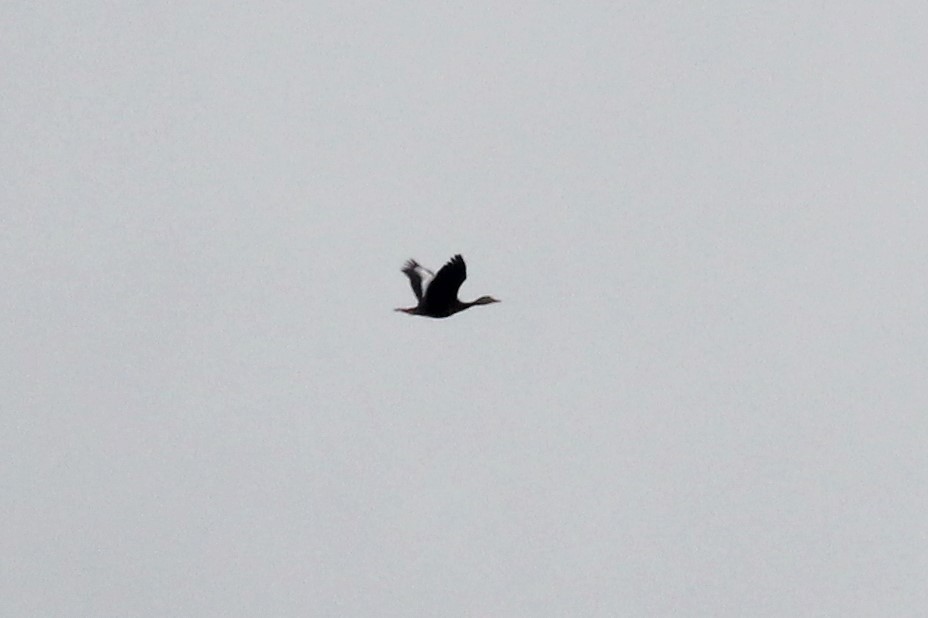
There were a number of Canada Geese moving on this day as well. I figure they are molt migrants. Around 8:30am, over the southern marsh, a large flock of geese approached. I snapped a couple of photos to count the flock later, and then turned my attention back to the shorebirds that were flying around. Just a minute or two later, I heard a very odd wheezy whistle vocalization that I did not recognize. Was it some sort of shorebird call I was unfamiliar with? Unlikely. I looked around frantically, and spotted something smaller with the flock of Canada Geese that were flying up river. Perhaps that was the source of the call. I snapped a few photos, and zoomed in. The first photo I looked at didn't show much. I scrolled to the next photo, and instantly felt my stomach drop. No. Freaking. Way.


It all clicked. The wheezy whistle belonged to none other than a Black-bellied Whistling Duck. This is a rare vagrant in Ontario, let along the middle of Algonquin Park. 

I tried to get some more photos of it as it flew away, now that I knew what it was, but was unsuccessful. It was gone, never to be seen or heard of again. 

The adrenaline rush that followed nearly made me tip the canoe. I couldn't even fathom that I had just seen a whistling duck in Algonquin Park, of all places. Needless to say, it is a first record for the Park. It also happened to be a lifer for me, and just like the Black-legged Kittiwake in October, seemingly the least likely place for me to see my first one. Although I sure hope I do, I very well may never find a better bird in Algonquin Park.

I'll be the first to admit that my photos aren't great, but they are diagnostic, showing the large striking white wing pattern, pink feet, and a bright red bill. Here is another photo, lightened, colour enhanced, and extra cropped to show these features. 


So yeah. Make sure you check those flocks of migrant geese for whistling ducks, I guess.


I wasn't really sure what to do after that. It was still early in the morning, and there was no way to top that! Every bit of me wanted to hop in my car and get back to cell service to share the sighting with everyone, but I told myself I must carry on and see what else I could find!

The goose flight continued. A couple flocks of Brant went over. I didn't end up with a huge number of these geese, but I would have been happy with one!


This photo is one of my favourites from the day, despite maybe not being the best quality. I think it really captured the spirit of Lake Travers that day. This was part of a flock of 160+ Canada Geese that put down to rest on the lake.


I stopped in at the campsite for breakfast/to let my heart calm down, and then went back out for another lap of the lake. There were a few different species of ducks that appeared. I'm not sure exactly where they came from! Perhaps dropped in when I wasn't looking.

Long-tailed Ducks

White-winged Scoter

Red-breasted Mergansers

Lesser Scaup

The rain cleared, and the wind started to pick up, so I decided to try and make my way back south. I was paddling into the wind, so it was really slow going, but I made progress. 

As I was still a kilometer or more from camp, I noticed a few white birds swooping around the marsh directly beside the site. Oh crap. I was sure they were terns, all of which are rare in the Park. I picked up the paddling a little bit. They moved over a creek mouth. No, no, no, no, no. I opted to snap a few photos as I got tossed around in the wind and waves. Soon after I did that, the three terns built altitude and left the lake, heading south and out of sight. I checked my photos...Caspian Terns!


There are surprisingly few (less than ten?) records of Caspian Terns from the Park. The only one that would be rarer I think is Arctic Tern (one record). This excludes Forster's Tern, of which there are no records. 

I arrived back at the campsite, feeling quite accomplished. I packed up camp, loaded the canoe, and headed back to the access point. It was mid-afternoon by this point, and I was ready to get back home (I still had a three hour drive). Perhaps I should have stuck it out longer, but I doubt I could have topped the best sighting of the day! My eBird checklist for the day can be seen here.

That day cemented my belief that Lake Travers is a truly magical place. Algonquin Park is such an incredible place once you get to know it...and the truth is, I really don't even know it very well! I am looking forward to a lifetime of exploration and similarly exciting discoveries. I love this park. 

Thursday, 5 May 2022

Marsh Madness

If you are connected to the birding world in any way, by now you have likely heard about the absolute mindboggling bird that is the Marsh Sandpiper in Thedford, Ontario.

On Saturday evening (April 30), I was texting back and forth with Jeff Skevington, planning a day trip to the north part of Algonquin Park (Brent, on Cedar Lake). We were all content and set for the next day (which included a 4:30 am meet-up in Pembroke), when he called me with an absolute bombshell: James Holdsworth, birder extraordinaire, had found the first Canadian, and Eastern North American, record of Marsh Sandpiper. Pretty crazy. Unfortunately, Jeff went on, there would be no access, and we couldn't very well go sneaking in. Alas, we would continue with our plans the next day. I wasn't bummed out, I was much looking forward to birding in an area of the Park I hadn't been in several months! 

About 30 minutes later I get another call from Jeff. He had managed to arrange access for birders the following day. To make a long story short, I made a split second descion, and agreed to meet him in Belleville at 10pm. 

A couple hours later, I left my Jeep in a parking lot (after taking a couple photos, as I expected I would have to report it stolen), and was in a car with Jeff and Paul Lagasi on the 401 headed west. The Marsh Sandpiper had been seen flying away to the northwest earlier that evening, so our hopes weren't high ("5% chance its there"), but at least it would be a fun trip, and we would be able to reconnect with some people we haven't seen in some time.

We arrived at Jeff's parents house near Woodstock around 2am, and quickly settled in for a few hours of sleep. While I'm sure many birders were not sleeping well that night because of the prospect of the bird the next day, I had trouble falling asleep thinking about my Jeep that was probably on some cargo ship halfway across the Atlantic by now. I did, eventually, drift off to sleep, and, not a word of a lie, dreamt of birders trespassing in sewage lagoons (which for the record, we were NOT doing the next day). 

5am came early, especially since we had set our alarms for 5:45am. I guess the coffee pot had other plans for us, and decided to beep, rousing us from our short slumber. After a quick breakfast, we were on the road towards the Thedford Sewage Lagoons. We got there shortly before the gates were set to open, but dozens of birders had already beat us.

The municipal worker with the key wasn't there at 8am sharp, but that was no problem for the nearly 100 birders there. When he finally arrived at 8:05am, he was met by the sight of everyone already scoping the sewage lagoons from the middle berm. Jeff and I had remained at the gate (I was in no hurry to not see the bird that had definitely already left the night before), and he seemed pretty chill with it. Or maybe he was just too stunned to speak. 

Jeff and I sauntered up to the crowd, and figured that the bird had not been seen as there didn't seem to be any direction to where people were pointing their optics. However, just a couple minutes later, miraculously, the Marsh Sandpiper was spotted. It wasn't long before everyone got on it. A collective sigh of relief was breathed. 


Over the course of the next few hours I think I spent more time looking at birders than the bird. This will be my one Southwestern Ontario birding trip of the spring, so certainly nice to see so many familiar faces, and to meet some new ones! All in all, I'd say close to 400 people saw this bird over the course of the day.

Our group left mid-day to go explore some other local areas. Not too much of note to speak of, but I was kind of shell shocked seeing so many birds! I think I forgot that it was spring...

We got back on the road after 4pm, and made our way east. It was around 9:30pm that we got back to Belleville, and I was relieved to see that my Jeep had somehow survived the time I was away from it. 

Three hours, two deer, many cookies, and one quick nap in Bancroft later, I arrived back home at the East Gate in Algonquin Park, all in time for work Monday morning. What a crazy day it had been. I'm sure we missed a Great Crested Grebe up on Cedar Lake, but hey, what we don't know can't hurt us? 

Saturday, 16 October 2021

Shorebirds of Algonquin

Been awhile, eh? 

Alright, I'll say it. Algonquin Park is notoriously bad for birding. Sure, there's some good things to be seen here and there, but you (usually) have to work very, very hard for it. I can't tell you the number of times I have walked around the Old Airfield over the past several weeks and the best bird be an American Pipit. 

However, despite how bad it is, many birders, myself included, absolutely adore birding in the park. Why? Well, when the work you put in pays off, it really pays off. 

Back in the summer I was joking about doing a little naturalist table on the "Shorebirds of Algonquin", which was quickly kyboshed when I realised that we only had like four (4) shorebird specimens. As you can imagine, Algonquin is not exactly the most "productive" place for shorebirds. Rocks? We got em. But we lack many of the sandy beaches and exposed marshes that are required for these migrants to touch down on.

There is however I very special place in the park that sometimes harbours shorebirds, you just have to maybe get rained on (after all, rain drives down the birds). That place is the magical East Side, specifically Radiant Lake and Lake Travers.

I only first set foot on the shores of Lake Travers this past summer, but have since made an effort to get back there as much as possible (which unfortunately, due to certain logistics, hasn't been super often). This is a very special lake in that is has a decent (for Algonquin) sized marsh with decent (for Algonquin) mudflats when the water is low. Many rarities have been found here over the years, and each time I go, I hope to add to that legacy (spoiler: no mind-bogglers yet).

Radiant Lake is another special lake in that it is very sandy, and very shallow. It is possible to wade pretty much right across the lake when the water is low enough. The sandy bottomed lake also translates into expansive sand bars that are sometimes exposed. 

30 species of shorebirds have been recorded in Algonquin Park, and I have seen 13 of them. Anyways, here's a few pictures of the ones I have encountered. 

On September 10, I went on a work trip to Lake Travers and Radiant Lake. Our best bird was a White-rumped Sandpiper (something like the 14th record for Algonquin). We also had Least Sandpipers, Semipalmated Sandpipers, Semipalmated Plovers, and a couple Greater Yellowlegs. 

White-rumped Sandpiper

Semipalmated Plovers

Least Sandpiper

A couple weeks later, I was on a camping trip to Lake Travers with Peter Simons, and we had a great time in the rain with a mini (emphasis on mini) shorebird fallout. We each got a few park shorebirds, such as a Lesser Yellowlegs, Pectoral Sandpiper, and Dunlin. 


Our eBird checklist is a sight to behold. At least, I think so :-) 

Annnndddd...that's it. Yup. A couple exciting instances for shorebirds is all you get! No fallouts of Hudsonian Godwits were observed (sadly). Water levels rose very quickly after that late September trip, and when I returned in early October, there were no exposed flats anywhere! A flyover Greater Yellowlegs is all I got...

I suspect my shorebird season is over in the park, but I'll still holding out for a Northern Lapwing in the airfield...

Monday, 31 May 2021

Middlesex Biggish Year: May Update

At what point does a "biggish year" become a "big year"?

May has just come to a close on my "Middlesex Biggish Year", and behind us we leave one of the busiest months of the year bird wise. And busy it was. In an absolute whirlwind of a month I saw SEVENTY (that's seven - zero) year birds. Maybe not a super crazy number on a provincial scale, but for Middlesex, and considering I had already seen over 80% of the birds reported in Middlesex at the end of April, I think it is quite exceptional. My year list now stands at 224 (over 90% of birds recorded in the county so far this year), which just so happens to be what I finished with at the end of last year. I have had a few misses this past month, including migrants such as Orange-crowned Warbler and Gray-cheeked Thrush, as well as some good rarities like Connecticut Warbler (not too torn up about that one, would rather self find my lifer anyways!), Kentucky Warbler (shows up the first morning in a week I don't go to Kilally), and Prairie Warbler. Never did get out to try for Whimbrel (would be a long shot, but doable), maybe next year. 

I should make a quick note about the weather: it sucked. Or rather, it sucked for birders. There were a few "good" days here and there, but nothing compared to what we had last year with "fallouts" of birds. The weather was conducive for migration the first few days of May, then we hit a patch of north winds with not much happening, followed by summer like temperatures with virtually no rain for a couple of weeks. Finally in the past few days we have had winds switch back to north, with temps down to the single digits. The clear nights coupled with south winds meant that birds got going...and just kept going. Although we had a pretty good diversity of birds this spring, we really had to work hard, and the case for many species was fewer individuals than normal (for example, I saw less than 20 individuals of Swainson's Thrush in the whole of May...what the heck??). 

The breakdown: 

Code 1: 129 (26 new)

Code 2: 60 (26 new)

Code 3: 22 (10 new)

Code 4: 8 (5 new)

Code 5: 4 (2 new)

A bunch of loose ends tied up with code 1s this month. In fact, 129 species marks every single one of the code 1s there are to see! It only gets harder from here. Flycatchers, warblers, vireos, gnatcatcher, a few thrushes...you know, the usual stuff.

Bay-breasted Warbler

Big increase in my code 2 list as well, leaving only three remaining (Marsh Wren, Gray-cheeked Thrush, and Orange-crowned Warbler). Quite a few shorebirds added here, as well as some of the more uncommon flycatchers, warblers, vireos etc. I worked pretty hard to get Yellow-bellied Flycatcher and Olive-sided Flycatcher, and it eventually paid off—I saw Yellow-bellied twice in the last week of May, and saw an Olive-sided yesterday in Skunks Misery! 

Yellow-bellied Flycatcher

Code 3s consist of mostly annual rarities, as well as scarce breeders. Up to 22/34, which I don't think is too shabby. A few good shorebirds such as Black-bellied Plover, Short-billed Dowitcher and White-rumped Sandpiper, as well as some rarer migrants like Common Gallinule and Golden-winged Warbler. The scarce breeders were made up of Acadian Flycatcher (seen both on migration and territory), Clay-colored Sparrow (which I actually saw as a migrant in my neighbourhood, a new patch bird!), and Cerulean Warbler. 

Common Gallinule

Acadian Flycatcher

Clay-colored Sparrow

What a crazy month for code 4s! More good shorebirds in the form of Ruddy Turnstone, Wilson's Phalarope and Red-necked Phalarope. Black Tern and Evening Grosbeak made up the other ones.

Evening Grosbeak

Phalaropes

One of my code 5s for the month was the Blue Grosbeak in Kilally Meadows. You can read more about that here. I also had a Western Meadowlark in early May.

So what's next going forward? Well, I think I will scale way back on my birding until the fall. Still a few birds to keep an eye out for over the late spring and summer months, so I guess we will have to wait and see what happens! For now, I think it is time to pay attention to insects and plants :) I have had an amazing time so far this year, and look forward to picking it up again! I guess I can actually sleep in now...

Friday, 21 May 2021

Mid-May Birding Highlights

What a week it has been! I have had some pretty great birding, and here are some of the highlights. 

Last Friday finally saw some movement (coincidentally, last year the 'drought' ended on May 14th as well), so I made a point of going to Kilally Meadows ESA first thing in the morning. Although it was not crazy, I still manged to tally 80 species in the five hours I was there (see the eBird checklist here). Highlights included Evening Grosbeak, Broad-winged Hawk (seemed a bit late), FOY Blackpoll Warbler, and my county lifer Golden-winged Warbler. 

Just as I was leaving, I got a call from Bill Lindley who had White-rumped Sandpipers at the Strathroy Sewage Lagoons, so that's where I headed next. Although I struck out on the White-rumpeds, I did end up finding a small flock of Short-billed Dowitchers. Not a species I was exactly expecting to see this year in the county! I also saw my FOY Dunlin and Semipalmated Plovers. 


As soon as I had gotten home, I got another call from Bill, letting me know a Wilson's Phalarope had been reported at Dingman Wetland, on the south side of the city. I was off again...

I arrived and immediately saw the female Wilson's Phalarope. What a gorgeous bird, the photo does it no justice. 

The next morning I went back to Kilally. It was a bit slower than the previous day (eBird checklist here), and I tallied a few less species. Nevertheless, it was nice to see my FOY Scarlet Tanager and Bay-breasted Warblers, as well as getting some decent looks at another Blackpoll. At one point, I was surprised to find a Savannah Sparrow in the tree right above my head! Odd place for such a bird. 

Savannah Sparrow

Blackpoll Warbler

Bay-breasted Warbler

Later that afternoon, I saw that a Prairie Warbler, a species not seen in Middlesex since 2002, had been found at Cavendish Woods earlier that morning in the middle of London. A couple phone calls later, and Bill, Gord, and I were on scene. 

To make a long story short, we spent a couple hours (with a short intermission to go see a White-rumped Sandpiper at Dingman) looking, but came up empty. We went back the next morning and found out from the guy who found it that the bird had stopped singing by early afternoon anyways. 

What we did find however, was a Hooded Warbler! I got some pretty bad photos of it, but you can tell what it is. Patagonia Picnic Table effect anyone?

I did my usual Kilally route on Sunday morning, followed by that return trip to Cavendish Woods, but nothing really of note.

I saw there was a chance of rain in the afternoon (spoiler alert: it didn't happen), so I went out to look for shorebirds. My first stop was Strathroy, which in addition to my FOY Black-billed Cuckoo, I saw some more dowitchers. Spent some time photographing shorebirds.

Short-billed Dowitchers


Dowitcher and Lesser Yellowlegs


Least Sandpiper

Dunlin

Dowitchers in flight

Afterwards I went to Dingman. There were many shorebirds to sort through, and I had 45 or so Semipalmated Plovers, which was my personal high count for southern Ontario (have had flocks of over 100 up on James Bay though), as well as my FOY Semipalmated Sandpiper. I was also pleased to get some better looks at the White-rumped Sandpiper. 

Digiscoped White-rumped with many Leasts

The next morning I went back out to Kilally, and was pleased to find a bunch of birds had come in, including my FOY Mourning, Canada, and Wilson's Warblers, Eastern Wood-pewees, Red-eyed Vireos (finally), and best of all, a Red-headed Woodpecker. Not a picture taking morning! See the eBird checklist here.

Later in the evening, I caught wind of Ruddy Turnstones down at Dingman (which is so inconveniently far away), and I was out the door before you could say "Arenaria interpres".

After some frantic scoping in the evening light, I managed to find them. A county bird for me, and one I was really hoping to cross paths with this spring. First Middlesex record in five years I believe. 

Another digiscope

A couple other birders showed up, and we stayed until dark. Paid off, since a Black-bellied Plover flew in!

The next morning I stuck to my neighbourhood (I wanted to be able to get home in time for the opening of vaccine registrations!), but I still managed to find my FOY Philadelphia Vireo and Alder Flycatcher. Compared to Kilally, not much going on though! 

I finally set up my moth sheet on this night as well, since it was warm out. Not much in the way of moths, but I did add a new neighbourhood bird when I heard a couple Long-tailed Ducks calling as they flew over. 

Kilally the next morning didn't yield much other than a few more Canada Warblers, and a lateish Common Loon. Still found nearly 70 species though. In the evening, I had my FOY Common Nighthawks flying above my yard.

The next morning once again started with Kilally (lol). FOY Yellow-billed Cuckoo was nice, but other than that no more year birds. I did have four Canada Warblers and three Mourning Warblers though, so hard not to be pleased with that I guess! 

After I got home, I got an alert for Red-necked Phalarope and some Wilson's Phalaropes at the Strathroy Sewage Lagoons, so I bet you can guess where I ended up in the afternoon! It took a loop of the north lagoon, but I finally spotted both species of phalaropes (one Red-necked and four Wilson's). This was my first time seeing a breeding plumaged Red-necked.

Wilson's, Red-necked, and a Mallard

And so that brings us to today, and of course I went to Kilally. Overall, it was pretty uneventful, although there was one highlight. As I was walking along the paved path, I heard a flycatcher vocalization deep in the woods that caught my ear. I suspected Acadian Flycatcher, so I investigated. Sure enough, I managed to get a better listen and a visual, and it was indeed an Acadian! The first one I have seen in four years. The species breeds regularly in a few woodlots in Middlesex, although there are very few records for right in London. It is no mega rarity, but it was nice to find something.

I have some audio recordings on my eBird checklist.

It was a fantastic week, and there should still be more to come! Still have a few species to catch up with, maybe tomorrow...