Showing posts with label Skunk's Misery. Show all posts

Sunday, 9 May 2021

eBird Global Big Day 2021

Yesterday was eBird's annual Global Big Day, which coincides with World Migratory Bird Day. As per usual, I like to do what I can and see how many species I can see. While in a normal year I would have likely gone down to Rondeau or Pelee, in this day and age, I decided to stick right around Middlesex County, like I did last year. Throughout this pandemic I have had an increasing interest in Middlesex birding, so I figured it would be fun! My camera was acting up unfortunately, so not many photos today. 

I threw together a rough plan for the day before I went to bed on Friday, and went to sleep dreaming of the success I was hoping to find. 

I woke up around 5:00am, and after throwing some stuff in the car, was on my way. My first stop was Fanshawe Lake to get Common Merganser. I only stayed for a few minutes, but was successful with my quarry! 

By 6:00am, I arrived at Kilally Meadows in North London, which has been in the birding news as of late for a rare visitor! It has also been one of the best birding locations in the city this spring, likely in part because of its proximity to the river. 

As soon as I got out of the car, I heard a Northern Waterthrush, an excellent bird to start the day. It was one of three I found here. Several other species of birds were vocalizing, and my day list was growing by the minute!

I stopped to check a tree in which a Whip-poor-will had been hanging out for a few days, and was pleased to find it in the same spot! Day tick.

I continued on my way hiking the trails, picking up many of the typical spring birds, although it seemed much quieter than previous days. It wasn't until a couple hours in did I get my first Palm and Yellow-rumped Warblers! In all, I ended up with 15 species of warblers here, a respectable count, with highlights including Magnolia, Tennessee, Blue-winged, Black-throated Green, and American Redstart.

As for some other miscellaneous highlights, there were several Least and Great Crested Flycatchers, Warbling and Blue-headed Vireos, Veery, Hermit Thrush, Tufted Titmouse (I've had at least four in London this year so far, pretty crazy), Merlin, Common Loon, and Purple Finch. 

On my way back, I came across a group of birders, and they had the Blue Grosbeak which has been around since at least Tuesday (I'll get around to writing a post about that soon). This bird has been pretty tricky to nail down because of its secretive habits, so I was quite happy to see it on this day! I got a couple record shots, nothing to write home about.

I stuck around a bit longer to help others see the grosbeak (some of which this was their fourth attempt trying to see it—that's how elusive it is!), but was eager to carry on my way. Just as I was pulling out of the parking lot, with my sights set on heading up Thorndale way to check out some ponds, I got a call from Pete Read...he had a Black Tern at the ponds at Komoka Provincial Park! This a rare species in Middlesex County nowadays, although a few decades ago it was a bit more expected. Needless to say, plans changed, and I zipped over there about as fast as I could go without getting pulled over. 

I pulled into the parking lot at Komoka, and made my way to the back pond, where it was last seen. On the way, a pair of Trumpeter Swans flew over. This pair has been seen with some regularity in the Komoka area for the past couple months, and they appear to be attempting to breed. This may be the first breeding record for Middlesex, but don't quote me on that.

I met up with Pete, and the two of us scanned the ponds, but were unable to come up with the tern. Darn. He mentioned that perhaps it has gone over to one of the other gravel pits in the area. I didn't really feel like driving around searching them all, so out of desperation, I pointed my spotting scope towards the nearest pit, which you could just barely see from where we were standing. There was a Bonaparte's Gull flying around. Nice. Then, a couple seconds later, I saw the Black Tern! Pretty sweet county bird! It ended up sticking around all day for everyone else to enjoy.

I took a more leisurely walk back to the car, and picked up such birds like Eastern Bluebird, Grasshopper Sparrow, Mute Swan, Double-crested Cormorant, and Eastern Meadowlark. By the time I finished up in Komoka, I was sitting around 90 species for my day list. 

My next stop was Skunk's Misery. Along the way I picked up Savannah Sparrow, Horned Lark, and a Bobolink. I took a drive down Centreville Drive, but overall it was pretty quiet. I did come across a group of warblers, which included my first Pine, Black-throated Blue (actually a FOY), and Chestnut-sided Warblers of the day, as well as a couple Yellow-bellied Sapsuckers. I didn't get any Hooded Warblers, but it was midday and overcast/cool, so perhaps they just weren't singing. 

I saw a lot of Flowering Dogwood (Cornus florida). The "petals" aren't actually petals at all, but are bracts! The genus Cornus has undergone a taxonomic shift, so perhaps the more proper name for this species is Benthamidia florida

I began my way back towards Strathroy along some of the backroads. I had originally intended to take highway 80 up to Calvert Drive, but opted last minute to take Old Airport Road. Glad I did! As I stopped at the stop sign at Carolinian Drive, I noticed a sparrow-like bird fly into a dead tree. I snapped a few (terrible) photos, and was shocked to see it looked like a Dickcissel! After a moment, it flew down towards the abandoned house, and I couldn't find it again. Shame that pesky branch was in the way.

Not a bad bird for #100.

I stopped into the Sydenham River Nature Reserve for a brief moment. Not too many birds, but I did hear a Yellow-throated Vireo. 

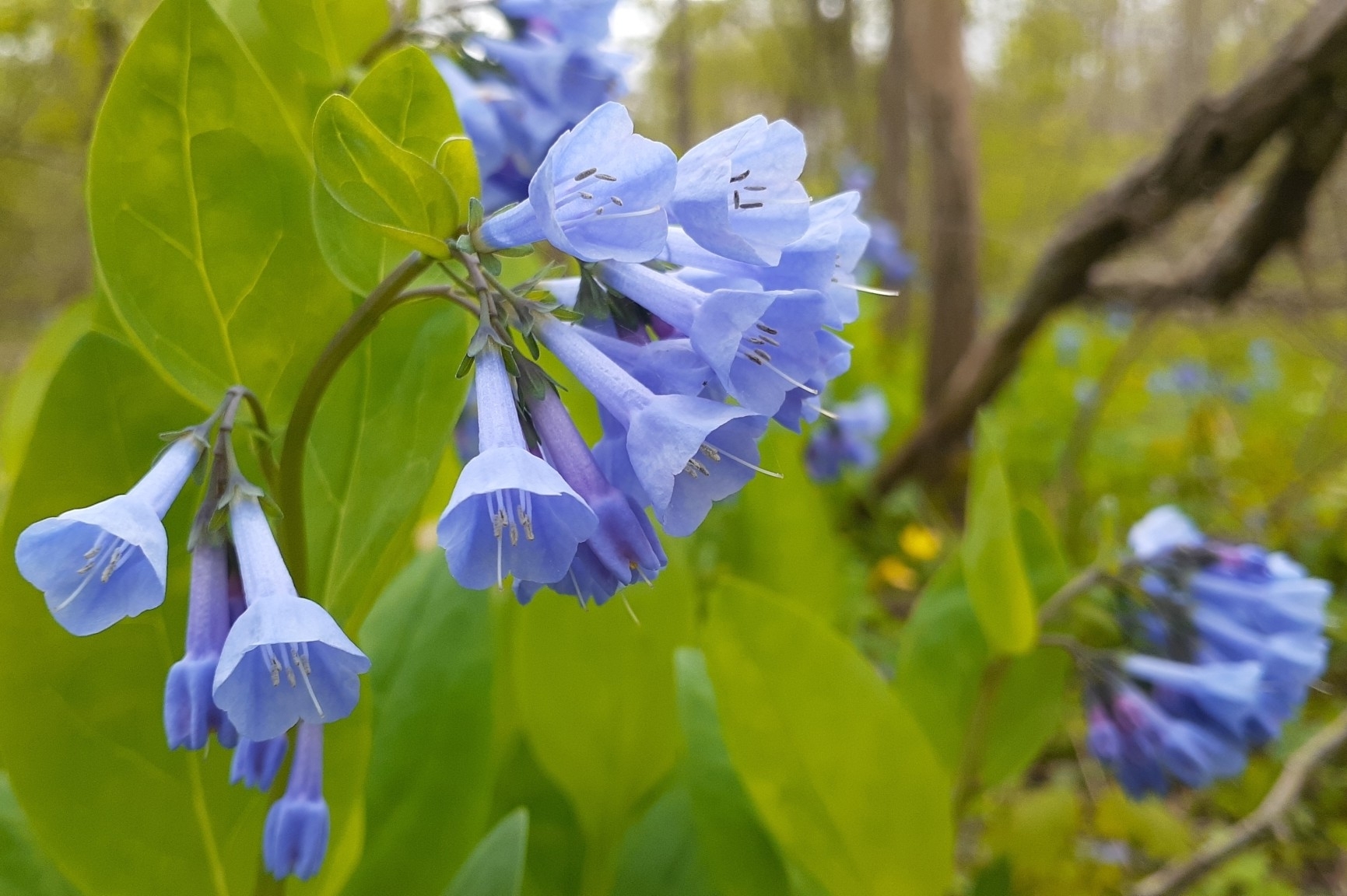
Lots of Virginia Bluebells (Mertensia virginica) in bloom. I'd be lying if I denied that part of the reason I made this detour was to see these plants. 


I made a quick stop at a spot for Upland Sandpiper (which I didn't see), before continuing onto the Strathroy Sewage Lagoons. Here I added such birds like Sora and Virginia Rail, American Coot, Common Gallinule (stuck around!), Cliff Swallow, Purple Martin (a FOY), and a variety of ducks and shorebirds. Seems I missed a Dunlin and Semipalmated Plover, but can't get them all I guess. 

It was time to head up to the northern part of the county. Along Sylvan Road, I found the pair of nesting Common Ravens, a nice addition to the day list. I then went to the Ausable River Valley Trail, which proved to be rather quiet, although I did get Eastern Phoebe, Pileated Woodpecker, and my main target here, Vesper Sparrows. They weren't new for the day list, but I also had a pair of Yellow-throated Vireos It was a nice walk anyways, and I saw a great variety of plants. Hopefully I can try to get my camera back in working order and come back to properly photograph them. 

I opted to skip out on Parkhill CA to try for Ruffed Grouse (partially because of running out of time, and partially because my phone battery died), so I made a beeline for Thorndale to check out those ponds I had not gotten a chance to go to earlier in the day. 

Birds were getting harder and harder to add, and when I arrived at one of the ponds, I saw they were doing work with heavy machinery on one of the hedgerows in which I had a variety of would be new birds for the day list the night before. All I managed to add at that one spot was Hooded Merganser. 

At the next spot, a gravel pit, I scoped for ducks, but was only able to find a single new bird, a lingering black duck. As I tried to find a place to turn around, I had my first and only White-crowned Sparrow of the day fly across the road. I let out a whoop when I saw that one. 

I stopped briefly at a spot where I had a singing Golden-crowned Kinglet earlier in the week, but I didn't find it. I then went out of my way to get an Osprey by scoping a known nest. A bit later one would fly over me, so I guess that was for naught...

I finished my diurnal birding by hitting a spot in the neighbourhood, which is where I got Green Heron, Cooper's Hawk, and Swamp Sparrow (good thing I know that spot well, I had to go to a pretty out of the way place to get that sparrow!). 

A couple hours later, I went out for woodcocks, but for the first time in pretty much all of my spring big days, I couldn't for the life of me find one! Over the course of an hour I checked five or six locations, each one of them coming up empty. Very strange, perhaps all the new development in the area made them move on. As a consolation, I still added two last birds to the day list: Great Horned Owl and an Eastern Screech-Owl.

At the end of the very tiring day, I ended up with 128 species all within the borders of Middlesex County. Sure beats last year's total of 94, and my total of 101 from earlier in the week. Had it been a bit later in May, and we were seeing more migrants move through (overall it was a pretty cold, windy, overcast day, and it hadn't been great for migration in the days leading up), I probably could have even tallied a few more! Of course, there were some quite notable misses, excluding woodcock, such as Eastern Kingbird, Brown Thrasher, Chimney Swift, Indigo Bunting, Northern Parula, Ruby-throated Hummingbird, Cedar Waxwing, and Herring Gull.

It was a really fun day, and I saw some great birds. I live for this kind of stuff! 

Monday, 28 December 2020

A Golden Day

I have been trying to see a Golden Eagle in Middlesex County for the past few months now. I struck out on getting them in migration (somewhat understandable, as we aren't really located in a good area for raptor migration), and then I missed them every time Bill and I had gone down to Newbury, where they are known to winter. You'd think four times would be more than enough! Anyways, today I decided to take another shot at it, and went down again. Perhaps fifth time would be a charm.

I started out on Argyll Drive, but couldn't turn up really anything of note except Snow Buntings. As I was driving down Watterworth Drive, I spied a couple eagles in the distance. I hit the gas, and turned down Oilfield Drive. My actions were rewarded by two adult Golden Eagles, which were soon joined by a subadult! It was my 223rd year bird for Middlesex, and probably my last. Not that bad, all things considered. 


Satisfied, it was time to head back home. On the way, we spotted two more adult Golden Eagles just south of Glencoe. Perhaps different birds. 

A quick check of the Snowy Owl area revealed one owl, my first this month!

Good to end the year with a bang. 

Saturday, 28 November 2020

A Good Week of Birding

 This past week has been quite good for birding here in Middlesex County. Although the pretty much non-stop action of late October and early November has slowed down, still plenty to be seen.

The week started off with a bang. Late Sunday evening, I saw a Summer Tanager posted to iNaturalist from London. I was able to get in contact with the homeowner, and arrange for myself and Bill Lindley to go see it the next day. So on Monday morning, Bill and I staked out the feeder. It had been seen five minutes before we got there, but was a no show for the next three hours we stood there. We decided to go home to warm up, then come back a couple hours later. Not 20 minutes after being home, I got a call from the homeowner that said the bird was back! About 25 minutes later, we were on it!


 Certainly makes up for missing all the ones in the spring!

Later that night, a White-winged Dove was reported in Lambton, about 500 meters from the Middlesex county line. Bill and I made plans to head out and try to see if we could find it within the county the next day.

On Tuesday afternoon, we went out, but were ultimately unsuccessful in finding the dove. Since we were nearby, we opted to head down to Newbury. Although there were no Golden Eagles to be seen, we did end up having some great birding along Argyll Drive, highlighted by a couple White-crowned Sparrows, a Northern Shrike, and nearly 300 Common Redpolls.

Wednesday was a washout (literally), and Thursday wasn't much better. I just did some local birding. One thing that has been pretty good is the duck diversity in the neighbourhood. This week I have had the usual Mallards, as well as American Black Ducks (and a hybrid), American Wigeon, Northern Shoveler, Northern Pintail, Hooded Merganser, and Green-winged Teal. 

On Friday, Bill and I were out again, looking for Hoary Redpolls and Pine Grosbeaks. 

We drove through the Strathroy area, and ended up finding a couple Snowy Owls, the first of the season. This is the first time I have seen this species in November.

Our first stop was Argyll Drive in Newbury. It was not quite as birdy as it was on Tuesday, but we did see a pair of Common Ravens, quite the oddity.


Next up, we tried going up Oilfield Drive. It was pretty quiet at first, but we pulled over at one point after seeing a couple sparrows flitting around the bushes. As we were stopped a single redpoll flew over, not really unexpected anymore. I pointed my binoculars out to the field and saw a few more flitting around the corn stubble, still not unexpected. Then, a few hundred lifted up! We scrambled to get our scopes, and set them up, scanning for a whiter redpoll. After a few "oh that's a white one", but nothing definitive, we noticed three redpolls sitting on the hydro wire, and wouldn't you know it, one of them was a Hoary! We got brief, but satisfactory, scope views. Splendid! I still need one for my neighbourhood (flushed a good candidate from underfoot today, but I lost it!), but at least I can stop worrying about it for Middlesex! Just need a Pine Grosbeak (and Bohemian Waxwing) now!

We traversed a few more concessions, but nothing more to report. We stopped into the landfill for a bit to look for gulls, but it was mostly just Herrings and Ring-billeds. We did manage to find a couple Great Black-backs and a single Lesser Black-backed though.

It was a very fun week! Onward to December, hopefully we can end the year with a bang!

Monday, 2 March 2020

Moss and Fish

I have spent more time than I probably should have in the last month or so looking at mosses, a difficult genera that I seem to really like for some reason. Here are some of my favourites. (Cell phone photos because I have forgotten my SD card in a few occasions).

Goose Egg Moss (Arrhenopterum heterostichum) is a species that seems to be indicative of rich Carolinian forest habitat. This was from Skunk's Misery in Southwest Middlesex county. I have also seen it in Rondeau Provincial Park. 


I believe that this is Steerecleus Moss (Rhynchostegium serrulatum), based on the capsule shape and twisted leaf tips (apices), among other microscopic features. It is fairly uncommon.


Another uncommon species of moss is Ohio Haircap Moss (Polytrichastrum ohioense)


A favourite of mine is Marsh Cardinal Moss (Ptychostomum pseudotriquetrum) is a species of calcareous habitats. The bright red stems are quite the show stopper.


One last moss is Streamside Schistidium Moss (Schistidium rivulare). This is a difficult genus to key out, but habitat is a huge indicator (I had this on a rock right beside a creek).


Now a couple fish to wrap things up.

Stonecat

Greenside Darter

Northern Hog Sucker

Central Stoneroller

Birdwise, I have seen the overwintering Golden Eagles and Short-eared Owls in the southern part of the county. The first blackbirds came in en masse (around 80 total) on February 24, but with the weather, I haven't seen any since. Still waiting for the vultures!

Tuesday, 2 January 2018

Snowy to Skunk's

I went out this afternoon to see what sorts of birds I could add to the good old year list. We started out looking for Snowy Owls. It wasn't long until I spotted one at the top of a tree.


At one point this crow started mobbing it. The owl wasn't bothered, so the crow didn't stick around long.


We spent some time driving country roads on the way to Skunk's Misery. We found a nice sized group of Horned Larks on one of them. Been awhile since I have seen a flock that large!


We were almost to Skunk's when I spotted a couple large raptors cruising just above the tree line. After looking at them closer with binoculars, I had a feeling that they were Golden Eagles, which are known to overwinter in the area. I got my answer when I managed to photograph one of the birds.


It was in fact a Golden Eagle! Quite an exciting find indeed!

It was almost sunset when we arrived in Skunk's Misery. We spent about an hour trying to find some owls, but we were unable to detect anything.

It was a pretty productive few hours of birding! I'm sure I'll be out again soon!


Sunday, 2 July 2017

Butterflies, Birds, and Mosquitoes

Today was the Skunk's Misery Butterfly Count. I joined Blake on his sections of the count. From what I heard it was a very slow day, although altogether we tallied 50 species. For most there were only a few representatives from each. The butterfly that was seen the most was Cabbage White, with over 400 (if I remember correctly).

In the morning, we walked about five kilometers down Centerville Rd.


A few butterflies greeted us as soon as we got out of the car, including Monarch, Orange Sulphur, Clouded Sulphur, European Skipper, Peck's Skipper, and Northern Crescent.

Orange Sulphur

Common Milkweed and Butterfly Weed were abundant, so the Milkweed Beetles were out.


Eastern Comma seemed to be easy to find, and were common in pockets here and there. There were some Gray Commas too.

Eastern Comma

A few Question Marks were to be found as well.


An exciting find was a Compton Tortoiseshell. These are rare in Middlesex, and aren't found every year. It is quite the stunner.


A few Tawny Emperors could be found.


The damsels and dragonflies also caught my attention.

Eastern Pondhawk

Aurora Damsel 

Little Wood-satyrs were numerous, as were Red Admirals. There were a couple Silver-spotted Skippers along the forest edge.

Silver-spotted Skipper

Red Admiral

There were a couple Appalachian Browns and Common Wood-nymphs throughout.

A. Brown

This Monarch is newly emerged. You can see the chrysalis on the right.


Only one Mourning Cloak was seen. It appeared quite fresh.


Only ONE hairstreak was seen on our route the entire day. It was a Banded. Apparently last year this count had the highest number of Banded Hairstreaks anywhere in North America.


As for birds, Hooded Warblers, Mourning Warblers, Pine Warblers, Ovenbirds, Veerys (Veeries?), Indigo Buntings, and a Broad-winged Hawk were just some of the species seen.


I almost got FULL FRAME shots of an ADULT MALE Hooded Warbler!!! I bushwhacked into where I heard one singing, then pished for a couple minutes. I saw it fly over into a bush, so I walked over to a clear area and started pishing again. Literally only seconds after I started pishing, one came in and perched on a bare branch about 3 meters away at eye level. I lifted my camera, but the darn bird caught my movement, squeaked, then flew off never to be seen nor heard again. ARGGHH!

After lunch, we headed farther afield.

A quick stop in County Line Woods yielded Eastern Tailed Blues and Ruby Meadowhawks.

E T Blue

Ruby Meadowhawk

Another location along the river had a lot of Great Spangled Fritillaries, European Skippers, and Delaware Skippers.

Great Spangled Frit


Delaware Skipper

I didn't know I had seen a Painted Lady until I was reviewing my photos. I just dismissed it as a Red Admiral. This brings the species count up to 51. However, I imagine that the official tally will remain 50.


Indigo Buntings were pretty common today. It wasn't uncommon to find one singing beside the road while we were looking for butterflies.


Is that a dragonfly on the log or not? I'll let you figure that out!


The final stop of the count was a small patch of wildflowers. It was pretty quiet.


Butterfly Weed

Common Milkweed

After we went to the BBQ to compile the lists and socialize. Exploring the property, we found a pair of Eastern Bluebirds and my first Pearl Crescent of the year.


It was discovered that more participants are needed for the Clear Creek count on July 22nd. If you are interested, then please come out (I'm not really sure about the details.)

Overall, despite lack of numbers, it was a good day. Below are the species that I personally saw. If it is bolded, then it was a lifer.

  1. Eastern Tiger Swallowtail
  2. Cabbage White
  3. Clouded Sulphur
  4. Orange Sulphur
  5. Banded Hairstreak
  6. Eastern Tailed Blue
  7. Great Spangled Fritillary
  8. Pearl Crescent
  9. Northern Crescent
  10. Question Mark
  11. Eastern Comma
  12. Gray Comma
  13. Compton Tortoiseshell
  14. Mourning Cloak
  15. Painted Lady
  16. Red Admiral
  17. Tawny Emperor
  18. Northern Pearly-Eye
  19. Appalachian Brown
  20. Little Wood-Satyr
  21. Common Wood-Nymph
  22. Monarch
  23. Silver-spotted Skipper
  24. European Skipper
  25. Peck's Skipper
  26. Northern Broken Dash
  27. Delaware Skipper