Showing posts with label challenge. Show all posts

Saturday, 25 August 2018

The Quest to...Ten

Of the dragonflies, the ones that I find the most fascinating, for some reason, are those of the genus Sympetrum, commonly known as the meadowhawks.

Meadowhawks have a reputation of being impossible to identify, and in most cases that is just not true. The only trouble comes with the Ruby, Cherry-faced, and White-faced (Sympetrum rubicundulum/internum/obtrusum) complex. Even so, in mature males, really only Ruby and Cherry-faced cause any problems.

Ontario has had ten species of meadowhawks, eight of which are regular, and two of which are very rare vagrants. 

  1. Saffron-winged Meadowhawk (Sympetrum costiferum) 
  2. Cherry-faced Meadowhawk (Sympetrum internum) 
  3. White-faced Meadowhawk (Sympetrum obtrusum) 
  4. Ruby Meadowhawk (Sympetrum rubicundulum) 
  5. Band-winged Meadowhawk (Sympetrum semicinctum) 
  6. Autumn Meadowhawk (Sympetrum vicinum) 
  7. Variegated Meadowhawk (Sympetrum corruptum) 
  8. Black Meadowhawk (Sympetrum danae) 
  9. Blue-faced Meadowhawk (Sympetrum ambiguum) ***VERY RARE 
  10. Red-veined Meadowhawk (Sympetrum madidum) ***VERY RARE
Of the regularly occuring eight, I'd say six are fairly easy to find.

At the time of writing, I have seen six out of the ten species:

  1. Saffron-winged Meadowhawk (Sympetrum costiferum) 
  2. Cherry-faced Meadowhawk (Sympetrum internum) 
  3. White-faced Meadowhawk (Sympetrum obtrusum) 
  4. Ruby Meadowhawk (Sympetrum rubicundulum) 
  5. Band-winged Meadowhawk (Sympetrum semicinctum) 
  6. Autumn Meadowhawk (Sympetrum vicinum) 
With any luck, by the time you are reading this I will have seen a seventh, Black Meadowhawk (Sympetrum danae), which regularly occurs on on the coast of James Bay, and ranges throughout much of central and northern Ontario.

Assuming I get lucky with those Blacks, I will be left with three species to complete my Ontario Sympetrum list.
  1. Variegated Meadowhawk (Sympetrum corruptum) 
  2. Blue-faced Meadowhawk (Sympetrum ambiguum) 
  3. Red-veined Meadowhawk (Sympetrum madidum) 
Variegated is regular but uncommon in Ontario. From my research, it seems that the "peak" is in the spring, however there are records each year from the fall. Literature suggests that these fall records may be migrants from the west, where they are much more common. With enough looking, I am bound to one day stumble across one.

As for the other two, Blue-faced and Red-veined, I will have to work much, much, much, MUCH harder. From my research, there are only a couple records of each from the province. I believe they do occur much more regularly, however go undetected due to lack of observers.

Blue-faced is likely to occur in the Windsor/Essex/Pelee region, and I'd imagine that with the right conditions, an individual or two are likely to wander from the population just on the other side of the border.

Red-veined is a dragon of the west, ranging into Manitoba fairly close to the Ontario border. I would think they could occur in Ontario, possibly as a breeder, but they just go undetected due to the remoteness. Places to check could include Rainy River and Kenora Districts.

I am looking forward to the challenge of finding these dragonflies. I am sure I will see lots of cool things along the way!

Band-winged Meadowhawk (Sympetrum semicinctum)

***This is a scheduled post, so if you are reading this within a couple weeks of when it was posted, I am currently on the coast of James Bay trying not to get eaten by a bear :-)

Friday, 26 May 2017

Point Pelee on Sunday

This past Sunday I travelled down to Point Pelee to try for the 150 species challenge. To do so, I would have to find 43 new species, but I was up for it.

The day started around 5:25 am, when we arrived in the park. Just driving along the road produced Swainson's Thrush, which was 108.

I chose to go to the tip first thing, hoping that I would maybe catch a "fallout". It was a mistake, as there was no tip, and the only way to really go anywhere past the washout was by hopping over a couple rocks and logs to stand on a small patch of sand.

I added a few new birds to the list, including Wilson's Warbler, Indigo Bunting, Surf Scoter, Willow Flycatcher, and, surprisingly, Rock Pigeon.


Others observed include orioles, mergansers, Northern Parula, Chestnut-sided Warblers, and a Blue-winged Warbler.


Tilden's was next. It was pretty slow, but we still turned up a few birds. FOY Magnolia Warblers were nice, as were some great looks at Wilson's Warbler, Canada Warbler, and a Yellow Warbler on a nest. A Great-crested Flycatcher was my first visual of the year.

Magnolia Warbler

Wilson's Warbler

By this point it was raining steadily, so we decided to get out of the park and explore the areas to the north, stopping by the Marsh Boardwalk first. The target in the marsh were the Black Terns, which I did end up seeing and getting some great photos of.


We headed through the Onion Fields, where we picked up a Ring-necked Pheasant.


Heading into Hillman, the rain was pretty bad, and by this point I had given up on keeping my equipment dry.

The shorebird cell was productive with a number of Least Sandpipers, Semipalmated Sandpipers, Semipalmated Plovers, Ruddy Turnstones, Lesser Yellowlegs and Whimbrel.

Whimbrel

Woodland birds included Alder Flycatcher, Willow Flycatcher, Ruby-throated Hummingbird, and Chestnut-sided Warbler.

Chestnut-sided Warbler

After Hillman, we went to the Wheatley harbour. Here we found numerous shorebirds such as Ruddy Turnstones, Sanderlings, Least Sandpipers, Semipalmated Sandpipers, and Dunlin.

Dunlin

Least Sandpiper

Sanderling

Ruddy Turnstone

There were a couple gulls and terns too.

Herring Gull

By the time we headed back into the park, it had stopped raining. We decided to check out Woodland Nature Trail next. Here we were greeted by birds like Gray-cheeked and Swainson's Thrushes.

Swainson's Thrush

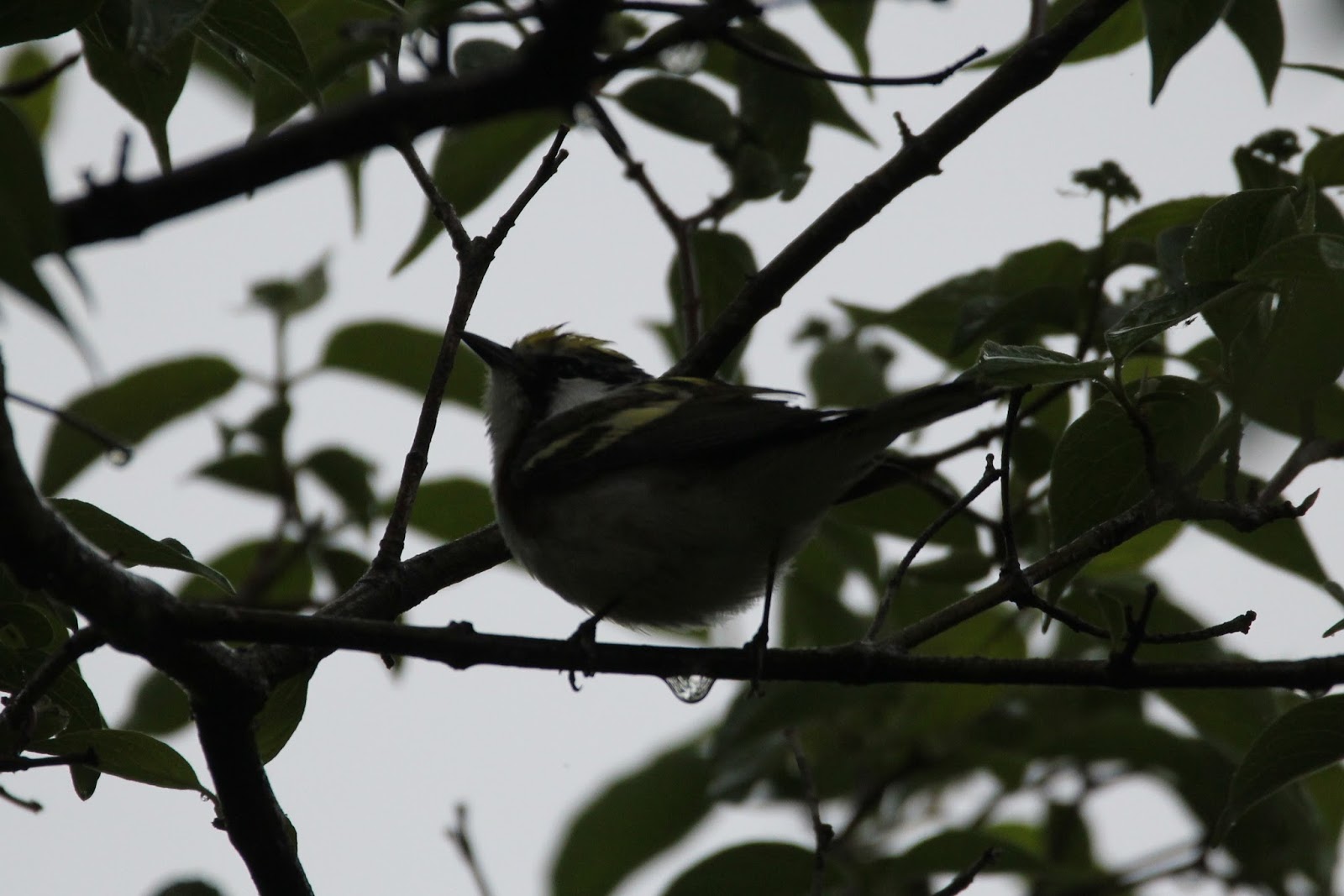
Also seen was a single male Prothonotary Warbler.


A hike down Redbud produced a FOY Monarch Butterfly.


Many other birds were seen, including a Black-billed Cuckoo that was calling somewhere off to the side of the trail. Baltimore Orioles were abundant.


I decided to walk to Sparrow Field, and as soon as I got there, a small brown bird flew up from the brush out into the open on a branch. Here is what I saw:


My heart was pumping, I had just seen a Henslow's Sparrow, and had gotten some great photos to boot. I high-tailed it back to the VC to alert everyone of my find. It wasn't until I was half way there that I finally clued in...


It was a female Bobolink. Still a decent bird that many birders miss while down in Pelee, but it's not a Henslow's Sparrow.

There were a couple nice flowers along the pathways.

Wild Columbine

Mayapple

Cactus Field didn't produce the Eastern Bluebirds I was hoping for, but we did get some great looks at some Indigo Buntings and nesting Yellow Warblers.


Since the sun had come out, I wanted to have another go at photographing the Black Terns. Unfortunately, there were just too many tourists, and the Marsh Boardwalk was very busy, so the terns weren't coming to close. I did get a couple shots that I'm happy with.


The last stop of the day was Hillman Marsh. It was much drier now, so scoping out the shorebird cell was a bit more enjoyable than earlier. It's a good thing that I took the time to scope, because I soon found two White-rumped Sandpipers. It seems to be a good year for them. I attempted photos, but I'm not sure how they turned out. I'm thinking this is one of the WRSA, but I could very well be one of the SESA.


There were a few White-tailed Deer hanging around.


I headed out toward the marsh, and began to listen for rails and herons. It wasn't long before I found about five or so Marsh Wrens.


Soon, I saw a Least Bittern, which was a lifer, flying over the cattails, then started calling. Not long after that another one came in and perched where is was visible.


An immature Black-crowned Night-heron joined in too.


It wasn't long before an American Bittern was found as well. A great ending to a great day.


While I never did reach 150 species (I still had 9 species to go), I surprisingly did better species wise this trip than last trip, as I finished with 108 species. Considering the conditions, and that almost all of my 141 species were "self found" I'm proud of my accomplishment.

I'll be heading up to the Bruce Saturday evening for the night, so hopefully I can at least get my month list up to 150 species. More on that, and part two of my Pelee Big Day, later.

Good birding!