Showing posts with label Eurasian Collared-Dove. Show all posts

Saturday, 21 April 2018

Spring has Sprung!

Recently there has been a large influx of birds in my area. Over the last few days I have spent quite a lot of time checking out some of my local spots. I have not been disappointed!

I was quite happy to see my first Yellow-rumped Warbler of the spring back on Tuesday.


I also managed to see a Savannah Sparrow and Wilson's Snipe that same day.

Savannah Sparrow

Wilson's Snipe

A pair of Eastern Phoebes were working a wetland.

Eastern Phoebe


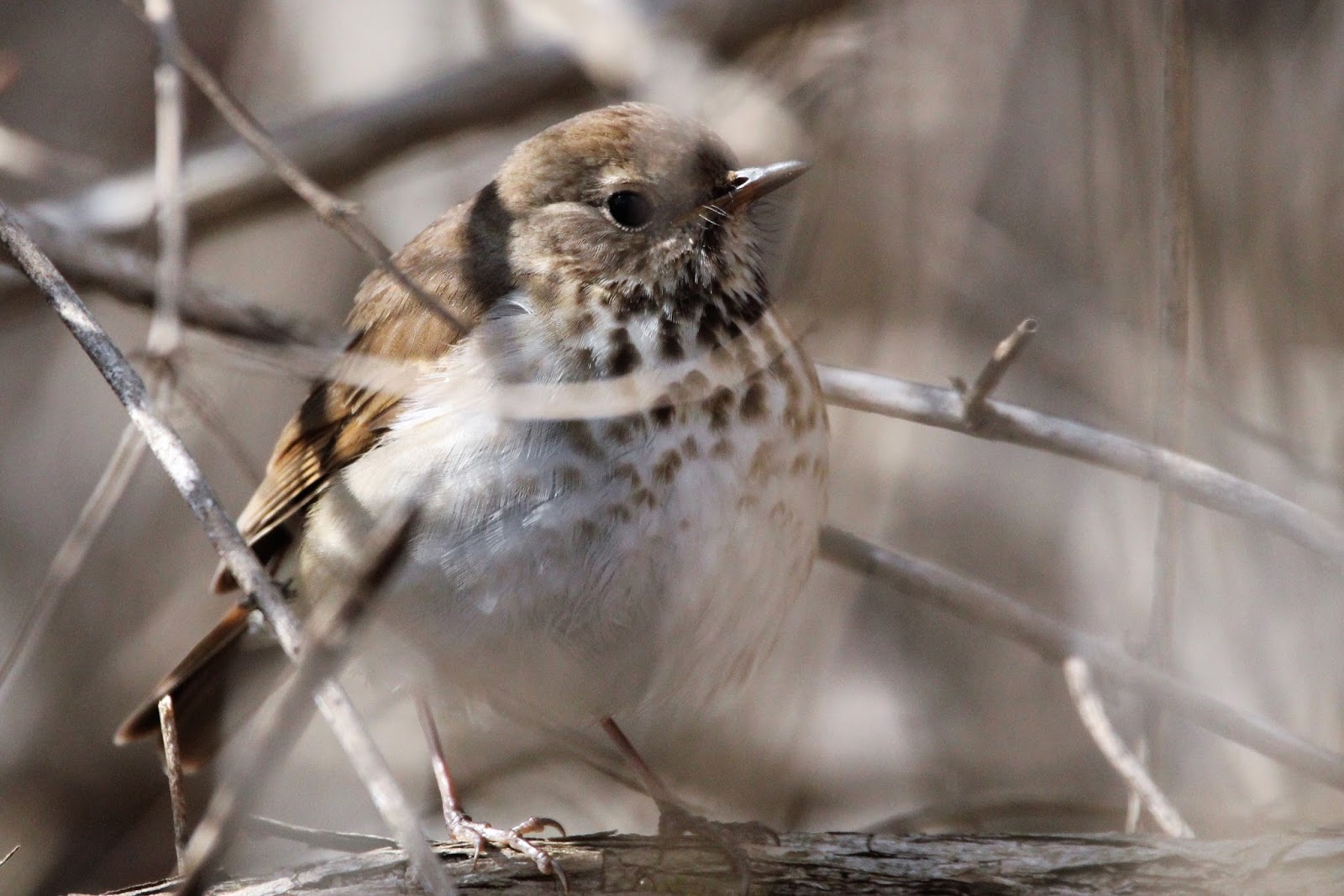
A couple days later I went out again, and saw my first Hermit Thrushes of the year, as well as a Yellow-bellied Sapsucker.

Hermit Thrush


Yellow-bellied Sapsucker

Yesterday, Friday, I went down to Dutton to try and see the presumed Eurasian Collared-Dove. It was a success!


Eurasian Collared-Dove (left) and Mourning Dove (right)

There were a few American Robins at the dove spot as well. I also managed to see my first Barn Swallow of the year on the drive.


I spent all day today riding around my neighbourhood looking for migrants. It was a nice surprise to find my first Spotted Sandpiper of the year.


There were a few swallows around today as well. Most were Tree Swallows, but I caught a glimpse of a Northern Rough-winged Swallow a couple times.

Tree Swallow

This Horned Grebe has been hanging around for a few days now. Today it allowed for some decent photos!


I also saw my first Broad-winged Hawk and Chipping Sparrow (finally) of the year.

Chipping Sparrow

After so much success first thing in the morning, I went back out after breakfast. I was quite pleased to find my first ever Dekay's Brownsnake.


There were a few Ospreys hunting for goldfish in the pond.


As I was rounding a corner I spotted something on the flooded pathway. It was an American Bittern! Unfortunately my camera was in my backpack when I first saw it out in the open, but thankfully it allowed me to get some record shots of it in the phragmites.


American Bitterns are a pretty rare find in the London area. This sighting is only the fourth record on eBird in the last decade!

I came back a little later, and found the bittern back on the path. Thankfully, I was prepared this time, and managed to get some photos that I am happy with.


What a great few days it has been! Let the madness (hopefully) begin!

Wednesday, 4 January 2017

The Rarities of 2016

2016 was an amazing year for rarities (check out my post on a 2016 Ontario Big Year for a list of rare birds). I didn't get to see all of them (Common Ringed Plover and Crested Caracara being the most painful not to see), but I caught up with a few of them.

The first rarity I was successful in seeing was a Greater White-fronted Goose in London.


This is typically more a "western goose", however large numbers showed throughout 2016. This individual was somewhat tame, and many birders got close enough to take decent photos. The bird that showed up in London appeared to be a "Greenland" type.

Nearly a month later a Gyrfalcon showed up in Warwick, Lambton.


The bird stayed for at least a month, and offered great views. This Gyrfalcon was a gray morph, and appeared to be male. Great bird for Southern Ontario!

A week after the Gyr, an Eurasian Wigeon showed up in Lambton as well. I didn't get a picture, nor did I get a good look at the bird, but it was a Euro Wigeon nonetheless, so it was a great find.

The next rare bird I was able to lay my eyes on were Loggerhead Shrikes.


While a regular breeder in Ontario, they are only about a dozen pairs in the province. Carden Alvar boasts over half of these pairs, and this is where I found the Shrikes.

Piping Plovers aren't really "rarities" in Ontario, but finding a successful nesting pair sure is!


Darlington Provincial Park hosted two successful broods in 2016, the first in over 80 years! I'm not alone in hoping for their return this year.

An Eurasian Collared-Dove the next week was a great bird in Guelph.


The Eurasian Collared-Dove is making it's way northward, and I'm sure it won't be long before they regularly breed  in the province.

Marbled Godwit was next almost a month later in Hamilton.


Marbled Godwits are hard to come across in Ontario, with only a few records, if any, each year.

I saw a Red Knot the same evening as the Marbled Godwit in Hamilton.


The light was fading fast, but I managed to find the bird and get a some record shots. Red Knots migrate in the thousands through Ontario way up north along Hudson and James bay, but we usually only find around a dozen down here in southern Ontario.

Two months later I catch up with another rarity...Cattle Egret in Blenheim.


Like the Greater White-fronted Goose, 2016 was a great year for Cattle Egrets in the province as well, and there could have been as many as two dozen, maybe even more.

November was highlighted by a Western Sandpiper at the Blenheim Sewage Lagoons. This bird sure made people confused. Originally identified as a Semipalmated Sandpiper, It wasn't until a couple weeks into it's visit that the possibility of it being a Western really got going. After a few days of debate and examining pictures, we reached the conclusion of it being a WESA. I would have attempted for a photo if I knew it was a WESA, but I figured that I've seen lots of Semis, so I don't need any photos. I'm kicking myself now!

A Red-headed Woodpecker was a great local rarity that I found (with the assistance of some companions) on the London CBC4Kids.


RHWO are hard to come across during the breeding season, and even harder to find in the Winter. The bird this past December was a juvenile.

A female King Eider in Hamilton was a great bird.


King Eiders are regular but usually hard to find. So far this winter has been a good one for this duck. I'm sure it's just a matter of time before an adult male is found.

Black Vultures are a Niagara specialty.


Black Vultures are becoming increasingly more common in Ontario, especially along the shores of Lake Ontario and Lake Erie. They can be separated from Turkey Vultures by the silvery spot on the tips of their wings.

My last rarity of 2016 was a Little Gull.


I've been searching for Little Gulls since I first learned about this species in July, 2015 (not all that far back, but I started birding in March, 2015). 2016 wasn't the best year for this rare gull species, but those who do a little birding in Niagara  are usually successful. They can be separated from a Bonaparte's Gull by their dark underwing.

Well their you have it. All the rare birds I saw in 2016. Hopefully 2017 will be even better, and I'm already off to a great start!


Wednesday, 3 August 2016

Eurasian Collared-Dove and Some Others

Sunday morning my mom and I got in the car and drove eastward. There were reports of a Eurasian Collared-Dove hanging around in Guelph for the last few weeks, so we checked that out first.

It was a cloudy day, and as the 'Burg Birder would say..."It's the weekend!"


When we arrived at the location (Elmira Rd. S) the bird was nowhere to be seen. So we turned onto Stephanie Dr., then typed "Cherrywood Drive" into the GPS (we call her Lady Nav), as I had remembered reading about Cherrywood some where along the line. As soon as we pushed "Go" the voice said "Arriving at Cherywood Drive on right". We pulled forward 5 feet and revealed the street sign that was concealed by a pine. Not 15 feet away from where we entered the street, I spotted the dove on top of one of those vent thingies.


We left in less than 10 minutes because it's a residential area, and the occupants probably wouldn't like me looking at their homes with binoculars. It's bad enough that on Nature London trips we usually find ourselves looking at people's feeders!

A shortish drive later, we find ourselves in Hamilton. There are a lot of Double-crested Cormorants, and I saw a nesting colony close to the highway.


I haven't seen this many since Pelee Island last fall.


They were perched on lampposts above the road, and there was even a sigh that said "caution: low flying birds"

Windermere Basin was home to a Snowy Egret for a few days, but it wasn't there when we went. There were however tons of Caspian and Common Terns, as both breed in the area. I'm still kicking myself for not getting a decent shot of the terns, as they flew right over!


Some others birds seen were Ring-billed Gulls, DC Cormorants, Mallards, Canada Geese, and a female Rudy Duck.


Shorebirds are starting to arrive, and I saw 5 species. Solitary Sandpiper, Stilt Sandpiper, Least Sandpiper, Short-billed Dowitcher, and Killdeer.

After the basin, we went down to Queenston Heights park in the Niagara region. I was hoping for Black Vultures, but I found out they don't hang around during the summer months. All I saw were Turkey Vultures.


And now some information for history buffs like me...

The Battle of Queenston Heights was fought on October 13, 1812. This is perhaps one of the best known battles of the War of 1812. The Americans decided to cross at Queenston, so they sent a small militia group on the 12th. General Sir Isaac Brock thought that the militia was a distraction, as crossing the Niagara currents isn't easy, and it would be much easier to cross at Fort George. So, Brock kept most of his men at the fort, but sent a few to Queenston.

It turned out that the Americans were intent on taken Queenston, so on the morning of the 13th, Brock woke to the sound of guns. He rode his horse all the way there, organized his troops, then personally lead the charge down the hill with his sword drawn. Unlike other generals, Brock liked to lead his men and not just direct them. His bravery lead to the victory of the British, but he was sadly killed by an unknown sniper. He was one of the 28 non-American causalities.

A monument was erected in his name, 182 feet tall. The monument is found on the longest un-defended border in the entire world. Brock's remains can be found here.


It is kind of neat that 200 years ago, men were running down these paths, fighting for their lives.


Its black, but not a vulture!


I didn't find anything out of the ordinary, but I spotted a lifer butterfly...Red-spotted Purple!

I can only imagine trying to cross this in 1812.


On the way home, we passed an old ship with a whole lot of cormorants.


The clouds cleared up and revealed a rainbow.


A nice ending to a awesome day. I finally tracked down a rare dove! It almost makes up for missing the White-winged Dove by TEN minutes back in June :)

These birds are eating the WWDO's seeds!

Good birding!