What a week it has been! I have had some pretty great birding, and here are some of the highlights.
Last Friday finally saw some movement (coincidentally, last year the 'drought' ended on May 14th as well), so I made a point of going to Kilally Meadows ESA first thing in the morning. Although it was not crazy, I still manged to tally 80 species in the five hours I was there (see the eBird checklist here). Highlights included Evening Grosbeak, Broad-winged Hawk (seemed a bit late), FOY Blackpoll Warbler, and my county lifer Golden-winged Warbler.
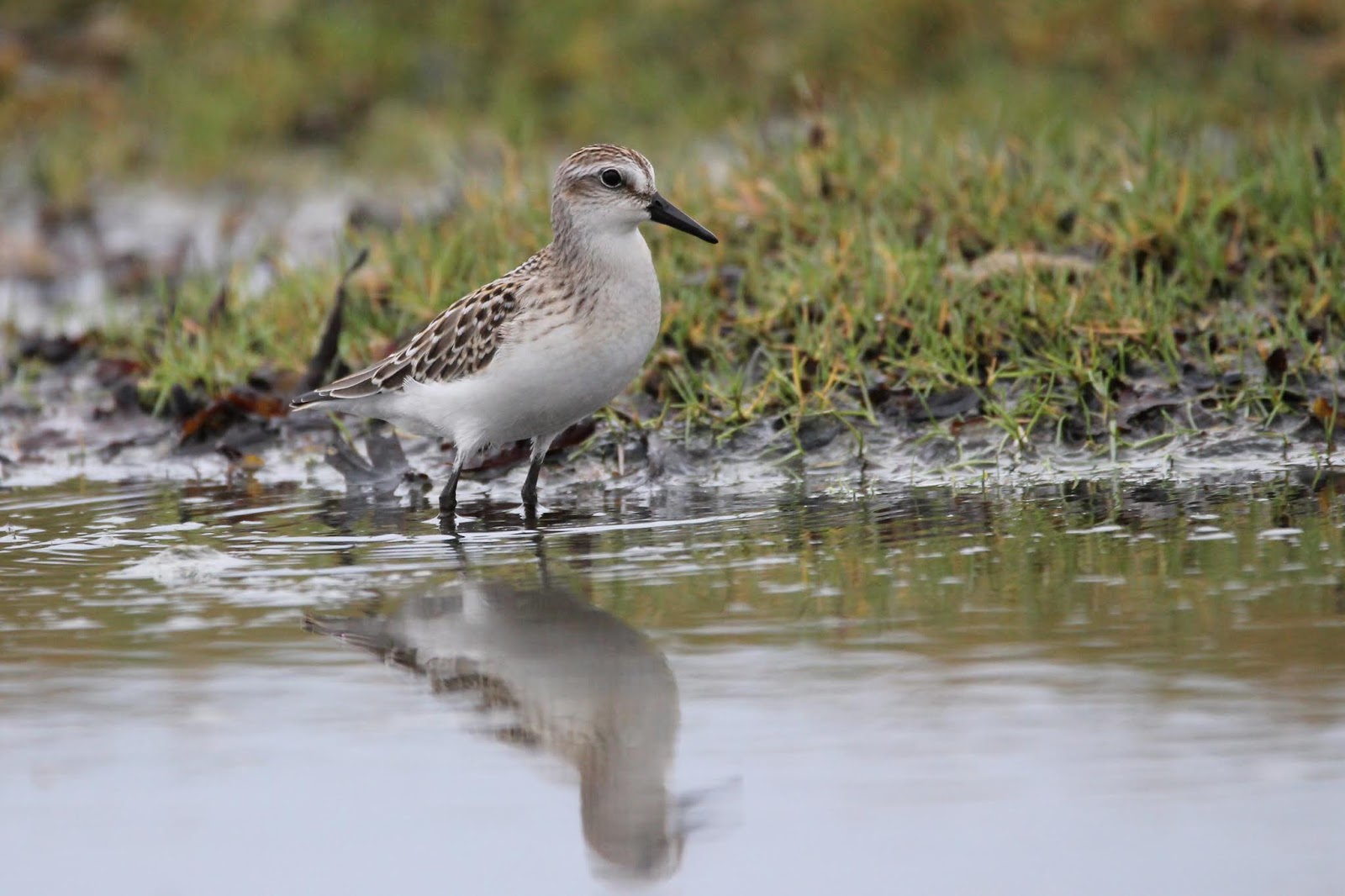
Just as I was leaving, I got a call from Bill Lindley who had White-rumped Sandpipers at the Strathroy Sewage Lagoons, so that's where I headed next. Although I struck out on the White-rumpeds, I did end up finding a small flock of Short-billed Dowitchers. Not a species I was exactly expecting to see this year in the county! I also saw my FOY Dunlin and Semipalmated Plovers.


As soon as I had gotten home, I got another call from Bill, letting me know a Wilson's Phalarope had been reported at Dingman Wetland, on the south side of the city. I was off again...
I arrived and immediately saw the female Wilson's Phalarope. What a gorgeous bird, the photo does it no justice.

The next morning I went back to Kilally. It was a bit slower than the previous day (eBird checklist here), and I tallied a few less species. Nevertheless, it was nice to see my FOY Scarlet Tanager and Bay-breasted Warblers, as well as getting some decent looks at another Blackpoll. At one point, I was surprised to find a Savannah Sparrow in the tree right above my head! Odd place for such a bird.
 |
| Savannah Sparrow |
 |
| Blackpoll Warbler |
 |
| Bay-breasted Warbler |
Later that afternoon, I saw that a Prairie Warbler, a species not seen in Middlesex since 2002, had been found at Cavendish Woods earlier that morning in the middle of London. A couple phone calls later, and Bill, Gord, and I were on scene.
To make a long story short, we spent a couple hours (with a short intermission to go see a White-rumped Sandpiper at Dingman) looking, but came up empty. We went back the next morning and found out from the guy who found it that the bird had stopped singing by early afternoon anyways.
What we did find however, was a Hooded Warbler! I got some pretty bad photos of it, but you can tell what it is. Patagonia Picnic Table effect anyone?

I did my usual Kilally route on Sunday morning, followed by that return trip to Cavendish Woods, but nothing really of note.
I saw there was a chance of rain in the afternoon (spoiler alert: it didn't happen), so I went out to look for shorebirds. My first stop was Strathroy, which in addition to my FOY Black-billed Cuckoo, I saw some more dowitchers. Spent some time photographing shorebirds.
 |
| Short-billed Dowitchers |

 |
| Dowitcher and Lesser Yellowlegs |

 |
| Least Sandpiper |
 |
| Dunlin |
 |
| Dowitchers in flight |
Afterwards I went to Dingman. There were many shorebirds to sort through, and I had 45 or so Semipalmated Plovers, which was my personal high count for southern Ontario (have had flocks of over 100 up on James Bay though), as well as my FOY Semipalmated Sandpiper. I was also pleased to get some better looks at the White-rumped Sandpiper.
 |
| Digiscoped White-rumped with many Leasts |
The next morning I went back out to Kilally, and was pleased to find a bunch of birds had come in, including my FOY Mourning, Canada, and Wilson's Warblers, Eastern Wood-pewees, Red-eyed Vireos (finally), and best of all, a Red-headed Woodpecker. Not a picture taking morning! See the eBird checklist here.
Later in the evening, I caught wind of Ruddy Turnstones down at Dingman (which is so inconveniently far away), and I was out the door before you could say "Arenaria interpres".
After some frantic scoping in the evening light, I managed to find them. A county bird for me, and one I was really hoping to cross paths with this spring. First Middlesex record in five years I believe.
 |
| Another digiscope |
A couple other birders showed up, and we stayed until dark. Paid off, since a Black-bellied Plover flew in!
The next morning I stuck to my neighbourhood (I wanted to be able to get home in time for the opening of vaccine registrations!), but I still managed to find my FOY Philadelphia Vireo and Alder Flycatcher. Compared to Kilally, not much going on though!
I finally set up my moth sheet on this night as well, since it was warm out. Not much in the way of moths, but I did add a new neighbourhood bird when I heard a couple Long-tailed Ducks calling as they flew over.
Kilally the next morning didn't yield much other than a few more Canada Warblers, and a lateish Common Loon. Still found nearly 70 species though. In the evening, I had my FOY Common Nighthawks flying above my yard.
The next morning once again started with Kilally (lol). FOY Yellow-billed Cuckoo was nice, but other than that no more year birds. I did have four Canada Warblers and three Mourning Warblers though, so hard not to be pleased with that I guess!
After I got home, I got an alert for Red-necked Phalarope and some Wilson's Phalaropes at the Strathroy Sewage Lagoons, so I bet you can guess where I ended up in the afternoon! It took a loop of the north lagoon, but I finally spotted both species of phalaropes (one Red-necked and four Wilson's). This was my first time seeing a breeding plumaged Red-necked.
 |
| Wilson's, Red-necked, and a Mallard |
And so that brings us to today, and of course I went to Kilally. Overall, it was pretty uneventful, although there was one highlight. As I was walking along the paved path, I heard a flycatcher vocalization deep in the woods that caught my ear. I suspected Acadian Flycatcher, so I investigated. Sure enough, I managed to get a better listen and a visual, and it was indeed an Acadian! The first one I have seen in four years. The species breeds regularly in a few woodlots in Middlesex, although there are very few records for right in London. It is no mega rarity, but it was nice to find something.

I have some audio recordings on my eBird checklist.
It was a fantastic week, and there should still be more to come! Still have a few species to catch up with, maybe tomorrow...