Click here to read Part 1.
Before I went out on Lake Travers, I decided to try and air out my feet a little bit. I learned at this point that not only did I forget to bring my boots, but for the first time ever, I apparently also neglected to bring a surplus of extra socks! This was going to be a rough 24 hours, especially if it rained as much as it was forecasted to do.
As I sat in my car doing so, I noticed something scrambling over the rocks on the other side of the river. It took me a second to figure out what it was...a baby moose!
Finally, I figured my feet were about as dry as they were going to be, so I put them back into my damp boots, loaded up the canoe, and launched.
I'm not sure if I have really introduced Lake Travers before. This lake is arguably my favourite one that I have visited in the Park. It is part of the Petawawa River system, located in the northeastern part of Algonquin. Because of its location, it is a great spot to look for birds, especially during periods of bad weather, that otherwise are very rare in the Park. Over the years, a number of rarities have been found here, and on this trip, I was hoping to get to add to that impressive list.
The campsite I like on this lake is not a very far paddle, so I got there in quick fashion and set up camp. It was mid-afternoon and sunny...not really much for me to do, so I took a nap. After that short siesta, I headed out on the lake for an evening paddle.
There was a White-winged Scoter, which is always nice to see. I would have preferred one of the other scoter species however :)
I also had one of my most memorable mammal encounters that evening. A (presumably different) baby moose was on the shore, and I was able to get quite close in the canoe without disturbing it. This was my first time seeing a moose this young. I will admit to becoming a bit complacent in regards to seeing moose—after all, I see them almost daily—but it is always nice to get to enjoy one by yourself for a prolonged period of time in a "natural" setting (i.e. not the shoulder of Highway 60).
Other than those sightings, no real highlights. It is just nice to get out on a calm lake sometimes!
Just as I was going to bed, the rain began to start softly. I hoped that with the rain, some goodies would drop down...
The next morning, I woke up around 4am to try and listen for any birds calling in the dark as first light approached, but it was quit hard to do with the rain pounding the tent. Had I made a mistake coming here? I could be sitting at home, warm and dry. Then, right around 4:30am, I heard a Black-bellied Plover calling as it flew overhead. This was a new bird for my park list. I scrambled out of the sleeping bag, threw on some clothes and my rain gear, and ran down to the lake's edge (not very far). The light was still dim, but I could hear Black-bellied Plovers, Semipalmated Plovers, and Least Sandpipers calling as they flew around. I couldn't believe it...it was actually happening.
I was in the canoe by 5am, and began to make the rounds, checking the little marshes and bays on the lake. The rain had sort of subsided by this point, and the shorebirds gone quiet, so I was getting a bit worried that the show was over. I persevered nonetheless.
After a bit over and hour of paddling around, the rain had begun to fall again, and in the distance I noticed a couple birds that ended up being Brant, also new for me in the Park. Not too long after those two, a small flock flew low down the lake.
So cool to see in this context! Being from Southwestern Ontario, and not really travelling too far very much, I had only ever seen this species on one occasion prior.
It was raining pretty steady by this point. I continued north up the lake, picking up species here and there, but noting too crazy. I looped around a small island at the north end of the lake, and began to make my way back south.
When I got to the south end of the lake, shorebirds started to fly around a bit more. Black-bellied Plover, Semipalmated Plover, Least Sandpiper, and Dunlin were tallied. Unfortunately, no mega rarities were mixed in! It was really fun to encounter these species in these numbers regardless.
.JPG) |
| Black-bellied Plovers |
.JPG) |
| Least Sandpipers and Semipalmated Plovers |
.JPG) |
| Dunlin |
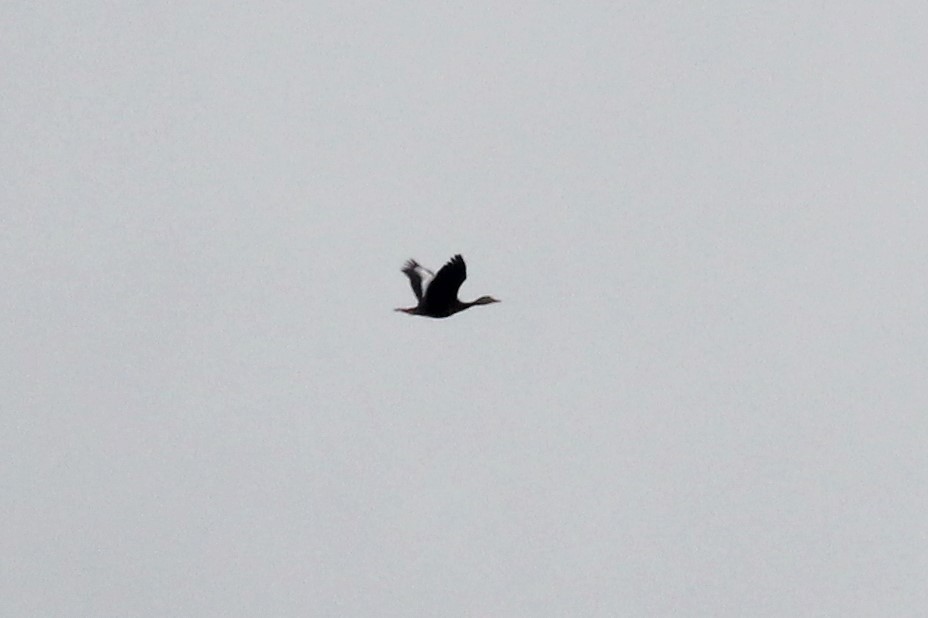
There were a number of Canada Geese moving on this day as well. I figure they are molt migrants. Around 8:30am, over the southern marsh, a large flock of geese approached. I snapped a couple of photos to count the flock later, and then turned my attention back to the shorebirds that were flying around. Just a minute or two later, I heard a very odd wheezy whistle vocalization that I did not recognize. Was it some sort of shorebird call I was unfamiliar with? Unlikely. I looked around frantically, and spotted something smaller with the flock of Canada Geese that were flying up river. Perhaps that was the source of the call. I snapped a few photos, and zoomed in. The first photo I looked at didn't show much. I scrolled to the next photo, and instantly felt my stomach drop. No. Freaking. Way.
It all clicked. The wheezy whistle belonged to none other than a Black-bellied Whistling Duck. This is a rare vagrant in Ontario, let along the middle of Algonquin Park.
I tried to get some more photos of it as it flew away, now that I knew what it was, but was unsuccessful. It was gone, never to be seen or heard of again.
The adrenaline rush that followed nearly made me tip the canoe. I couldn't even fathom that I had just seen a whistling duck in Algonquin Park, of all places. Needless to say, it is a first record for the Park. It also happened to be a lifer for me, and just like the Black-legged Kittiwake in October, seemingly the least likely place for me to see my first one. Although I sure hope I do, I very well may never find a better bird in Algonquin Park.
I'll be the first to admit that my photos aren't great, but they are diagnostic, showing the large striking white wing pattern, pink feet, and a bright red bill. Here is another photo, lightened, colour enhanced, and extra cropped to show these features.
So yeah. Make sure you check those flocks of migrant geese for whistling ducks, I guess.
I wasn't really sure what to do after that. It was still early in the morning, and there was no way to top that! Every bit of me wanted to hop in my car and get back to cell service to share the sighting with everyone, but I told myself I must carry on and see what else I could find!
The goose flight continued. A couple flocks of Brant went over. I didn't end up with a huge number of these geese, but I would have been happy with one!
This photo is one of my favourites from the day, despite maybe not being the best quality. I think it really captured the spirit of Lake Travers that day. This was part of a flock of 160+ Canada Geese that put down to rest on the lake.
I stopped in at the campsite for breakfast/to let my heart calm down, and then went back out for another lap of the lake. There were a few different species of ducks that appeared. I'm not sure exactly where they came from! Perhaps dropped in when I wasn't looking.
.JPG) |
| Long-tailed Ducks |
.JPG) |
| White-winged Scoter |
.JPG) |
| Red-breasted Mergansers |
.JPG) |
| Lesser Scaup |
The rain cleared, and the wind started to pick up, so I decided to try and make my way back south. I was paddling into the wind, so it was really slow going, but I made progress.
As I was still a kilometer or more from camp, I noticed a few white birds swooping around the marsh directly beside the site. Oh crap. I was sure they were terns, all of which are rare in the Park. I picked up the paddling a little bit. They moved over a creek mouth. No, no, no, no, no. I opted to snap a few photos as I got tossed around in the wind and waves. Soon after I did that, the three terns built altitude and left the lake, heading south and out of sight. I checked my photos...Caspian Terns!
There are surprisingly few (less than ten?) records of Caspian Terns from the Park. The only one that would be rarer I think is Arctic Tern (one record). This excludes Forster's Tern, of which there are no records.
I arrived back at the campsite, feeling quite accomplished. I packed up camp, loaded the canoe, and headed back to the access point. It was mid-afternoon by this point, and I was ready to get back home (I still had a three hour drive). Perhaps I should have stuck it out longer, but I doubt I could have topped the best sighting of the day! My eBird checklist for the day can be seen
here.
That day cemented my belief that Lake Travers is a truly magical place. Algonquin Park is such an incredible place once you get to know it...and the truth is, I really don't even know it very well! I am looking forward to a lifetime of exploration and similarly exciting discoveries. I love this park.


.JPG)
.JPG)
.JPG)
.JPG)
.JPG)
.JPG)
.JPG)
.JPG)
.JPG)
.JPG)
.JPG)
.JPG)
.JPG)
.JPG)
.JPG)