Showing posts with label Indian Paintbrush. Show all posts

Monday, 29 May 2017

Birding the Bruce

On Saturday, my dad and I headed up to the Bruce Peninsula to join the group from Nature London. They had gotten up there on Friday, but we were unable to get up until the following evening. Despite missing out a couple good birds (they had a beautiful Golden-winged Warbler), it was still worth the trip.

Driving up, we came across a Red Fox den with some fairly young cubs.


Then, a couple hours later, we came across this...


That's right, a Black Bear! This was a lifer for me, and I was excited to be able to see one.

We soon arrived at Little Cove road were a couple of the group members were waiting. Around eleven Common Nighthawks made an appearance, which were nice to see. Note the white bars under the wings.


Grasshopper Sparrow, Eastern Towhee, and Black-billed Cuckoo were also seen. Coyotes were heard giving some weird vocalizations, and at first we thought they were a loon.

BB Cuckoo

We managed to hear and see American Woodcocks and Eastern Whip-poor-wills. The whips were quite close to the road, and at one point we actually saw two of them jump up and sort of attack each other. We counted five, but there very well could have been more. It would be interesting to return in late June and see if there are any successful nests.


The next morning the two of us hit Dyer's Bay and Crane Rd. before joining the group.


American Bitterns, Ring-necked Pheasant, and a Sora were calling. The bitterns in particular were quite cool as I've never heard them before this trip.

American Bittern

A few Sandhill Cranes, as usual, were found.
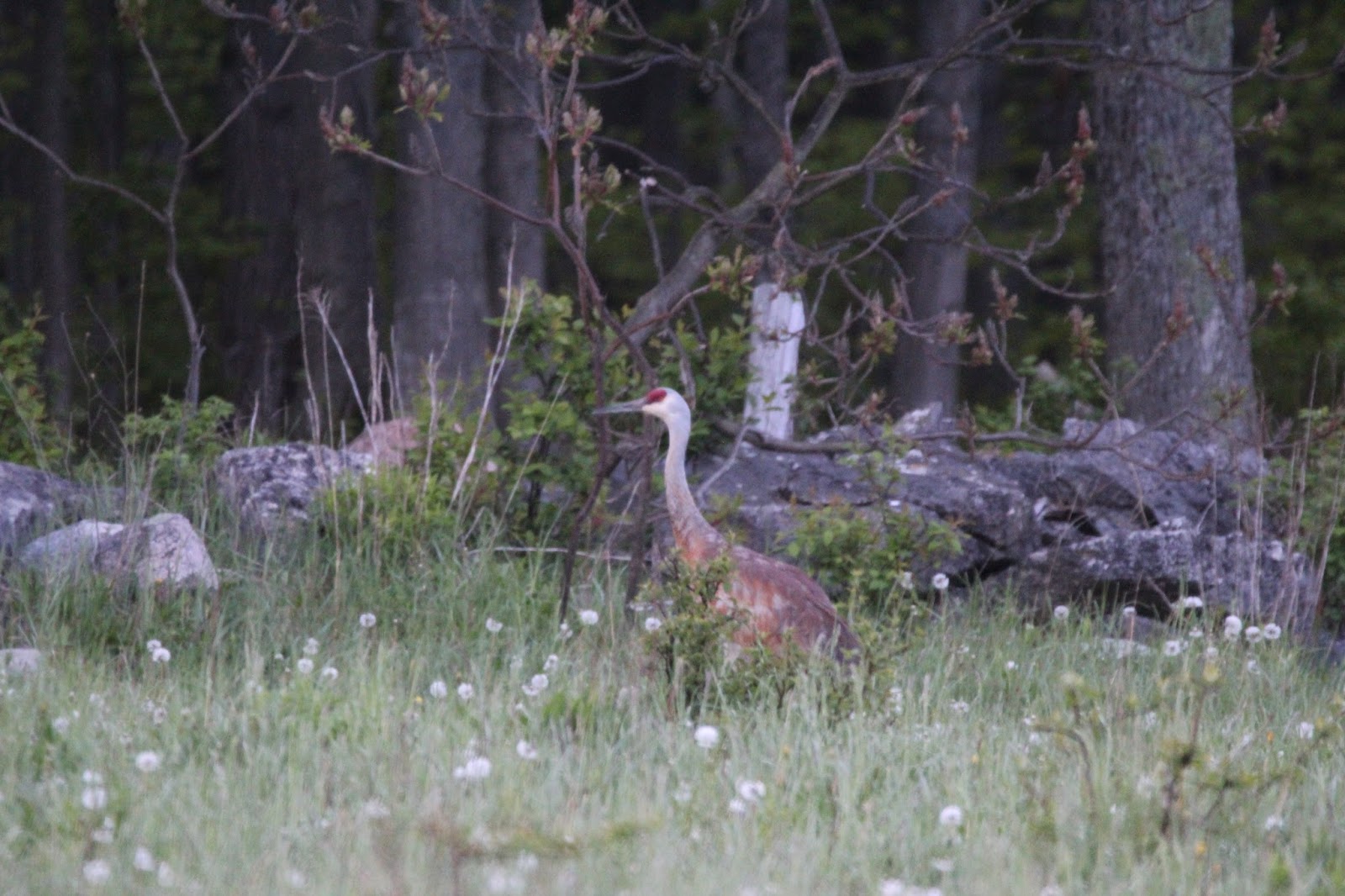

I'm sure we would have heard more had it not been for the cows making a racket.


Grasshopper and Swamp Sparrows were present, along with Yellow Warbler and some Eastern Kingbirds.

Eastern Kingbird

We met up with the group in Tobermory. We walked around a bit and ate some breakfast, stopping to look at birds when we found them.

Double-crested Cormorant

Black-and-white Warbler

Ring-billed Gull

Hooded Merganser

There wasn't really all to much to be seen...except....American Redstarts.


The Bruce seems to be the place to get redstarts, and it isn't uncommon to hear someone exclaim "oh, it's a.....(discouraged noises) redstart"

After breakfast, it was off to Cape Hurd road. There was a bit of excitement as we first turned onto it, with a small group of warblers containing Chestnut-sided, Wilson's, and, of course, redstarts.

American Redstart

Some more excitement when we found a nice low kettle of Broad-winged Hawks and a Ruby-crowned Kinglet, the first and only of the trip. Winter Wrens created a stir as well.

Broad-winged Hawk

We stopped into Sunset Park. This is a great spot for Indian Paintbrush.


You can get some great looks at Common Yellowthroats here as well.


Moving onward to the dump, we quickly located a few Common Ravens, the target species.


Distinguishing Field Mark: Wedge Shaped Tail

Also seen were Eastern Pheobe, American Kestrel, Black Bear, Ruby-throated Hum-, wait a BLACK BEAR?!?!? My second one of the weekend and the first for the rest of the group. It ambled out of the forest into the field then commenced to head toward us.


It soon broke out in a run...but not before a few of the group members had already gotten back into their cars a couple hundred meters away.

We were (mostly) calmly returning to our vehicles when we heard the loud bang of one of the garbage bin lids. After a couple explosive obscenities, we realized that it was just the wind.

Continuing on to Warner Bay road, we came across an Alder Flycatcher, Eastern Bluebird, and a Clay-colored Sparrow.

Eastern Bluebird

Then came another lifer...a Massasauga Rattlesnake. Only thing was that it was being eaten by a Great Blue Heron...it was still alive so it technically counts, right?

The rattlesnake had somehow wrapped it's way around the heron's head, and the bird soon flew away with the snake still tangled up in it's bill. We can only wonder who won (my money is on the heron).


Singing Sands revealed our first terns of the trip.

Common Tern

It was quite nice to be able to take a little break from hiking and walk in the water.


While in the woods, we came across a nice little grouping of warblers including Nashville, Canada, and a Blackpoll.

There were a couple other flowers around, including the Dwarf Lake Iris, which is only reliably found in this part of Ontario.

Fringed Polygala (Gaywings)

Dwarf Lake Iris

Star-flowered Solomon's Seal

Indian Paintbrush

After Singing Sands, we headed toward Sky Lake, but not before checking out a spot known for Brewer's Blackbirds. It was here we found numerous Savannah Sparrows, Bobolinks, and our first Warbling Vireos.

Savannah Sparrow

Warbling Vireo

We did eventually find a couple Brewer's Blackbirds. The distinguishing white eye is visible.


The lake was not as busy as we would have liked, but a few Great Egrets and Marsh Wrens kept us more or less entertained.


A few Bullfrogs and fish as well.

Rock Bass

Isaac Lake was next on the agenda, but this cow didn't really want us to go.


Blue-winged Teal was quickly found, as were Caspian Tern, Tree Swallow, and American Wigeon.

BW Teal

Caspian Tern

Tree Swallow

The star of the show was a Sedge Wren that appeared to be building a nest. It took me awhile, but I eventually scored some decent photos of it. Photos of this bird are nearly impossible to get at they seem to never come out into the open. I got lucky and the bird came out for about 20 seconds.


A few new birds were added to the trip list here including Wilson's Snipe, Mute Swan, and Common Loon. The swans were new for my county list.

The last stop of the Nature London trip was the Wiarton Sewage Lagoons. Here we saw our first Spotted Sandpiper, Northern Shovelers, and Lesser Scaup. According to eBird, the Lesser Scaup are uncommon/rare at this time of the year in the Bruce.


After breaking off from the group, we headed down to Sauble Beach for the Piping Plovers. We found a pair, including an unbanded male, which I thought was interesting. Hopefully their nest succeeds this year.


It was a pretty good trip, and I can't wait until my next excursion northward.

Tuesday, 14 June 2016

Bruce Birding Weekend: Part One

On May 20-22, I went on a Nature London field trip with my father up to the Bruce Peninsula. I have so much to talk about, that I decided to split the story into 2 blog posts. Part one will highlight Friday Evening and Saturday up to lunch, while part two will be about Saturday afternoon until our departure late Sunday afternoon. I saw a total of 116 bird species, and all my life birds will be in bold print. Hope you enjoy!

Friday was a lot of driving. What was supposed to be a 4 hour trip turned out to be closer to 6! The best birds on the way up were a pair of Sandhill Cranes near Wiarton.


As soon as we got to our campsite, I instantly saw and heard Blackburnian, Northern Parula, Black-and-white, and Magnolia Warblers. American Redstart was the last warbler species I saw before departing.

Northern Parula

Blackburnian

American Redstart

Magnolia

We met up with the group and the leader briefed us, I left it to my dad to get the info, and began to wander around. I noticed movement in a cedar, and bam! The first Cape May Warbler of the trip was observed. A few others managed to see this pretty bird.

The Sunset was beautiful.


After the briefing, we got into the car and drove over to Little Cove road to listen for the American Woodcocks. By this point, it was too dark for photos. When we pulled up, Ovenbirds were singing. A White-throated Sparrow gave one of the most beautiful oh sweet Canada Canada Canada I've ever heard. Ruby-crowned Kinglet and Common Yellowthroat was observed as well.

The woodcocks started peenting, and soon enough there were four of them along the short stretch of road. While enjoying the aerial display of our target bird, someone called out "Whip-poor-wills!" I tuned out of Woodcock Radio, and into the Whip-poor-will talk show. Finally, it was faint, but I heard the Eastern Whip-poor-will. Even better, it wasn't only one...but three! Since this bird is s threatened species in both Ontario and Canada, hearing all of them was pretty cool. As we moved up the road toward our cars, their song grew much louder. It was around 9:45 pm when we were talking about what the plan was tomorrow morning when an American Bittern flew over. There was a moment of confusion when this silhouette went overhead, as I said "Green Heron" (it sounded like one), and another said "Night Heron". But, as the bins went up, bittern was agreed upon.

To top the night off, just a minute or two after the bittern, a pack of Eastern Coyotes started making a racket. This is apparently the first time they've had Coyotes (or Whip-poor-wills!) on this trip. We decided to meet at 7:00 am the next day for a hike.

That night the campground was quite quiet, both human-wise and bird-wise. The only recognizable bird that night was a woodcock.

The next morning, we woke at around 5:00 am to the sound of  various Warblers, Robins and a lone Veery (species of thrush). We walked down to the beach around 5:30 am to catch the sunrise. Nothing much except for a couple Mallards. A lone Common Loon was spotted way out on the lake (bay?). I didn't have the camera on me as I had just given to my dad. I always seem to give him the camera right before a good shot! In Point Pelee, I'd just given him the camera, and an Ovenbird flies right in front of me and perched! Anyway, the sunrise was nice (Photo Credit: Dad)


A quick stop at Light House Point yielded a Great Blue Heron, Double-crested Cormorants, and a few American Redstarts.

GB Heron

DC Cormorant

3...2...1...

Blast off!
This sign was a nice thing to see at 6:30 in the morning!


We met up for a hike, and the first warbler I saw was a male Chestnut-sided. The second bird I found was a male Blackburnian Warbler, which a few members of the group managed to see.

Chestnut-sided

Blackburnian

Starting down the road, we saw may Barn Swallows and Blue Jays. The first warbler that gave good views was a Cape May.


The next warbler to do the same was American Redstart. American Redstart became the joke of the weekend, as it was the most common warbler by far. It was easy to get over three dozen in a single hike! I pointed out that most days in Pelee we say "It's just a yellow", while here we were all saying "It's just a redstart". "It's a Redstart" was the Bruce Birding Weekend 2016 motto!


Most of the Redstarts seen would have moved further north in search of breeding territory. In Ontario, this species northern limit is around James Bay.


A Snowshoe Hare allowed us to get quite close, making for great photos.


Bird-wise, warblers were everywhere (but not as many as the next day, highlighted in part 2!). Chestnut-sided, Black-and-white, Yellow-rumped, and Palm, and American Redstart were seen the most. Ovenbird was heard, and I got my eyes on one Bay-breasted Warbler. Surprisingly, there was only one Yellow Warbler! Myself and one or two others saw it.

Female Cape May

Palm Warbler

Pine Siskins, the first of the trip, were seen along with a female Cape May.

Cape May

Pine Siskin

Afterword, we had breakfast. I walked around outside, and found the first two Common Terns of the trip. Solitary Sandpiper was also heard. I had no luck finding any other swallows with the barn, but I'm sure there were some tree or cliff in there somewhere. A single Eastern Kingbird was seen on top of a tree, but flew before others could see it.

Ring-billed Gull

Red-winged Blackbird

Eastern Kingbird

Barn Swallow

Next stop, Mermaid Cove. The first bird seen here was a Hermit Thrush. As we went along the trail, Yellow-rumped, Bay-breasted, Blackburnian, Redstart, Black-and-white, Black-throated Greenn, and Chestnut-sided Warblers were quite common. A Female Pine Warbler was seen for a couple seconds, then flew off.

Bay-breasted

Butter butt

Female Yellow-rumped

At the cove, a single male Mallard was swimming, and a few Common Mergansers flew over. I got bored, so I started to climb across the rocks, where I stumbled upon Spotted Sandpiper, Common Tern, and four Black-throated Blue Warblers. The group got to view the first two, but the Warblers didn't want to come out into the open (luckily, an adult male was seen later).


Common Tern


The way back was pretty quiet, until we hit this "hotspot". Four or Five species of warbler were seen here, including that male Black-throated blue, which in my opinion, was the best out of the others.

Black-throated Blue

Black-and-white Warbler

We then drove around the backroads. This kettle of raptors was quite nice. You might need to click on the image for a better view!

Turkey Vultures, Broad-winged, and Red-tailed Hawks

We stopped by a little marsh by the road side, where three of us heard some Common Loons. We tried for a Sora, but no luck.

We came to this park-type area, and walked into it. The first birds heard/seen were Common Yellowthroats, Redstarts, and Magnolia Warblers.

Common Yellowthroat
Redstart

I accidently flushed a Great Blue Heron before the rest of the group saw it, but made up for it by finding a Blue-gray Gnatcatcher (only one all weekend). Baltimore Oriole was seen along with some Song Sparrows.

Baltimore Oriole

This Indian Paintbrush (Castilleja coccinea) was quite pretty. It was only seen on two occasions that I can remember that weekend. Indian Paintbrush isn't too rare in Ontario, but it sure is uncommon.


Next up, and the last stop before lunch, was the Tobermory Landfill. There were a whole bunch of Herring Gulls, but we couldn't find any other species.


A couple Common Ravens and about a dozen American Crows were milling around.

Common Raven


We noticed a buteo (hawk) sitting in a tree, and after training almost every scope the group had (including mine), called it a Broad-winged Hawk.


Away form the garbage there were some other nice birds as well. Cedar Waxwings, Red-eyed Vireos, and Great-crested Flycatcher to name a few.

Waxwings

After the dump, we headed to lunch. I saw a Warbling Vireo and a Ruby-throated Hummingbird, which was first of the year (FOY). Other than that, the meal was fairly quiet.

As stated before, part one covers up until lunch, so this is it for now.

To read part two, click here.