Wednesday, 27 April 2022

The Perfect Storm

If you've been keeping your finger on the pulse of Ontario birding, you'll know that earlier this week we saw some of the best migration of the year to date. Ontario saw a massive influx of early migrants, and localities along Lake Erie recorded 20+ species of warblers (including such gems as multiple Yellow-throated, Kentucky, Prairie, Golden-winged, and Worm-eating), multiple species of flycatchers, tanagers (all three!), orioles, and lots of special sparrows. 

Back at the beginning of April I was planning out my work schedule, and decided to take Sunday, Monday, and Tuesday (April 24-26) off, and then hope for the best. Well, I guess I know how to pick time off, as these days perfectly coincided with the "best" days for bird action! Three days off, good weather for birding...any birder in their right mind would make a beeline for Point Pelee or Rondeau, but I opted for something much closer—the Old Airfield in Algonquin Park. 

There were lots of birds in the air Saturday night heading into Sunday, and I could barely sleep just thinking of what was going to be found the next day. Still, my alarm seemed to go off much too soon. After some stumbling around and throwing a couple of sandwiches together (see Mom? I'm feeding myself), I was out the door and in my car heading towards the best birding location Highway 60 has to offer. I soon met up with Jeff and Angela Skevington, and we spent the day birding together.

One of my first birds of the day was a new one for the year, a Palm Warbler. A good sign.

As we continued to walk around the airfield, we flushed up a pretty exciting bird: a Vesper Sparrow! This is the second one reported in the Park this spring, but I had missed the first one. It was a new park bird for me, ending a dry spell of a couple weeks. This is a very uncommon bird in Algonquin Park, and appears to be on the decline. 

After that nice little flurry of activity, we set up shop in the east end of the airfield and waited to see what would fly by us. I wish I could tell stories of flyover Red-bellied Woodpeckers and House Sparrows, but alas, it was fairly quiet overall. We did, however, see one very good bird...a Cooper's Hawk! It was pretty distant, but unmistakeable. This is another rarity in Algonquin Park, and a new one for my list. 

In terms of year birds, the first Chipping Sparrows and Savannah Sparrows were seen. Another large flight of 3330 Common Redpolls was observed. Why these birds are moving in such large numbers, and why this movement is really only being seen in Algonquin Park, is unknown. We ended up with just over 50 species for the day at the airfield, my first time breaking that threshold this season. You can see the eBird checklist here.

We spent the rest of the day birding around the Hwy 60 corridor. We found the first Barn Swallow of the year at the Opeongo Docks, and then some more of them at East Gate. It was a great day.

Now, while Sunday was a great day, looking at the forecast, I was sure that Monday would be not quite as good. Sure, the winds were south, but rain was going to hit during the night, shutting down migration, and the temperatures were going to drop. Oh boy, I was wrong.

I actually got a slightly later start at the airfield than usual (I wouldn't see much, I told myself). I opted to do my usual loop backwards to get to the marsh/river mouth first, just in case the rain grounded any ducks (a fairly rare occurrence in Algonquin Park). As I approached, in the distance I saw a group of three American Wigeon flying with some Mallards over Lake of Two Rivers. Nice, I thought, but I was half expecting the species (which is very uncommon in the Park) today with the rain. I continued on my way, and spotted a male Blue-winged Teal in the distance all by his lonesome. Huh, things were getting good. I then rounded the corner and nearly dropped to my knees as I spotted as many as ninety Ring-necked Ducks all huddled together in the river mouth. By far the most I have seen along Hwy 60, this could only mean one thing: fallout. I scanned that group of Ring-necks, and came up with several more Blue-winged Teal, as well as some Northern Pintails. A few flocks of ducks started flying around, and I got on some more pintails and wigeon and teal. There actually seemed to be too many birds! I couldn't get on all of them, and it haunts me thinking about what I could have missed.

Northern Pintails

As the fog lifted, I spotted something even crazier: a large raft of scaup in the middle of Lake of Two Rivers. I would later count as many as sixty Lesser Scaup, a very high count (if not a new high count) for the spring in Algonquin. The duck raft was a bit too far to see all of it from the airfield, so I made the decision to pry myself away and go over to the picnic area, which would hopefully get me closer. 

I arrived at the picnic area beach, and soon was sorting through the flock. Unfortunately, nothing super crazy (I wanted a Redhead), but a small group of Red-breasted Mergansers was nice. As I scanned, I spotted a Pied-billed Grebe, which was a new (and slightly overdue) park bird for me. What a day it was turning into. 14 species of ducks for the day already by this point. 

Pied-billed Grebe

I returned to the Old Airfield and carried on with the rest of my day. Birds were in constant motion, despite the rain. My best birds of the day was a pure flock of eight Cackling Geese that flew by, another rarity in Algonquin Park. I ended with 64 species of birds at the airfield. I had other places I wanted to check, so I decided to leave around 3pm. You can see the eBird checklist here.

I had gotten word of some ducks down on Smoke Lake, so I went over that way to investigate. Along the way, I noticed a few ducks flying out of Cache Lake, so I quickly turned into there. Right from the parking lot, I found two pretty nice birds—a pair of Long-tailed Ducks and my park bird Horned Grebe. Nobody quite likes the rain like an Algonquin Park birder! 

Long-tailed Duck

The ducks were gone off Smoke by the time I got there, so I turned back around and headed east. I checked the PLE Pond near East Gate before calling it a day. I was dead tired, but had seen nearly 80 species of birds, including three park birds. It was the kind of day that I have long dreamed about having, and is right up there with the most fun and rewarding birding days that I have ever had.

Tuesday I figured would be a bit more subdued, and I was right to a degree. Because the rain continued into the night, many of the waterfowl lingered into the next day (which is fairly unusual), so that bolstered the day list. As the weather cleared, many had left by mid-morning. Because of the rain, very few new birds arrived overnight, and I got the impression that many of the same birds I had seen the day before were still around.

American Wigeon getting outta there

I spent the whole day in the airfield, and had a few highlights.

As I sat in my chair freezing my butt off, I noticed a bird come flying out of the small trees on the north side of the airfield. It took me a second, but...

"HOLY [I'll let you fill in the blank, be imaginative]!!!"

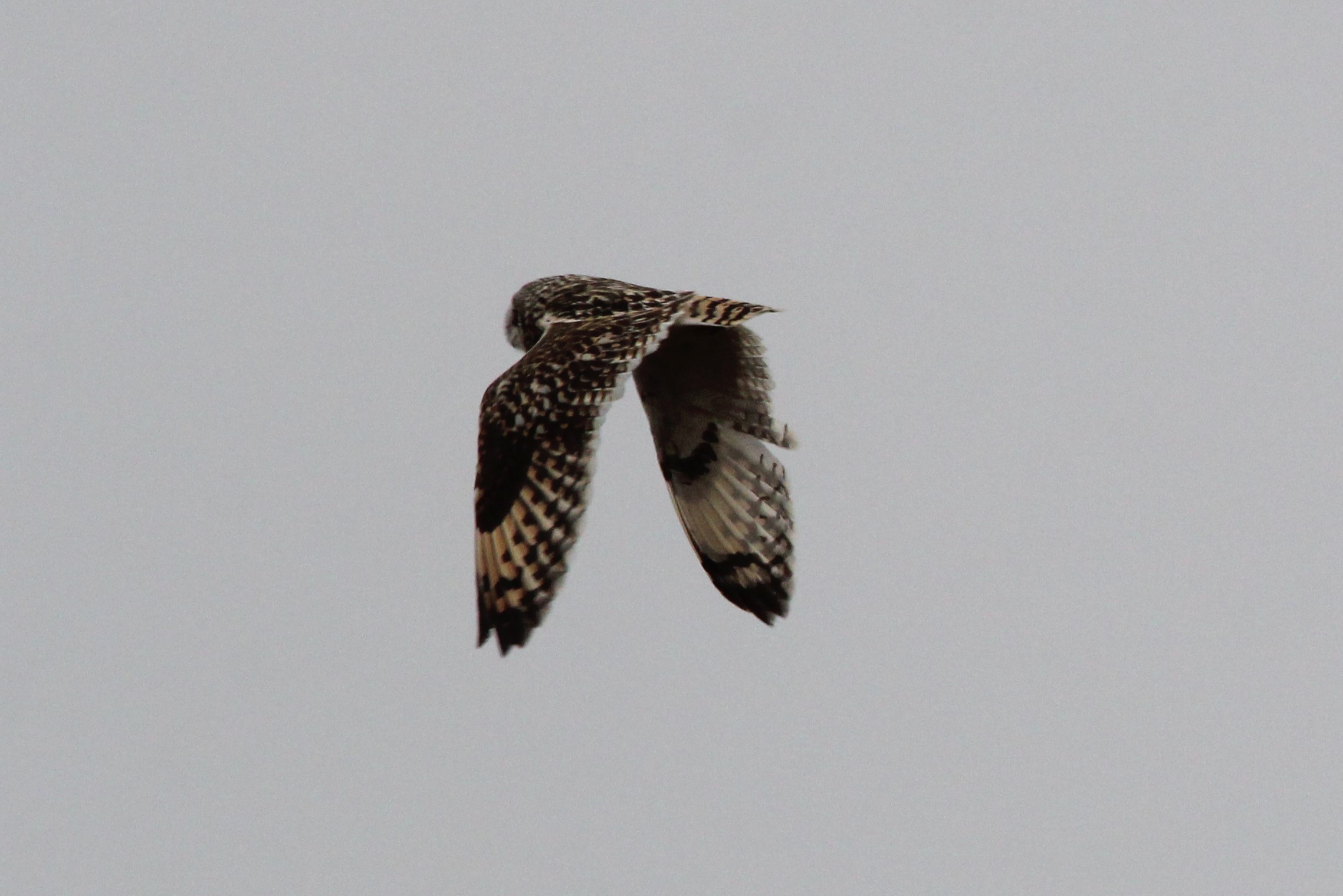
I was looking at a Short-eared Owl. Sure, not the rarest of rare birds, but for Algonquin Park, this is a very, very tricky bird to nail down, and not a ton of people have seen one in the park before. This is subject to revision, but I believe this is around the 20th record for Algonquin Park. As is typical of Algonquin Short-eared Owls, it continued on its way, never to be seen again. Lucky for me, I managed to get off one good record shot in my excitement/panic. 
Well, hard to top that, and it was only 8:30 am. I spent a good chunk of the rest of the day telling myself "just another little bit" fighting off the uncomfortable cold. The next most interesting thing to happen was spotting some grebes on the lake, both Red-necked and Horned. I had seen one Red-necked in the park prior, but it was certainly still nice to see. 

Red-necked Grebe

Horned Grebes

Other than that, I wouldn't say there was really anything else to write home about, so I'll just let the eBird checklist do the talking. I ended with 72 species, which I thought was pretty cool. I probably could have turned up a few more if I had put a bit more effort in seeking out certain species earlier in the day (I would've had I known I'd tally so many!).

In all, over my three days off I tallied 94 species, including 15 year birds and six new birds for my park list. I would chalk that up to being a success! Sure, we didn't get anything super flashy like Point Pelee or Rondeau or Long Point, but hey, it's early yet ;) 

Tuesday, 12 April 2022

More Algonquin April Birding

Last Thursday, there was a little bit of rain in the forecast, but with the south winds, I figured I should head out birding at the Old Airfield in Algonquin Park anyways. Lucky for me, the rain subsided early in the day, and I ended up having my best day of birding of the year thus far.

Not a ton of new arrivals per se, but certainly a good number of species on the move. The day started off well with an Eastern Phoebe soon after the rain stopped, the first of the year. 

In late morning, an Eastern Meadowlark dropped in, which was great to see. I believe this is a different bird than the one from a couple of days prior. 

I saw two Sandhill Cranes fly over, which are pretty scarce migrants and breeders in the Park.

A short while later, a lone Double-crested Cormorant flew by, far away and high up. I think this ties the early record.

And just five minutes after that, I spied an immature Golden Eagle migrating in the distance. No (conclusive) photos of that one though! 
A nice male American Kestrel also visited in the early afternoon.

The headliner for the day were Common Redpolls. I counted an incredible 3740 individuals migrating southbound. Why they were headed that way, is beyond me. Here is a portion of a flock of 500+ that I saw.

Here is my eBird checklist.

In some other Algonquin birding odds and ends, Winter Wren was a new one for the year on April 8. April 9 brought two new birds: Northern Flicker and Blue-winged Teal. The teal are of particular excitement, as they are a very uncommon spring migrant and were a new species for my park list.


Yesterday yielded no new year birds, despite spending most of the day birding on good winds. Perhaps driving from London and getting back at 3am was not the best idea after all! That's just how it goes sometimes! This morning I found a little bit of movement had occurred, as I found Hermit Thrush, Green-winged Teal, Bufflehead, and Wilson's Snipe in the Old Airfield. 

I've been quite happy with what I've been seeing so far (it somewhat offsets my sour feelings about missing a Black-necked Stilt back home), and am quite excited to see what else is to come. The beauty of Algonquin Park birding...it doesn't take much to make us happy! 

Wednesday, 6 April 2022

April in Algonquin Update

 A title I just may reuse later if I feel so inclined...

Spring migration is well underway here in Algonquin Park. After months of seeing the same species day in and day out, it is nice to see some new arrivals.

With it being spring once again, I have made it my goal to bird the Old Airfield as much as possible. It makes a good place for a walk before work, even if I do have to back track to get back to the Visitor Centre! The Old Airfield has hosted many rarities over the years, and with any luck, I will add some to that list. 

The first Turkey Vultures and Great Blue Heron of the year showed up at the airfield on Sunday, which were lovely to see.

Yesterday, Jeff Skevington found an Eastern Meadowlark in the airfield. This is an almost annual migrant in the park, but very hit and miss, and was a big target of mine this spring. I was really hoping to find my own, so it was with reluctance I decided to twitch it after work. I might not get another chance to see one this spring, after all. It wasn't long before I heard its song, and located it in a tree. 

This is an extra special sighting for me, because it marked my 170th species of bird seen in Algonquin Park. As of writing, this is the threshold species count to get on the "short list" of Algonquin bird listers. I still have quite the long way to go, but it was nice to finally reach that milestone. 

I decided to hang around the rest of the evening and see what else was moving. As it turned out, not much. I had a Killdeer fly over, only my second in the park (and my first since being on contract), which was nice to see. After sunset, the first woodcocks of the year were displaying.

This morning, the weather looked like it might be a good day, so I, of course, headed to the airfield. 

The river mouth was pretty productive in terms of waterfowl, with the first Ring-necked Duck and Wood Ducks of the year. There were also a number of black ducks, a Common Merganser, and Hooded Mergansers. 

Ring-necked Duck

Lots of robins were on the move, by the end of the day I counted nearly 80. Probably more that I missed.

American Crows were moving in small numbers. I only saw a few ravens.

After I walked around for a bit, I picked a spot to sit down and just watched. It wasn't really a hawkwatching day as it would turn out (took 8 hours to spot my first hawk), but it was neat seeing a few birds drop in. Nothing too crazy, and no new park birds, but there were some spring migrants that were on the early side. These included a Yellow-bellied Sapsucker, Eastern Bluebird, Belted Kingfisher, American Kestrel and a Tree Swallow.

Belted Kingfisher

Eastern Bluebird

The "best" bird of the day was probably an American Pipit, which appears to be record early by about two weeks. I am sure Ron Tozer will confirm or deny this statement before long!

I ended my 10.5 hour day tired, wind burnt, and with 39 species. I just couldn't keep going and find that 40th! Woodcock would have been guaranteed, but as I push "publish" on this post, they would have only just started to display!  Here is my eBird checklist.

Tomorrow is supposed to be wet. Rain means one of two things to the Algonquin birder: good birds or a bad time! Will be interesting to see how it plays out.

Wednesday, 9 March 2022

Algonquin Park Winter List 2021-22

Well, a week and a half into March already, but better late than never.

Each winter, birders in Ontario (and beyond) may keep what is known as a "winter list". These winter lists record birds seen between the dates of December 1st and February 28/29th. Birders and obscure lists, I know. This past "winter listing period" was a record setting year in Ontario, with 229 species recorded. The total for Algonquin Park, however, as you can expect, was slightly lower than that.

Best that I can tell, the final tally for Algonquin Park was a grand total of 42 species. This is pretty impressive for Algonquin, I think. Of note, 30 species were recorded on the Christmas Bird Count on January 3rd, which is slightly above average.

Some species highlights include:

- Common Goldeneye (Tea Lake Dam February 17 onwards)

- Hooded Merganser (Western Uplands Backpacking Trail on January 3, Tea Lake Dam on February 19)

- Herring Gull (Brewer Lake on December 2)

- Common Loon (Lake of Two Rivers on December 8)

- Golden Eagle (Mew Lake Campground on February 7)

- Red-tailed Hawk (Opeongo Road on December 22)

- Sharp-shinned Hawk (Visitor Centre from late December until January 3)

- Merlin (Old Airfield until January 3)

- Northern Shrike (Spruce Bog Boardwalk on January 8)

- Boreal Chickadee (Black Fox Portage on January 3)


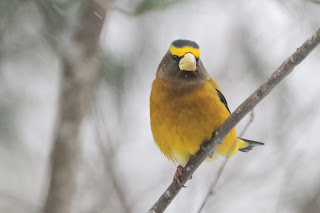
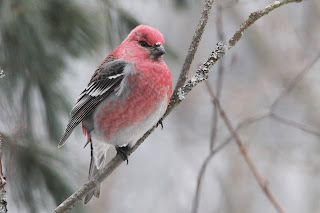
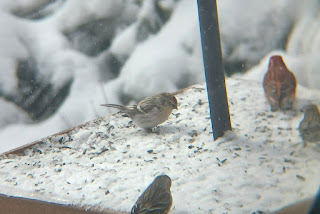
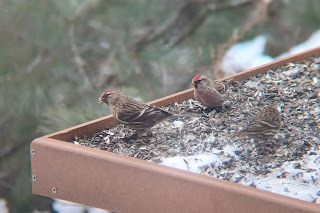
Many of these species are usually not seen in Algonquin Park during the winter months, or are quite uncommon in the park (note Boreal Chickadee!). Some other highlights included three species of owls (Barred Owl, Great Grey Owl, and Northern Hawk Owl) and all nine expected species of finches, including a rostrata Common Redpoll. 

The mild start to the winter, as well as several mild patches here and there throughout the remainder of the winter, likely attributed to the numbers of American Tree Sparrows (two wintered at the visitor centre, several others encountered throughout) and Dark-eyed Juncos (one wintered at the visitor centre, others throughout). Snow Buntings, a species that typically departs once snow covers the ground, was recorded a few times throughout the winter listing period. 

As for misses? Nothing really stands out to me. American Crow and European Starling both just narrowly missed the count period, both showing up in the park on March 4th. Slightly later than average for crow, and slightly before average for starling. Crows were seen just outside the park in Dwight as early as February 16th or 17th.


Now, how about my winter list? Since I would be living in the park over the winter, I thought it would be fun to see what I could tally. I ended up with 35 species. I will admit, I didn't really go out of my way to add species—although an early December trip to Brent or Lake Travers likely could have yielded something of interest, I had a Glaucous-winged Gull that I wanted to see! In the new year, I kind of got a bit lazy with it, and as such only added a few species (Purple Finch, Sharp-shinned Hawk, Hoary Redpoll, and Common Goldeneye).

My biggest miss was the Old Airfield Merlin. Despite first observing this individual back in mid-October and seeing it almost every time I birded there throughout November, I did not see it in December on the few times I went out. Other than that, I don't feel robbed on really anything other than the Boreal Chickadees. Although I thought about it, I never did make that four kilometer hike in to where they were seen. Oh, and Barred Owl, but I never tried for them!

My biggest highlights, other than the Sharp-shinned and Common Goldeneye I mentioned prior, was Common Loon, Red-tailed Hawk, Northern Hawk Owl, and Herring Gull. Seeing all nine finches, plus a rostrata Common Redpoll, was pretty neat, and kept the winter lively and entertaining. 

Evening Grosbeak

Pine Grosbeak

Hoary Redpoll

rostrata Common Redpoll with flammea

Bottom line...had some fun with it and didn't take it too seriously. A nice change of pace! 

Now, to find a Boreal Owl...


Tuesday, 18 January 2022

Plants That Do Weird Things: Part 3 (Carnivorous Plants)

Plants are a very diverse group of organisms, so as one could expect, there are a number of them that do "weird" things. There is no shortage of fascinating techniques that plants employ in order to survive in their environment. This is part 3 of my little series "Plants That Do Weird Things". Check out part 1, where we look at myco-heterotrophy, and part two on haustorial parasites if you haven't already, as they will explain certain concepts that I refer to here.

In this post, I want to look at a group of plants that may be much more familiar to even the casual observer: carnivorous plants. Carnivorous plants are a plant which are able to catch, kill, and digest prey, and then use the nutrients from said prey to grow. 

Recall in part 2, I mention that we were done looking at the heterotrophic plants. You may be wondering, since a heterotrophic plant is one that feeds off other organisms, then is that statement still true? Yes it is. Despite having the ability to intake nutrients from digesting other organisms, carnivorous plants would be considered autotrophic, as they are perfectly able to grow and survive by creating their own energy through photosynthesis. That being said, the extra nutrients from prey items helps the plant to not just survive, but thrive, often growing larger and producing more seeds. 

In order to capture their prey, carnivorous plants employ one (or in some cases, several) of five trap mechanisms: flypaper traps, pitfall traps, bladder traps, snap traps, and "lobster-pot" traps. All of these traps are derived from highly specialised leaves. Carnivorous plants in Ontario utilize one of the first three methods. 

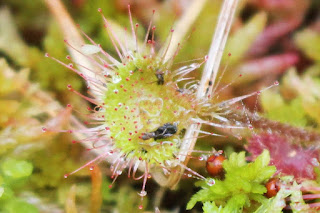
Plants with flypaper traps simply use a sticky glue-like substance, known as mucilage. The leaves of these plants have many glands that secrete mucilage, and these glands may be short or long. Once a prey item (almost always an insect) is trapped, then these plants respond by actually growing or moving their parts in response, which not only helps ensnare it further, but also digestion. This is called thigmotropism, which simply put, is directional growth in response to touch. To digest their prey, these glands will release a series of enzymes, which break down the insect, and this is true regardless of the trap type. 

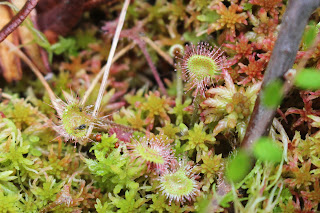
In Ontario, there are two genera from two families that would be classified as using flypaper traps. Perhaps the most well known are the sundews (Drosera, Droseraceae). Sundews have many long "tentacles", which are tipped in mucilage. Many species also have short glands, which are sessile (attached at the base without a stalk). When an insect is trapped, these tentacles are mobile, and move into the centre of the leaf so the insect is in contact with as many of these tentacles as possible. 

There are four species known from Ontario, as well as a couple of hybrids. Round-leaved Sundew (D. rotundifolia) is likely the best known. Spoon-leaf Sundew (D. intermedia) is another common species that tends in inhabit a slightly different habitat than Round-leaved.

Round-leaved Sundew

Despite having seen all of the sundew species in Ontario, I have never made a point of actually taking good pictures of the mucilage glands. A reoccurring issue in this project is finding I don't have adequate photos for quite a few of the things I want to illustrate—sounds like something to tackle this year! In this cropped image of the above picture, you can see a couple of prey items (insects), as well how the tentacles have moved to contact these unlucky critters.

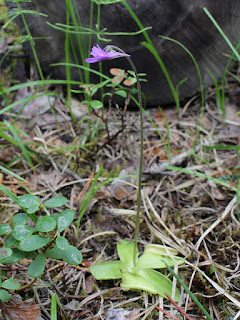
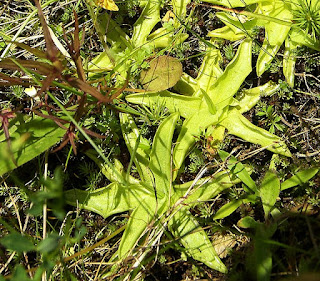
The other genus in Ontario with flypaper traps is Pinguicula, the butterworts (Lentibulariaceae). This is a bit more of an inconspicuous genus, and not one I have personally seen in situ (a bit hard to believe, I know!). Much like the sundew, this plant has mucilage-secreting glands. However, unlike the sundew, these glands are very short and close to the surface of the leaf, so there are no obvious tentacles. When an insect is captured, thigmotrophic growth occurs, and the leaf may curl over, or form a shallow "pit" for digestion to occur in. 

Two species occur in Ontario. Common Butterwort (P. vulgaris) is more widespread than Hairy Butterwort (P. villosa). Common Butterwort is portrayed below.

From Wikimedia

From Wikimedia

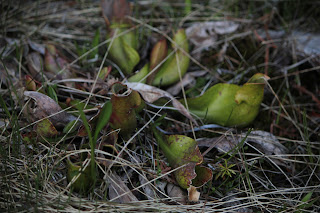
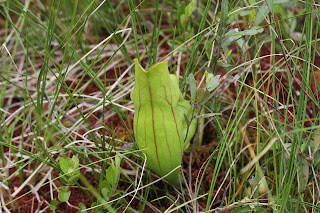
The second type of trap which occurs in Ontario genera is the pitfall trap. There is but one species in the province that uses this method, the Purple Pitcher Plant (Sarracenia purpurea, Sarraceniaceae). As one can imagine, the pitfall works when a prey item falls into the fluid-filled "pitcher", where it is digested. In the case of pitcher plants, although newer plants secrete and use enzymes, as the plant ages, it tends to utilize the bacterial community and microorganisms (mutualistic species) that live within the pitcher to break down the prey into a form that the plant can absorb nutrients from. In order to lure the prey to enter the trap, a series of methods may be employed, including use of scent and colour. On the inside of the pitcher, there is often a number of red venations, and there is evidence to show the bolder these are, the more prey items that are attracted.  From there, it is gravity that does the rest of the work!


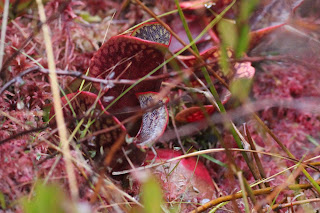
On the inside of the lip, there are downward facing hairs (yet another thing I wish I had a better photo of!) These act to stop insects from being able to crawl back up and out of the pitcher. 

You can see the hairs in this image

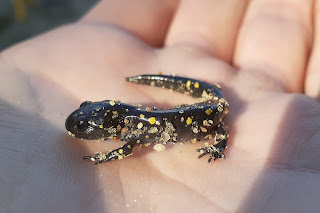
And its not just insects that pitcher plants consume! A few years ago in Algonquin Park it was discovered that pitcher plants around Bat Lake (a well studied area of wildlife research) were catching recently metamorphosed Spotted Salamanders as they emerged from their breeding pools. These prey items are of course rather large, but there is some evidence that the plants are at least partially digesting them. I haven't seen this bog in person, but from what I have heard, many of the pitcher plants are larger than average, likely from the extra nutrients they are receiving. This story was all over the news, and you can read a little more about it and see some pictures here.

Lucky for this little guy, no Sarracenia nearby...

The last kind of trap found in Ontario are the bladder traps. There is only one genus in the world with this design, Utricularia, the bladderworts. These are in the same family as the butterworts, Lentibulariaceae. Nine species are found in Ontario, and they range from being aquatic to nearly terrestrial.

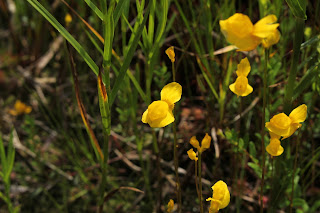
Horned Bladderwort (U. cornuta)

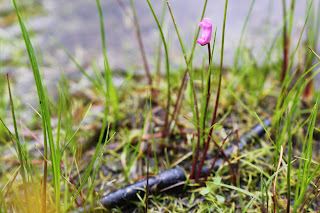
Northeastern Bladderwort (U. resupinata)

The bladder traps are typically submerged, at least in most of our species. To put it in the simplest terms, these bladder traps work as a vacuum. Through osmosis (the diffusion of water, or flow of water from an area of high concentration to low concentration, across a membrane), the bladder traps are "primed" when water is pumped out of the bladder. The walls of the bladder are sucked inwards with the negative pressure created from this. The traps are triggered when a prey item (which are very small aquatic invertebrates) touches a "trigger hair" near the entrance or door of the trap, which then breaks the seal, and water flows back into the bladder, and with it the prey item. 

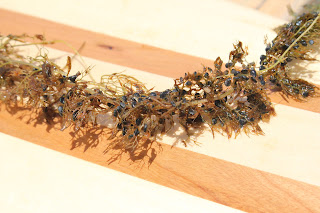
"Bladders" of Common Bladderwort (U. macrorhiza)

Much like the pitcher plant, a community of microorganisms may in part help the bladderwort break down and digest its prey. 

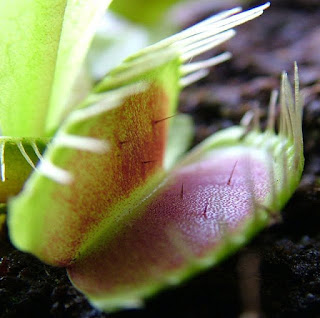
The other two trap mechanisms, snap traps and "lobster-pot" traps, do not occur in Ontario, but are still worth a mention. Only two plants in the world use snap traps, one of which is the poster child for carnivorous plants—the Venus Flytrap (Dionaea muscipula), which is endemic to the southeastern United States, found in wetlands in North and South Carolina, and are introduced to Florida. This plant is related to the sundews, both being in family Droseraceae. The "snap trap" likely needs very little explanation. There are a series of trigger hairs on the specialised leaf, which when triggered, causes them to shut close around the prey item. In order to avoid closing unnecessarily, such as if a raindrop were to hit a trigger hair, the Venus Flytrap will only close if there are two or more touch stimuli a certain length of time apart. 

From Wikimedia

"Lobster-pot" traps are found in a tropical group of plants, the corkscrew plants (Genlisea, Lentibulariaceae). This trap works much like a lobster pot or a minnow trap. It is easy to get in, but part to get out due to downward facing hairs, which force prey deeper into the trap. 

You may have noticed that Lentibulariaceae was mentioned three times. Quite neat that within one family, which only include the three genera detailed here, all employ different trap styles! 

On a similar note, if we take a step back and look at how these plants are all related to one another, we would likely be quite surprised. You might assume that since these are all carnivores they would be closely related, as we saw with several of the heterotrophs. However, each of the three families mentioned here, Droseraceae, Lentibulariaceae, and Sarraceniaceae all belong to different orders, Caryophyllales, Lamiales, and Ericales respectively. Because of this, carnivorous plants are an excellent example of convergent evolution, which is when distantly related organisms independently evolve similar traits, in this case carnivory, to adapt to similar situations. 

But, why carnivory? We have already established that carnivorous plants are autotrophs—they are able to photosynthesise their own energy. Why would a plant that can produce its own food adapt to be able to digest prey items?  If you were to stand over and observe a carnivorous plant in its natural habitat, the answer would likely lie directly beneath your feet. For many of our carnivorous plants, especially in the Ontario context, they live in very nutrient poor habitats. Take things like the sundews and pitcher plants for examples, which often grow amongst Sphagnum moss in fens and bogs. Sphagnum moss actually lowers the pH of the soil, making it more acidic. Acidic soil tends to be quite nutrient poor. Since there is a lack of nutrients, in particular nitrogen, then these plants had to look elsewhere, and that was to carnivory. By being able to get energy from an additional source, these plants have that much more of an edge in this harsh environment. 

Carnivory is not without a cost, however. By developing these specialised leaves, such as in the sundews and pitchers, the plant will sacrifice some of its photosynthetic ability. A pitcher plant with a pitcher that is roughly vertically inclined (so that it can catch prey) is not photosynthesizing to the same extent that a leaf that is broad and flat, facing the sun, would. Is it worth it? Evolutionarily speaking, it must for for the plant if it continues engage in this behaviour. That being said, a study done on pitcher plants found that each pitcher only has a prey capture efficiency rate of 0.83% - 2.1%, depending on how you wish to calculate it. This is quite low, but an insect once every couple of weeks must be better than trying to live in acidic soil on just your own photosynthetic processes alone!   

Carnivorous plants are certainly some of the oddest members of the plant family, employing a number of different methods of capturing and digesting their prey, as well as being able to survive in some the harshest conditions a plant can live in. Carnivores have a fascinating evolutionary history (which I largely didn't touch on here!), and have long been of interest to naturalists. Even Charles Darwin, considered by many to be the father of evolution (perhaps contested by Wallace), had a strong attraction to these plants, writing in 1860, "I care more about Drosera than the origin of all species in the world". 

While I believe this will conclude (unless I dig up something else) the look at plants that get their nutrients in unique ways, whether through heterotrophy or carnivory, there are still plenty of special things that plants do I wish to cover! Plants do weird things, and I want to talk about them.

Sunday, 9 January 2022

Plants That Do Weird Things: Part 2 (Haustorial Parasites)

Plants are a very diverse group of organisms, so as one could expect, there are a number of them that do "weird" things. There is no shortage of fascinating techniques that plants employ in order to survive in their environment. This is part 2 of my little series "Plants That Do Weird Things". Check out part 1, where we look at myco-heterotrophy, if you haven't already, as it will explain certain concepts that I refer to here.

With this post, we will dive into haustorial parasites. In plants, there are two types of heterotrophs: myco-heterotrophs and haustorial parasites. The term "haustorial parasite", henceforth referred to simply as parasite or parasitic plant, comes from the organ all parasitic plants possess, the haustorium, which is a root-like structure. Fungi also have this structure, but for our purposes, we will be focusing on haustoria in parasitic plants. 

Parasitic plants get some or all of their nutrients from other plants. These parasites use their haustorium to penetrate the host plant, and they may either attach themselves to the root or the stem. In order to extract the required water and nutrients, the parasite connects with the conductive tissue of the plant, either the xylem (transports water and nutrients from the roots to the stem and leaves), the phloem (transports products of organic materials made during photosynthesis, such as sugars, to other parts of the plant), or both. 

Much like myco-heterotrophs, there are both "full" and "partial" parasites. In regards to parasitic plants, these are typically referred to as either hemiparasites (both parasitic, and able to complete photosynthesis), or holoparasites (obtains all nutrients from a host plant, often lacks chlorophyll). It is important to note that neither hemiparasites or holoparasites are inherently more parasitic than the other, they just are able to perform different functions. 

Another important distinction is whether a parasite is obligate or facultative. With obligate parasites, they require a host plant to complete their life cycle. On the contrary, with a facultative parasite, it is not imperative that a host plant is present, as it is able to complete its life cycle regardless, taking advantage of a host if the opportunity arises. A hemiparasite can be either obligate or facultative, but a holoparasite can only be obligate. 

As one can imagine, parasitic plants needs to germinate close to their host plant, especially in the case of obligate parasites. Parasitic plants can germinate either using chemical or mechanical mechanisms, and is often dependant on which part of the plant it parasitizes—the root or the stem. In the case of root parasites, seeds must land very close to the host, as they receive a chemical signal from said host, leached from the root system into the surrounding soil, which initiates germination. Unlike root parasites, stem parasites are able to germinate and then survive for some time as they try to find a host using resources from the seed endosperm (tissue inside the seed that is able to provide nutrients to the embryo).

While worldwide there are approximately 4500 species of parasitic plants spanning 20 families, in Ontario, where our focus lies, there are only three families that have parasitic members. 

Perhaps the most well known family is the broomrapes (Orobanchaceae). This is a unique family in that it features both hemiparasites and holoparasites. It also has a few non-parasitic genera, but these do not occur in Ontario.

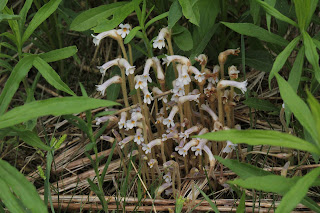
One-flowered Cancer-Root (Aphyllon uniflorum) is the more widespread of the two Aphyllon species (formally Orobanche) in Ontario. It is an uncommon species that is always a joy to come across. This is a holoparasite, with its host being the aster family (Asteraceae), saxifrage family (Saxifragaceae), and the stonecrops (Sedum).  In the below photo, you will see an abundance of goldenrod (Solidago spp) leaves, which are likely hosting this particular plant. 

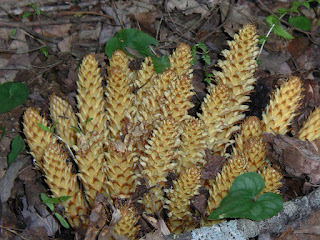
Another holoparasite in the broomrape family is Bear Corn (Conopholis americana). This is a root parasite of woody plants, in particular oaks (Quercus spp) and beeches (Fagus spp). 

From Wikimedia

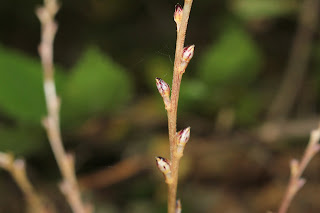
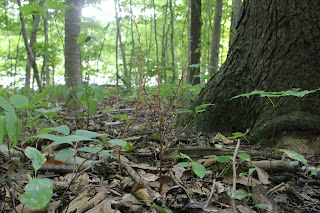
The last holoparasite broomrape from Ontario is Beechdrops (Epifagus virginiana). As the name suggests, this plant is parasitic of the American Beech (Fagus grandifolia). This is a root parasite, so chemical signals from the host is what triggers germination. There is not really any negative effects on the beech tree from this parasite, and its absence may be indicative of deteriorating forest health. 


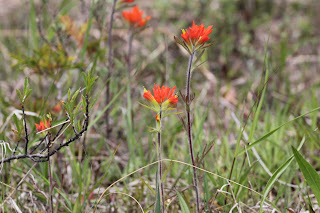
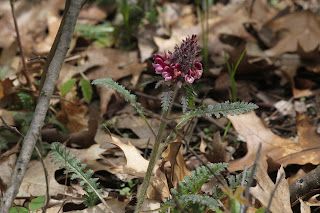
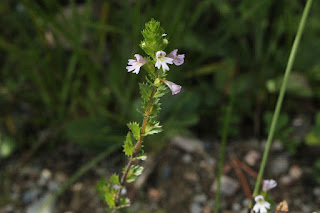
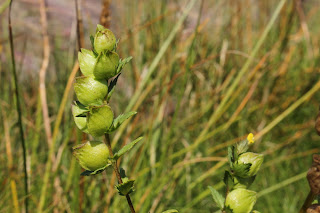
As mentioned above, the broomrape family features many hemiparasites. A number of the Ontario species parasitize the roots of graminoids, particularly sedges (Cyperaceae) and grasses (Poaceae). Some of these are found below:

Scarlet Painted-cup (Castilleja coccinea)

Canadian Wood Betony (Pedicularis canadensis)

Eyebright (Euphrasia spp)

Yellow Rattle (Rhinanthus minor)

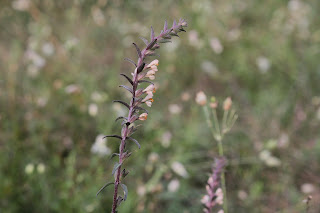
Red Bartsia (Odontites vernus) NOTE: non-native

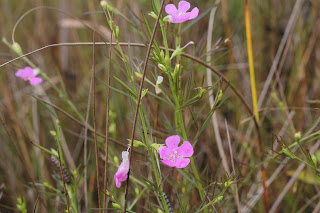
Purple False Foxglove (Agalinis purpurea)

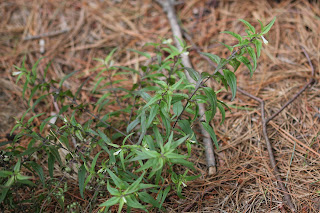
Narrow-leaf Cow-wheat (Melampyrum lineare) parasitizes much different host plants than the above species. This root hemiparasite has a wide variety of hosts, including blueberry (Vaccinium), pines (Pinus spp), poplars (Populus spp), Sugar Maple (Acer saccharum), and Northern Red Oak (Quercus rubra). As one can imagine, this species thrives in a number of different habitats.


The second family of parasitic plants in Ontario are the sandalwoods (Santalaceae). Genera in this family are all hemiparasites.
 
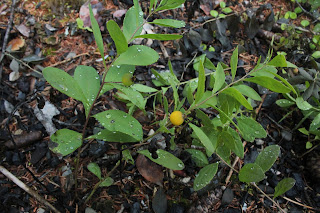
Three species are found in Ontario. The first is Northern Comandra (Geocaulon lividum). This is a species with a more northerly distribution in Ontario, with occurrences on the Bruce Peninsula. This root parasite attacks many different plants, such as asters (Asteraceae), spruce (Picea spp), pines, alders (Alnus spp), willows (Salix spp), birches (Betula spp), Bearberry (Arctostaphylos uva-ursi), and Twinflower (Linnaea borealis), to name a few. You can see some Twinflower in the background of this photo, and it is quite possible that is what this individual plant is taking advantage of. 


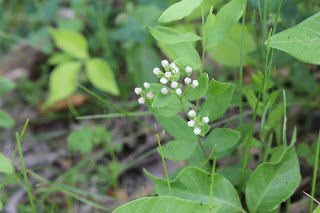
Bastard Toadflax (Comandra umbellata) is the southern counterpart of Northern Comandra. It has a bit of a wider variety of known hosts than the aforementioned species as well—over 200 different hosts. These include many of the ones mentioned under Northern Comandra, in addition to oaks, true sedges (Carex spp), roses (Rosa spp), blackberries (Rubus spp), and grasses. 

The last member of this family is a bit more of a cryptic species (I have never seen it in the flesh, aside from one very poor herbarium specimen), but may have a familiar name. That species is Eastern Dwarf Mistletoe (Arceuthobium pusillum). Its hosts are a variety of conifers: Black Spruce (Picea mariana), White Spruce (Picea glauca), Red Spruce (Picea rubens), Norway Spruce (Picea abies), Blue Spruce (Picea pungens), Jack Pine (Pinus banksiana), Eastern White Pine (Pinus strobus), Red Pine (Pinus resinosa), Balsam Fir (Abies balsamea), and Tamarack (Larix laricina). While this is a hemiparasite, it is obligate, and borders on being a holoparasite. Once the seed lands on the host branch, it germinates and is completely dependant on the host for nutrients. It is not until the mistletoe grows stems that it is able to photosynthesize. Even then, this plant possess very little photosynthetic ability, and draws heavily on its host. Because of this, dwarf mistletoe is considered a pest and can be very damaging to forests. That being said, it does not spread very fast, so is not invasive. 

 Arceuthobium pusillum by Joesph O'Brien

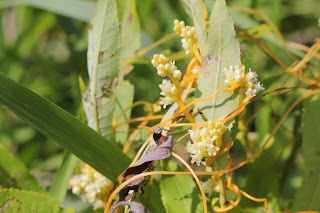
The last parasitic plant family in Ontario is the morning glory family (Convolvulaceae), however there is only once genus in that family, dodder (Cuscuta), that demonstrates parasitic behaviours. There are several species of dodder in Ontario, but Common Dodder (Cuscuta gronovii) is by far the most common. Dodders are stem holoparasites, and are often quite specialized in their hosts. In the case of Common Dodder, it is not super limited with its hosts, with species such as jewelweeds (Impatiens spp), Wood Nettle (Laportea canadensis), and willows. Since dodder is an obligate parasite, it must germinate very close to its host. Dodder seedlings are able to live for as long as a week, and are able to grow around 30cm in their search for a host, living off the nutrients from their endosperm, before dying. If the dodder finds a host, it will tap into the phloem, and then its roots will wither away—a mature plant is not rooted to the ground when it is growing around a host.

Common Dodder

With myco-heterotrophy and haustorial parasitism, that concludes our look at the heterotrophic plants, but fret not! Still plenty of weird things to look at.