Thursday, 6 January 2022

Plants That Do Weird Things: Part 1 (Myco-heterotrophy)

Plants are a very diverse group of organisms, so as one could expect, there are a number of them that do "weird" things. There is no shortage of fascinating techniques that plants employ in order to survive in their environment.

Today, I want to look at some of the myco-heterotrophs. There are a number of these species worldwide, especially in more tropical regions, but I will be focusing on species found in Ontario.

"Myco-heterotroph" sure looks like a scary word, but once you break it down, it becomes much more digestible."Myco" comes from the Greek mýkēs, which means "fungus". "Heterotroph" means an organism that gets its nutrients from another organism, but can be further broken down into "hetero", meaning different, and "troph", coming from the Greek trophḗ, meaning "nutrition".

Putting it all together, you get an organism (in this case, a plant) that gets nutrients from parasitism upon a fungus rather than through the conventional method of photosynthesis. Recall that in essence, photosynthesis is the process in which a plant with chlorophyll (the pigment which makes plants green) makes its own energy using the sun's energy. Photosynthetic plants are for the most part autotrophs (the opposite of heterotroph, organisms that produce their own energy)

This is a somewhat complicated process, but in the simplest terms, it goes a little something like this:

First, to set the scene: A fungus colonizes the root tissue of a host plant, to which it has a symbiotic relationship (long-term interaction between two organisms). The host plant gives the fungi nutrients from photosynthesis (e.g., sugars), and in return, the fungi gives the host plant nutrients from the soil (e.g., phosphorus). This relationship is known as a mycorrhizal association. Mycorrhiza can be broken down into "Myco" (fungus) and "rhiza", Greek for "root". 

In most myco-heterophic relationships, the myco-heterotophs will capitalize off this mycorrhizal association (which would occur regardless of whether a myco-heterotroph is present or not). The myco-heterotroph's roots interact with the fungus' mycellium (the thread-like, vegetative part of the fungus, for further reading click here), and this is where the flow of nutrients takes place. Note that unlike a mycorrhizal association, there are no nutrients leaving the myco-heterotroph and going to the fungus—it is a true parasite.

So bottom line, the flow of nutrients is as follows:

Host autotrophic plant  Mycorrhizal fungus → Myco-heterotroph 

In the past, myco-heterotrophs were mistakenly classified as saprotrophs. Saprotrophy is the process in which an organism breaks down organic material and turns it into usable nutrients ("sapro" means "rotten material"). It is now largely accepted that no vascular plants are saprotrophs, and that this is a process largely restricted to fungi. 

There are both partial and full myco-heterotrophs. Partial myco-heterotrophs (also called mixotrophs) are able both to utilize nutrients from mycorrhizal fungi, as well as complete photosynthetic processes. Full myco-heterotrophs are unable to complete photosynthesis due to a lack of chlorophyll, so are dependant on nutrients from fungi. It is important to keep in mind, however, that just because a plant lacks chlorophyll, does not automatically make it a myco-heterotroph! While I do not believe this is an Ontario example of this, it is possible for a species to have individuals that are both partial and full myco-heterotrophs.  

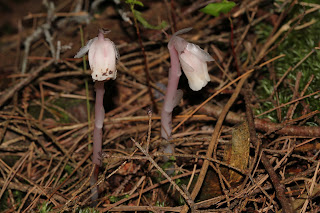
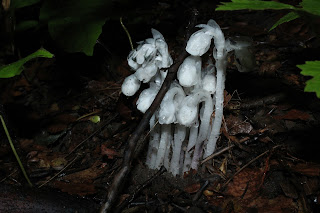
There are several examples of each type from Ontario. Perhaps the most well known is Ghost Pipes (Monotropa uniflora). A common misconception is that this is a fungus, but it is a plant! This is a full myco-heterotroph. This plant is well adapted to life in shady places, such as sugar maple forests (a whole post in itself), as it does not require sunlight, since it does not undergo photosynthesis. Ghost Pipes gets its name from his ghostly appearance, as a result of it not having chlorophyll. Ghost Pipes is parasitic of the fungi family Russulaceae. 


A similar plant is Pinesap (Monotropa hypopitys syn. Hypopitys monotropa). It is, in my experience, nowhere near as common as Ghost Pipes. I have only ever seen this plant in fruit, so I have used a photo off of Wikimedia. The main difference between this plant and Ghost Pipes is that it has multiple flowers on the same stem, whereas the latter only has one. Pinesap parasitizes the family Tricholomataceae, which may have something to do with its abundance, but that is something I will have to look into more. 
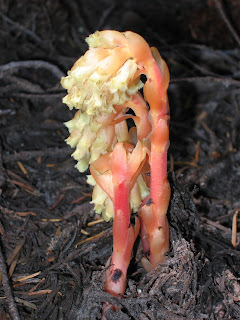
From Wikimedia

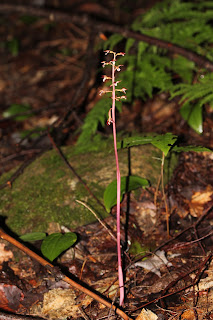
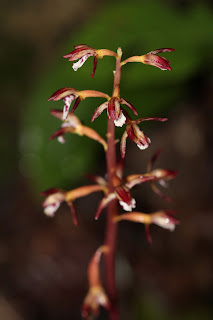
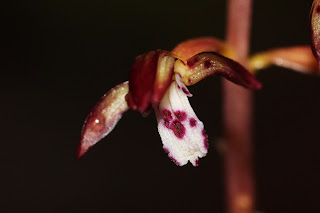
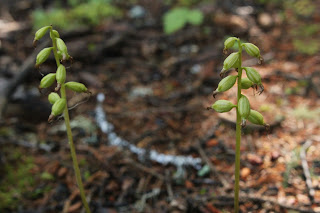
A somewhat surprising group of myco-heterotrophs are the coralroots, a type of orchid. Spotted Coralroot (Corallorhiza maculata) is a species found throughout Ontario, and like Ghost Pipes, it is a parasite of Russulaceae. There are two varieties found in Ontario, Western (var. occidentalis) and Eastern (var. maculata). The Western variety tends to flower several weeks earlier than the Eastern variety.
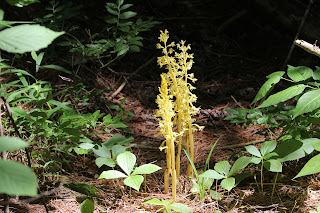
var. occidentalis f. flavida

var. maculata


There is an exception however. Early Coralroot (Corallorhiza trifida) is considered partially myco-heterotrophic, as it contains some chlorophyll and is able to produce its own nutrients through autotrophic processes. Early Coralroot's choice of fungus to parasitize is the genus Tomentella (Thelephoraceae). 

There are other examples of partial myco-heterotrophs as well, perhaps species that one would not immediately associate with such an unusual process! First, take a look at some of the taxonomy. The Ghost Pipes and Pinesap mentioned above are part of the heath family (Ericaceae). This contains many familiar plants, such as blueberries, cranberries, and laurels. These two species are part of the subfamily Monotropoideae, which are myco-heterotrophs. Within this subfamily, there are three tribes; Pyroleae, Montropeae, and Pterosporae. The latter two are full myco-heterotropic, whereas Pyroleae is partial myco-heterotrophic. Ghost Pipes and Pinesap, as you may have guessed, are part of Monotropeae. There is one species of Pterosporae in Ontario, the rare Woodland Pinedrops (Pterospora andromedea). (NOTE: some treatments list Pyroleae as its own subfamily, Pyroloideae)

Monotropoideae have very small seeds, known as "dust seeds". These dust seeds require a mycorrhizal fungi to germinate (to begin to grow), however in the case of plants in the tribe Pyroleae, they develop the ability to photosynthesize as they mature. 

There are four genera in Pyroleae, all of which are found in Ontario.

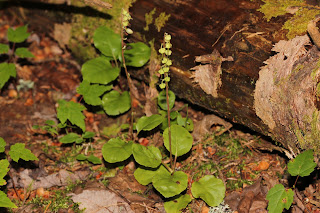
Pipsissewa (Chimaphila umbellata) is the more widespread member of its genus. Striped Wintergreen (C. maculata) is limited to only two or three areas of occurrence in Ontario. 
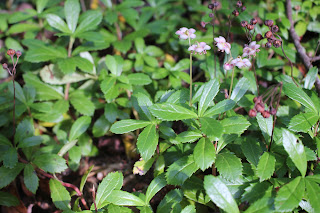
Pipsissewa

Pyrola is the largest genus in Pyroleae in Ontario. They are commonly referred to as "wintergreens" or "shinleaf". 
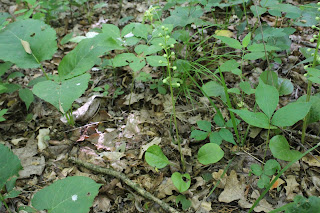
Shinleaf (P. elliptica

Moneses is represented by a single species, known as Single Delight or One-flowered Wintergreen (M. uniflora). 
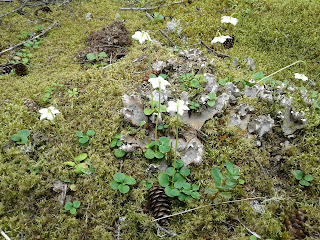

And finally, Orthilia. One-sided Wintergreen (O. secunda) is the monotypic member of this genus. 


Myco-heterotrophy is just one of the many unique and crazy things that plants do to both survive and thrive. This is one of the several weird things that plants do that I hope to highlight in this series in an effort to shine some light on these incredible organisms! 

Monday, 3 January 2022

Algonquin Christmas Bird Count

Today was the Algonquin Christmas Bird Count, the first time I have ever participated in this count. I'll keep this post short and sweet, much like our species list. Quite the contrast to the 124 species CBC at Rondeau just two weeks ago...

It was quite cold this morning when I woke up, with my car reading -29 Celsius. Speaking of my car, I was a bit worried it wouldn't start, although after it made a sound I think no vehicle should ever make, to my relief, it did.

My day started at 8am at the Spruce Bog Boardwalk, where I was to meet my group (first count, and already the pressure is on as an area leader!) We spent the majority of the first hour looking for Spruce Grouse to no avail. Our search was cut short however when I went over to investigate a beaver lodge and then fell through the ice. It was only up to my knee on one leg, but enough to be a bit worrisome with the -25 temperatures out. The luxury of only living 10 minutes away is that I was able to go back home and put on some dry clothes. I will assure you, however, that I was not the only one to make this mistake today.

After that little mishap, we were back at it! Another unsuccessful search for Spruce Grouse, before completing the rest of the trail, as well as another bog slog in a different part of the wetland. 

By the end of our time at Spruce Bog, we has 12 species, with highlights being Red Crossbill, Canada Jay, Pileated Woodpecker, and the best bird of the day: Purple Finch (my first in Algonquin this winter).

After a lunch break in the Visitor Centre, we went up to the Sunday Lake Road and walked along there for a few kilometers. I had only ever been on this road once before, and only up a little ways, so it was a nice little walk. Nothing really of note other than five Downy Woodpeckers, Ruffed Grouse, and good numbers of finches. 

At the end of it all, we had 15 species. I saw an additional species (Pine Grosbeak) while driving outside of our area. I spent the last hour of light walking around with Jeff and Angela Skevington, who were also done their area. It was a gorgeous day to be outside. Results from this count are just starting to come in, but it will be interesting to see the totals. I know that at least one pair of Boreal Chickadees was found, which is not a species I was really expecting to be recorded this year. 

The first of many Algonquin CBCs, I'm sure. 

Sunday, 2 January 2022

Middlesex Biggish Year—What Happened???

As some readers may recall, in January 2021 I decided to go for a laid back "biggish" year in Middlesex County. I wasn't going for any records, but wanted to see how well I could do if I actually put in some effort. For the first six months of the year I was really cooking...but then, I just faded out of Middlesex birding existence. 

For all intents and purposes, I still think I did a biggish something, just that something was a "Biggish Half-Year". I got a job in Algonquin Park starting in July, and with incredible luck (and perhaps a little bit of hard work), I have managed to keep employment here throughout the remainder of 2021, and into the new year. As such, no new Middlesex year birds, save for Marsh Wren and Baird's Sandpiper when I visited home over Labour Day weekend. 

My grand total for the year was 228 species, 226 of which I saw by June, which certainly exceeded my expectations. Remember those codes from way back when? Here is the breakdown. 

Code 1: 129 species

Code 2: 61 species

Code 3: 24 species (1 new)

Code 4: 9 species (1 new)

Code 5: 4 species

Which adds up to 227, so I missed adding something in there, but it probably isn't crucial, so meh, close enough. Its a "biggish" year, I don't need to put in THAT much effort figuring it out. 

Basically I saw all the code 1 species (yay me), all but two of the code 2 species, all but 10 of the code 3s and then didn't see a bunch of the others, as expected.

There were many highlights from the year, some of which I will detail below:

It was a great start of the year with winter finches. Quite funny actually, crossbills had pretty much all left by the end of November, and then bam, on January 1st I found over 40 White-winged Crossbills. Pine Grosbeak ended up being the only winter finch to evade me. 

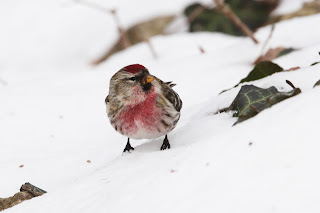
Common Redpoll

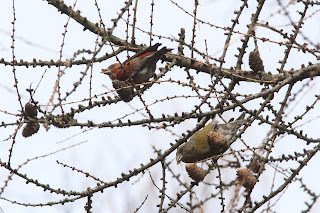
Red Crossbill

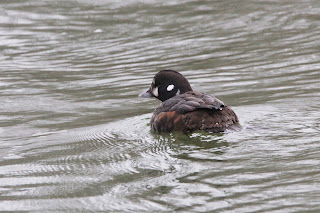
First big rarity of the year was a Harlequin Duck that we had to do some sleuthing to find out the most likely location that is was being seen at. Seems I picked the right spot, and managed to refind it!


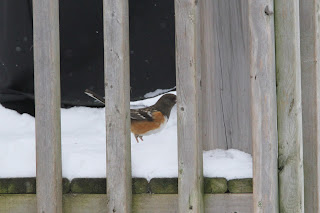
First (and I think only) OBRC bird of the year was a Spotted Towhee coming to a feeder in North London. My first lifer of the year as well. 


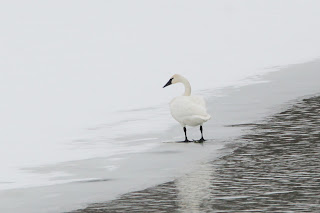
A Trumpeter Swan down along the river was another great pick up. I only encountered one other pair during the year.

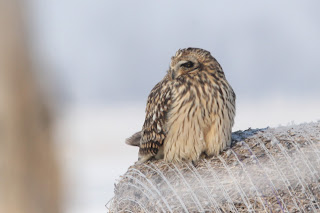
Short-eared Owls, always a highlight. This photo is actually from Lambton County, but I could see them from Middlesex...

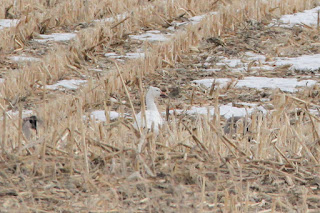
I saw two Snow Geese in 2021, and this is one of them. It was not at the original reported location in Strathroy when I went, but I found it on a hunch in a nearby field. 


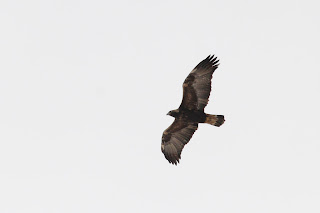
Golden Eagles didn't give me nearly as much trouble in 2021 as they did in 2020. This is one from Newbury, where they overwinter.

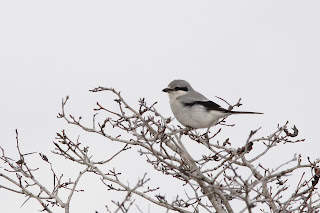
Some Northern Shrike action is always appreciated. 


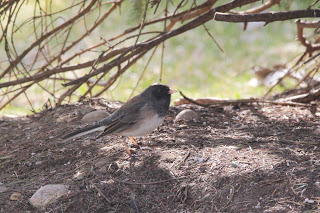
Arguably the "rarest" bird I found this year, a "Cassiar" Dark-eyed Junco from North London in March. I just didn't seem to luck out with any good rarities this spring.


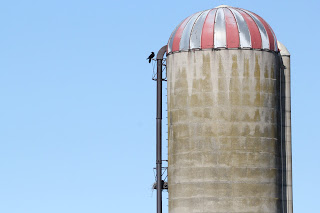
Common Ravens are a formally rare species in Middlesex, but we now have a few breeding pairs. This pair occupied the site in 2020, and then again in 2021. 


I found several Vesper Sparrows throughout the course of the spring. A species I had honestly only encountered a handful of times before.


A good sized flock of 30+ Lapland Longspurs in April was a highlight. 


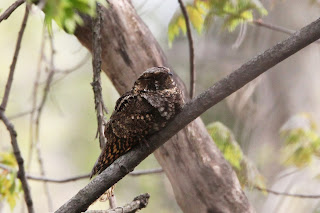
This is one of two Eastern Whip-poor-wills that I saw this year. 


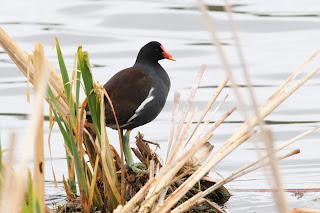
A Common Gallinule took up residence at the Strathroy Sewage Lagoons for a couple of weeks, proving that I had not needed to abandon my schoolwork and drive over there as fast as possible. 


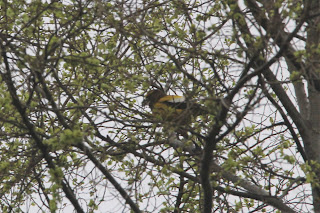
Evening Grosbeak!!! Very few were reported this year in the county, after the previous fall's major flight. I was lucky enough to come across a grand total of three.


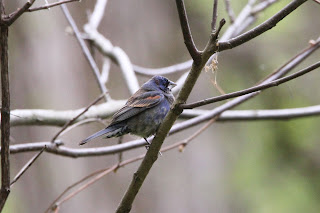
A rarity that was enjoyed by many was a Blue Grosbeak in Kilally Meadows in North London back in May. It was extremely elusive, and despite me birding there every day for most of May, I only saw it twice. Easily could have been "my" bird, as I had walked right by where it was found several times that same day! 

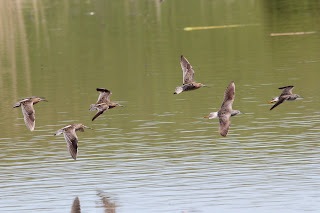
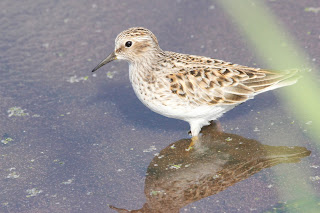
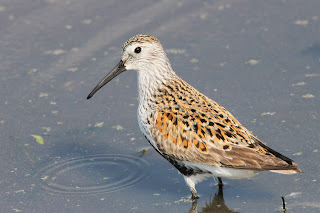
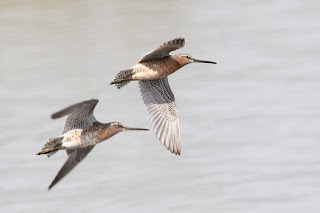
We enjoyed a variety of shorebirds in Middlesex this spring, including dowitchers, Ruddy Turnstone, White-rumped Sandpiper, and two phalaropes. My only Black-bellied Plover of the entire year anywhere in Ontario was a single bird that flew in at dusk at the Dingman Wetland in mid May.

Short-billed Dowitcher

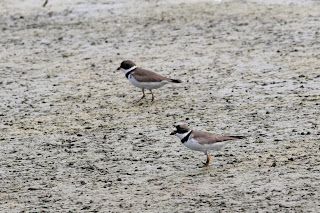
Semipalmated Plover...there was a surplus of these in May

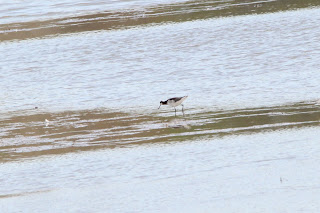
Wilson's Phalarope

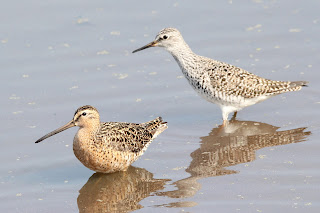
Short-billed Dowitcher and Lesser Yellowlegs

Least Sandpiper

Dunlin

Short-billed Dowitcher

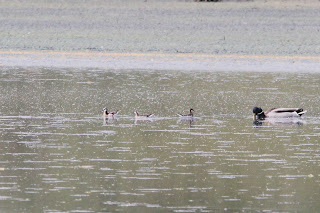
Wilson's and Red-necked Phalarope

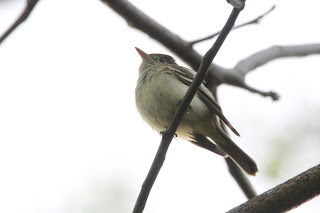
What I would consider my best find of May was an Acadian Flycatcher at Kilally Meadows, my spring birding patch. I saw a number of nice birds here this spring, including Golden-winged Warbler, Red-headed Woodpecker, and a couple of Yellow-bellied Flycatchers.


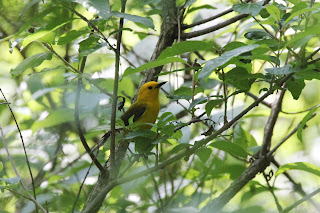
My last year bird before leaving in July was this Prothonotary Warbler that was only around for a day in South London. I had spent some time in Skunk's Misery at the end of May trying to find some, encountering Cerulean Warbler and Acadian Flycatcher along the way, but no luck.


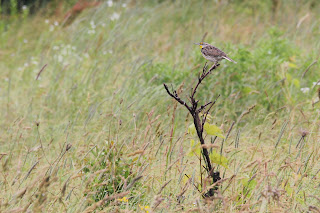
A big highlight of the year was a Western Meadowlark near Glencoe. I first saw it on May 8th, but my photos from late June turned out much better...


Not pictured are many other nice species such as Dickcissel, Northern Mockingbird, Forster's Tern, American Bittern and Upland Sandpiper.

Now for some honourable misses...

Orange-crowned Warbler - this is a tricky species in the spring (although usually I see at least one), so I wasn't really worried since they are a dime a dozen in the fall...but then I just never came back in the fall.

Gray-cheeked Thrush - I don't really have a good excuse for this one. I am very surprised I didn't see any in May (though as I recall, Catharus thrushes were actually fairly difficult to come by). I think this is just one I was also counting on as being fairly easy in the fall, at least as a nocturnal migrant flight call.

Red-shouldered Hawk - this one is all about patience with a healthy dose of pure luck. I did do a few hawkwatches in the spring during a time they were supposed to migrate through, but no dice. Middlesex isn't a great place for hawkwatching, and I find that my yard seems to be as good a place as anywhere (both my Middlesex observations of this species come from there). There was a wintering one early in the year I didn't connect with, and of course, no fall for me!

Red-necked Grebe - not a huge miss actually, as I believe there was only one seen all year! I birded Fanshawe CA pretty heavily in April, but I couldn't find one. 

Cattle Egret - just adding this to say that I searched unsuccessfully for two different birds during my visits home in November

Now, other than those, I don't think that I really "missed" anything. Sure, there were lots of other rare shorebirds (Hudsonian Godwit), some geese (Ross's Geese, Greater White-fronted Geese), a Sedge Wren, and a saw-whet owl, but I wasn't around for those! It stings a bit, but nothing I can do.

So in conclusion, I am quite happy with my six month effort, and even happier that I wasn't able to complete the remaining four months of the year as initially planned. I probably would have surpassed 240, maybe even 250 species, had I been around for the entirety of 2021, but oh well. I had more fun finding a Black-legged Kittiwake on Lake Opeongo in the cold than waiting for a Gray-cheeked Thrush to call while sitting on my back deck in the cold.

Well. That's all folks. 

Friday, 31 December 2021

Ontario Big Year in 2022

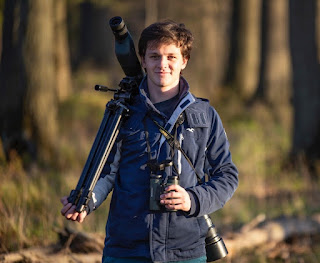
No, this isn't me making ground breaking announcement about my attempt at one of the most grueling ventures in birding, but rather me highlighting two individuals who are about to undertake this exciting task. Starting tomorrow, two of my good friends Ezra Campanelli and Kiah Jasper will begin their Ontario Big Years, and attempting to achieve a new record. These two will be joining forces for an attempt that has been in the work for some time now...and it is finally time to act. Using never before seen tactics, these two are sure to excel. 

Ezra Campanelli

Kiah Jasper

Although in my younger days (yes, even younger than I am now), all I could dream of was doing a big year, I no longer have that desire. Plants have really changed me it seems, That being said, I still love the strategy and excitement behind it all, so I for one am really looking forward to following along with these two. I'm sure I'll get roped into some adventures along the way...it won't take much convincing. 

Ezra and Kiah will sure have a great start to their year, if all goes to plan, as there are a number of lingering rarities that appear as though they will make it to the new year. Some of their top priorities which will keep them occupied for the first few days, at least, include a long staying Black-bellied Whistling Duck and Razorbill(s) in Niagara, Harris's Sparrow in Hamilton, Golden-crowned Sparrow in Toronto, Mountain Bluebird in Wellington, and the possibility of a Prairie Falcon in Durham (and literally as I was writing this, news of possibly even an Arctic Loon in Algoma). Of course, they would certainly take that Glaucous-winged Gull in Barrie if it were to ever pop back up! Townsend's Solitaire and Varied Thrush are two species that are also of high interest, and there a couple options to choose from for both.  

Once they get a number of these rarities, their attention will turn to some of the harder winter species in the province, such as Gray Partridge, Purple Sandpiper, finches, sea ducks, and northern owls. 

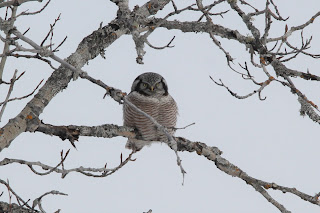
Northern Hawk Owl (Cochrane District, March 2020)

The current big year record for Ontario is 347, set by Jeremy Bensette in 2017, so it will not be an easy feat, but it sure will be a rewarding one. 2021 was a super year for rare birds, with Geoff Carpentier seeing 343 species (and not starting his serious big year attempt until May!), so here's hoping that 2022 is even better. 

If you wish to follow along with their big year progress, check out Kiah's blog and Ezra's website. If you are social media savvy, check out Ezra's big year Instagram account @bigyearbirdxbird where he will be posting photos of each year bird he sees. 

Best of luck to you both, and Happy New Year to all!!!

Sunday, 19 December 2021

Christmas Bird Counts 2021

Time for my annual Christmas Bird Count (CBC) blog post, which shrinks in content and length every year since I hardly carry a camera anymore...that's why I have friends who take pictures! 

I arrived in London late Friday night, and was up early the next morning for the London CBC. This is my fifth year doing this count, and my route covers about a 5km stretch along the river. Some years it can be dynamite, but others, like this year, it can be quite poor.

It was so poor in fact that I got my lowest species total ever on this route with 28 (average 32), and lowest individual total with 323 (average 685). Averages are only based on five years of data, but still...

Highlights? Not much! A couple Winter Wrens, nine Swamp Sparrows, and 47 Northern Cardinals were all nice. Lots of misses though. I did add Great Blue Heron to my all time list for this route. 

eBird checklist here: https://ebird.org/checklist/S99036733

Today I got to do a slightly more exciting count, the Rondeau/Blenheim CBC. This is my sixth year doing this count. This time around, I was joined by Nathan Hood and Ezra Campanelli. 

We started with a lakewatch at the VC beach access (which apparently is beach #10, never noticed the number before). It was slow at first, but quickly picked up. Highlights were Surf Scoters, White-winged Scoter, Long-tailed Duck, and lots of Red-breasted Mergansers. Took a bit for the loons to start, but ended up with 47 Red-throateds and a Common. Although I guess the place to be was off South Point because Blake had 217 Red-throats! I'm happy though, my perfect streak for Red-throated Loon on this count continues!

Eventually we had to pry ourselves away from the lake, and begin walking up Lakeshore towards the campground. Lots of redpolls around (we ended up with 95, a new Rondeau bird for me). Tufted Titmouse and several Carolina Wrens were real treats for me, having not seen either in months. A Fox Sparrow that was pished in was another real highlight for our trio of dedicated counters. 

A quick check of the beach at the traffic circle revealed a Great Black-backed Gull, a new one for our list. 

After walking the maintenance loop, which was pretty birdy, although nothing really of note, we began our way down Harrison. I thought for sure we'd get a Pileated Woodpecker, but it was not to be. What we did get however was a pair of singing Great Horned Owls, the screech-owl along Bennett Ave, and a flyover Eastern Bluebird at the group campground. 

We finished our route with 45 species, which we were quite happy with. Nothing too rare, and plenty of misses, but that is to be expected on a CBC.  

eBird checklist here: https://ebird.org/checklist/S99134628

After finishing our area, we went to walk around the campground for a bit. Although it was covered by others earlier in the day, always a good place to look around. It did not take us long to locate several Yellow-rumped Warblers, and the Blue-grey Gnatcatcher that has been around. The gnatcatcher is new for the Rondeau CBC if I am not mistaken. 

We scoped the bay before leaving the park. A few Canvasback among other ducks were nice to see.

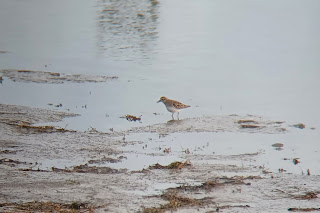
One last stop was Keith McLean's CA to look for a couple lingering birds. After a bit of searching, we spotted the continuing Nelson's Sparrow. As we were in pursuit of the sparrow for a better look (which we got), we also saw the continuing Least Sandpiper, another new species for the count. The sandpiper also has the honour of being the only photo I took all weekend.

Rondeau has so far recorded 117 species this year, a very high total. It is still a developing situation, and will be interesting to see what the finally results are.  Edit: final tally is 124 species, setting a new record for Ontario if I am not mistaken 

And that just about wraps it up! An enjoyable weekend birding back in Southwestern Ontario. As much as I love Algonquin (to which I am just about to begin my journey back to), I sure have missed these locations! Although in past years I have only done these two counts, this year I have the Algonquin CBC coming up on January 3rd.

Today it was Least Sandpiper, Nelson Sparrow, Blue-grey Gnatcatcher, and Red-throated Loons, tomorrow its Evening Grosbeaks, crossbills, Pine Grosbeaks, and Canada Jays...

Monday, 13 December 2021

Barrie Birding

Last Tuesday I ventured back down to Barrie to search for the Glaucous-winged Gull. I felt a little bit robbed after only seeing it for a few seconds my first time, so I wanted redemption. Barrie is only about two and a half hours from where I'm living, which is certainly one of the shorter drives I've done on my days off as of late :)

I got a late start to the day, as the weather was a little bit iffy. There were also a couple of delays on 11 heading south. As such, I didn't get to Barrie until a little bit after noon. I certainly didn't need to be in a rush however, because the Glaucous-winged Gull wasn't there when I arrived!

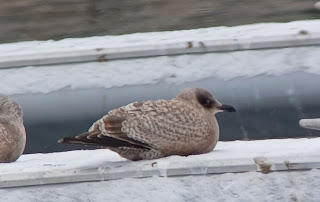
I spent the next freezing few hours watching gulls the and waiting. There certainly was some nice variety, with a few Glaucous Gulls and a couple Icelands, including two Kumlien's and a Thayer's. 

Thayer's Gull

A couple nice wintering passerines made an appearance in the form of a White-crowned Sparrow and Yellow-rumped Warbler. 

Finally, just past 4:30, the Glaucous-winged Gull flew in. I don't know enough about cameras to have photos turn out in such low light, nor was I keen to play around too much as my fingers were frozen solid. At least it proves I saw it!


Nice to get out of the park every once in awhile to see some birds! Although, perhaps I shouldn't venture too far until I have that pesky Merlin that has been hanging out around the Old Airfield on my winter list! :P

I'll be back down home this weekend for a couple of Christmas Bird Counts that I usually do. Will be nice to see some rarities (House Sparrows). 

Wednesday, 1 December 2021

One Long Drive, Two (?) Lifers

Yesterday, I drove back down to London from Algonquin to visit home for a couple of days. On my way south, I made a couple stops to look for some ongoing rare birds.

My first stop was the Barrie waterfront, where I was going to look for the putative Glaucous-winged Gull, first found on November 27th by Justin Peter, Peter Mills, Lyndsey Friesen (and I'm not sure who the fourth observer was). This is the second record for Ontario, pending acceptance. Out west, where this bird is from, they hybridize widely with a few species, most notably Western Gull. There is some concern that this bird, a second cycle, may be a hybrid, although several gull experts think it looks within reason for a "good enough" Glaucous-winged. Justin collected a stool sample to sequence the DNA, so we'll see what that turns up. Given the extent of the hybrid mess out west (coming from someone who hasn't been there before), I won't be the least bit surprised if its great-grandmother was a Western Gull.  

I very briefly saw the Glaucous-winged Gull on the docks shortly after I arrived, but as soon as I took my eyes off it to get closer, it disappeared into thin air. I think I may have saw it flying away, but the bird was quite distant, and certainly not getting any closer. No doubt the individual in question, but I sure am bummed not to have gotten any pictures. 

Regardless of what it "turns out to be", it is a gull that came from the west coast, so that's pretty cool! 

A few hours later, I pulled up to a Rufous Hummingbird stakeout in Lambton. Within a few minutes, the bird appeared at the feeder, and I was able to get some photos. With at least three Rufous Hummingbirds in the province this fall, I'm kind of feeling desensitized to this species (even though this is the first one I have seen haha).


I looked in vain for a Cattle Egret on my way home from the hummingbird spot. Would have been a nice county bird, but oh well.

Nice to see some new birds. Its been a pretty great fall for lifers for me. I saw Razorbill in Ottawa, Black-legged Kittiwake in Algonquin, Barrow's Goldeneye and Say's Phoebe in Ottawa again (right place, right time for that phoebe, I was literally right around the corner from where it was found), and of course Glaucous-winged (??) Gull and Rufous Hummingbird, as detailed above. I'm certainly not huge on chasing birds, but its fun when it works out!