Showing posts with label Snow Goose. Show all posts

Wednesday, 31 March 2021

Middlesex Biggish Year: March Update

Hard to believe we are already three months into the year! The Middlesex Biggish Year continues. A bout of warm weather brought in some migrants perhaps a bit earlier than normal, although I didn't capitalize too much off this (I'll get them later anyways). In total, I added 19 new species to my year list, which now stands at 112 species, or about 82% of the birds recorded so far this year in Middlesex County. I nabbed a couple tough species, I missed a couple of my targets this month: Lapland Longspur and Red-shouldered Hawk. Certainly still time to cross paths with them! The finches that graced us last fall have yet to make a northward return. This next month will prove critical. I was hoping to get some rare waterfowl this month, but it never happened. There is still time I guess. 

The breakdown:

Code 1: 76 species (12 new)

Code 2: 21 species (4 new) 

Code 3: 10 species (3 new)

Code 4: 3 species

Code 5: 2 species

Code 1s consisted of the typical spring migrants. Killdeer, Tundra Swans, and Turkey Vulture were all, as expected, checked off in the first week of March. Gadwall and Northern Shovelers were found in the first half of the month as well, with Blue-winged Teal coming in within the last week. I saw my first Eastern Phoebe the same day as my first Eastern Meadowlark. American Woodcocks showed up about halfway into the month. An early Common Loon was seen on Fanshawe Lake, with a Double-crested Cormorant appearing that day as well.

I guess I didn't take many pics this month,
so here is a record shot of my FOY vulture


Code 2s were some of the expected but harder to find migrants. These included Horned Grebe and Lesser Scaup on some of the larger bodies of water, as well as a Peregrine Falcon, which was chasing down some Northern Pintails. A singing Tufted Titmouse, still uncommon in Middlesex, was nice to get out of the way early.

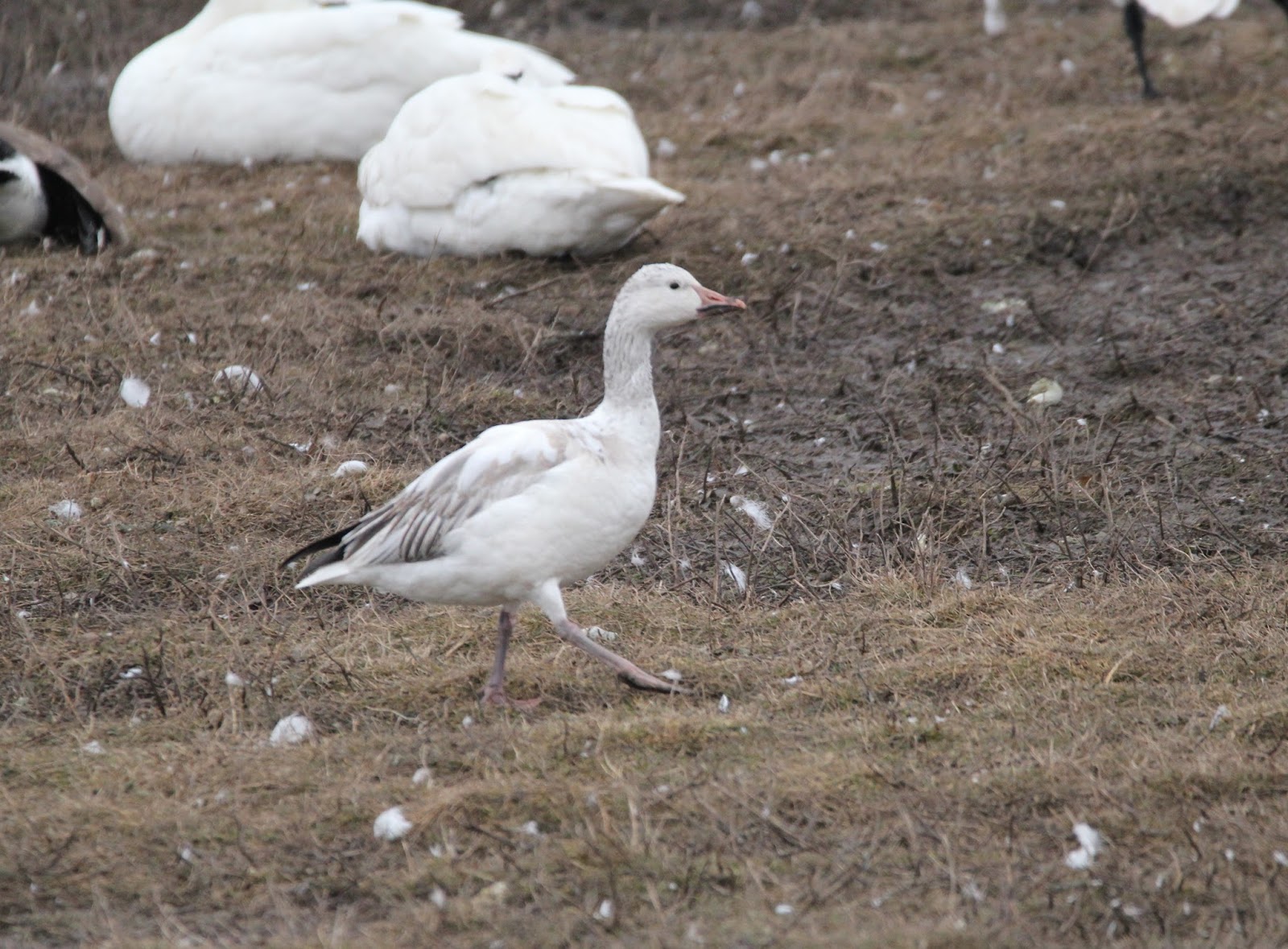
Code 3s included two of the North Middlesex specialties: Ruffed Grouse and Common Raven. I also saw two different Snow Geese this month, a nice bird and not always a guarantee to be seen every year.

Snow Goose


Well, that's the month of March for you! It has been fun so far, and I anticipate that it will continue to be that way. Onward to one of my favourite months!

Friday, 5 March 2021

Touring Southwest Middlesex

Today my aunt and I went for a tour of Southwest Middlesex. I had a goal of trying to find the Western Meadowlark within Middlesex County bounds, but it was not to be. I even made several passes of where it was in Lambton with no success! I think that the melting of the snow exposed a lot more open ground for which the meadowlark to feed, so it was no longer restricted to right beside the road.

Lots of driving today (we spent about three hours going up and down roads!) with few photos. A couple highlights which were not photographed include several Rough-legged Hawks (seemed weirdly abundant), as well as my first Killdeer and Tundra Swans of the year. I was hoping to cross paths with a Lapland Longspur, but it was not to be.

Down near Glencoe, we came across an adult Golden Eagle while cruising down Watterworth Road. Not great photos, but my best ones of the species. No flat tires today!


A little bit later, we came across a Northern Shrike, also my best photos of the species. I have enjoyed seeing shrikes this past winter (this was my fourth individual, usually I am lucky to see one!)


After spending nearly three hours going in circles, we called it quits and headed back to London. We stopped into Strathroy, where we saw the Snow Goose which has been around for a few days. I managed to see it a few days ago, but it had been back in a field, so was nice to see it close. I didn't feel like getting out of the car, so no photos :)

My aunt hadn't seen the famous Harlequin Duck in London yet, so we went to visit him. His molt is progressing nicely. I wonder how long he'll stay around. 

Afterwards we went to go check out the Spotted Towhee. I heard it call once, but it never came out into the open. Oh well, it'll probably be around for awhile yet.

MODO hanging out


A good day! 

Friday, 19 October 2018

James Bay 2018: Part Seven

This past summer I was given the opportunity to volunteer for the James Bay Shorebird Project on the coast of James Bay, north of Moosonee. For two weeks from August 13th to August 27th, I was stationed at Longridge Point, the most northern of the three survey sites in the project.

James Bay 2018:
Part One
Part Two
Part Three
Part Four
Part Five
Part Six
Part Seven
Part Eight
---------------

August 24, 2018

After all the excitement from the day prior, we were excited to head out and see what may have changed in the high winds. The day's survey was West Bay. It was to be our last survey of West Bay during our time at Longridge. 

The Wood Frogs look a bit different up on the coast than they do further south. One of the big differences is that the northern frogs have much more spotting on their sides.


We spotted this bear feeding near the start of the West Bay survey route.


Over the past few days, Snow Geese became a regular sight in West Bay, as they hung out with the large (usually 80-120 individuals) flock of Canada Geese. Most of the birds we saw where "blue morphs", but on this day we saw a decent number of the regular "white morphs" mixed in.


There was a little bit of Marsh Felwort growing around the grassy areas of the flats.


Grey Wolf tracks are a common sight on the mudflats.


I usual shorebirds were seen on survey. Highlights include both phalaropes and a couple of Short-billed Dowitchers. 

Least Sandpiper

The really big highlight was another (or the same?) Parasitic Jaeger seemingly hunting shorebirds over the mudflats. I managed a digiscoped photo (somehow). 


We got back late in the afternoon, and pretty much just hung around the rest of the day. I took a few photos of the camp.

The view from our porch

Main/kitchen cabin on the left


Our water filtration system. We would haul water from the creek, then hand filter it through coffee filters, before putting it in this device to filter it again. We couldn't afford to get sick!


Our bear defense, powered by a car battery. I never volunteered to test it, but I am told it was a "good shock".


August 25, 2018

We spent days hoping that James Bay would give us a "good bird". Today was that day.


We started our day at Paskwatchi, where we planned to spend a little bit of time before starting the survey. Off in the distance, a Parasitic Jaeger (another!) was found.

Looking at a jaeger!

It was my turn to be primary observer (basically the person that calls the species name, age, activity (flying, loafing, feeding, or a combo of any of those three) and the number of individuals.) Not too long after I started my survey, we heard the crackling over the radio from one of our crew mates who had stayed back at the point. 

"Sabine's Gull flying out over the north point over the Bonaparte's"

We were close to 500 meters away from the described location. We all turned our scopes to the area and scanned frantically. Finally, after what seemed like forever, I saw the very distinct wing patterning of a juvenile Sabine's Gull come into view! Awesome!

The guys ended up turning around and staying at Paskwatchi, but we had a survey to complete so myself and one other continued on our way. When we were about three kilometers the radio came to life again.

"We have a Black Tern as well"

We tried to finish up the survey as fast (and efficiently) as we could, before making the long dash back (about four kilometers) back to Paskwatchi, in hopes of getting better looks at the Sabine's, and to see the Black Tern. Unfortunately, the tern had left by the time we got there (the tern and Stilt Sandpiper, seen the next day, are my only two "painful" misses of the trip). The Sabine's, however, was still there, and giving great looks. I could only digiscope, as my DSLR was sitting on my bed several kilometers away, but at least I managed identifiable photos...

Sabine's Gull - the dark on in the middle

This photo, although you can't really "tell", has three species in it: Sabine's Gull, Little Gull, and Bonaparte's Gull. Not a trio you'd typically expect to be sitting all next to each other!


Speaking of Little Gulls, I saw my first juvenile pluamged Little Gull that day. Sticks out like a sore thumb!


I think that the Sabine's Gull wing we found a few days earlier brought us good luck!

It was very nice evening, and our last evening all out together as a crew. This young Whimbrel put on a good show on the walk back.


All of us went to bed happy that night.


Sunday, 18 March 2018

Some Aylmer Things

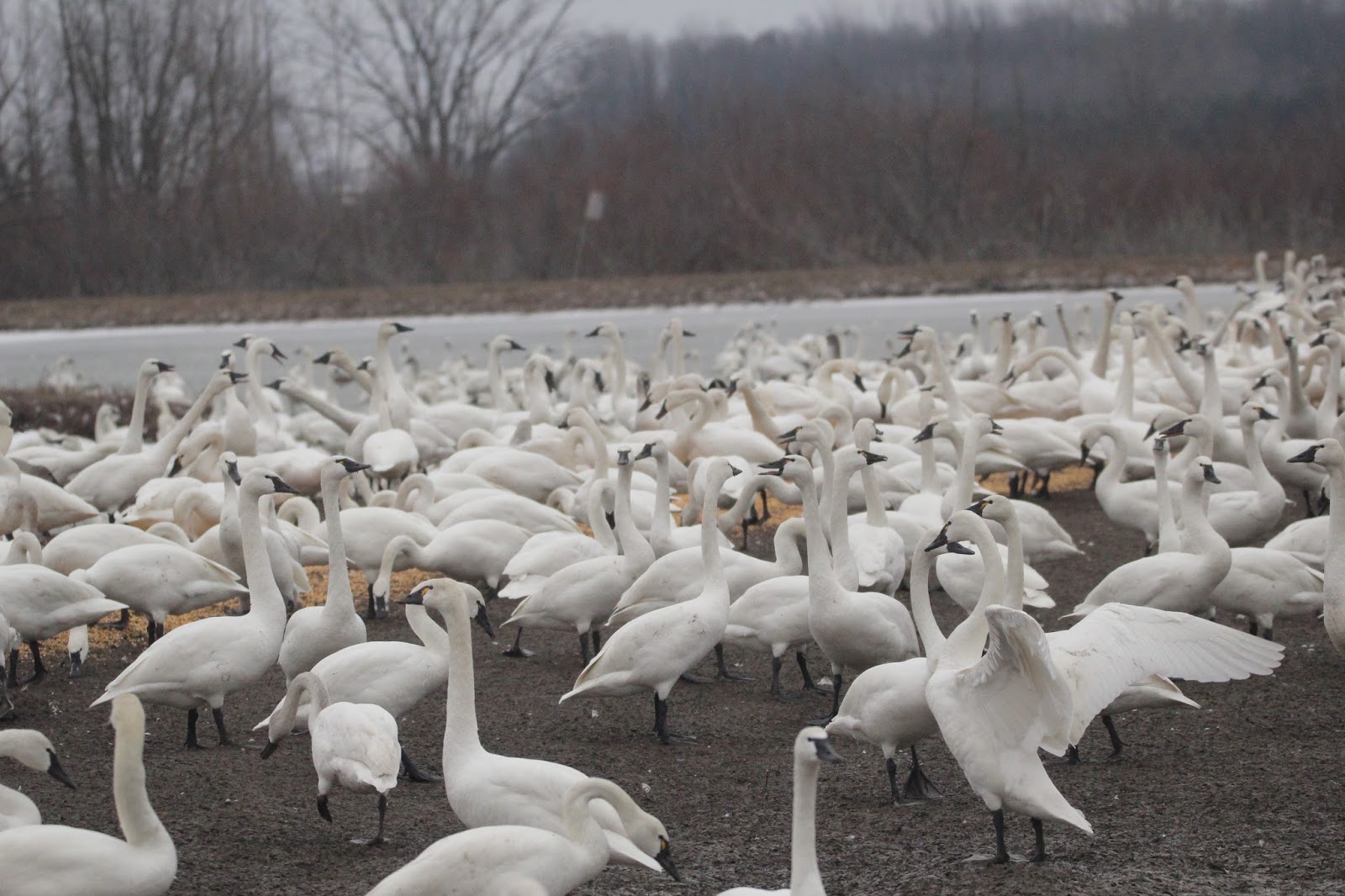
Today I went to the Aylmer Wildlife Management Area and Aylmer Sewage Lagoons with my local nature club, Nature London. We saw quite the variety, including Eastern Bluebirds, Snow Geese, Tundra Swans, Cackling Geese, and Greater White-fronted Geese.

Snow Goose (blue morph)

Tundra Swans

Canada Goose

Cackling Geese

Eastern Bluebird (male)

Eastern Bluebird (female)

Greater White-fronted Geese

Cackling Geese


Friday, 17 November 2017

Townsend's Take Two

This afternoon, I went back down to Rondeau hoping for a second chance at the long-staying (for a warbler) Townsend's Warbler. It had been seen in the morning, and our ETA was a couple hours earlier than when I went on Tuesday, so going into the twitch I was feeling pretty good.

When we arrived, we were met by silence, so we set up shop at the corner of Second and Centre street, where the bird has been most reliable. Two Snow Geese in the company of Canada Geese flew over just above the tree line...too fast for photos!

After about half an hour, the chickadees and kinglets started making a commotion, so we knew that if the rare warbler was going to show up, it would be with the group of common songbirds.


After about 10 minutes of searching through the flock, I happened to look up and see a small songbird fly into a Juniper Tree. I got my bins on it, and imagine my surprise when I saw it was the Townsend's Warbler! I quickly called over the other birders, and almost all of us got decent looks at the bird, or at least enough to confirm the identification.

Photos, well, to say the least didn't work out. Auto-focus tends to hate me when it comes to rare birds, and this time it was no different.


Within 30 seconds the bird was gone. I relocated it 5 minutes later, but only saw it for about 3 seconds...no good photo ops for me today!

Basically, I devoted my entire week to trying to find this bird, and I saw it for 33 seconds total...

The bird appears to be very healthy, and will no doubt be around longer. Is it too early to start thinking about the Christmas Bird Count?

Other bird life in the area included many finches, including siskin and Purple. A group of Cedar Waxwings was present as well. A first of season Brown Creeper was seen briefly.

Cedar Waxwings

I checked the beach, but I could only find a few Canada Geese and a Bald Eagle. No Ross's today!


I was thinking that maybe the geese went to the bay, so I checked it out just before we left. No geese, but plenty of ducks. The majority were American Wigeon and Redhead, but I also found small  numbers of Lesser Scaup, Ring-necked Duck, Ruddy Duck, Bufflehead, Hooded Merganser, and Canvasback.

Wigeon and Redhead

Ring-necked Duck

I left very happy that I was able to find the bird, even if I couldn't get any decent photos! A lifer is worth a thousand pictures!


Tuesday, 21 March 2017

Swan and Snow Show

This past Sunday, my dad and I went back to Aylmer to join the Nature London field trip.

Surprisingly, there was a large number of Tundra Swans still around. The recent cold spell most likely has something to do with it.


The immature Snow Goose was still there, but the bird was joined by an adult this time.


Later, they separated and the immature got close to the viewing stands.


The bird was very skittish and was frequently chased by the larger geese and swans.


Within the hundreds of Tundra Swans, we managed to find at least one Trumpeter Swan.


Trumpeter Swans are pretty rare in this part of Ontario, but not unexpected.

The same ducks as last time were around, however this time there were a couple of Gadwall and Hooded Mergansers.

American Wigeon

Hooded Merganser

The group was moving very slowly, so myself and a friend went off on our own...well, that cost us beautiful looks at a NORTHERN SHRIKE! I spent about an hour trying to find it again, but I was only successful in hearing it call twice.

There was a lot moving around in the forest, however not much variety in species.

American Robin

Red-winged Blackbird

Overall, it was an okay day, despite it being slow. I guess I'm just spoiled from Virginia!

Oh, and I finally got my Ontario life list up to 250!!!!!