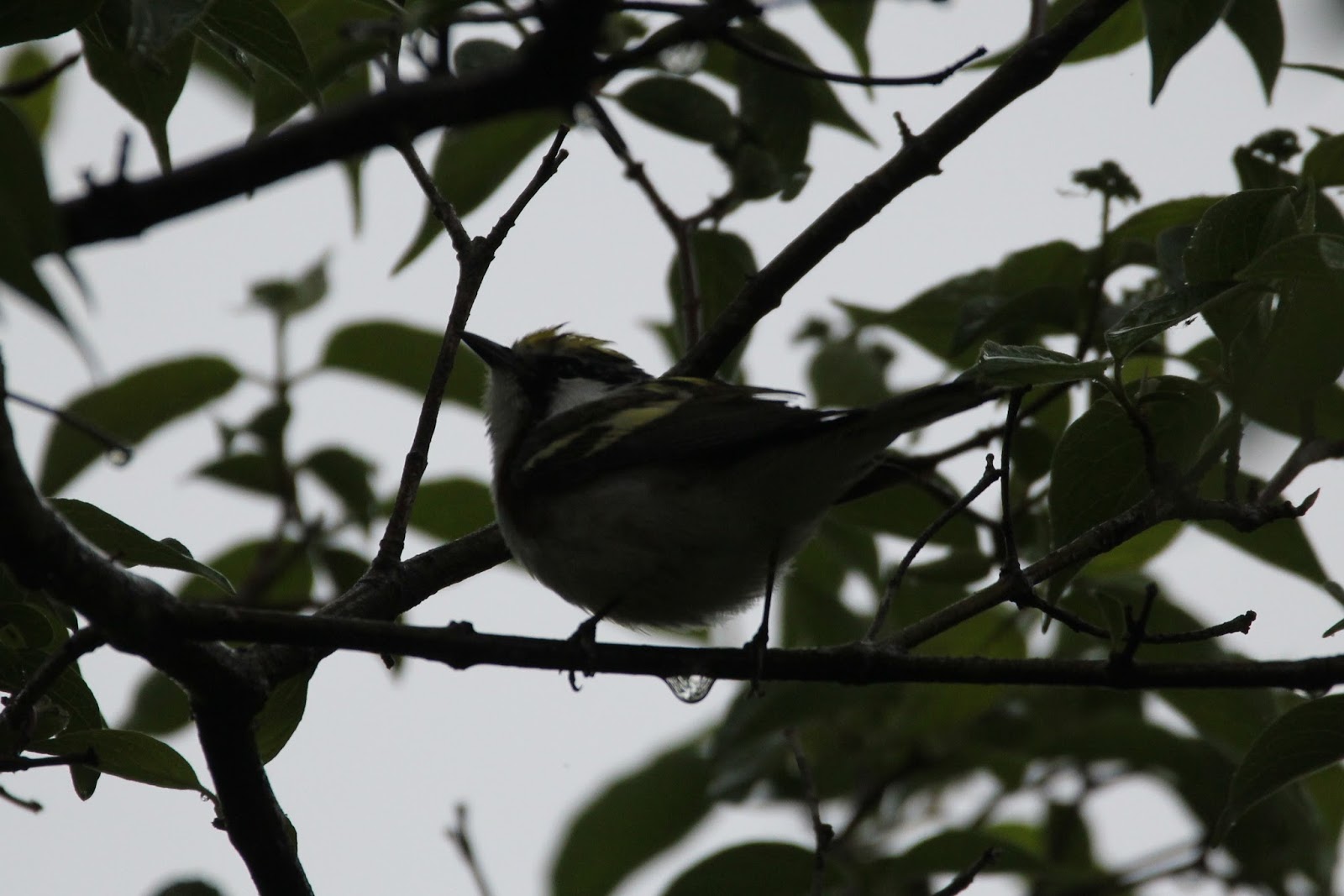
It has been quite awhile since I last posted something to this blog. Since my last post in June (!!!), a lot has happened in my life, including finishing up my contract working in Algonquin Park (ending an amazing 14 months of my life), and starting my undergraduate degree at the University of Guelph. Understandably, with that latter thing, the time I have had for naturalizing has decreased significantly, although I must assure you, I still get out from time to time.
I wanted to come back and write a post on something I am surprised I never mentioned here—the story of one morning in late May, back when I was working in Algonquin. If nothing else, it will be good to immortalize the story here, even if it is eight months late!
The date was May 22, 2022. It was a Sunday of the May long weekend, and I was scheduled to work a later shift that day (we were going to be leading a night hike with the interpretive program). It was a rather cool and drizzly day, with winds coming out of the northwest, as they had been all night (and I believe it even rained overnight), so generally things didn't look like it would be a great day to go out an observe migrant birds. However, as had been my routine for the past month or so, I pulled myself out of bed, and made my almost-daily pilgrimage to the Old Airfield in the morning. I was thinking it would just be a quick morning walk, just going through the motions, you know? I wasn't properly dressed at all. I think I may have even been in my uniform. The quicker I get this walk over with, the quicker I can go back home and be dry, I thought to myself.
I walked the edge of the airfield, and was quite pleased when I spotted a Wilson's Warbler working the edge. There had been one reported the day prior, so it was one I was hoping to encounter. This was a new Park bird for me, as I hadn't seen any the fall previous. It was surely going to be the highlight of my day!
I snapped a couple mediocre photos, and continued on my way. I was sort of absent mindedly sauntering along, when I heard it. What was it that I heard? A very weird sounding Northern Flicker. But no, that wasn't quite right. There is goes again. Certainly not flicker. What was it? It sounded very mimid-y. The phrases were repeated ~6 times. Hmmm...that's what mockingbirds are supposed to do. Must be my Park bird Northern Mockingbird then! Cool! I walked towards the alder thicket, expecting it see the culprit, but...nothing. Playing hard to get, I see. I bushwhacked a little bit, the bird singing the whole time, but I just couldn't lay eyes on it. I knew that mockingbirds could be skulky, but this was getting ridiculous. It moved further down the edge, and I followed in hot pursuit, wanting to see what the heck I was dealing with. What could possibly be making that sound, but also be so hard to see? I racked my brain, trying to place it. A thought crossed my mind, and on a whim I decided that maybe just a little bit of playback wouldn't hurt. So I pulled out my phone, and played a small snippet of song of my far fetched idea...and wouldn't you know it, a couple seconds later, my far fetched idea wasn't looking so far fetched. Up popped a Yellow-breasted Chat. I saw it for approximately two seconds before it disappeared and shut up.
Oh. My. Goodness.
I frantically tried to re-find it over the next few minutes, but it wasn't turning back up. At this point I put out the alert to the community, and made a few phone calls. Jeff Skevington was just packing up his car in Ottawa, two hours away, when I called him. My friend and colleague Henrique Pacheco (who, it should be noted, I invited to come out with me that morning, but had opted to sleep in), finally picked up on about the sixth call. He would later tell me that he thought, in his sleepy state, that he was being bombarded with spam calls. I also called Algonquin Park legend Ron Tozer, who famously missed the only other park record of Yellow-breasted Chat in October 1981, by only a matter of seconds. You can read his account on this in his 2012 Birds of Algonquin Park (A.K.A The Bible). Unfortunately for Ron, when he picked up the phone he was at Big Creek NWA down near Long Point. It appeared that he would be missing another chat in the Park!
What followed will probably go down as the most intense twenty minutes of my life. Finally (finally!), the bird popped up again, not to far from where it was first seen, and began to sing. I was very happy to be able to finally document this sighting photographically, and with an audio recording.
The first ever photo of a Yellow-breasted Chat in Algonquin Park
The chat soon moved to a more unobstructed perch, and gave me some great views—the best views anyone got of this bird. As a side note, this was only the second Yellow-breasted Chat that I have ever seen—and frankly it may as well be the first, as my experience with the other individual was very brief and largely unmemorable.
The bird flew back over to the alders beside Lake of Two Rivers. This photo isn't great, but I kind of like it—a Yellow-breasted Chat in the Old Airfield!
Henrique, who had been asleep only moments ago in the staff house not too far away, arrived on the scene at this time, and thankfully the bird was cooperative enough for him to see it. Those who arrived after Henrique, not so lucky...
A few more observers had arrived by this point, however we had lost the chat. We spent the next hour or so scouring the airfield, but I could tell that hope was waning. On a whim I walked over to the southeast corner overlooking the Madawaska River, and paused to look at the water. Wouldn't you know it...the chat popped up basically at my feet. Somehow, we had lost the bird on one side of the airfield, and it had managed to move undetected to the other side! I called over the others, and after another few minutes of intensity, managed to get those present on the bird. I feel not only lucky and overjoyed to have been able to find this bird to begin with, but also that I was able to share it successfully with others. Almost everybody who came out that morning, some as far away as Ottawa and Arnprior, were able to eventually see or at least hear this incredible bird—a species nobody thought would ever be likely to occur in Algonquin Park again.
It turned out to be a great morning of birding, chat aside. It was drizzly the whole time, which seemingly "knocked down" some other birds. The highlights for me were two new species of swallow for my Park list, Cliff Swallow and Bank Swallow. Both of these species have become rather rare in Algonquin.
Cliff Swallow
Bank Swallow
There were a couple other nice birds as well, such as a group of four White-winged Scoters flying off the lake, and a few Bobolink. As there always are in Algonquin Park birding, there were a couple that "got away"; a flyover pair of Calidris sandpipers, and a couple of scaup sp. (hopefully not Greaters, as I missed that in 2022 for the Park).
It was an absolutely spectacular morning of birding, and just another example of why late May birding is so magical in Algonquin Park.
------
Fast forward a week, and I had my "grand finale" of Spring birding in the Park (see my blog posts from back in June that detail the climax of the week). I was just out for a pretty lowkey morning of birding on my day off at the Old Airfield, and I paused to stop and listen at the northeast corner, overlooking the airfield marsh when I heard something that I could hardly believe...the song of a Least Bittern. Although I was pretty confident in the ID, it was a bit distant and I wanted to rule out the very small possibility that it was another birder, unseen to me, playing a tape, so I went over to the Lake of Two Rivers Campground beach and launched my canoe (I knew it was a good thing I didn't take it off after my adventure a couple days prior on Lake Travers!). After paddling around for over an hour, myself, and Sarah Lamond (who had arrived on the scene) were able to locate the Least Bittern. Super exciting! Later that evening, we got several more of the Park Naturalist staff on the bird—except for Henrique, who was back home for the weekend. Sorry buddy!
I think this is the seventh (?) record for Algonquin Park, and only the second time one has ever been actually seen and photographed. This is a species that is probably annual in the Park, but very under detected—although that being said, proper breeding habitat is rather limited.
Well, that's all for now folks! I have soooo many more stories about my time in Algonquin. One just has to wonder how many I'll actually get around to writing about, before I'm right back up there again making more memories!
This past Sunday I travelled down to Point Pelee to try for the 150 species challenge. To do so, I would have to find 43 new species, but I was up for it.
The day started around 5:25 am, when we arrived in the park. Just driving along the road produced Swainson's Thrush, which was 108.
I chose to go to the tip first thing, hoping that I would maybe catch a "fallout". It was a mistake, as there was no tip, and the only way to really go anywhere past the washout was by hopping over a couple rocks and logs to stand on a small patch of sand.
I added a few new birds to the list, including Wilson's Warbler, Indigo Bunting, Surf Scoter, Willow Flycatcher, and, surprisingly, Rock Pigeon.
Others observed include orioles, mergansers, Northern Parula, Chestnut-sided Warblers, and a Blue-winged Warbler.
Tilden's was next. It was pretty slow, but we still turned up a few birds. FOY Magnolia Warblers were nice, as were some great looks at Wilson's Warbler, Canada Warbler, and a Yellow Warbler on a nest. A Great-crested Flycatcher was my first visual of the year.
Magnolia Warbler
Wilson's Warbler
By this point it was raining steadily, so we decided to get out of the park and explore the areas to the north, stopping by the Marsh Boardwalk first. The target in the marsh were the Black Terns, which I did end up seeing and getting some great photos of.
We headed through the Onion Fields, where we picked up a Ring-necked Pheasant.
Heading into Hillman, the rain was pretty bad, and by this point I had given up on keeping my equipment dry.
The shorebird cell was productive with a number of Least Sandpipers, Semipalmated Sandpipers, Semipalmated Plovers, Ruddy Turnstones, Lesser Yellowlegs and Whimbrel.
Whimbrel
Woodland birds included Alder Flycatcher, Willow Flycatcher, Ruby-throated Hummingbird, and Chestnut-sided Warbler.
Chestnut-sided Warbler
After Hillman, we went to the Wheatley harbour. Here we found numerous shorebirds such as Ruddy Turnstones, Sanderlings, Least Sandpipers, Semipalmated Sandpipers, and Dunlin.
Dunlin
Least Sandpiper
Sanderling
Ruddy Turnstone
There were a couple gulls and terns too.
Herring Gull
By the time we headed back into the park, it had stopped raining. We decided to check out Woodland Nature Trail next. Here we were greeted by birds like Gray-cheeked and Swainson's Thrushes.
Swainson's Thrush
Also seen was a single male Prothonotary Warbler.
A hike down Redbud produced a FOY Monarch Butterfly.
Many other birds were seen, including a Black-billed Cuckoo that was calling somewhere off to the side of the trail. Baltimore Orioles were abundant.
I decided to walk to Sparrow Field, and as soon as I got there, a small brown bird flew up from the brush out into the open on a branch. Here is what I saw:
My heart was pumping, I had just seen a Henslow's Sparrow, and had gotten some great photos to boot. I high-tailed it back to the VC to alert everyone of my find. It wasn't until I was half way there that I finally clued in...
It was a female Bobolink. Still a decent bird that many birders miss while down in Pelee, but it's not a Henslow's Sparrow.
There were a couple nice flowers along the pathways.
Wild Columbine
Mayapple
Cactus Field didn't produce the Eastern Bluebirds I was hoping for, but we did get some great looks at some Indigo Buntings and nesting Yellow Warblers.
Since the sun had come out, I wanted to have another go at photographing the Black Terns. Unfortunately, there were just too many tourists, and the Marsh Boardwalk was very busy, so the terns weren't coming to close. I did get a couple shots that I'm happy with.
The last stop of the day was Hillman Marsh. It was much drier now, so scoping out the shorebird cell was a bit more enjoyable than earlier. It's a good thing that I took the time to scope, because I soon found two White-rumped Sandpipers. It seems to be a good year for them. I attempted photos, but I'm not sure how they turned out. I'm thinking this is one of the WRSA, but I could very well be one of the SESA.
There were a few White-tailed Deer hanging around.
I headed out toward the marsh, and began to listen for rails and herons. It wasn't long before I found about five or so Marsh Wrens.
Soon, I saw a Least Bittern, which was a lifer, flying over the cattails, then started calling. Not long after that another one came in and perched where is was visible.
An immature Black-crowned Night-heron joined in too.
It wasn't long before an American Bittern was found as well. A great ending to a great day.
While I never did reach 150 species (I still had 9 species to go), I surprisingly did better species wise this trip than last trip, as I finished with 108 species. Considering the conditions, and that almost all of my 141 species were "self found" I'm proud of my accomplishment.
I'll be heading up to the Bruce Saturday evening for the night, so hopefully I can at least get my month list up to 150 species. More on that, and part two of my Pelee Big Day, later.
.JPG)
.JPG)
.JPG)
.JPG)
.JPG)
.JPG)
.JPG)
.JPG)
.JPG)