Showing posts with label Least Sandpiper. Show all posts

Sunday, 19 December 2021

Christmas Bird Counts 2021

Time for my annual Christmas Bird Count (CBC) blog post, which shrinks in content and length every year since I hardly carry a camera anymore...that's why I have friends who take pictures! 

I arrived in London late Friday night, and was up early the next morning for the London CBC. This is my fifth year doing this count, and my route covers about a 5km stretch along the river. Some years it can be dynamite, but others, like this year, it can be quite poor.

It was so poor in fact that I got my lowest species total ever on this route with 28 (average 32), and lowest individual total with 323 (average 685). Averages are only based on five years of data, but still...

Highlights? Not much! A couple Winter Wrens, nine Swamp Sparrows, and 47 Northern Cardinals were all nice. Lots of misses though. I did add Great Blue Heron to my all time list for this route. 

eBird checklist here: https://ebird.org/checklist/S99036733

Today I got to do a slightly more exciting count, the Rondeau/Blenheim CBC. This is my sixth year doing this count. This time around, I was joined by Nathan Hood and Ezra Campanelli. 

We started with a lakewatch at the VC beach access (which apparently is beach #10, never noticed the number before). It was slow at first, but quickly picked up. Highlights were Surf Scoters, White-winged Scoter, Long-tailed Duck, and lots of Red-breasted Mergansers. Took a bit for the loons to start, but ended up with 47 Red-throateds and a Common. Although I guess the place to be was off South Point because Blake had 217 Red-throats! I'm happy though, my perfect streak for Red-throated Loon on this count continues!

Eventually we had to pry ourselves away from the lake, and begin walking up Lakeshore towards the campground. Lots of redpolls around (we ended up with 95, a new Rondeau bird for me). Tufted Titmouse and several Carolina Wrens were real treats for me, having not seen either in months. A Fox Sparrow that was pished in was another real highlight for our trio of dedicated counters. 

A quick check of the beach at the traffic circle revealed a Great Black-backed Gull, a new one for our list. 

After walking the maintenance loop, which was pretty birdy, although nothing really of note, we began our way down Harrison. I thought for sure we'd get a Pileated Woodpecker, but it was not to be. What we did get however was a pair of singing Great Horned Owls, the screech-owl along Bennett Ave, and a flyover Eastern Bluebird at the group campground. 

We finished our route with 45 species, which we were quite happy with. Nothing too rare, and plenty of misses, but that is to be expected on a CBC.  

eBird checklist here: https://ebird.org/checklist/S99134628

After finishing our area, we went to walk around the campground for a bit. Although it was covered by others earlier in the day, always a good place to look around. It did not take us long to locate several Yellow-rumped Warblers, and the Blue-grey Gnatcatcher that has been around. The gnatcatcher is new for the Rondeau CBC if I am not mistaken. 

We scoped the bay before leaving the park. A few Canvasback among other ducks were nice to see.

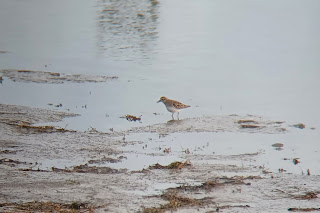
One last stop was Keith McLean's CA to look for a couple lingering birds. After a bit of searching, we spotted the continuing Nelson's Sparrow. As we were in pursuit of the sparrow for a better look (which we got), we also saw the continuing Least Sandpiper, another new species for the count. The sandpiper also has the honour of being the only photo I took all weekend.
Rondeau has so far recorded 117 species this year, a very high total. It is still a developing situation, and will be interesting to see what the finally results are.  Edit: final tally is 124 species, setting a new record for Ontario if I am not mistaken 

And that just about wraps it up! An enjoyable weekend birding back in Southwestern Ontario. As much as I love Algonquin (to which I am just about to begin my journey back to), I sure have missed these locations! Although in past years I have only done these two counts, this year I have the Algonquin CBC coming up on January 3rd.

Today it was Least Sandpiper, Nelson Sparrow, Blue-grey Gnatcatcher, and Red-throated Loons, tomorrow its Evening Grosbeaks, crossbills, Pine Grosbeaks, and Canada Jays...

Saturday, 16 October 2021

Shorebirds of Algonquin

Been awhile, eh? 

Alright, I'll say it. Algonquin Park is notoriously bad for birding. Sure, there's some good things to be seen here and there, but you (usually) have to work very, very hard for it. I can't tell you the number of times I have walked around the Old Airfield over the past several weeks and the best bird be an American Pipit. 

However, despite how bad it is, many birders, myself included, absolutely adore birding in the park. Why? Well, when the work you put in pays off, it really pays off. 

Back in the summer I was joking about doing a little naturalist table on the "Shorebirds of Algonquin", which was quickly kyboshed when I realised that we only had like four (4) shorebird specimens. As you can imagine, Algonquin is not exactly the most "productive" place for shorebirds. Rocks? We got em. But we lack many of the sandy beaches and exposed marshes that are required for these migrants to touch down on.

There is however I very special place in the park that sometimes harbours shorebirds, you just have to maybe get rained on (after all, rain drives down the birds). That place is the magical East Side, specifically Radiant Lake and Lake Travers.

I only first set foot on the shores of Lake Travers this past summer, but have since made an effort to get back there as much as possible (which unfortunately, due to certain logistics, hasn't been super often). This is a very special lake in that is has a decent (for Algonquin) sized marsh with decent (for Algonquin) mudflats when the water is low. Many rarities have been found here over the years, and each time I go, I hope to add to that legacy (spoiler: no mind-bogglers yet).

Radiant Lake is another special lake in that it is very sandy, and very shallow. It is possible to wade pretty much right across the lake when the water is low enough. The sandy bottomed lake also translates into expansive sand bars that are sometimes exposed. 

30 species of shorebirds have been recorded in Algonquin Park, and I have seen 13 of them. Anyways, here's a few pictures of the ones I have encountered. 

On September 10, I went on a work trip to Lake Travers and Radiant Lake. Our best bird was a White-rumped Sandpiper (something like the 14th record for Algonquin). We also had Least Sandpipers, Semipalmated Sandpipers, Semipalmated Plovers, and a couple Greater Yellowlegs. 

White-rumped Sandpiper

Semipalmated Plovers

Least Sandpiper

A couple weeks later, I was on a camping trip to Lake Travers with Peter Simons, and we had a great time in the rain with a mini (emphasis on mini) shorebird fallout. We each got a few park shorebirds, such as a Lesser Yellowlegs, Pectoral Sandpiper, and Dunlin. 


Our eBird checklist is a sight to behold. At least, I think so :-) 

Annnndddd...that's it. Yup. A couple exciting instances for shorebirds is all you get! No fallouts of Hudsonian Godwits were observed (sadly). Water levels rose very quickly after that late September trip, and when I returned in early October, there were no exposed flats anywhere! A flyover Greater Yellowlegs is all I got...

I suspect my shorebird season is over in the park, but I'll still holding out for a Northern Lapwing in the airfield...

Friday, 11 August 2017

West Perth Shorebirds

A couple days ago, I checked out the Mitchell Sewage Lagoons/West Perth Wetlands in Perth County. This location is known for being great for shorebirds, and it certainly doesn't disappoint. Over the years, more than 30 species of shorebirds have been spotted there.

Unlike last year, the water levels were quite high, making some of the cells perfect for shorebirds and other desolate of them.


There was quite the variety of shorebirds, and I ended up with 10 species. Not an earth-shattering number, but still impressive given the location and how some common species (Semipalmated Plover) were absent.

Killdeer and Lesser Yellowlegs were the most common.


Peeps such as Least and Semipalmated Sandpipers could be found in decent numbers as well.


Solitary Sandpipers weren't very solitary and I found about 5 throughout the cells.


I found only one Stilt Sandpiper, but I'll take it because they are uncommon. Stilt Sandpipers are more common fall migrants than springtime migrants. Finding one in spring is a real treat, and the one that was found when I was at Hillman got some of the shorebird enthusiasts excited. I'm not sure if it stuck around for anyone to add to their Festival of Birds list though.

There were a few Pectoral, Greater Yellowlegs, and Spotted Sandpipers working the shoreline. My records show that they were the first Pectoral Sandpipers that I've seen this year!

Pectoral

The best shorebird species seen were two White-rumped Sandpipers. White-rumps are sought after shorebirds that are hard to get if you aren't in the right place at the right time. They are a bit easier to find in the fall than the spring, much like the Stilt Sandpiper. This year has thus far proven to be a good year for them. I only saw them in the scope, so I was unable to get a photo.

A few other birds can be found around cells.

Green Heron

Red-tailed Hawk

Chimney Swift

Song Sparrow

Cedar Waxwing

Yellow Warbler

One bird that I am surprised I missed is Savannah Sparrow. They are almost guaranteed!

There were a few other things around that I didn't bother getting any photos of such as Monarchs, Viceroys, Painted Ladies, Common Whitetails, and Common Green Darners. I have found CGD pretty scarce this year, and I have seen more in the past few days than so far this entire year!

Despite the lack of photographs, it was a very successful outing and I can't wait to do some more shorebirding. Fall migration is upon us!

Saturday, 5 August 2017

Northumberland Birding

After two weeks at cadet camp, it was great to get my binoculars back around my neck and the camera in my hands. Since Presqu'ile Provincial Park was on the way back home, we stopped there for a few hours of birding.

But not before stopping at McDonald's, where we were rewarded with an Osprey.


When we got to the park, we were met with off-and-on rain, flooding (many closures), and mosquitos. Not the most fun conditions, but you just have to deal with it! Owen Point trail looked like this in some sections.


At one point, a C-177 Globemaster flew over. I was lucky enough to be one of the chosen cadets to go up in this plane. The one pictured here is the exact one that I went up in.


This Cherry-faced Meadowhawk was cooperative, however the angle it was perching at was not the best for photos.


There were a few Summer Azures flying around, along with Painted Ladies, Viceroys, and Monarchs (which I will start tagging soon).

Summer Azure

Numerous birds were fliting about, such as chickadees, woodpeckers, robins, Eastern Kingbirds, and a Brown Thrasher.

Black-capped Chickadee

Pileated Woodpecker

Along the shoreline, gulls and terns were quite numerous.


Caspian Tern

This Bonaparte's Gull got me a bit excited when I first saw it from a far. Upon closer inspection I couldn't turn it into a Franklin's Gull.


Shorebirds were hard to find, but I did eventually find a nice little pocket of seven species. Least Sandpipers (note the diagnostic yellow legs) were the most numerous, followed by Semipalmated Sandpipers, Semipalmated Plovers, Baird's Sandpipers, and singles of Black-bellied Plover, Spotted Sandpiper, and Sanderling.

Least Sandpiper

Spotted Sandpiper

Semipalmated Plover

Double-crested Cormorants were everywhere, as they nest on Gull Island.


The Marsh Boardwalk was closed due to flooding, but from the observation tower we saw a Great Egret and heard a few Marsh Wrens.

Great Egret

We finished off the day at the lighthouse. By this point the weather was turning quite bad.


Double-crested Cormorant

Considering the conditions it was a pretty good outing, and I recorded 47 species. I can only imagine what the park is like during peak migration (it is still a little bit early for a major influx of shorebirds).

On the way home we stopped at the Big Apple. I found this sign a bit funny.


I'm sure it will be a busy next few weeks as I try to get in as much birding as I can before school starts up again. Fall migration has just begun!!!


Sunday, 7 August 2016

A Moment in Mitchell


I felt like going to the West Perth Wetlands in Mitchell, so that's what I did yesterday afternoon.

When I got there, I was surprised to see that it was very dry. Last year this area was covered in water.

I saw a Green-winged Teal in this area last year.

Shorebirds weren't around in as large numbers like last year, aside from the Killdeer and Lesser Yellowlegs.


Last year's eBird checklist: August 25, 2015

Yesterday's eBird checklist: August 6, 2016

Interestedly, I saw the same shorebird species as last year, despite the lower water levels.


Lesser Yellowlegs outnumbered the larger Greater 6 to 1.


Killdeer were the second most numerous shorebird.


I managed to find a juvenile with it's parent.


Semi-palmated Plovers look sort of like small Killdeer. I saw a total of four.


Comparison of the two species...Killdeer on the right and Semi-palmated on the left.


Least Sandpipers were the most common peep (a small shorebird). A couple Pectoral and Semi-palmated Sandpipers could be found with them.


Similar to the yellowlegs, Solitary Sandpipers were around as well.


Butterflies included Orange Sulphurs, Cabbage Whites, Black Swallowtails, and Monarchs.


I didn't focus too much on botany, but here's some Chicory!


Other birds included Goldfinch, Northern Flicker, Wood Duck, and Green-winged Teal.


I can't wait for shorebird migration to really pick-up!