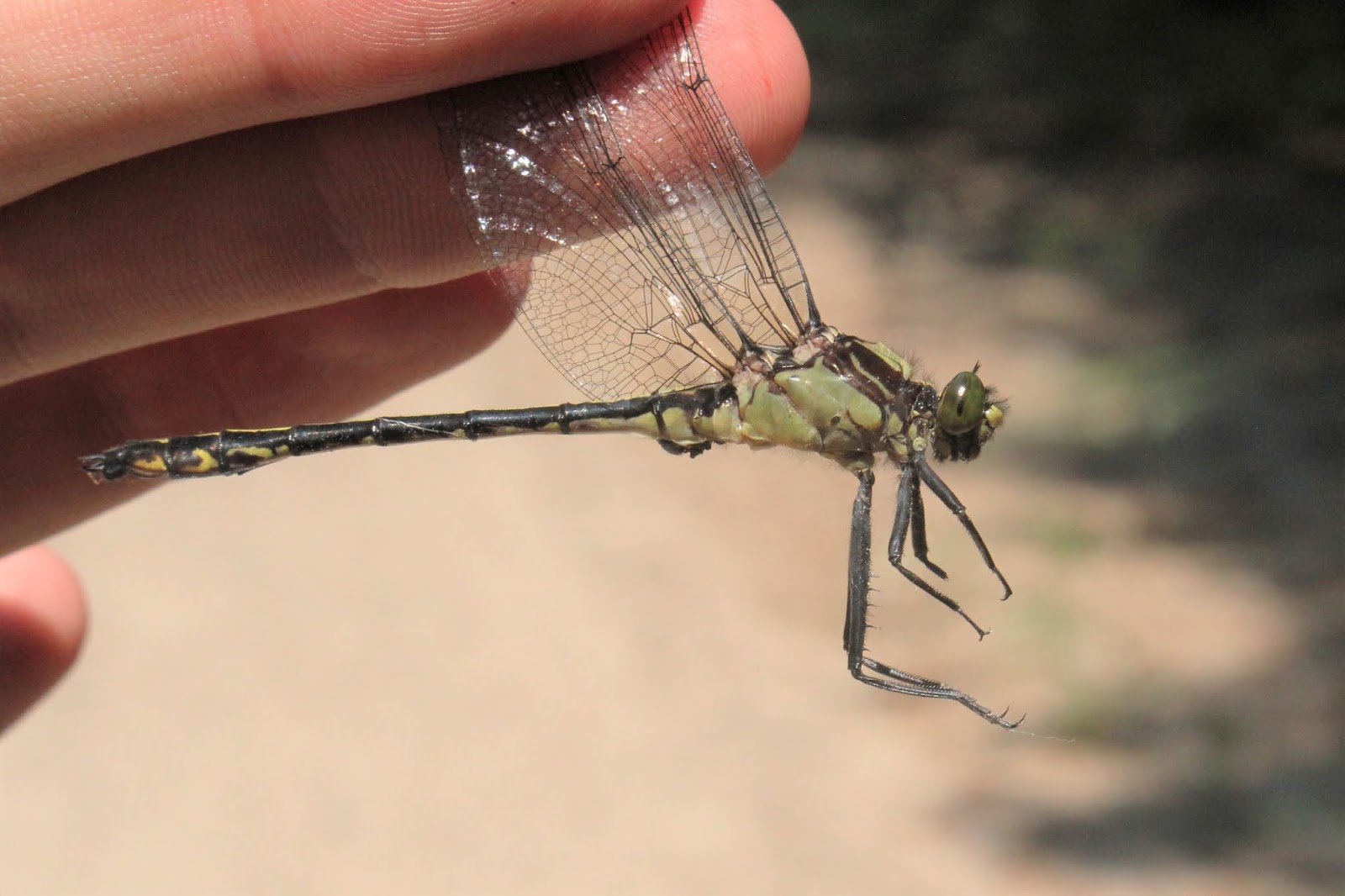
Hopefully I will get around to writing about some of the other activities from my recent trip, but for now, I will just copy and paste my writeup about the ode (dragonflies and damselflies) portion of the trip from the google group, Ont-Odes.
----
This past weekend, myself, along with Owen Strickland, Riley Walsh, Ethan Gosnell, and Jack Farley, departed for Algonquin Park, to spend our days looking at odes, and spend our nights looking at moths. This was the first time any of us had had a chance to properly look for odes outside of "southwestern" Ontario (south of the shield), with the exception of the five of us having done the shorebird project in southern James Bay last summer, so we were all looking forward to a bunch of lifers!
Our first stop upon our arrival in the park was the Whiskey Rapids trail. Almost immediately, we found a bunch of odes foraging out over the river. The first to be caught was Twin-spotted Spiketail, which proved to be the most common species at that location. We also netted a few Swift River Cruisers and a Stream Cruiser. In addition, we netted three species of clubtail; Ashy, Mustached, and a single Harpoon. A fourth species, a teneral Eastern Least Clubtail, was seen on the shore with its wings damaged. There were a couple Springtime Darners patrolling the river, as well as a few Ulher's Sundragons. Both Ebony and River Jewelwings were spotted.
 |
| Harpoon Clubtail |
 |
| Mustached Clubtail |
 |
| Swift River Cruiser |
 |
| Twin-spotted Spiketail |
 |
| Uhler's Sundragon |
Continuing down the trail, we were able to add a few more species to the list, including the incredibly common Chalk-fronted Corporal, and a female Hudsonian Whiteface. At a small pond along the trail, we netted Frosted Whiteface, Four-spotted Skimmer, and Calico Pennant, along with a couple of Marsh Bluets. We netted a female Ashy Clubtail here as well. Racket-tailed and American Emeralds were also netted along the remainder of the trail.
 |
| Ashy Clubtail |
 |
| Four-spotted Skimmer |
 |
| Belted Whiteface |
Next, we went to the Tea Lake dam. A couple of new clubtails for the trip were found, including a female Lancet Clubtail, and a Rusty Snaketail. A Common Basketail was flying around. Over the river, we caught another Springtime Darner, as well as a Hagen's Bluet. Hagen's Bluet was the most common bluet all weekend, and it took us until late Sunday afternoon to net a bluet of another species! We caught another Uhler's Sundragon here as well.
 |
| Springtime Darner |
 |
| Common Baskettail |
 |
| Lancet Clubtail |
Our last stop before supper was the Peck Lake trail, which proved to be pretty quiet. Tons of Hagen's Bluets, as well as a couple American Emeralds. The most noteworthy odes were a couple of Crimson-ringed Whitefaces.
 |
| American Emerald |
 |
| Crimson-ringed Whiteface |
After dinner at the VC, we checked out the Highland Backpacking trail head. Here we were pleased to net a Spiny Baskettail, as well as a Delta-spotted Spiketail. The "surprise" of the night was a female Ski-tipped Emerald. All of us had seen very few Somotochlora emeralds prior, myself having only seen Williamson's, so we were quite happy with the catch.
 |
| Ski-tipped Emerald |
 |
| Spiny Baskettail |
 |
| Delta-spotted Spiketail |
The final stop of the night was the Lake Opeongo access docks to look for an ode that we all really wanted to see. Around 9 pm, I caught the first Stygian Shadowdragon of the night. In total, there were about six individuals, and every member of the party was able to catch them. Be warned, however, the blackflies were pretty bad. I also briefly saw a Vesper Bluet skimming the water.
After a night of mothing, we awoke the next morning after a few hours of sleep, and headed back out to look for odes. We stopped again at the Highland Backpacking trail parking lot, this time successful in our search for Beaverpond Clubtail.
Next, we went to the Big Pines trail. There was a large swarm of baskettails right at the parking lot, and we added Prince Baskettail and Beaverpond Baskettail to the trip list. We were all pleased when I was able to net a pair of Eastern Red Damsels along the stream near the parking lot as well. The most noteworthy ode along the trail was a female Beaverpond Clubtail.
 |
| Eastern Red Damsel |
 |
| Beaverpond Baskettail |
 |
| Beaverpond Clubtail |
Afterward, we went to the logging museum, where we saw a pair of Harpoon Clubtails, as well as a Canada Darner and Elegant Spreadwing. Here we finally found our first, and I believe only, Dusky Clubtail of the trip.
 |
| Elegant Spreadwing |
 |
| Dusky Clubtail |
Right after the logging museum, we went to the Cameron Lake logging road, off of Opeongo Road. We had considerable luck here, with a Dragonhunter right off the bat, followed closely by a Black-shouldered Spinyleg, two species we had just been commenting on how it had been weird it was how we hadn't seen any yet. After many, many, Racket-tailed Emeralds, I finally was able to net a Somotachlora, which proved to be a Brush-tipped Emerald, one of two males we caught on the road. We managed to catch two other species of Somotachlora, a couple more Ski-tipped, and a nice female Clamp-tipped Emerald. On our way back, we netted a Stream Cruiser.
 |
| Dragonhunter |
 |
| Black-shouldered Spinyleg |
 |
| Brush-tipped Emerald |
 |
| Clamp-tipped Emerald |
 |
| Stream Cruiser |
After dinner, we headed to the Hemlock Bluff parking area in hopes of Harlequin Darner and Lake Emerald. We struck out on Harlequin Darner, which was one of three misses (the others being Cyrano Darner and Subarctic Bluet) over the course of the weekend. We risked life and limb to try and net odes as they flew around the marshes on either side of highway 60, and eventually, after several Common Baskettails, I netted a Somotochlora after a brief chase. It proved, however, not to be a Lake Emerald, but instead a female Williamson's Emerald. A while passed, but eventually, I spotted a Lake Emerald, hovering just out of reach, but it flew off before the others could see it. We were unable to find another the next evening.
That night proved to be another great night of mothing, and we saw several species of sphinxes, and four species of silkmoths (Cecropia Moth, Luna Moth, Rosy Maple Moth, and Polyphemus Moth).
We spent our last day looking for some of our final target species. After a morning in the airfield looking at tiger beetles, we went to the Spruce Bog Boardwalk in hopes of Sphagnum Sprite, but were only able to turn up Sedge Sprites. A few other species were flying around, including Prince and Common Baskettails, as well as a few Common Whitetails.
 |
| Prince Baskettail |
 |
| Sedge Sprite |
Afterward, we headed to Eos Lake, hoping for Subarctic Bluet, but, as previously mentioned, we failed to find any. We did, however, luck out and find a few Sphagnum Sprites. After two of us fell through the sphagnum mat, unfortunately, one being me, we decided to head back. However, just as we were leaving Owen was able to net a male Elfin Skimmer, a very nice surprise. They are truly very tiny!
 |
| Belted Whiteface |
 |
| Elfin Skimmer |
 |
| Sphagnum Sprite |
Our last ode stop of the trip was late afternoon at the Bat Lake trail. The buggy, and somewhat uncomfortable for us with wet shoes, walk was made worthwhile when we found many Amber-winged Spreadwings, Northern Bluets, and a single Boreal Bluet (which was let go before I got a photo, argh!). Also of note were many Crimson-ringed Whitefaces and a Lake Darner.
 |
| Amber-winged Spreadwing |
 |
| Lake Darner |
It was an excellent trip. In total, we saw 56 species, 53 of which we were able to net. Many lifers were seen by everybody, myself having seen 30 personally. Special thanks to Henrique for answering our questions in regards to odeing in the park!