| Song Sparrow |
| Philadelphia Vireo (from December 14) |
| Red-breasted Mergansers |
| Hermit Thrush |
| Song Sparrow |
| Philadelphia Vireo (from December 14) |
| Red-breasted Mergansers |
| Hermit Thrush |
Time for my annual Christmas Bird Count (CBC) blog post, which shrinks in content and length every year since I hardly carry a camera anymore...that's why I have friends who take pictures!
I arrived in London late Friday night, and was up early the next morning for the London CBC. This is my fifth year doing this count, and my route covers about a 5km stretch along the river. Some years it can be dynamite, but others, like this year, it can be quite poor.
It was so poor in fact that I got my lowest species total ever on this route with 28 (average 32), and lowest individual total with 323 (average 685). Averages are only based on five years of data, but still...
Highlights? Not much! A couple Winter Wrens, nine Swamp Sparrows, and 47 Northern Cardinals were all nice. Lots of misses though. I did add Great Blue Heron to my all time list for this route.
eBird checklist here: https://ebird.org/checklist/S99036733
Today I got to do a slightly more exciting count, the Rondeau/Blenheim CBC. This is my sixth year doing this count. This time around, I was joined by Nathan Hood and Ezra Campanelli.
We started with a lakewatch at the VC beach access (which apparently is beach #10, never noticed the number before). It was slow at first, but quickly picked up. Highlights were Surf Scoters, White-winged Scoter, Long-tailed Duck, and lots of Red-breasted Mergansers. Took a bit for the loons to start, but ended up with 47 Red-throateds and a Common. Although I guess the place to be was off South Point because Blake had 217 Red-throats! I'm happy though, my perfect streak for Red-throated Loon on this count continues!
Eventually we had to pry ourselves away from the lake, and begin walking up Lakeshore towards the campground. Lots of redpolls around (we ended up with 95, a new Rondeau bird for me). Tufted Titmouse and several Carolina Wrens were real treats for me, having not seen either in months. A Fox Sparrow that was pished in was another real highlight for our trio of dedicated counters.
A quick check of the beach at the traffic circle revealed a Great Black-backed Gull, a new one for our list.
After walking the maintenance loop, which was pretty birdy, although nothing really of note, we began our way down Harrison. I thought for sure we'd get a Pileated Woodpecker, but it was not to be. What we did get however was a pair of singing Great Horned Owls, the screech-owl along Bennett Ave, and a flyover Eastern Bluebird at the group campground.
We finished our route with 45 species, which we were quite happy with. Nothing too rare, and plenty of misses, but that is to be expected on a CBC.
eBird checklist here: https://ebird.org/checklist/S99134628
After finishing our area, we went to walk around the campground for a bit. Although it was covered by others earlier in the day, always a good place to look around. It did not take us long to locate several Yellow-rumped Warblers, and the Blue-grey Gnatcatcher that has been around. The gnatcatcher is new for the Rondeau CBC if I am not mistaken.
We scoped the bay before leaving the park. A few Canvasback among other ducks were nice to see.
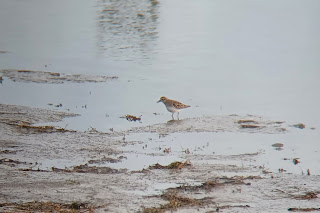
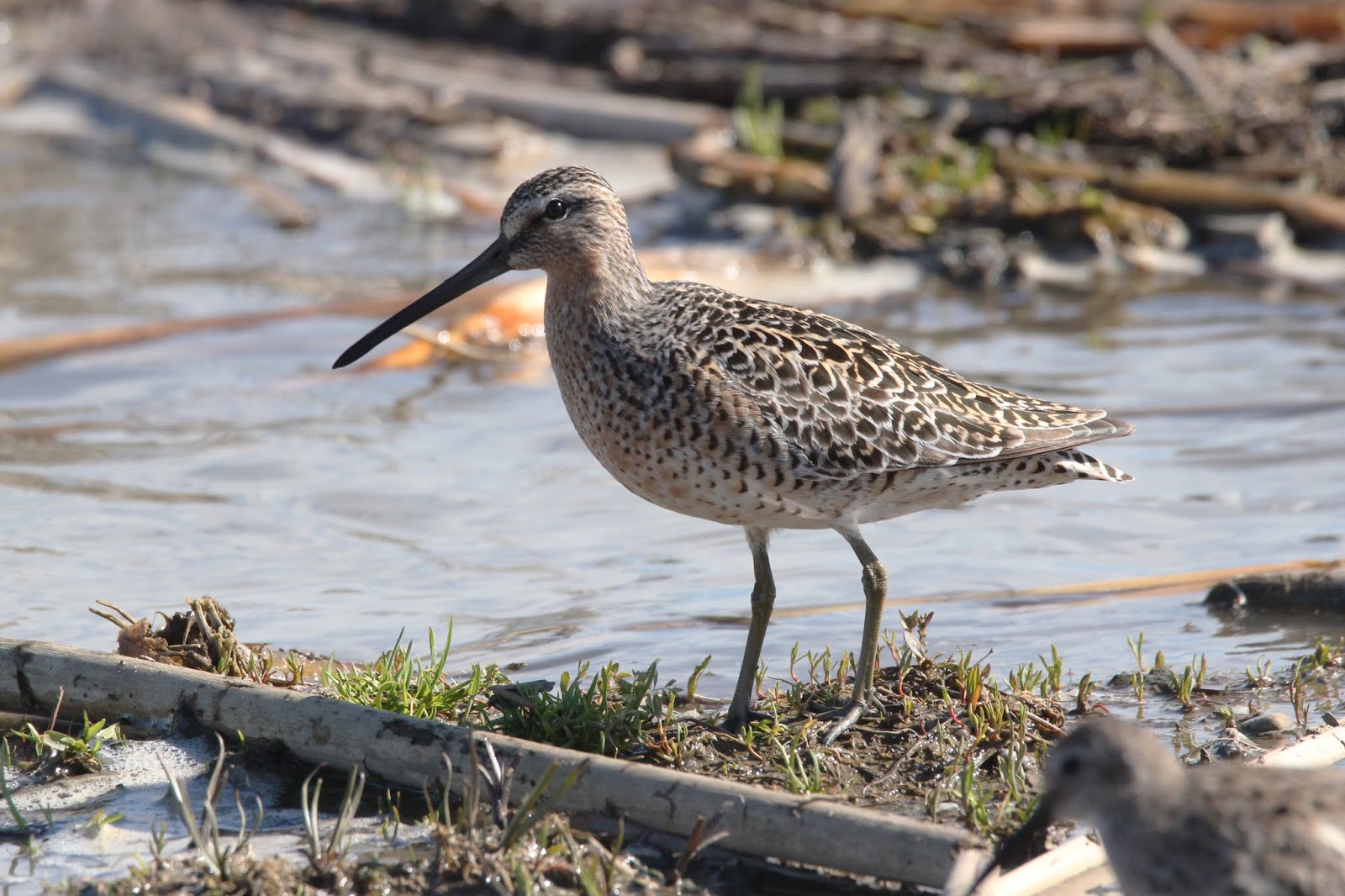
One last stop was Keith McLean's CA to look for a couple lingering birds. After a bit of searching, we spotted the continuing Nelson's Sparrow. As we were in pursuit of the sparrow for a better look (which we got), we also saw the continuing Least Sandpiper, another new species for the count. The sandpiper also has the honour of being the only photo I took all weekend.
Rondeau has so far recorded 117 species this year, a very high total. It is still a developing situation, and will be interesting to see what the finally results are. Edit: final tally is 124 species, setting a new record for Ontario if I am not mistaken
And that just about wraps it up! An enjoyable weekend birding back in Southwestern Ontario. As much as I love Algonquin (to which I am just about to begin my journey back to), I sure have missed these locations! Although in past years I have only done these two counts, this year I have the Algonquin CBC coming up on January 3rd.
Today it was Least Sandpiper, Nelson Sparrow, Blue-grey Gnatcatcher, and Red-throated Loons, tomorrow its Evening Grosbeaks, crossbills, Pine Grosbeaks, and Canada Jays...
It had been way too long since my last visit to Rondeau, so that is where I decided to head yesterday.
Although birding was my main intention, I didn't really take any photos of birds, so you'll have to live with some plants and insects :)
First things first, I went to Keith McLean CA, along the Rondeau causeway. Always worth a stop I find. There had been a Yellow-headed Blackbird seen there the day prior, but no sign of it when I went. Plenty of Marsh Wrens however, as well as some more unusual birds for the time of year, like Blue-winged Teal, Ruddy Duck, and Semipalmated Sandpiper. In the group of gulls sitting in the field, I found a single adult Lesser Black-backed Gull.
It was time to head into Rondeau. My first stop was the South Point Trail. Not too much bird song, other than the usual suspects, but a pair of Blue-grey Gnatcatchers and a Least Flycatcher (a species I often don't encounter in the summer, oddly enough) was nice. I went out to the beach at the light beacon, and found a new species of sedge for me, Sand Sedge or Mulhenberg's Sedge (Carex muehlenbergii). Much more robust and impressive than I imagined it being!
There were some loafing gulls further down the beach, so I decided to keep going. Nothing special among them however, only Bonaparte's, Ring-billed, and Herrings. I continued until I hit the washout, then headed back along the trail.
There were a few Painted Skimmers along the way.
I encountered this grass as well, which I have tentatively called Schribner's Grass (Dichanthelium oligosanthes var. scribnerianum).
I had originally keyed it out to Common's Grass (Dichanthelium commonsianum) using Michigan Flora, but have since revised my identification (this genus is hard!). While we're on the topic, the genus Dichanthelium is a real mess. It used to be the genus Panicum, however Panicum was then split into several more genera (while some species retained the genus name). Even within Dichanthelium, things are confusing. It seems every species name is a synonym for something else! Not to mention the numerous varieties. With some authorities, such as in the checklist of plants for Ontario's Carolinian zone, D. commonsianum is included under D. ovale ssp. pseudopubescens.
Next, I decided to go to the Tulip Tree Trail. Largely had the place to myself, which was nice. Almost immediately, I heard an Acadian Flycatcher, soon followed by two more. This was my main target for the day, as it was a species I had never seen in Rondeau before. A couple other goodies rounded out the bird list here, including a Wood Thrush carrying food, a Prothonotary Warbler, and a singing Black-throated Green Warbler. Maybe it is just a very late migrant, but I guess it isn't out of reason for a Black-throated Green to attempt to breed here.
Another Dichanthelium for you, this one a bit more straightforward: Broad-leaved Panic Grass (Dichanthelium latifolium).
I then intended to go to the Marsh Trail, but on the way passed Spicebush Trail. Last minute I decided to turn in and give it a go, because why not? Glad I did!
Nothing really of note bird wise, but as I was walking along I noticed this sedge (Carex).
I recognized it immediately as something in Section Griseae, and felt as though it was something I hadn't seen before. I had a sneaking suspicion it was Eastern Narrow-leaved Sedge (Carex amphibola), which is somewhat similar to the common Inflated Narrow-leaved Sedge (Carex grisea). I consulted a key, and found that my initial thought seemed to be correct, it appeared to in fact be Eastern Narrow-leaved Sedge, a rare species in Ontario, ranking S2 (between 5-20 known occurrences, I believe). Despite its rarity in Ontario, it is actually considered to be the most common species in its section further south of us. The perigynia of this species is triangular in cross section, and seems to be relatively a bit narrower and longer than in Inflated Narrow-leaved Sedge.
Compare to Inflated Narrow-leaved Sedge. I took this photo back in late May in London. The perigynia aren't completely mature here, but they are mature enough to see the difference.
I saw another member of the section Griseae along the same trail. Hitchcock's Sedge (Carex hitchcockiana) is a fairly distinct species, with hairy lower stems.
My last stop in the park was the first little bit of the Marsh Trail. Not really much of note.
| Flowering Rush (Butomus umbellatus) |
| Silverweed (Argentina anserina) |
| Swamp Rose Mallow (Hibiscus moscheutos) |
| Hairy Beardtongue (Penstemon hirsutus) |
| Greater Straw Sedge (Carex normalis) |
My eBird checklist for the day: https://ebird.org/checklist/S90074662
I went to Shrewsbury after and drove around looking for the Eurasian Collared-Dove, but no luck. Only saw a few Mourning Doves!
I went to Stefina Line east of Blenheim, and saw the reported Dickcissels just before heading back home. Always a nice one to see!
I took some backroads home, but didn't see too much. I had debated about going to check a field that gets Dickcissels each year, but opted to just go home. One was found there this morning! Oh well.
Gotta love this time of year!
As per usual for this time of year, I did a couple Christmas Bird Counts. I do two counts, the London one, which I have been doing for four years, and the Rondeau/Blenheim count, which I have been doing for five. Obviously this year is quite different than previous ones!
Yesterday was the London count. I did my usual route along the Thames River in the south part of the city. I was unable to turn up anything good however! Just the usual suspects. I ended up with 36 species on my walk, which ties 2018 for the most species I have seen on this route. It is up from 32 species from last year! The weather was sort of mild, which meant not many ducks on the river, but at least it was cold enough to somewhat concentrate the smaller birds.
eBird checklist here.
I ended up with two new species for my overall route list, Merlin and Common Redpoll. Interestingly, Carolina Wrens were fairly numerous. I couldn't find a single one last year! I think it has been a good year for the species.
| Carolina Wren (from this spring) |
Afterwards, I went to the landfill as it was not too far away. I only found one concentration of gulls, and only four species among them (Herring, Ring-billed, Glaucous, and Great Black-backed). Thankfully, Reuven Martin, who had been doing that area for the count, managed to also turn up Lesser Black-backed and Iceland in a different field, so at least we got those for the cumulative total!
I did a quick check of a couple spots around the neighborhood later, but couldn't turn up anything of note.
Today was the Rondeau/Blenheim CBC, so I was down there by shortly after 7am. I started at the VC beach, where I was shortly thereafter joined by Reuven. We did a short lakewatch, highlighted by White-winged Scoter, Long-tailed Duck, and a couple Red-throated Loons. I have had at least one Red-throated Loon every time I have done this count, so I am glad my streak was not broken!
We then began the long 16 kilometer walk up Lakeshore Drive, with plans of returned back down Harrison trail. It wasn't super birdy, but we managed to turn up an Eastern Towhee, a couple Hermit Thrushes, and a Yellow-rumped Warbler. Nothing really out of the ordinary. Lots of woodpecker action, as we had twelve Downies, eight Hairies, eight Red-bellieds, and three Pileateds.
| Downy Woodpecker from a past CBC |
eBird checklist here.
With no compilation to go to, there wasn't much reason to stick around, so after scoping the bay, which held many distant ducks, we headed out. Reuven went back to London, but I wanted to quickly pop over to Erieau. It ended up being pretty quiet over there, and the only thing of note was about 165 American Coots.
That's a wrap for another year!
Yesterday I went down to the Rondeau area, in hopes of catching up with a couple of birds, one of which being the juvenile Purple Gallinule found by Steve Charbonneau on Tuesday, at the Blenheim Sewage Lagoons. This is apparently the first record for Chatham-Kent.
It rained most of the way there, and upon pulling up to the lagoons, there was quite a bit of lightning. It was decided that standing out in the open on the lagoons with a metal tripod was probably not in my best interest. So instead, I opted to go to Erieau first. There were quite a few gulls, terns, and cormorants on tbe pier, in the trees, and on the beaches. I picked through them, but was unable to turn up anything good. I had about 250 (probably more) Common Terns, which is the most I had ever seen at once. Hardly any shorebirds, other than three Sanderlings, and a few Spotted Sandpipers. I flushed a Black-crowned Night-Heron from the base of the pier, which seemed like a really odd spot. My first for the Rondeau area.
Afterwards, the rain seemed to let up a bit, so I went back to the sewage lagoons. The sky seemed sort of threatening, so I left the camera in the car. It took a bit, but finally the Purple Gallinule made its appearance. Quite the pretty thing, even if it wasn't an adult. It hopped up onto some Phragmites and sat and preened itself. It was up high enough we were able to have it at eye level!
| Trailing Fuzzy Bean (Strophostyles helvola) |
| Northern Evening Primrose (Oenothera parviflora) |
| Redwhisker Clammyweed (Polanisia dodecandra) |
| Seaside Sandmat (Euphorbia polygonifolia) |
| Tumbleweed (Salsola tragus) |
| Cylindrical Blazing Star (Liatris cylindracea) |
| Golden Sedge (Carex aurea) |
| Matted Spikerush (Eleocharis intermedia) |
| Blunt Spikerush (Eleocharis obtusa) |
| Straw-coloured Flatsedge (Cyperus strigosus) |
| Takeoff |
| Dad looking at something, probably a Yellow Warbler |
| Hairy Solomon's Seal (Polygonatum pubescens) |
| White Bear Sedge (Carex albursina) |
| Wild Geranium (Geranium maculatum) |
| Licorice Bedstraw (Gallium circaezans) |
| Bulbous Cress (Cardamine bulbosa) |
| Rattlesnake Fern (Botrypus virginianus) |
| Round-lobed Hepatica (Hepatica americana) |
| Blue Phlox (Phlox divaricata) |
| Twoleaf Mitrewort (Mitella diphylla) |
| Goose Egg Moss (Arrhenopterum heterostichum) |
| Least Sandpiper |