Showing posts with label Ausable River. Show all posts

Tuesday, 22 June 2021

Early June Insects

Early June is always a great time of year to go out and look for bugs. I have gotten out on a few occasions to try and nail down some of my target species for this time of year. I have compiled some of the more notable sightings into this post.

Back on June 5th I went to Lambton Shores in search of some of the neat insects that call that place home. I didn't see too much of interest when I visited The Pinery, other than a Cyrano Darner and an Eastern Pine Elfin butterfly on a dock. Its not an insect, but these Northern Sunfish were just off the same dock! 


I visited the MNR parking lot and the Ipperwash Dunes and Swales in search of my main target species, Dusted Skipper. This is a very range restricted butterfly, and I believe that Lambton Shores may be the only place it is found in Ontario. It took a bit, but eventually I found some. 


I also ended up seeing another lifer butterfly in the form of a Common Roadside Skipper.


Several species of dragonflies were around as well.

Racket-tailed Emerald

Slaty Skimmer

Belted Whiteface

Lancet Clubtail

Beaverpond Baskettail

A couple of neat flies were seen too.

Bumble Bee Mimic Robber Fly

Golden-backed Snipe Fly

I next visited Fossil Road on the Ausable River, since it was more or less on my way home. I always enjoy stopping here, as it seems you never know what you will see!

I was mostly focusing on dragonflies, and came up with two species of clubtails, Midland and the rare Rapids Clubtail. I saw a couple Rapids about 4 kilometers up river last year.

Midland Clubtail

Rapids Clubtail


I also saw a Common Sootywing, a somewhat uncommon butterfly species.


A couple days later on June 7th I was back out to the Ausable River in search of a rare species of clubtail, Green-faced Clubtail. I worked the section of river near Rock Glen CA. It took a bit, but I finally managed to find a few Green-faced Clubtails, a new species for me!


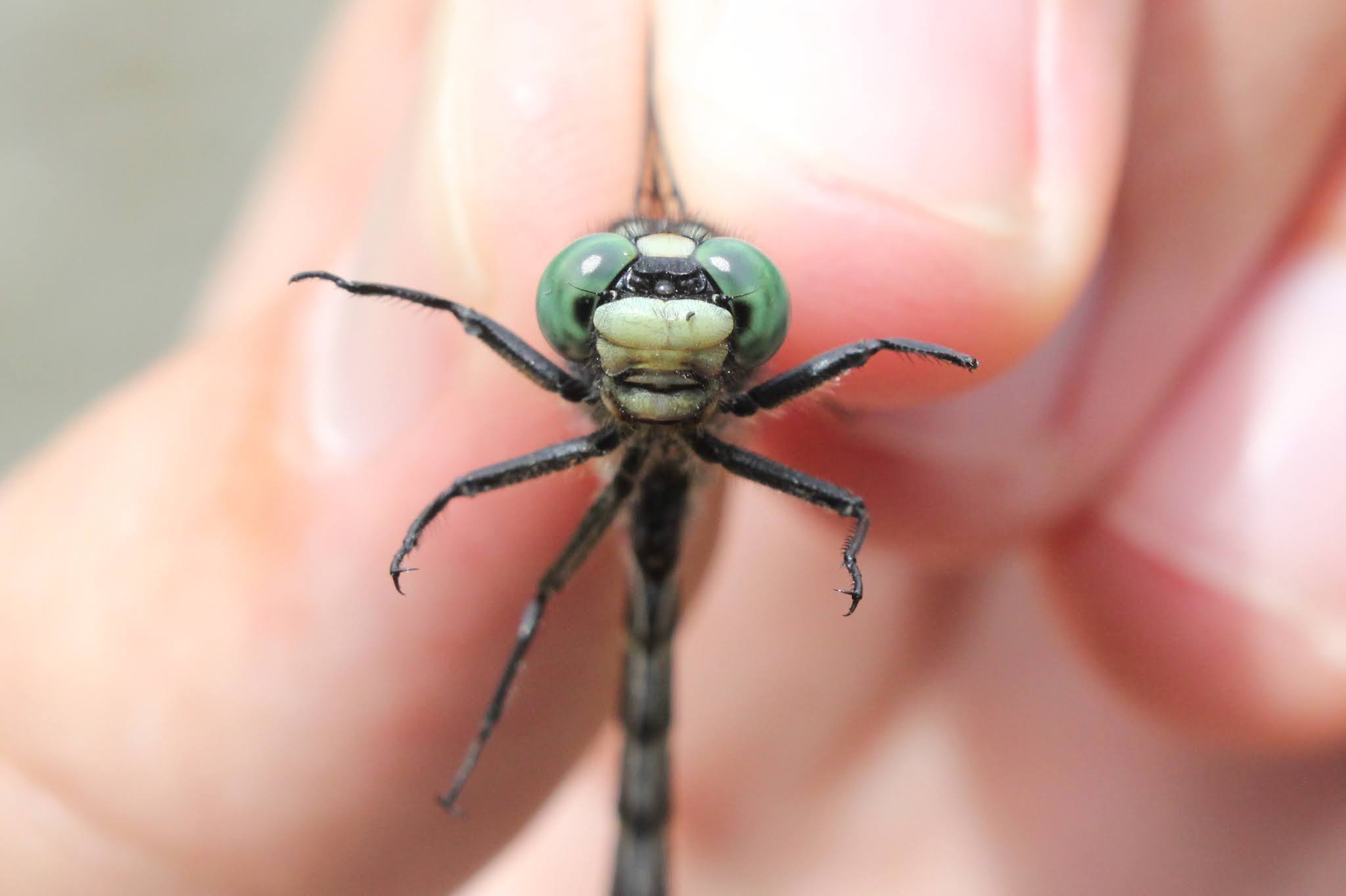

There were a few males patrolling the river, and I caught a female later on.


One of my most notable sightings wasn't even of a live dragonfly. I spotted a dead Twin-spotted Spiketail caught up on some grass! This may be the first record of this species for the Ausable River, and perhaps Lambton County. On the 5th I had seen a spiketail sp. briefly while I was on Fossil Road, which is in Middlesex. If it was the same species, it would have constituted a new county record for Middlesex. Due to this individual's proximity to Middlesex, I can only assume they are present there too. 


After I was done at Rock Glen, I made another stop along Fossil Road. Completely different than just a couple days prior in that there were no clubtails flying around! I did however find an Eastern Red Damsel, a new one for my Middlesex list.


On June 10th I decided to check out some areas close to home for odonates. I figured it was about time for a visit to the Sifton Bog, so that was my first destination of the day. 

I was quite pleased to see that there were several Spatterdock Darners, which I first found here in 2019 (first Middlesex county record) out over the pond, indicative of a breeding population here. None came close enough for a swing with my net, other than this one when I only had my camera in my hand! At least I got a nice photo :)


There were many Painted Skimmers as well, including a couple pairs in copula and an oviposting female, also indicative of a breeding population. The only Painted Skimmer I had seen prior to this was also at Sifton Bog in 2019. Absolutely gorgeous dragonflies. 


My first "in hand" Carolina Saddlebags were seen as well. Another breeding species here.


There were a few damselflies of interest as well.

Azure Bluet

Boreal Bluet

Amber-winged Spreadwing

Boreal Bluet was a new Middlesex species for me.

I made a visit to Komoka Provincial Park next. Here I was in search of another potentially new species for my county ode list, Delta-spotted Spiketail. After a long and grueling hike, I eventually spotted one, but was only able to get off a quick photo. 


There were also quite a few of these cicadas around as well, Say's Cicada (Okanagana rimosa).


I made one last stop at a storm pond in North London, where I found an unexpected county lifer ode, Lancet Clubtail.


It was an enjoyable few days of tracking down insects! Not much else to do these days :-P

Thursday, 15 April 2021

Mid-April Along the Ausable

On Tuesday I went up for a hike on the Ausable River Valley Trail near Sylvan, off Elm Tree Drive. This trail takes you into some of the best Carolinian habitat that Middlesex has to offer. It is still rather early for most of the notable stuff, but I wanted to take advantage of the good weather.

On my way in, I made a quick stop and checked in on the nesting Common Ravens. Both were present at the nest site. They also nested here last year, which I believe was the first nesting record for Middlesex County.

After I parked the car, I was greeted with the songs of Vesper Sparrows. Before this year, I don't think I had ever (knowingly) heard this species sing, weirdly enough. I tracked down a couple individuals, and photographed one.

I made my way into the forest, flushing a pair of Wood Ducks from a flooded section of the trail along the way. One of the first plants of note I saw was this American Gromwell (Lithospermum latifolium). This is very uncommon species in Ontario, although is to be expected in the right habitats. 

I was a bit surprised to see Yellow Downy Violet (Viola pubescens). Lots of things are early this year! 


American Bladdernut (Staphylea trifolia) was occasionally seen, especially closer to the river. 


Black Maple (Acer nigrum) with the distinctive pubescent leaves was common.


 Pennsylvania Sedge (Carex pensylvanica) is a common colony forming sedge in forests. It can be separated from other members of its taxonomic section, Acrocystis, by its round perigynia (when present, in this photo they still aren't developed), narrow leaves, and the presence of rhizomes, which are modified stems which run underground, which give this species its colonial forming tendency. 

When I spotted this sedge, I had Acrocytis on the mind, so I tried to key it out to that, which didn't really end up working. That is because as it turned out, it wasn't in that section at all! It was actually Peduncled Sedge (Carex pedunculata), another common species. This particular plant wasn't very lax in appearance, as this species typically is, and its peduncles (stalks with the flowers) were very short, to the point I didn't even notice them in the field.


I continued on my merry way, and ended up coming across a cool cedar seepage area. I was getting limited on time by this point, so I'll have to go back to explore it further (it'd probably be best later in the growing season anyways). Ebony Sedge (Carex eburnea) was somewhat common, my first time seeing this species in Middlesex County.

Plantain-leaved Sedge (Carex plantaginea) was also pretty common. I will never tire of seeing this species.

I kept a sharp eye out, and as I expected, I was able to locate some Carey's Sedge (Carex careyana). Now that I have a search image, it is getting pretty easy to pick out. I am not sure if it is known from this exact location, but it is definitely known from the area. 


Pretty Sedge (Carex woodii) was also seen. Another species that now that I have a search image for, I am picking out all over the place.


Hairy Sedge (Carex hirtifolia) was also seen. This particular plant was further along than most of the others, which were still just vegetative. 


As for interesting wildflowers, this Purple Cress (Cardamine douglassii) was just starting to bloom.


Red Columbine (Aquilegia canadensis) was also coming up, although no sign of any flowers yet.


On my way back home, I stopped along Fossil Road for a few minutes. Not too much of note, other than super early Seneca Snakeroot (Polygala senega). Usually, I don't think this species pops up until May. I did a double take when I spotted it!


And I'll throw this one in, Labrador Violet (Viola labradorica) from yesterday a site here in London. The fourth species of violet I have seen this week!