James Bay 2018:
Part One
Part Two
Part Three
Part Four
Part Five
Part Six
Part Seven
Part Eight
---------------


August 22, 2018
Another Paskwatchi survey day! I went out a bit earlier than the rest of the crew, with intentions of waiting for them at the point, then surveying our way back. Just as I was about to cross the creek, I came across two young Sandhill Cranes and their parents. A nice surprise!


Flocks of Snow Geese were now regular. A couple flocks went over on the walk to the point.

Paskwatchi Point.

It is a favourite place for gulls and cormorants to sit when the tide is out. Hundreds of Bonaparte's Gulls were there that day. I also managed to pick out a couple Little Gulls, an adult with a full hood (my first in this plumage) and a second summer bird.

The "flats" near Paskwatchi are a favourite place for many shorebirds, in particular Hudwits and Red Knots. You can see Fantasy Island off in the distance.

I was the recorder for this survey, and since I had brought my scope, it made the walk feel like the longest walk ever. No matter how many different strategies I tried for carrying that thing, nothing felt right!
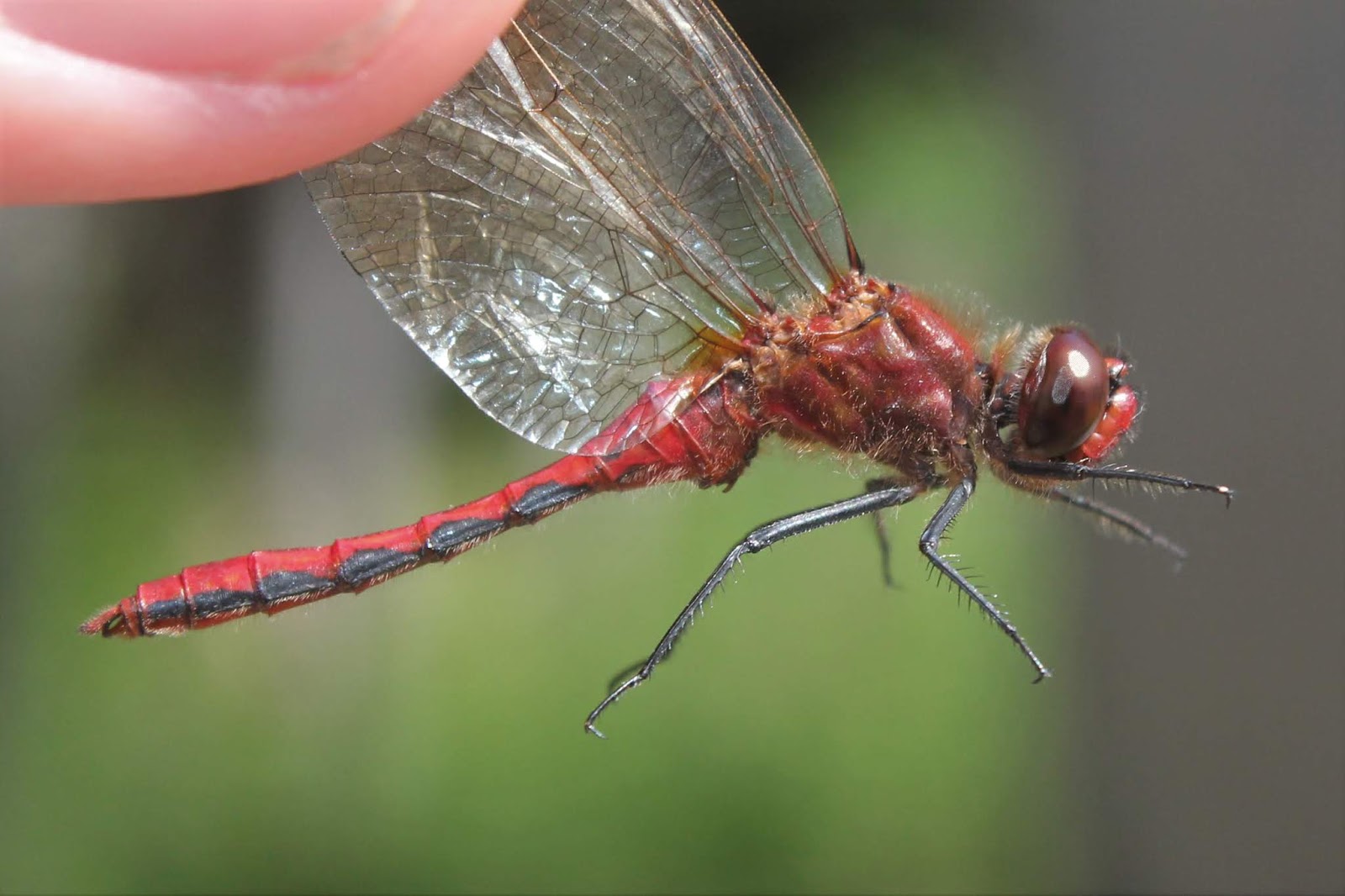
We got back to camp mid-afternoon, and I went straight out to the marsh to catch some odes, as it was a very nice sunny day. Not too much flying around, but I caught some more meadowhawks.
 |
| Black Meadowhawk |
 |
| Cherry-faced Meadowhawk |
I also saw a Bronze Copper (horrible pic)

While I was out, I came across a very vocal LeConte's Sparrow. I only had my 55mm lens on, so I went back to camp for my other lens, and hope that the sparrow would still be there.
I saw this Gray, I mean Canada, Jay on the path on my way back out. Canada Jays hung around camp. We saw at least three or four family groups throughout our stay.

Coming up to the creek, I decided to pish a little. Up popped a Nelson's Sparrow! You'll notice that she is banded, meaning that it was the same one from the day before!

Lucky for me, the same LeConte's was still in the same area. I came away with some of my favourite photos of birds that I have ever taken. I think LeConte's Sparrow may be my new favourite bird!


Plenty of other sparrows were also present. Many Swamps and Lincoln's, as well as about a gazillion Savannah Sparrows (I had a day where stood in a single spot for about 5 minutes and had 50 or 60 stream by me)
 |
| Swamp Sparrow |
 |
| Savannah Sparrow |
A few other birds were making use of the marsh.
 |
| Wilson's Snipe |
 |
| Sandhill Cranes |
Harriers were a daily occurence. One day I saw around nine of them in one "swarm". It was the oddest thing!

Common Ringlets are sometimes seen up there. They look at tad darker than the ones down south.

I spotted this skunk while photographing the LeConte's.

This Greater Yellowlegs was feeding in the creek.

I didn't anticipate such a great evening for photography, so I didn't charge my battery (yes, we had electricity...sort of). My battery died.
That night I got a text via satellite texting from my friend in the south. It simply read "Guess what showed up today?"
So yep. That is how I found out about the Reddish Egret.
August 23, 2018
We woke up to a very calm morning. Almost too calm. Off on the horizon we could see some dark clouds, but it was somewhat sunny and warm where were were, so we weren't worried. We had a Longridge Point survey that day. Our plan was to leave early, walk to the tip (doing the survey along the way) then have lunch while we waited for the tide to be low enough for us to walk back (there are several places that become gravel "islands" when the tide comes in).
We got to out starting point right on schedule, and then began the survey. Soon after we started, the banders radioed us to say they had a jaeger! Not too long after that, we were looking at a beautiful adult light-morph Parasitic Jaeger with full tail streamers (longer than one would think!). We were ecstatic, we knew it was going to be a good day!
We walked another couple kilometers, seeing things such as White-winged Crossbill and Marbled Godwit along the way. We came across a group of birds, so we stopped to scope them. As we where looking through them, my hat blew off. I turned around to pick it up, and then I heard a "thump", I turned back around to see my scope laying in the ground. And that's when it hit us...a huge gust of wind! We decided to hunker down for a couple minutes to wait it out before we continued on our way. James Bay, however, had different plans for us. The tide came up faster than we had expected, and it was high. Before we knew it, we were stuck.

Over the next 10 minutes, it must have dropped something like 10 or 15 degrees. Lucky for me, I had grabbed my jacket and gloves and stuffed it in my bag just before we left (I almost forgot it!).
All was not lost however, as there were lots of birds to be seen. We had around eight, nine, or even ten thousand shorebirds stream by the "island" over the course of a couple hours, as the mudflats were they would normally feed (in this case West Bay) flooded. The majority of the birds were White-rumped Sands, but there were also a large numbers of Semipalmated Sands. Hudwits, Red Knots, Baird's Sands, and plovers (mostly Semipalamted) were mixed in as well. We even had a few Red-necked Phalaropes (perhaps not unexpected, but my first time seeing them "on the move" like that!).
We set up a nice little seawatch station to watch the action.

I was curious to see where all the peeps from West Bay were going (the majority where roosting on the gravel, some even touched down on our island) so I got up from the "blind" and fought my way through the wind. Not long into my "journey to the far side of the island" (in reality like 40 or 50 meters), I looked up and was shocked to see a dark morph subadult Parasitic Jaeger directly overhead! It was gone as soon as it arrived it seemed, within seconds it had soared over the rest of the crew and shot out over the bay, headed south.
In short, we were stuck out there for four hours. In an effort to boost morale (and warm up, it was might cold) we built a fire. The brisk wind certainly fueled it with the needed source of oxygen!

Just before I burned it, I found this piece of White Cedar. Like the White Birch, it doesn't grow in the area, so it would have come from farther south.

I got hungry after awhile.

Eventually the tide was low enough (normally the tide goes down in a couple hours, so it stuck around awhile!) for us to "island hop" on some of the grassy islands back to "safety".
We made it home about an hour later, and were pleased to be met with a nice warm supper (thanks banders!).
It was certainly an experience, and quite frankly I had a fun time being "stranded". We slept well that night.