Showing posts with label moss. Show all posts

Sunday, 21 November 2021

Species Spotlight: Powder Gun Moss (Diphyscium foliosum)

I was recently walking one of Algonquin Park's trails, when I looked down and spied something I had been long wanting to see—Diphyscium foliosum, perhaps better known by its common name of Powder Gun Moss. 


This is a very distinctive moss, as I am sure you have noticed, due to it's unique capsules.


The capsules are believed to be shaped in this manner to aid in spore dispersal. Whenever a rain drop hits it, spores would be emitted from the capsule in a cloud that can reach as far as a few centimeters. 

The perichaetial leaves, the leaves which surround the base of the capsule, of Powder Gun Moss are lawn awned and also quite distinctive. 


The vegetative leaves are not quite as showy, and are no doubt overlooked by even the most keen observer. Their blunt leave apices (leaf tips) separate this species from the other North American species, Diphyscium mucronifolium, which is found in the southeastern United States. Diphyscium mucronifolium is an Asian disjunctive species. 


Powder Gun Moss is found throughout Eastern North America, as well as parts of Western North America. Keep an eye out for it on soil banks and soil on forest floors. 

Monday, 28 September 2020

Algonquin Scenes

This past Saturday, my family and I went to Algonquin Park. They wanted to see some fall colours, and I figured I could see some plants along the way!

After a 4:30am departure from London, we arrived in the park shortly after 10am. The leaves didn't disappoint.


Wanting to avoid the crowds, I suggested we try the Old Railbed, up Arowhon Road. It proved to be relatively quiet, away from the hustle and bustle of the main highway!

Arowhon Road

I hadn't been to the railbed since 2017, so it was nice to be back. Since vascular plants are starting to die down for the year (though there are still plenty to look at!), I have started to look at moss again. Here are the obligatory moss pictures :) 

Ribbed Bog Moss (Aulacomniu palustre)

Knight's Plume Moss (Ptilium crista-castrensis)

Dicranum sp. (tbd)

Red-stemmed Feather Moss (Pleurozium schreberi)

Juniper Haircap Moss (Polytrichum juniperinum)

Bristly Haircap Moss (Polytrichum piliferum)

I liked how this photo of Houghton's Sedge (Carex houghtoniana) turned out.


I didn't really have any special birds. Lots of chickadees and nuthatches, as well as a few warblers (Palm and Myrtle). A single flyover Rusty Blackbird and a young Yellow-bellied Sapsucker were probably the highlights.

We only made it as far as Wolf Howl Pond. Very picturesque. There was a pair of Wood Ducks and a few Ring-necked Ducks present on the pond. I should not I saw a Compton Tortoiseshell, the first I have seen in Algonquin. Good year for them, I have recently even seen some in London!


Next up was lunch. As expected, the lunch areas were crazy, but luckily we were able to find a nice quiet spot in the outdoor theatre parking lot.

Prickly-tree Clubmoss (Dendrolycopodium dendroideum)

Fringed Brome (Bromus ciliatus)

After a stop at the VC (picked up a book on ferns and an Algonquin bryophyte checklist), we went to the logging museum. It is a neat little place.

Bebb's Willow (Salix bebbiana)

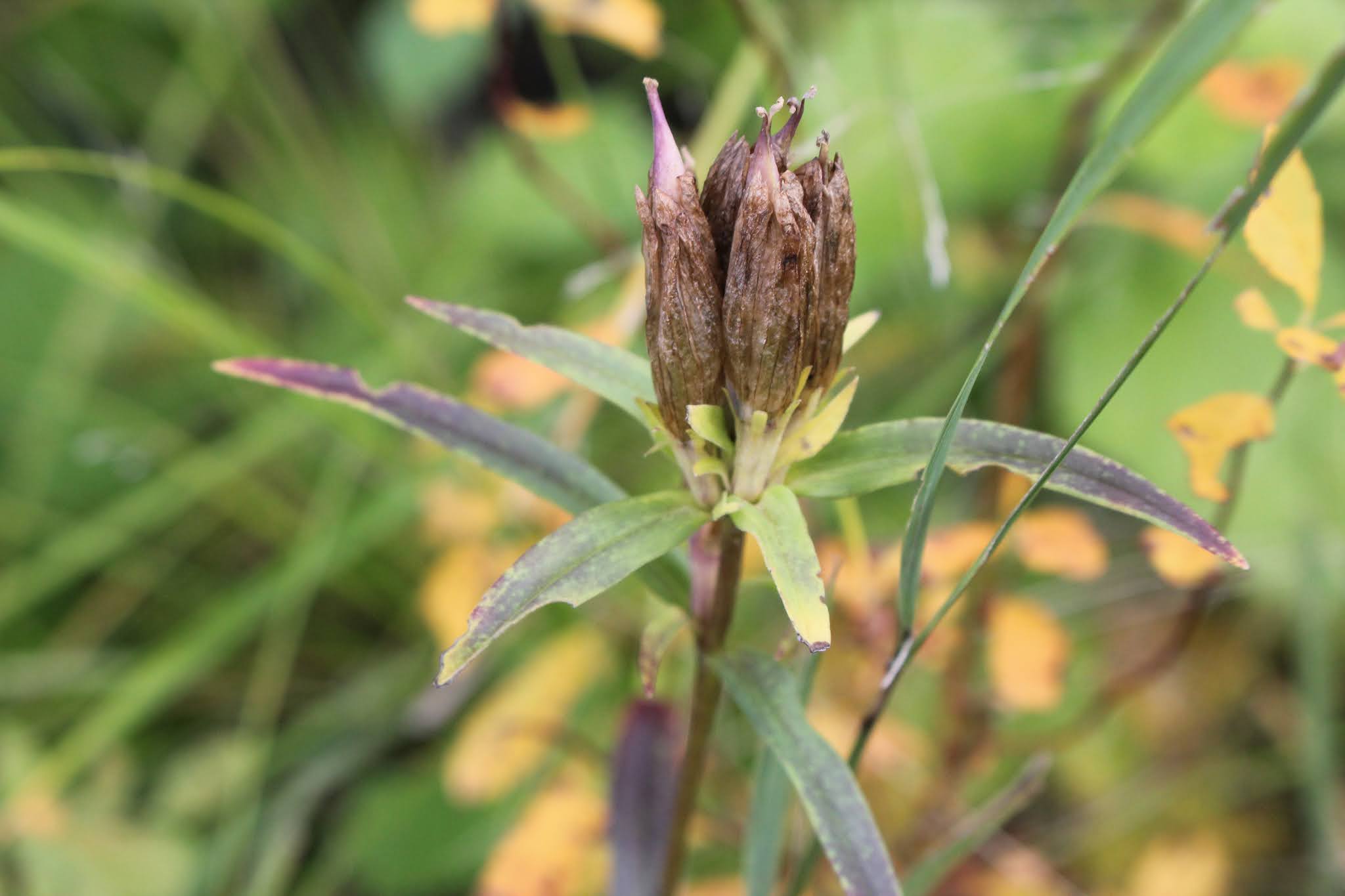
Narrow-leaved Gentian (Gentiana linearis)

We went to Spruce Bog next. Not much to report on there, but it always a nice place to stop.


Last stop was the Old Airfield. I had the place to myself! 

Leathery Grapefern (Sceptridium multifidum) was a new one for me.


A good end to a great day! The crowds can be a little ridiculous at times, especially with the current situation, but we managed to avoid them for the most part. Algonquin remains one of my favourite places to explore.


Sunday, 19 April 2020

Some Local Stuff

For obvious reasons, I haven't gone too far. But I have gotten out a couple times just around the neighborhood. There is still a noticeable lack of migrants, but hopefully things will pick up!

Last Sunday, it was quite nice, so I went out for a brief walk. I was pleased to find Virginia Spring Beauty (Claytonia virginica), a native spring wildflower, new for my neighborhood plant list (425 species and growing!).


I was also very happy to stumble across a fox den, with five kits.


With a shrew (Sorex sp)
A couple days later, I went out and found some more plants.

Goblet Moss (Physcomitrium pyriforme)

Yellow Trout Lily (Erythronium americanum)

Family Bryceae (tentatively thinking Ptyschostomum)

Bonfire Moss (Funaria hygrometrica)

Yesterday, I went out hoping for some new birds. It was pretty quiet, but I did come across a few things. One highlight was a Lesser Scaup, a new bird for my neighborhood list (#171).


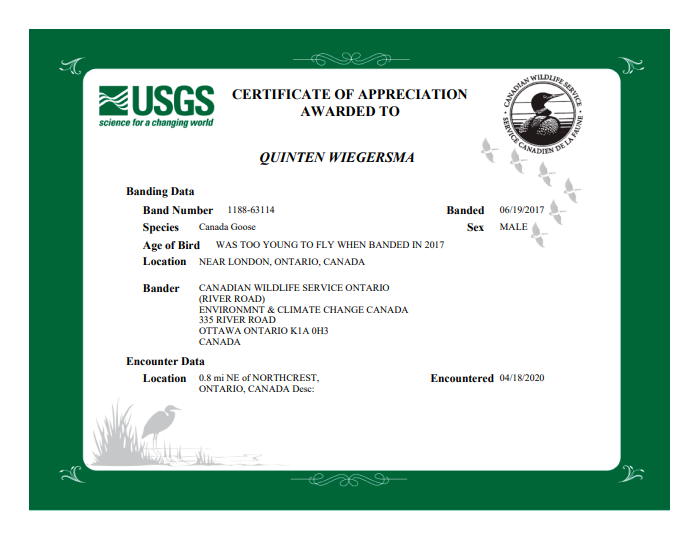
I came across a banded Canada Goose. I managed to get the band number and reported it.


There was a goose on a nest as well. The beavers have once again done a good job at damming up the place. There used to be a grassy field where this bird was nesting!


My efforts of a Virginia Rail finally paid off (I tried in five different spots today!). This is my second record for the neighborhood, and the first visual. I wasn't toting around my big lens today, so he came in quite close!


Stay safe out there, hopefully there are local areas for you to explore!

Saturday, 11 April 2020

Early April Plant Life

This afternoon I got out for just over an hour in one of London's natural areas. I can't venture too far for obvious reasons, so it's nice to have areas like these close to home.

Many early spring wildflowers still have yet to emerge, but I found a few things of interest.

My main reason for going out was to check out a population of False Rue Anemone (Enemion biternatum). This species is ranked S2, with between 5 and 20 occurrences in the province. I visited this population last spring and was pleased to find many individuals. This time around, the plants were yet to flower, but I found hundreds of plants, way more than last year, and I turned up plants in places I didn't note them previously. Should be nice when they flower!


Here is is in flower, from last year.


Another species of interest was Cut-leaved Toothwort (Cardamine concatenata). This is a common spring wildflower. While I didn't see any in flower, by the looks of it, that should be happening soon!


Canadian Wild Ginger (Asarum canadense) is just starting to peek up from beneath the leaf litter.


Wild Leek (Allium trichoccum), also known as "Ramps", was fairly prevalent in this natural area. The variety I saw was Wide Leek (A. t. var. trichoccum). It can be told from the much rarer Narrow-leaved Leek (A. t. var. burdickii) based on its reddish basal sheaths, leaf width (>2cm), and petiole length.


 There is an uncommon "albino" form of Wide Leek, with uncoloured basal sheaths (which is like Narrow-leaved Leek), so identification of this variety must be made with the combination of the other characteristics. This "albino" form is seen below.


Another nice early season plant is Early Blue Cohosh (Caulophyllum giganteum). Like the name suggests, it emerges in the early part of the growing season. It can be differentiated from Blue Cohosh (C. thalictroides) by its purple flower (the latter has a yellow-green flower). Additionally, Early Blue Cohosh flowers before its leaves open, whereas Blue Cohosh flowers after its leaves open. Early Blue Cohosh typically flowers a couple weeks in advance of Blue Cohosh.


A favourite of many naturalists is Bloodroot (Sanguinaria canadensis), named for the reddish sap that can be seen when the root (rhizome) is broken. 


Northern Spicebush (Lindera benzoin) is somewhat locally abundant in the area. It's just the buds now, but soon they will brighten up the forest with their brilliant yellow flowers. 


I would be remiss if I didn't throw in a couple mosses.
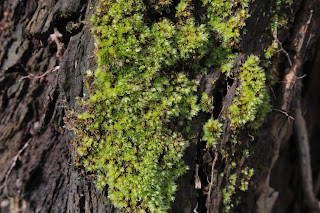
Rosulabryum capillare

Schistidium apocarpum

Yellow Yarn Moss (Anomodon rostratus)

Delicate Fern Moss (Thuidium delicatulum)

Silvery Bryum (Bryum argenteum)

Dwarf Anomodon Moss (Anomodon minor)

Bird-wise, I saw my first of year Yellow-rumped Warblers and Hermit Thrush. Lots of Golden-crowned Kinglets today.

It is a very strange world we live in currently. Hopefully you can get out safely and still enjoy some of what has to be offered around home!