Showing posts with label Painted Skimmer. Show all posts

Tuesday, 22 June 2021

Early June Insects

Early June is always a great time of year to go out and look for bugs. I have gotten out on a few occasions to try and nail down some of my target species for this time of year. I have compiled some of the more notable sightings into this post.

Back on June 5th I went to Lambton Shores in search of some of the neat insects that call that place home. I didn't see too much of interest when I visited The Pinery, other than a Cyrano Darner and an Eastern Pine Elfin butterfly on a dock. Its not an insect, but these Northern Sunfish were just off the same dock! 


I visited the MNR parking lot and the Ipperwash Dunes and Swales in search of my main target species, Dusted Skipper. This is a very range restricted butterfly, and I believe that Lambton Shores may be the only place it is found in Ontario. It took a bit, but eventually I found some. 


I also ended up seeing another lifer butterfly in the form of a Common Roadside Skipper.


Several species of dragonflies were around as well.

Racket-tailed Emerald

Slaty Skimmer

Belted Whiteface

Lancet Clubtail

Beaverpond Baskettail

A couple of neat flies were seen too.

Bumble Bee Mimic Robber Fly

Golden-backed Snipe Fly

I next visited Fossil Road on the Ausable River, since it was more or less on my way home. I always enjoy stopping here, as it seems you never know what you will see!

I was mostly focusing on dragonflies, and came up with two species of clubtails, Midland and the rare Rapids Clubtail. I saw a couple Rapids about 4 kilometers up river last year.

Midland Clubtail

Rapids Clubtail


I also saw a Common Sootywing, a somewhat uncommon butterfly species.


A couple days later on June 7th I was back out to the Ausable River in search of a rare species of clubtail, Green-faced Clubtail. I worked the section of river near Rock Glen CA. It took a bit, but I finally managed to find a few Green-faced Clubtails, a new species for me!


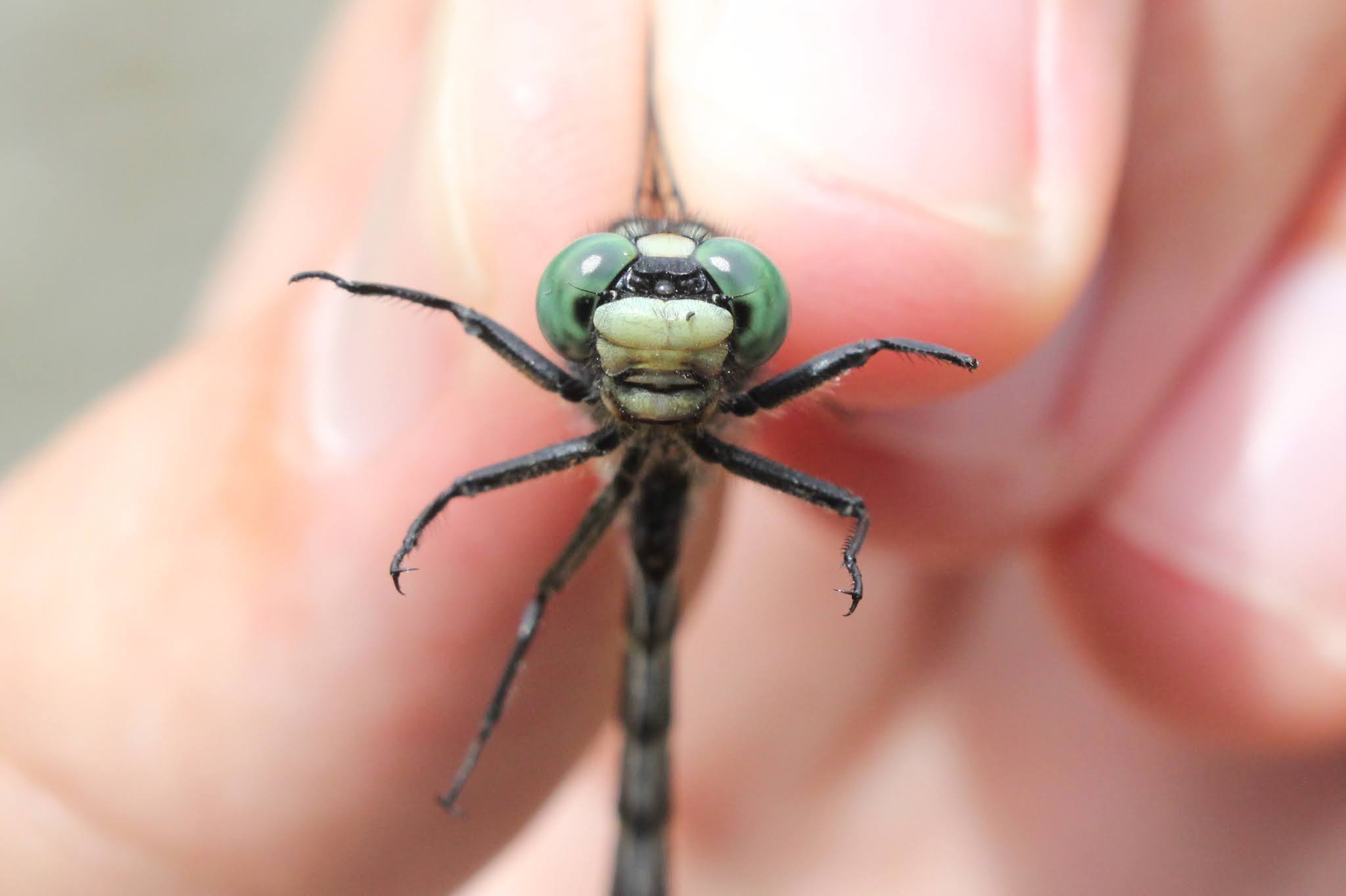

There were a few males patrolling the river, and I caught a female later on.


One of my most notable sightings wasn't even of a live dragonfly. I spotted a dead Twin-spotted Spiketail caught up on some grass! This may be the first record of this species for the Ausable River, and perhaps Lambton County. On the 5th I had seen a spiketail sp. briefly while I was on Fossil Road, which is in Middlesex. If it was the same species, it would have constituted a new county record for Middlesex. Due to this individual's proximity to Middlesex, I can only assume they are present there too. 


After I was done at Rock Glen, I made another stop along Fossil Road. Completely different than just a couple days prior in that there were no clubtails flying around! I did however find an Eastern Red Damsel, a new one for my Middlesex list.


On June 10th I decided to check out some areas close to home for odonates. I figured it was about time for a visit to the Sifton Bog, so that was my first destination of the day. 

I was quite pleased to see that there were several Spatterdock Darners, which I first found here in 2019 (first Middlesex county record) out over the pond, indicative of a breeding population here. None came close enough for a swing with my net, other than this one when I only had my camera in my hand! At least I got a nice photo :)


There were many Painted Skimmers as well, including a couple pairs in copula and an oviposting female, also indicative of a breeding population. The only Painted Skimmer I had seen prior to this was also at Sifton Bog in 2019. Absolutely gorgeous dragonflies. 


My first "in hand" Carolina Saddlebags were seen as well. Another breeding species here.


There were a few damselflies of interest as well.

Azure Bluet

Boreal Bluet

Amber-winged Spreadwing

Boreal Bluet was a new Middlesex species for me.

I made a visit to Komoka Provincial Park next. Here I was in search of another potentially new species for my county ode list, Delta-spotted Spiketail. After a long and grueling hike, I eventually spotted one, but was only able to get off a quick photo. 


There were also quite a few of these cicadas around as well, Say's Cicada (Okanagana rimosa).


I made one last stop at a storm pond in North London, where I found an unexpected county lifer ode, Lancet Clubtail.


It was an enjoyable few days of tracking down insects! Not much else to do these days :-P

Sunday, 13 June 2021

Return to Rondeau

It had been way too long since my last visit to Rondeau, so that is where I decided to head yesterday.

Although birding was my main intention, I didn't really take any photos of birds, so you'll have to live with some plants and insects :)

First things first, I went to Keith McLean CA, along the Rondeau causeway. Always worth a stop I find. There had been a Yellow-headed Blackbird seen there the day prior, but no sign of it when I went. Plenty of Marsh Wrens however, as well as some more unusual birds for the time of year, like Blue-winged Teal, Ruddy Duck, and Semipalmated Sandpiper. In the group of gulls sitting in the field, I found a single adult Lesser Black-backed Gull. 

It was time to head into Rondeau. My first stop was the South Point Trail. Not too much bird song, other than the usual suspects, but a pair of Blue-grey Gnatcatchers and a Least Flycatcher (a species I often don't encounter in the summer, oddly enough) was nice. I went out to the beach at the light beacon, and found a new species of sedge for me, Sand Sedge or Mulhenberg's Sedge (Carex muehlenbergii). Much more robust and impressive than I imagined it being!


There were some loafing gulls further down the beach, so I decided to keep going. Nothing special among them however, only Bonaparte's, Ring-billed, and Herrings. I continued until I hit the washout, then headed back along the trail.

There were a few Painted Skimmers along the way.

I encountered this grass as well, which I have tentatively called Schribner's Grass (Dichanthelium oligosanthes var. scribnerianum).


I had originally keyed it out to Common's Grass (Dichanthelium commonsianum) using Michigan Flora, but have since revised my identification (this genus is hard!). While we're on the topic, the genus Dichanthelium is a real mess. It used to be the genus Panicum, however Panicum was then split into several more genera (while some species retained the genus name). Even within Dichanthelium, things are confusing. It seems every species name is a synonym for something else! Not to mention the numerous varieties. With some authorities, such as in the checklist of plants for Ontario's Carolinian zone, D. commonsianum is included under D. ovale ssp. pseudopubescens. 

Next, I decided to go to the Tulip Tree Trail. Largely had the place to myself, which was nice. Almost immediately, I heard an Acadian Flycatcher, soon followed by two more. This was my main target for the day, as it was a species I had never seen in Rondeau before. A couple other goodies rounded out the bird list here, including a Wood Thrush carrying food, a Prothonotary Warbler, and a singing Black-throated Green Warbler. Maybe it is just a very late migrant, but I guess it isn't out of reason for a Black-throated Green to attempt to breed here. 

Another Dichanthelium for you, this one a bit more straightforward: Broad-leaved Panic Grass (Dichanthelium latifolium).

I then intended to go to the Marsh Trail, but on the way passed Spicebush Trail. Last minute I decided to turn in and give it a go, because why not? Glad I did!

Nothing really of note bird wise, but as I was walking along I noticed this sedge (Carex).

I recognized it immediately as something in Section Griseae, and felt as though it was something I hadn't seen before. I had a sneaking suspicion it was Eastern Narrow-leaved Sedge (Carex amphibola), which is somewhat similar to the common Inflated Narrow-leaved Sedge (Carex grisea). I consulted a key, and found that my initial thought seemed to be correct, it appeared to in fact be Eastern Narrow-leaved Sedge, a rare species in Ontario, ranking S2 (between 5-20 known occurrences, I believe). Despite its rarity in Ontario, it is actually considered to be the most common species in its section further south of us. The perigynia of this species is triangular in cross section, and seems to be relatively a bit narrower and longer than in Inflated Narrow-leaved Sedge. 

Compare to Inflated Narrow-leaved Sedge. I took this photo back in late May in London. The perigynia aren't completely mature here, but they are mature enough to see the difference. 

I saw another member of the section Griseae along the same trail. Hitchcock's Sedge (Carex hitchcockiana) is a fairly distinct species, with hairy lower stems. 


My last stop in the park was the first little bit of the Marsh Trail. Not really much of note.

Flowering Rush (Butomus umbellatus)

Silverweed (Argentina anserina)

Swamp Rose Mallow (Hibiscus moscheutos)

Hairy Beardtongue (Penstemon hirsutus)

Greater Straw Sedge (Carex normalis)

My eBird checklist for the day: https://ebird.org/checklist/S90074662

I went to Shrewsbury after and drove around looking for the Eurasian Collared-Dove, but no luck. Only saw a few Mourning Doves!

I went to Stefina Line east of Blenheim, and saw the reported Dickcissels just before heading back home. Always a nice one to see!

I took some backroads home, but didn't see too much. I had debated about going to check a field that gets Dickcissels each year, but opted to just go home. One was found there this morning! Oh well. 

Gotta love this time of year!

Friday, 21 June 2019

Bogged Down

I had a pretty good outing today, so I figure I'd share it!  (Oh yeah, and school's out, I'm on summer break now!)

My destination today was Sifton Bog, here in London. It is a pretty special place botanically. Its a northern peat bog in the middle of the city!

Purple Pitcher Plant (Sarracenia purpurea) is a pretty common plant in the bog, but this was the first time I have ever seen them in flower!


Sedges (Carex spp.) were fairly abundant. I have managed to ID a few.

Tall Bog Sedge (Carex magellanica)

Hoary Sedge (Carex canescens)

Three-seeded Sedge (Carex trisperma)

Bristly Sedge (Carex comosa)

This year there has been a large northward push of Painted Skimmers. Just yesterday I was thinking about the possibility of running into one today, and low and behold, there was one! It took me an hour and a half before I finally was able to snap a photo.


I saw another lifer dragonfly too! While working my way through the bog, I noticed a smaller darner (in comparison to the Common Green Darners). I couldn't believe it...the darner had blue eyes!

The only darner in Ontario with blue eyes is Spatterdock Darner, which is fairly rare, but I think it is increasing, perhaps due to more coverage. I couldn't net it, but I managed an identifiable pic.


It wasn't completely unexpected, as the Spatterdock (Nuphar advena) is fairly abundant in the bog.


I also saw a couple species of orchids.

Tuberosus Grasspink (Calopogon tuberosus)

Rose Poginia (Pogonia ophioglossoides)

As well as Round-leaved Sundew (Drosera rotundifolia).


Certainly a place to check out again soon!