This past weekend I was down in Kingsville for a bioblitz (perhaps more on that later). On Sunday, after waking up from some much needed rest after mothing until the wee hours of the morning, I began my drive back home to London. Since the weather was quite nice, I decided to make a few stops along the way.
My first destination was near Tilbury. I knew that were were some rare sedges found here, and I wanted to see if I could find them. I needed my sedge fix! I was sort of disappointed by the lack of sedge diversity on the bioblitz.
Almost immediately, I found a nice little "honey hole" by a pond. One of the species that first caught my eye was Muskingum Sedge (Carex muskingumensis). This is a somewhat rare sedge in Ontario, ranked S3, although it is listed as common in Essex County. It is a member of Carex section Ovales, which can be a pain to identify. Thankfully, this one is quite distinctive, as its spikes are elongated.


Another species I was extremely pleased to see was Ravenfoot Sedge (Carex crus-corvi). In Ontario, it is only found in Essex and Lambton counties, and it ranked S1, the rarest of the rare. This is a species I have long wanted to see in the flesh. It is a member of Carex section Vulpinae, and is told from the others by its crazy long-beaked perigynia. There are four species from this section in Ontario, all of which I have now seen!


There were a few other more common species of sedges growing in the same area as well.
 |
| Swan's Sedge (Carex swanii) is typically fairly rare, but common in the area! |
 |
| Hop Sedge (Carex lupulina) |
 |
| Greater Straw Sedge (Carex normalis) |

 |
| Necklace Sedge (Carex projecta) |
 |
| Blunt Broom Sedge (Carex tribuloides) |
Another species of sedge restricted to the Carolinian zone is Shoreline Sedge (Carex hyalinolepis). This is another species that is actually common in Essex County, despite its rarity everywhere else. Although I didn't stop to look for myself, my understanding is that is grows in the roadside ditches with frequency! It is similar to Lake Sedge (Carex lacustris), which is quite common. Both of these species of sedges are host plants for the Dukes' Skipper, although it seems most of Ontario's Dukes' Skippers (that I know of) are found where there is Shoreline Sedge present.

This is Bracted Sedge (Carex radiata). It is quite similar to Rosy Sedge (Carex rosea), but has thinner leaves, and the stigmas are coiled differently when present. There is a rare similar species known from Essex, Reflexed Sedge (Carex retroflexa), but the beak of its perigynia isn't toothed, as you can see is the case here. I am not sure the last time Reflexed Sedge has been seen in Ontario, but I am hoping to one day come across it for myself!

One last interesting sedge I found was this one. It gave me a bit of trouble, but I eventually settled on Bronze Sedge (Carex foenea), although that still remains a bit tentative. Bronze Sedge is a bit of a weird one in that it is a native species further north in Ontario, but is introduced in the Carolinian zone. This would be a new record for Essex County if my identification is correct.

I spotted a Racket-tailed Emerald at one point, which certainly seemed odd for this far south in the province. I am not sure of their status in Essex County.

There were tons of hairstreaks. Most were Banded, but a couple Striped were mixed in. I would estimate there to have been easily over 100 in total.


I walked around a bit more. I spotted a few interesting species of dragonflies.
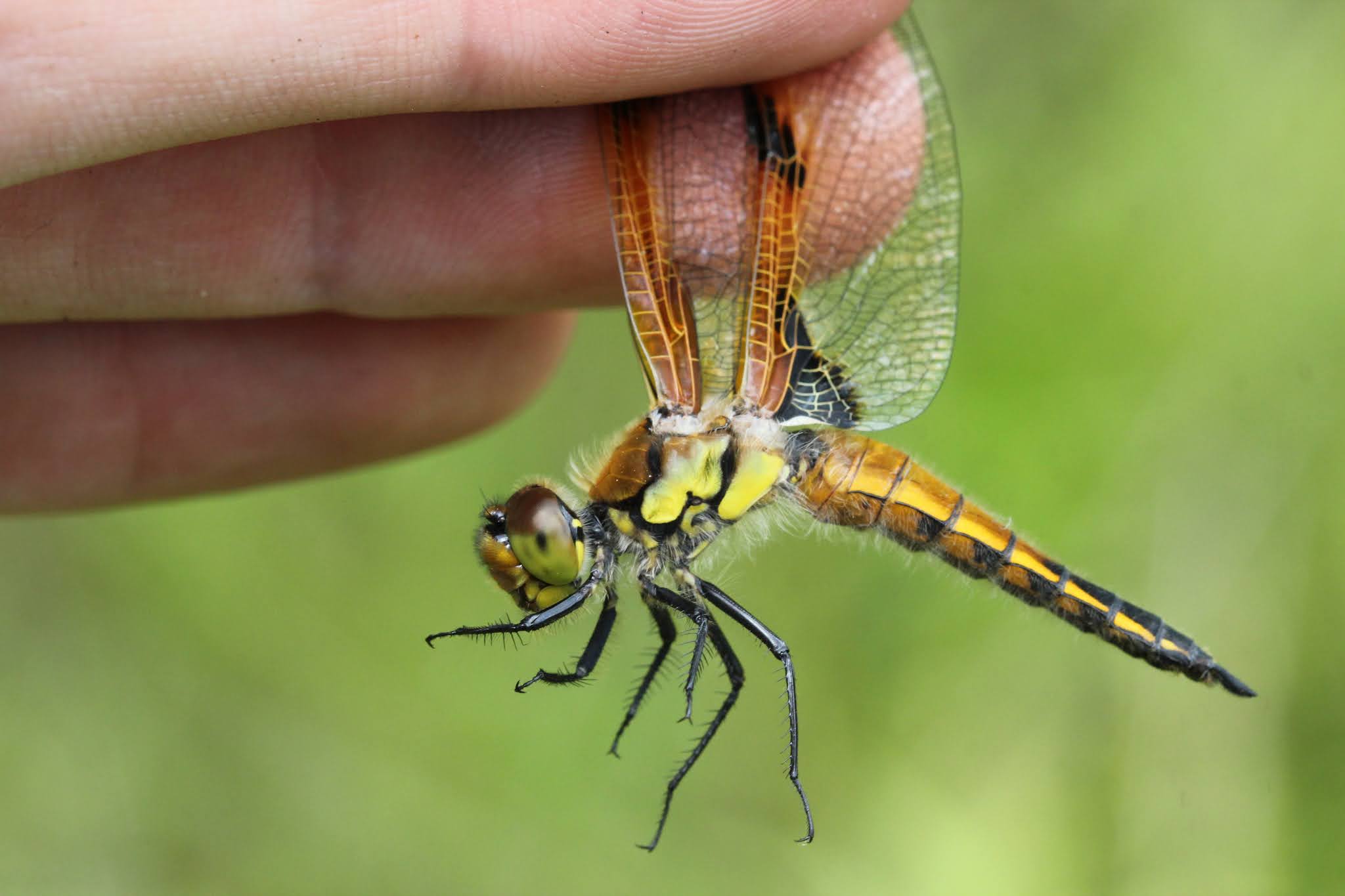 |
| Four-spotted Skimmer |
 |
| Royal River Cruiser |
 |
| Racket-tailed Emerald |
I also saw a Slaty Skimmer and a Spot-winged Glider near the entrance, but I didn't get any photos. As I was walking back, I had a dragonfly go over I am fairly sure was a Somatochlora emerald, likely Mocha, but I lost it. I still need Mocha Emerald, so file this under "disappointing misses".
Since I was in the area I popped up to McKeough CA and looked for Pronghorn Clubtails. I found one right away.

Still too early for Flag-tailed Spinyleg I imagine!
On my way north, I made a quick stop into Moore WMA to check on a population of Davis' Sedge (Carex davisii), another rare (S2) sedge in Ontario. This species seems to be mature and finish up quickly!


One last stop before going home was to check on some Dickcissels. I went to the field at the corner of Winter Drive and Sexton Drive, and found a couple of singing males, as well as a third bird that I was unable to sex. They were singing from a wheat field, so who knows how long they'll last.
Great way to cap off the weekend!