Showing posts with label plants. Show all posts

Thursday, 6 January 2022

Plants That Do Weird Things: Part 1 (Myco-heterotrophy)

Plants are a very diverse group of organisms, so as one could expect, there are a number of them that do "weird" things. There is no shortage of fascinating techniques that plants employ in order to survive in their environment.

Today, I want to look at some of the myco-heterotrophs. There are a number of these species worldwide, especially in more tropical regions, but I will be focusing on species found in Ontario.

"Myco-heterotroph" sure looks like a scary word, but once you break it down, it becomes much more digestible."Myco" comes from the Greek mýkēs, which means "fungus". "Heterotroph" means an organism that gets its nutrients from another organism, but can be further broken down into "hetero", meaning different, and "troph", coming from the Greek trophḗ, meaning "nutrition".

Putting it all together, you get an organism (in this case, a plant) that gets nutrients from parasitism upon a fungus rather than through the conventional method of photosynthesis. Recall that in essence, photosynthesis is the process in which a plant with chlorophyll (the pigment which makes plants green) makes its own energy using the sun's energy. Photosynthetic plants are for the most part autotrophs (the opposite of heterotroph, organisms that produce their own energy)

This is a somewhat complicated process, but in the simplest terms, it goes a little something like this:

First, to set the scene: A fungus colonizes the root tissue of a host plant, to which it has a symbiotic relationship (long-term interaction between two organisms). The host plant gives the fungi nutrients from photosynthesis (e.g., sugars), and in return, the fungi gives the host plant nutrients from the soil (e.g., phosphorus). This relationship is known as a mycorrhizal association. Mycorrhiza can be broken down into "Myco" (fungus) and "rhiza", Greek for "root". 

In most myco-heterophic relationships, the myco-heterotophs will capitalize off this mycorrhizal association (which would occur regardless of whether a myco-heterotroph is present or not). The myco-heterotroph's roots interact with the fungus' mycellium (the thread-like, vegetative part of the fungus, for further reading click here), and this is where the flow of nutrients takes place. Note that unlike a mycorrhizal association, there are no nutrients leaving the myco-heterotroph and going to the fungus—it is a true parasite.

So bottom line, the flow of nutrients is as follows:

Host autotrophic plant ↔ Mycorrhizal fungus → Myco-heterotroph 

In the past, myco-heterotrophs were mistakenly classified as saprotrophs. Saprotrophy is the process in which an organism breaks down organic material and turns it into usable nutrients ("sapro" means "rotten material"). It is now largely accepted that no vascular plants are saprotrophs, and that this is a process largely restricted to fungi. 

There are both partial and full myco-heterotrophs. Partial myco-heterotrophs (also called mixotrophs) are able both to utilize nutrients from mycorrhizal fungi, as well as complete photosynthetic processes. Full myco-heterotrophs are unable to complete photosynthesis due to a lack of chlorophyll, so are dependant on nutrients from fungi. It is important to keep in mind, however, that just because a plant lacks chlorophyll, does not automatically make it a myco-heterotroph! While I do not believe this is an Ontario example of this, it is possible for a species to have individuals that are both partial and full myco-heterotrophs.  

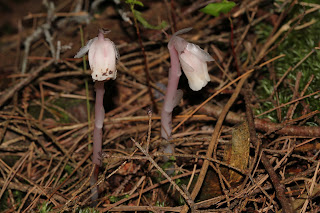
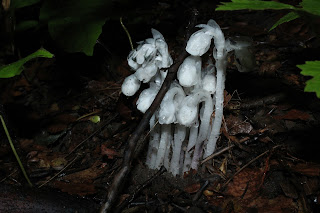
There are several examples of each type from Ontario. Perhaps the most well known is Ghost Pipes (Monotropa uniflora). A common misconception is that this is a fungus, but it is a plant! This is a full myco-heterotroph. This plant is well adapted to life in shady places, such as sugar maple forests (a whole post in itself), as it does not require sunlight, since it does not undergo photosynthesis. Ghost Pipes gets its name from his ghostly appearance, as a result of it not having chlorophyll. Ghost Pipes is parasitic of the fungi family Russulaceae. 


A similar plant is Pinesap (Monotropa hypopitys syn. Hypopitys monotropa). It is, in my experience, nowhere near as common as Ghost Pipes. I have only ever seen this plant in fruit, so I have used a photo off of Wikimedia. The main difference between this plant and Ghost Pipes is that it has multiple flowers on the same stem, whereas the latter only has one. Pinesap parasitizes the family Tricholomataceae, which may have something to do with its abundance, but that is something I will have to look into more. 
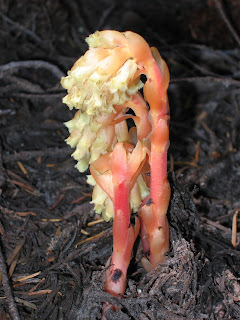
From Wikimedia

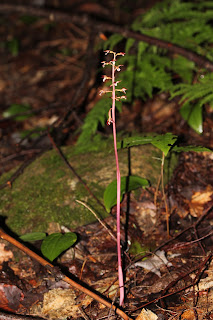
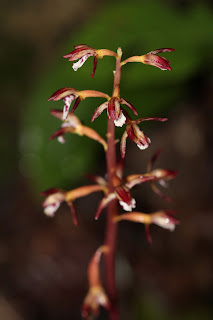
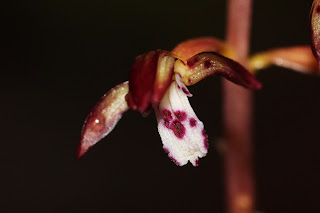
A somewhat surprising group of myco-heterotrophs are the coralroots, a type of orchid. Spotted Coralroot (Corallorhiza maculata) is a species found throughout Ontario, and like Ghost Pipes, it is a parasite of Russulaceae. There are two varieties found in Ontario, Western (var. occidentalis) and Eastern (var. maculata). The Western variety tends to flower several weeks earlier than the Eastern variety.
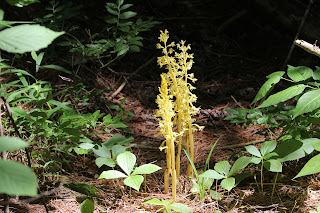
var. occidentalis f. flavida

var. maculata


There is an exception however. Early Coralroot (Corallorhiza trifida) is considered partially myco-heterotrophic, as it contains some chlorophyll and is able to produce its own nutrients through autotrophic processes. Early Coralroot's choice of fungus to parasitize is the genus Tomentella (Thelephoraceae). 
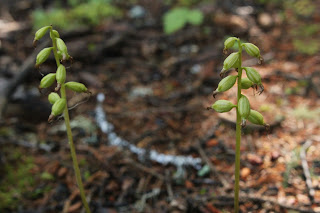

There are other examples of partial myco-heterotrophs as well, perhaps species that one would not immediately associate with such an unusual process! First, take a look at some of the taxonomy. The Ghost Pipes and Pinesap mentioned above are part of the heath family (Ericaceae). This contains many familiar plants, such as blueberries, cranberries, and laurels. These two species are part of the subfamily Monotropoideae, which are myco-heterotrophs. Within this subfamily, there are three tribes; Pyroleae, Montropeae, and Pterosporae. The latter two are full myco-heterotropic, whereas Pyroleae is partial myco-heterotrophic. Ghost Pipes and Pinesap, as you may have guessed, are part of Monotropeae. There is one species of Pterosporae in Ontario, the rare Woodland Pinedrops (Pterospora andromedea). (NOTE: some treatments list Pyroleae as its own subfamily, Pyroloideae)

Monotropoideae have very small seeds, known as "dust seeds". These dust seeds require a mycorrhizal fungi to germinate (to begin to grow), however in the case of plants in the tribe Pyroleae, they develop the ability to photosynthesize as they mature. 

There are four genera in Pyroleae, all of which are found in Ontario.

Pipsissewa (Chimaphila umbellata) is the more widespread member of its genus. Striped Wintergreen (C. maculata) is limited to only two or three areas of occurrence in Ontario. 
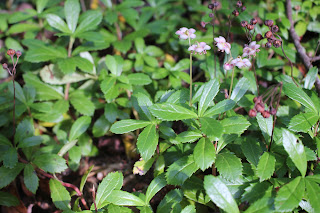
Pipsissewa

Pyrola is the largest genus in Pyroleae in Ontario. They are commonly referred to as "wintergreens" or "shinleaf". 
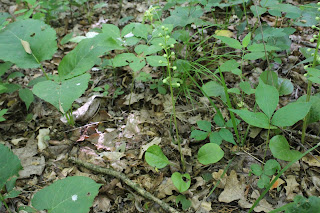
Shinleaf (P. elliptica) 

Moneses is represented by a single species, known as Single Delight or One-flowered Wintergreen (M. uniflora). 
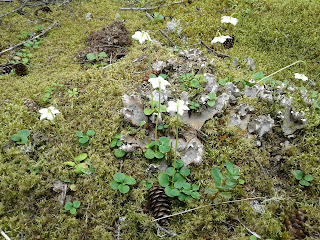

And finally, Orthilia. One-sided Wintergreen (O. secunda) is the monotypic member of this genus. 


Myco-heterotrophy is just one of the many unique and crazy things that plants do to both survive and thrive. This is one of the several weird things that plants do that I hope to highlight in this series in an effort to shine some light on these incredible organisms! 

Saturday, 19 June 2021

Sydenham Saturday

Today I was down in the Alvinston area for an odonate (dragonfly and damselfly) survey on the Sydenham River Nature Reserve (SRNR) for Ontario Nature arranged by Blake Mann. This reserve is one of my favourite sites in the area, and its a shame I am unable to visit it more often! For the past couple of years, I have partaken in a breeding bird survey on SRNR, and each year we have spotted some cool odes along the way. 

I got up early to head down and do some birding before starting the survey. My first stop was the Strathroy Sewage Lagoons. There was not much of note here in my loop of the south lagoon. I did count over 90 Wood Ducks, several broods, which is always great to see. Another interesting find was a pair of Northern Shovelers. It is likely nothing will come out of it, but you never know. On Tuesday I had a pair of Green-winged Teals here, but they were nowhere to be found this morning. 

Digiscope

I decided to get some point counts done in my Lambton atlas square (17TMH34), and succeeded in completing twelve over the course of a couple hours. Point counts happy pretty fast, so no photos! I recorded over 50 species of birds from these counts. One of my best stops was in the field near the corner of Calvert Drive and Kerwood Drive. Here I had a couple singing Dickcissels on territory (one had been present for about a week now, and a second one seems to have joined it), a pair of Upland Sandpipers, and perhaps most exciting, a family group of Common Ravens which flew over just as I started the point count. Pretty eventful five minutes! 

I eventually got to the SRNR around quarter to ten. The area I was to cover was the Buttonwood Drive side, which is on the east side of the river. This is typically not the most "ode-y" side, but I was more than happy to do it—someone has to! 

I began by walking the field to the south of the parking area, skirting the forest edge. It was not nearly as eventful as I had imagined it to be, and for the longest time, I only came across a few Common Whitetails, a pair of Twelve-spotted Skimmers, and of course several Midland Clubtails. It wasn't until I got down to the river I added Powdered and Blue-tipped Dancer, as well as several Stream Bluets and more Midland Clubtails, to my list. 


I was a bit surprised to see some Banded Hairstreaks, my first this year. There were tons of Hackberry Emperors, as well as a few Tawny Emperors, as well. 


Quite a few of these Haploa moths as well. I think they are LeConte's Haploa moths.


While walking at the far end of the field, I was somewhat surprised to hear a Hooded Warbler, the first time I have encountered one at SRNR. Other breeding birds here included Mourning Warbler, Yellow-throated Vireo, Red-headed Woodpecker, Wood Thrush, Scarlet Tanager, and Blue-grey Gnatcatcher. A couple weeks ago I had a Cerulean Warbler here as well. 

I decided it was time to cut into the forest and head towards the river. As I did so, I came across a fairly fresh Black-shouldered Spinyleg, my first for this property. 


I bushwhacked to the river through seemingly endless patches of stinging nettle, a reoccurring theme for the day. As much as I like SRNR, the one thing I am not a fan of is all of the stinging nettle! Although you can't get "zapped" through jeans, today I was wearing my quick-dry field pants, which apparently offer no protection! I found minimal success with side-stepping through the patches, being careful to flatten the plants down before your legs made contact. 

There was less than expected by the river, just a bunch of Ebony Jewelwings and American Rubyspots. I did have a single female Swift River Cruiser and a Fragile Forktail, but that was it for new species. I continued quite a ways upriver, before crossing over and going to the other side. I walked downriver for a bit, and ended up almost to the other entrance for the reserve. Not much to report on ode wise! A long walk in the hot and humid conditions with an abundance of stinging nettle—fun times! (I actually did quite enjoy myself, doing this beats sitting around at home)

I found myself turning my attention to plants quite a bit on the quiet stretches, although I didn't stop to take very many photos. This is the first time I have seen Broad-leaved Waterleaf (Hydrophyllum canadense) in flower. 


Michigan Lily (Lilium michiganense) is always a fun one to come across.


I saw a number of sedges as well. Since this is such a rich forest, I was hoping to come across some rare species, but it was not to be. Nevertheless, I still came across some high quality species. The diversity of sedges you can find in any given area is something that really appeals to me.

Hitchcock's Sedge (Carex hitchcockiana)

Sprengel's Sedge (C. sprengellii)

White Bear Sedge (C. albursina)

Nerveless Woodland Sedge (C. leptonervia)

Inflated Narrow-leaved Sedge (C. grisea)

Eastern Rough Sedge (C. scabrata)

Drooping Sedge (C. prasina)

Smooth-sheathed Sedge (C. laevivaginata)

Fringed Sedge (C. crinita)

The walk back to the car was largely uneventful. I was quite happy to get back and out of the stinging nettle! 

I had planned to go to Reid CA near Wallaceburg afterwards to look for Oak Hairstreaks, but the sky was threatening rain, so I opted to head back home. Perhaps some other day I will go look for this rare butterfly. 

Overall, a very productive day, even if odonate diversity was lower than I had imagined it would be. I expect to get the results of the survey soon, and will update this post once they come out! 

Sunday, 13 June 2021

Return to Rondeau

It had been way too long since my last visit to Rondeau, so that is where I decided to head yesterday.

Although birding was my main intention, I didn't really take any photos of birds, so you'll have to live with some plants and insects :)

First things first, I went to Keith McLean CA, along the Rondeau causeway. Always worth a stop I find. There had been a Yellow-headed Blackbird seen there the day prior, but no sign of it when I went. Plenty of Marsh Wrens however, as well as some more unusual birds for the time of year, like Blue-winged Teal, Ruddy Duck, and Semipalmated Sandpiper. In the group of gulls sitting in the field, I found a single adult Lesser Black-backed Gull. 

It was time to head into Rondeau. My first stop was the South Point Trail. Not too much bird song, other than the usual suspects, but a pair of Blue-grey Gnatcatchers and a Least Flycatcher (a species I often don't encounter in the summer, oddly enough) was nice. I went out to the beach at the light beacon, and found a new species of sedge for me, Sand Sedge or Mulhenberg's Sedge (Carex muehlenbergii). Much more robust and impressive than I imagined it being!


There were some loafing gulls further down the beach, so I decided to keep going. Nothing special among them however, only Bonaparte's, Ring-billed, and Herrings. I continued until I hit the washout, then headed back along the trail.

There were a few Painted Skimmers along the way.

I encountered this grass as well, which I have tentatively called Schribner's Grass (Dichanthelium oligosanthes var. scribnerianum).


I had originally keyed it out to Common's Grass (Dichanthelium commonsianum) using Michigan Flora, but have since revised my identification (this genus is hard!). While we're on the topic, the genus Dichanthelium is a real mess. It used to be the genus Panicum, however Panicum was then split into several more genera (while some species retained the genus name). Even within Dichanthelium, things are confusing. It seems every species name is a synonym for something else! Not to mention the numerous varieties. With some authorities, such as in the checklist of plants for Ontario's Carolinian zone, D. commonsianum is included under D. ovale ssp. pseudopubescens. 

Next, I decided to go to the Tulip Tree Trail. Largely had the place to myself, which was nice. Almost immediately, I heard an Acadian Flycatcher, soon followed by two more. This was my main target for the day, as it was a species I had never seen in Rondeau before. A couple other goodies rounded out the bird list here, including a Wood Thrush carrying food, a Prothonotary Warbler, and a singing Black-throated Green Warbler. Maybe it is just a very late migrant, but I guess it isn't out of reason for a Black-throated Green to attempt to breed here. 

Another Dichanthelium for you, this one a bit more straightforward: Broad-leaved Panic Grass (Dichanthelium latifolium).

I then intended to go to the Marsh Trail, but on the way passed Spicebush Trail. Last minute I decided to turn in and give it a go, because why not? Glad I did!

Nothing really of note bird wise, but as I was walking along I noticed this sedge (Carex).

I recognized it immediately as something in Section Griseae, and felt as though it was something I hadn't seen before. I had a sneaking suspicion it was Eastern Narrow-leaved Sedge (Carex amphibola), which is somewhat similar to the common Inflated Narrow-leaved Sedge (Carex grisea). I consulted a key, and found that my initial thought seemed to be correct, it appeared to in fact be Eastern Narrow-leaved Sedge, a rare species in Ontario, ranking S2 (between 5-20 known occurrences, I believe). Despite its rarity in Ontario, it is actually considered to be the most common species in its section further south of us. The perigynia of this species is triangular in cross section, and seems to be relatively a bit narrower and longer than in Inflated Narrow-leaved Sedge. 

Compare to Inflated Narrow-leaved Sedge. I took this photo back in late May in London. The perigynia aren't completely mature here, but they are mature enough to see the difference. 

I saw another member of the section Griseae along the same trail. Hitchcock's Sedge (Carex hitchcockiana) is a fairly distinct species, with hairy lower stems. 


My last stop in the park was the first little bit of the Marsh Trail. Not really much of note.

Flowering Rush (Butomus umbellatus)

Silverweed (Argentina anserina)

Swamp Rose Mallow (Hibiscus moscheutos)

Hairy Beardtongue (Penstemon hirsutus)

Greater Straw Sedge (Carex normalis)

My eBird checklist for the day: https://ebird.org/checklist/S90074662

I went to Shrewsbury after and drove around looking for the Eurasian Collared-Dove, but no luck. Only saw a few Mourning Doves!

I went to Stefina Line east of Blenheim, and saw the reported Dickcissels just before heading back home. Always a nice one to see!

I took some backroads home, but didn't see too much. I had debated about going to check a field that gets Dickcissels each year, but opted to just go home. One was found there this morning! Oh well. 

Gotta love this time of year!

Sunday, 4 October 2020

Recent Odds and Ends

School has kept me pretty busy over the last few weeks, but I have still managed to get out here and there. 

Last weekend, a Long-billed Dowitcher showed up just south of the city. I hadn't bothered to get the one that showed up last year, so I went. I got brief looks, but it was a new one for me in Middlesex nonetheless. I also saw Amethyst Aster (S.× amethystinum), my first time seeing it. It is a hybrid between White Heath Aster (Symphyotrichum ericoides) and New England Aster (Symphyotrichum novae-angliae).

Amethyst Aster (Symphyotrichum × amethystinum) 

A few days ago I went to Kilally Meadows in the north part of London. I was mostly looking at plants, but I did flush a Black-billed Cuckoo at one point. I think this is the latest I have ever seen one.
Black-billed Cuckoo

Here are a couple of the plants I saw.

Silky Wild Rye (Elymus villosus)

River Wild Rye (Elymus riparius)

Arrow-leaved Aster (Symphyotrichum urophyllum)

Smooth Blue Aster (Symphyotrichum laeve)

New England Aster (Symphyotrichum novae-angliae)

American Hog-peanut (Amphicarpaea bracteata)

Canada Clearweed (Pilea pumila)

Fast forward to yesterday, I visited one of the most productive places in my neighbourhood for birds. I spend a good two and a half hours there, as there were plenty of birds to sort through. I had several first of season birds including Winter Wren (neighbourhood year bird #150), American Pipit (neighbourhood year bird #151), Blue-headed Vireo, and White-crowned Sparrow. eBird list.

Dotted Knotweed (Persicaria punctata)
American Kestrel


Today, Reuven Martin had some great luck (he has been on fire this fall around here), and found a Nelson's Sparrow and a couple of Hudsonian Godwits in Komoka Provincial Park. I called up Bill Lindley to let him know, and shortly thereafter the two of us were on route. Both of us had had Hudwit on the brain for the last few days, and I always have thoughts of Nelson's Sparrow at this time of year, so we were keen to see these birds!

The godwits had just been a fly by for Reuven, but we checked some nearby ponds to no avail. We arrived in the rain at Komoka, and soon began our search. We were joined by others soon as well in the form of Gord Payne, Pete Read, Mike Cowlard, and Nancy Douglas. We scoured the area, but came up empty, flushing a Sora and a couple snipe in the process. We also had a Long-billed Dowitcher, always a great record for the county. The others left, leaving Bill, Gord, and myself. Bill and I were going to start walking the perimeter of the pond when Gord called us back, saying he had seen a bird skulking around the edge of the water. Soon, the Nelson's Sparrow popped up for some brief looks! It was a new Middlesex bird for all three of us.

Nelson's Sparrow (Longridge Point, August 2018)

Afterwards, Bill and I went to the Strathroy Sewage Lagoons. No godwits there either, but we did have another Long-billed Dowitcher and some Stilt Sandpipers. 

This evening before it got dark I went to check the local wetland. Nothing unusual, but I did score two more neighbourhood year birds, Northern Pintail and American Black Duck. 

It is one of my most favourite times of year! Looking forward to see what else will pop up.