August 14, 2019
The weather was looking good, so it was no surprise when we received confirmation that the chopper would be flying that day. The plan was that the chopper would fly in just over half of the new Longridge Point crew, then pick up three Longridge crew members, drop one (Gray Carlin) off at Piskwamish on their way back, and pick up Kevin, before making its way back to Moosonee. At that point, the chopper would pick up the remaining Longridge crew member, before flying back to Piskwamish, pick me up, the continue onto Longridge, where I would spend the next two weeks. Sounded simple enough.
I enjoyed my last few hours at Piskwamish, and right on schedule and to plan, the chopper came and picked up up. I got to see where I had been walking for the past couple weeks from the air, and had a new found appreciation for the winter road and power line.
Soon we touched down in the marsh at Longridge Point. I was back! I was reunited with Doug McRae, and after a few camp orientation things, the new crew went out to explore the area. Longridge is certainly very different than Piskwamish, since most of the walking involves walking along gravel ridges (compared to the expansive mudflats of Piskwamish). It is certainly more physically demanding, but having already spent two weeks on the coast, it wasn't as strenuous for me as the crew members who had just come in.
 |
| Autumn Gentian (Gentianella amarella) |
eBird checklist
August 15, 2019
I did my first Longridge Survey on this day, Paskwatchi Point, which is my favourite survey route. Whiles numbers were basically nothing compared to the numbers of birds I had seen at Pisk, it was still quite enjoyable. Highlights on the survey included a Red-necked Phalarope, a juvenile Marbled Godwit (the second record that season for Longridge), and an adult Little Gull.
I found a few orchids in the morning before survey.
 |
| Lesser Rattlesnake Plantain (Goodyera repens) |
 |
| Nodding Ladies Tresses (Spiranthes cernua) |

That evening I heard a Long-eared Owl, which had been hanging around for a few weeks apparently. This was actually my first ever Long-eared Owl!
eBird checklist
August 16, 2019
I was the first awake that day, so as I stumbled outside half asleep, I went to the main cabin and began disabling the bear fence. At one point, I looked up and there it was! A juvenile Northern Goshawk perched 20 feet above me! Unfortunately it flew off before others got to see it, however it came back several more times over the course of the next couple weeks. We also had a different individual hanging around, another juvenile.
On this day, I tackled the Longridge Point survey, which follows Longridge Point, a gravel spit about two kilometers in length. There wasn't too much of note this day, just the usual. We had 153 White-winged Crossbills tallied that day, which certainly made Doug laugh since he had said until I came, they would only get a dozen or so a day at most. We joked I brought the crossbills with me, since we had hundreds daily at Piskwamish.
eBird checklist
August 17, 2019
I believe on this day, I made another Paskwatchi survey. Again, nothing really of note.
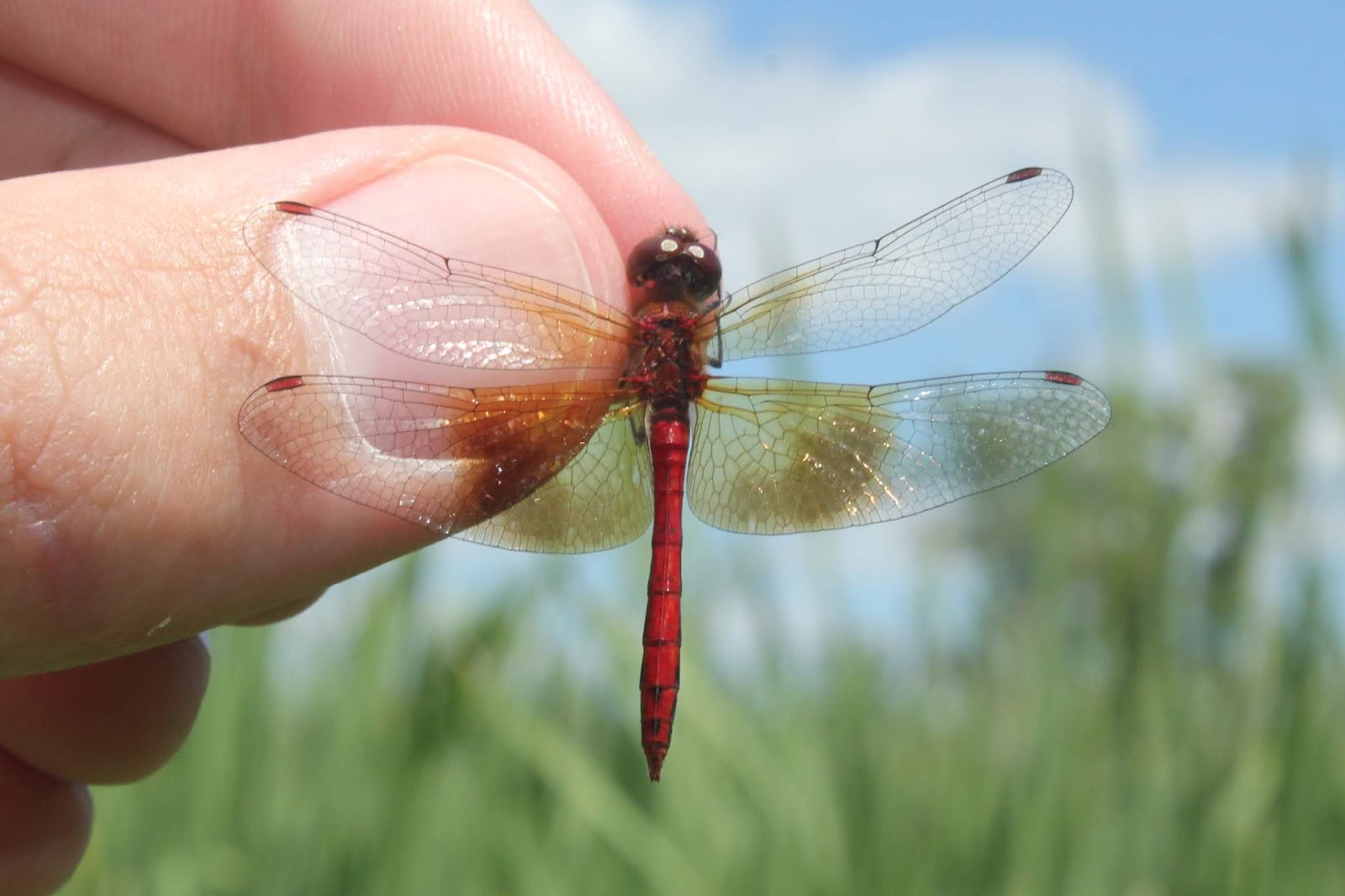
I went out to explore in the marsh, with the intention of checking out where I had discovered a single Saffron-winged Meadowhawk the previous year. Imagine my delight when I found a few dozen!

A Green Comma in camp was a lifer butterfly for me.

A decent number of finches this day, with almost 200 crossbills, and decent numbers of Common Redpolls.
 |
| Common Redpolls |
eBird checklist
August 18, 2019
I did the West Bay survey this day, highlighted by 15 Wilson's Phalaropes. It was an excellent year for phalaropes on the coast. In 2018, we would consider it a good day if we saw a phalarope. This past year, they were a nearly daily occurrence.
eBird checklist
August 19, 2019
Before heading out on the Longridge Survey, I saw a Northern Blue, only my second time seeing this species.

Around this time, we were dealing with pretty high tides. Because of the time of day, we decided we would start our survey at the tip of Longridge, and then survey our way back. As we were walking out, I noticed the tide coming in, and it was coming in fast. I remember thinking to myself that we were going to get stuck somewhere along the ridge today. As it turned it out, my prediction was right. However, instead of getting stuck where I had thought we would get stuck, we found ourselves stranded at the very tip of Longridge, a mere 500 meters into our survey! Since I was the "survey crew leader", I made the call to end the survey and stay put, since the wave action and current would have made the 20 foot crossing potentially dangerous.
After a few hours, the tide finally went down far enough for us to cross safely. However, that was the least of our problems. For the last hour we had watched as a massive thunderhead made its way towards us. So, with lighting and thunder coming at us, we began the walk/jog/sprint towards the closest cover...two kilometers away (oh, and I was carrying a metal tripod).
In short, we made it out alive, and there was an epic double rainbow (I was unable to catch all of it in the frame!)

eBird checklist
August 20, 2019
We had been planning to meet up with the Piskwamish Crew at "The Barge" which is between the two camps for a "party", however the forecast had been less than satisfactory, so we opted to postpone until the next day. It turned out to be a very nice day, and we remarked how we should have gone ahead with the party that day. We couldn't know at the time how postponing would be perhaps one of the best decisions we had ever made...
I did the West Bay survey this day. Just the usual stuff, but I finally saw my first James Bay Stilt Sandpipers.
eBird checklist
August 21, 2019
Ah yes, August 21, 2019...
I volunteered to do the Paskwatchi survey (quite) early in the morning, along with a fellow crew member. The rest of the crew would then meet us at Paskwatchi point, where we would ditch our gear and continue to walk the distance to the Barge for the meetup.
The survey went without a hitch, so when joined by the other crew, we began the walk, birding the ridge along the way. About a kilometer south of Paskwatchi, we stopped to "pish" because we heard a Red-breasted Nuthatch. Off to my left I saw a flash of the brightest yellow I had ever seen. Puzzled, I raised my binoculars, trying to discern what it was. The yellow body, black eye, huge bill...blue-grey wings?
"Holy @$#%, it's a Prothonotary!"
Doug has also gotten on the bird, and was seeing the backside. As soon as I said what it was, it came out into the open, in all its golden yellow glory. We observed it for the next few minutes, before losing it for good. It was fair to say we were all in shock. It took us a couple days before it to even begin to set in what we had seen! That chance sighting of a beautiful male bird represented the second record for the James Bay area, the last one being in Moosonee in October of 1989. Unless I am mistaken, this seems to be the most northerly record of the species in the province, and one of most northern records of the species ever. Honestly one of the craziest birds I have ever seen, good thing we postponed the party!
So yeah, it was a pretty good day. The "Barge Party" was fun, and it was good to see my old camp mates again.
eBird checklist
August 22, 2019
I did the Longridge Survey this day. Shorebird numbers were still much lower than we expected they should have been (only a couple hundred White-rumped Sandpipers, should have been thousands). We did a short seawatch after the survey, which was highlighted by a Marbled Godwit.

I should note that on the pond near camp we had a couple families of a rare bird...American Coots! We had seen a few juveniles daily, however on this day we finally saw all 14 young! This represented the second or third breeding record for the Hudson Bay Lowlands.

eBird checklist
August 23, 2019
I did the Paskwatchi survey this day. As was the trend for recent surveys it seemed, the survey was pretty quiet. As soon as we ended the survey, we found a nice and somewhat cooperative Stilt Sandpiper.
 |
| Lesser Yellowlegs and Stilt Sandpiper |
We went for a walk down the ridge south of Paskwatchi after the survey, since the habitat was quite nice. Nothing rare on this day, but we did have a pretty high number of Tennessee Warblers, definitely the most common small interesting looking bird on this walk.
eBird checklist
August 24, 2019
Did the West Bay survey. Again, not much to report on, besides the small "flock" of six Silt Sandpipers were encountered, which seemed a bit out of place. A single Marbled Godwit was nice to see. Over 100 Snow Geese was a good count. We also had a good number of Broad-winged Hawks. We are north of their usual range, so they are a bit odd to see, however they sometimes do occur.
Highlight of the day was an Old World Swallowtail caterpillar.

eBird checklist
August 25, 2019
For my second last full day on the coast, I did the Longridge survey for the last time. Once again, shorebird numbers were low! Highlight were the first American Pipits of the fall. On our walk back to camp, I spotted a Ruffed Grouse, my first for James Bay.
That night at dinner, as we were doing our daily totals, a Grey Catbird showed up outside our cabin! This is a fairly northern record of the species. It was good to finally lay eyes on the bird, as I had been hearing catbird-like calls for several days now, but could never get a visual to confirm.
eBird checklist
August 26, 2019
My last full day on the coast.
I did my favourite survey for the last time, Paskwatchi Point. Unfortunately, the shorebird numbers didn't increase. In fact, we had ZERO White-rumped Sandpipers that day. They are supposed to be the most common and numerous species! We had a couple good birds at Paskwatchi, including a pair of Little Gulls, and a Parasitic Jaeger.
It was with reluctance we walked back to camp, knowing it would be the last time we would make that walk this year. We enjoyed our last night together as a camp, and reflected on our past couple weeks together. For me, it was amazing how fast a month had flown by!
eBird checklist
August 27, 2019
It was zero hour. I secretly prayed for a freak storm which grounded all choppers for a month, but some of my camp mates were itching to get out, for they had responsibilities to attend to.
Doug found this dead Arctic Shrew, it was pretty cool.

We went for one last walk to the banding station to take a look at the ocean. My attempts at escape into the bush were foiled both times.
Around noon, just as I had finished lunch, I went outside, and in the distance I could hear it. The distinctive sound of a chopper. This was it.
I said my good byes, to both my friends, and the coast, and packed up the chopper, and then we were off. Less than half an hour later I was back in Moosonee. After my first shower in a month, we got onto the train, and were back on our way to southern Ontario. For another year, my time in the north had come to an end.
eBird checklist
------
I was really happy to be able to spend a month up on the coast, which is undoubtedly my favourite place I have ever been (which, I guess isn't too many places). I am anxiously awaiting my next opportunity to return!Until next time, James Bay.