Showing posts with label Dragonfly. Show all posts

Thursday, 1 July 2021

Homeward Bound

I don't really have a snazzy title for this post...

This past weekend I was down in Kingsville for a bioblitz (perhaps more on that later). On Sunday, after waking up from some much needed rest after mothing until the wee hours of the morning, I began my drive back home to London. Since the weather was quite nice, I decided to make a few stops along the way. 

My first destination was near Tilbury. I knew that were were some rare sedges found here, and I wanted to see if I could find them. I needed my sedge fix! I was sort of disappointed by the lack of sedge diversity on the bioblitz. 

Almost immediately, I found a nice little "honey hole" by a pond. One of the species that first caught my eye was Muskingum Sedge (Carex muskingumensis). This is a somewhat rare sedge in Ontario, ranked S3, although it is listed as common in Essex County. It is a member of Carex section Ovales, which can be a pain to identify. Thankfully, this one is quite distinctive, as its spikes are elongated. 


Another species I was extremely pleased to see was Ravenfoot Sedge (Carex crus-corvi). In Ontario, it is only found in Essex and Lambton counties, and it ranked S1, the rarest of the rare. This is a species I have long wanted to see in the flesh. It is a member of Carex section Vulpinae, and is told from the others by its crazy long-beaked perigynia. There are four species from this section in Ontario, all of which I have now seen! 


There were a few other more common species of sedges growing in the same area as well.

Swan's Sedge (Carex swanii) is typically fairly rare,
but common in the area!

Hop Sedge (Carex lupulina)

Greater Straw Sedge (Carex normalis)


Necklace Sedge (Carex projecta)


Blunt Broom Sedge (Carex tribuloides)

Another species of sedge restricted to the Carolinian zone is Shoreline Sedge (Carex hyalinolepis). This is another species that is actually common in Essex County, despite its rarity everywhere else. Although I didn't stop to look for myself, my understanding is that is grows in the roadside ditches with frequency! It is similar to Lake Sedge (Carex lacustris), which is quite common. Both of these species of sedges are host plants for the Dukes' Skipper, although it seems most of Ontario's Dukes' Skippers (that I know of) are found where there is Shoreline Sedge present. 


This is Bracted Sedge (Carex radiata). It is quite similar to Rosy Sedge (Carex rosea), but has thinner leaves, and the stigmas are coiled differently when present. There is a rare similar species known from Essex, Reflexed Sedge (Carex retroflexa), but the beak of its perigynia isn't toothed, as you can see is the case here. I am not sure the last time Reflexed Sedge has been seen in Ontario, but I am hoping to one day come across it for myself! 


One last interesting sedge I found was this one. It gave me a bit of trouble, but I eventually settled on Bronze Sedge (Carex foenea), although that still remains a bit tentative. Bronze Sedge is a bit of a weird one in that it is a native species further north in Ontario, but is introduced in the Carolinian zone. This would be a new record for Essex County if my identification is correct. 


I spotted a Racket-tailed Emerald at one point, which certainly seemed odd for this far south in the province. I am not sure of their status in Essex County.


After I was done there, I went up to Reid CA north of Wallaceburg. Here I was in search of Oak Hairstreak butterflies, a rare species in Ontario. I knew it was getting to the end of their flight period, but thought I would give it a try.

There were tons of hairstreaks. Most were Banded, but a couple Striped were mixed in. I would estimate there to have been easily over 100 in total.


Finally I managed to find a couple Oak Hairstreaks, looking a bit worse for wear.


I walked around a bit more. I spotted a few interesting species of dragonflies.
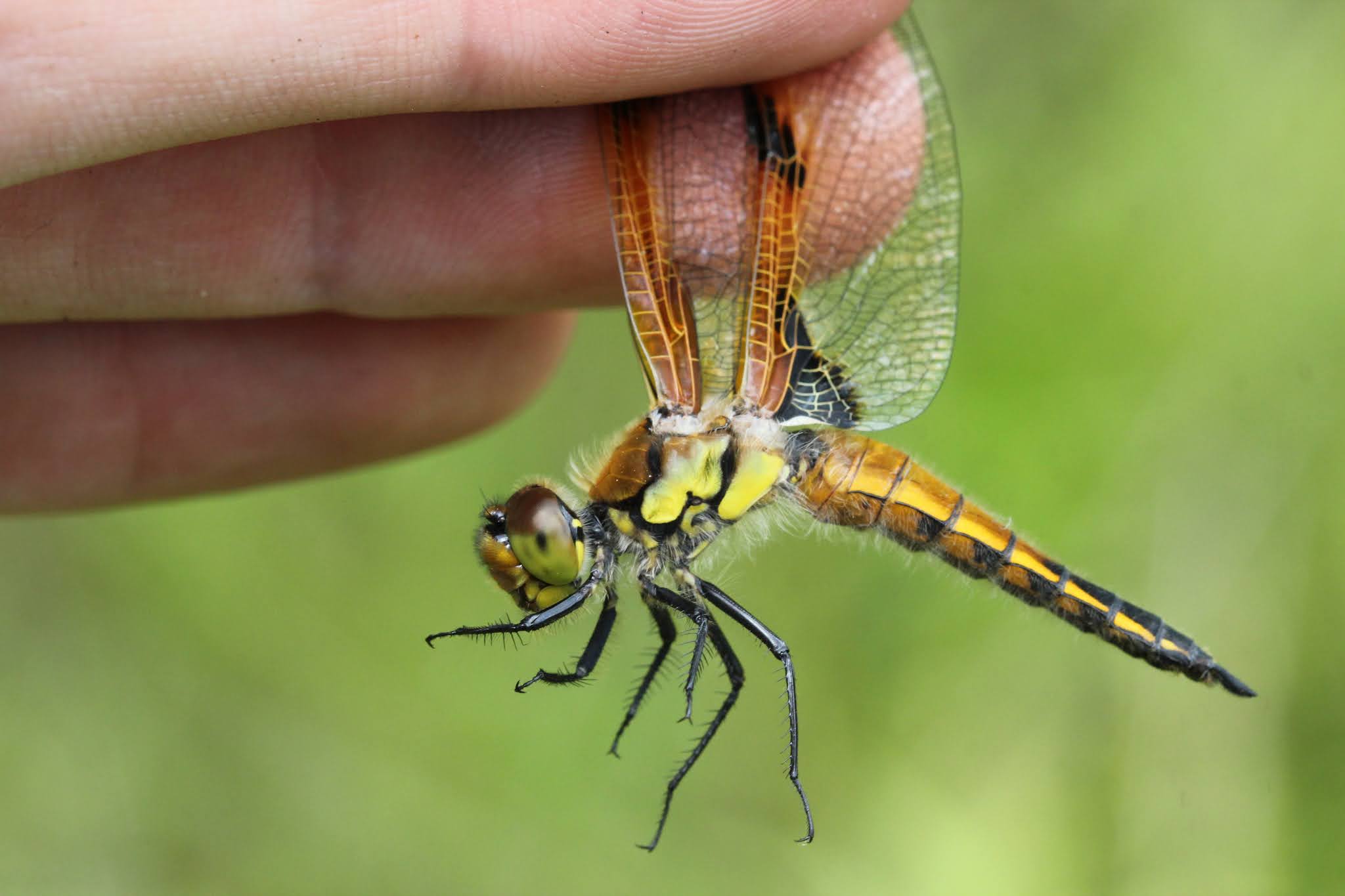
Four-spotted Skimmer

Royal River Cruiser

Racket-tailed Emerald

I also saw a Slaty Skimmer and a Spot-winged Glider near the entrance, but I didn't get any photos. As I was walking back, I had a dragonfly go over I am fairly sure was a Somatochlora emerald, likely Mocha, but I lost it. I still need Mocha Emerald, so file this under "disappointing misses". 

Since I was in the area I popped up to McKeough CA and looked for Pronghorn Clubtails. I found one right away. 


Still too early for Flag-tailed Spinyleg I imagine! 

On my way north, I made a quick stop into Moore WMA to check on a population of Davis' Sedge (Carex davisii), another rare (S2) sedge in Ontario. This species seems to be mature and finish up quickly! 


One last stop before going home was to check on some Dickcissels. I went to the field at the corner of Winter Drive and Sexton Drive, and found a couple of singing males, as well as a third bird that I was unable to sex. They were singing from a wheat field, so who knows how long they'll last.

Great way to cap off the weekend!

Thursday, 11 March 2021

Dragonflies and Damselflies of Middlesex County

I recently wrote an article on the dragonflies and damselflies (odonates) of Middlesex County for The Cardinal, the publication put out by Nature London (formally the Mcllwraith Field Naturalists). I thought I would share it here as well. The bonus if you get to see more photos than what was in print! Enjoy! 

------


While many are familiar with the birds, plants, and butterflies of Middlesex County, seemingly very few are aware of the diversity of damselflies and dragonflies, known as odonates, or simply odes, that can be found in the county. In fact, as of time of writing, 98 species of these insects have been found within Middlesex. Not much is known about odes in the county, and new discoveries happen all the time. I will walk through the checklist taxonomically, and discuss a few of these awesome odonates.

First up, we have the damselflies (Zygoptera). Four species of broad-winged damsels (Calopterygidae), all of the ones that knowingly occur in Ontario, can be found in the county. Ebony Jewelwings, with their striking all black wings, are quite common along streams and rivers. These can start to be observed at the end of May. River Jewelwings are similar in appearance, but are apparently much more uncommon. We have two species of rubyspots as well, American Rubyspot, which is fairly common, and Smoky Rubyspot, very rare and local, restricted to the Thames River in the extreme southwest of the county. 

American Rubyspot

Next we have the spread-winged damsels (Lestes), represented by eight species. Slender Spreadwing is one of our most numerous spreadwings, followed by Emerald Spreadwing. Amber-winged Spreadwing is much more local, with one of the best spots to see it in Middlesex being the Sifton Bog. Later in the season, you may come across the Spotted Spreadwing, which is also one of our latest flying odonates. 

Slender Spreadwing
  

The dancers (Argia) are always a favourite, and six species can be readily seen around almost any flowing watercourse, with some of the best spots being the Thames River, the Ausable River, and Medway Creek. Our most common species is the Powdered Dancer, which can number in the hundreds at the right time of year. Violet and Blue-fronted Dancers can often be found mixed in as well. Rarer and more local species include Blue-ringed, Blue-tipped, and Dusky Dancers, all of which are provincially uncommon. 

Violet Dancer

Bluets (Coenagrion and Enallagma) are often something that casual ode enthusiasts dismiss, as to identify them, you often need to catch and examine the genitalia of the males. It may come to a surprise to some that 16 species of these damselflies have been recorded in the county. Many are quite common, such as Familiar, Marsh, Stream, Skimming, and Orange Bluets. Others, such as Tule, Double-striped, Azure, and Rainbow are much more uncommon. The best places to see bluets are often around ponds, and the many stormwater management ponds in the London area are a great place to start!

Stream Bluet

Rainbow Bluet


The forktails (Ischnura) and sprites (Nehalennia) are our smallest damselflies, the sprites especially. Three species of forktails have been recorded, with Eastern Forktails being the most common, followed by Fragile Forktails. Citrine Forktail, an uncommon to rare vagrant to Ontario, has been recorded once, but is very likely to be found again. We have two species of sprites. Sedge Sprites are quite common, but Sphagnum Sprites are much more local, restricted to sphagnum bogs, such as at the Sifton Bog.

Next, the dragonflies (Anisoptera). The darners (Aeshnidae) are often a crowd pleaser, with ten species having been reported from the county. The season starts off strong with the return of Common Green Darners in late April to early May, and these migrants can be seen throughout the summer into the early fall, which is when they head south. Springtime Darners and Swamp Darners start to appear near the end of May, with Springtime finishing up for the season by the end of June. Another early flier is the Spatterdock Darner, a provincially rare species first found in 2019 at the Sifton Bog. This is a striking insect with its bright blue eyes. Later in the summer, the Aesha darners start to appear, and may gather in feeding “swarms” in the evening. Shadow Darner is the most common. Occasionally, a Lance-tipped may be mixed in. A rarer species is the Black-tipped Darner, which can be found in the Sifton Bog. Along streams and rivers, watch for Fawn Darners working the edges looking for their next meal.

Fawn Darner

 
Common Green Darner


One of our most unique groups of dragonflies are the clubtails (Gomphidae), and 13 species have been seen in the county. These dragons are by no means common, and are always a treat when they are come across. Stormwater management ponds can be good places to look for Unicorn and Pronghorn Clubtails, both of which are provincially uncommon. Along rivers, keep an eye out for Black-shouldered Spinylegs and Midland Clubtails. Rusty Snaketails have only been seen once, but should be looked for along the Sydenham River, where they were first discovered in 2019. Later in the summer, you may come across an Arrow or Zebra Clubtail, members of the highly sought after Stylurus genus. There was a flurry of excitement in June 2020 when the provincially rare Rapids Clubtails were discovered for the first time along the Ausable River, representing the first record of this previously thought extirpated species in the county since 1989. Green-faced Clubtails, another provincially rare species, were also found for the first time in Middlesex County. 

Rapids Clubtail

Spiketails (Cordulegastridae) and river cruisers (Macromiidae) are a pair of unique dragonflies, two species of which have been found in the county. Delta-spotted Spiketails are apparently uncommon and local, with Komoka Provincial Park being a good spot to see one. Swift River Cruisers can be seen along most of the major rivers in Middlesex, with its large yellow spot on the tip of its abdomen making for easy identification. 

Swift River Cruiser

Emeralds (Corduliidae) are represented by five species. The most numerous is Common Baskettail. Prince Baskettails can be found in smaller numbers. Beaverpond Baskettails are rarely encountered, and may just be vagrants, but should be looked for. The only member of the rare genus Somatochlora we have is Mocha Emerald, a provincially rare species found mostly in the southwestern part of the county, but has also been seen along the Ausable River. Racket-tailed Emerald has been seen once at the Sifton Bog, and an eye should be kept out for more! 

Our largest group of dragonflies is the skimmers (Libelluidae), of which 25 species have been recorded. Many are very common, such as Common Whitetails, Widow Skimmers, Eastern Pondhawks, Blue Dashers, Twelve-spotted Skimmers, Eastern Amberwings, Black Saddlebags, and Dot-tailed Whitefaces. Halloween and Calico Pennants, Slaty Skimmers, Chalk-fronted Corporals, and Carolina Saddlebags are more uncommon. Painted Skimmer, a rare vagrant, can occasionally be seen. Ponds are great places to see all of these species. Six species of meadowhawks have been seen as well, with Ruby, White-faced, and Autumn Meadowhawks being the most common. Band-winged, Cherry-faced, and Saffron-winged Meadowhawks are much more local. Two species of gliders, Wandering and Spot-winged Gliders, can also be found, but numbers of this highly migratory species vary year to year. 

Black Saddlebags

Wandering Glider

White-faced Meadowhawk


Of course, there are many holes in the Middlesex County list. There are several species that may occur in the county that have not yet been found, which I have listed. Many occur in neighbouring counties, some along the same rivers. Habitat and flight periods are from The Dragonflies and Damselflies of Algonquin Provincial Park and the Surrounding Area by Colin D. Jones, Andrea Kingsley, Peter Burke, and Matt Holder, as well as Dragonflies and Damselflies of the East by Dennis Paulson. Provincially uncommon to rare species are indicated by an asterisk: Vernal Bluet (ponds and rivers, May-July), *Lilypad Forktail (ponds and slow streams with water lilies, June-September), *Comet Darner (ponds, June-August), *Cyrano Darner (wooded wetlands, June-July), *Harlequin Darner (conifer swamps and bogs, May-July), Variable Darner (ponds, June-September), Mottled Darner (ponds and bogs with abundant emergent vegetation, June-October) , *Flag-tailed Spinyleg (rivers, July-August) *Riverine Clubtail (slow moving creeks and rivers, July-August), *Elusive Clubtail (rivers, June-October), *Arrowhead Spiketail (wooded streams and seepages, May-July), Twin-spotted Spiketail (fast flowing rivers and wooded streams, June-August), Stream Cruiser (rivers, May-September), *Royal River Cruiser (wooded streams and rivers, July-September), Spiny Baskettail (ponds and slow streams, May-August), Williamson’s Emerald (quiet forest streams, June-September), *Clamp-tipped Emerald (forest streams with rapids and pools, July-September), Brush-tipped Emerald (streams through wetland habitat, June-August), and *Variegated Meadowhawk (highly migratory, breeds in ponds and slow streams, April-November).

Elusive Clubtail

Watching dragonflies and damselflies is a very enjoyable, and addicting, pastime. Much like birding, you never know what you may find! Hopefully your eyes have been opened to the amazing world of odonates right on your doorstep!

Saturday, 15 August 2020

Neighbourhood Odonate Count: Round Two

 A month ago (July 14), I did an odonate count around my neighbourhood (results and comments here), so yesterday (August 14), I decided to do one again, to see how much has changed in a month's time. I followed roughly the same route, and conditions were more or less the same (it was quite windier yesterday though). The biggest difference between the two dates (other than the results) was the change in habitat. One location which was a pond last time was now all dried up, with only a small stream running through. I was actually able to walk across what was once the bottom of the pond! There is some Phragmites management/wetland improvement going on here, so will be interesting to see how that changes over time. On the flip side, a wetland that I was able to easy walk around due to low water levels, has completely flooded because of recent rain. The increased water level resulted in a loss of shorebird habitat, but wasn't completely bad. 

Prior to this count, I had recorded 43 species in my neighbourhood, and that number still stands. I managed to find 26 species on this day (compared to 27 on July 14). The numbers of individuals was also down in comparison to July, with 917 individuals recorded, compared to 1388 individuals last month. This difference in individuals is not entirely surprising however. It can be hypothesized we are past the peak of the odonate season for the neighbourhood. 

Anyways, the results, and some notes. The total from the July 14th count are included in parentheses. 

Broad-winged Damsels (Calopterygidae)
Ebony Jewelwing - 1 (33)
    - one individual in an odd place, zero individuals in the ravine I usually see them, so perhaps they have dispersed? 

Spread-winged Damsels (Lestidae)
Slender Spreadwing - 11 (147)
    - surprisingly low numbers, I wasn't able to access the area where I had the bulk last time, but still way fewer individuals in accessible areas than last time

Narrow-winged Damsels (Coenagrionidae)
Familiar Bluet - 167 (101)
Azure Bluet - 4 (0)
    - recent addition to the neighbourhood list when I found a couple individuals on August 8th. This is a species that is quick to colonize new areas, and I think that perhaps the recent flooding contributed to their arrival. The individuals found on the count were throughout the wetland, indicating they are spreading out. 
Marsh Bluet - 1 (6)
Stream Bluet - 2 (2)
    - pair in copula, as opposed to two males on July 14, indicates breeding
Skimming Bluet - 1 (0)
Orange Bluet - 1 (42)
    - starting to get late, higher water levels resulted in less emergent vegetation for this species to perch on, where they are conspicuous 
Enallgma sp. - 3
Fragile Forktail - 71 (118)
Eastern Forktail - 211 (420)

Darners (Aeshnidae)
Lance-tipped Darner - 1 (0)
Shadow Darner - 1 (0)
Common Green Darner - 46 (14)

Skimmers (Libelluidae)
Halloween Pennant - 2 (0)
    - second record for the neighbourhood, first for location
Eastern Pondhawk - 39 (68)
     - with one location having next to no water, skimmer numbers were down
Widow Skimmer - 46 (25)
    - only one location with this species, making the count excellent
Twelve-spotted Skimmer - 66 (45)
Blue Dasher - 87 (89)
Wandering Glider - 1 (0)
Eastern Amberwing - 23 (57)
Common Whitetail - 47 (80)
White-faced Meadowhawk - 10 (2)
Ruby Meadowhawk - 19 (8)
Band-winged Meadowhawk - 16 (68)
     - no evidence of large numbers like in July, still a few individuals and pairs
Autumn Meadowhawk - 12 (7)
Black Saddlebags - 28 (14)

Total Species: 26 (27)
Total Individuals: 917 (1388)

I once again divided the checklist into the four locations. Quite a striking difference to last time!

Virginia Park
Species: 7 (14)
Individuals: 81 (138)

Northbrook Park (decreased water level)
Species: 18 (24)
Individuals: 244 (620)

Uplands North Wetland (increased water level)
Species: 22 (17)
Individuals: 587 (621)

Uplands Trail
Species: 3 (4)
Individuals: 3 (9)

Misses from the first count:

Emerald Spreadwing - not all that surprising, as I don't normally see this species during the summer. The individual in July was in a part of the wetland that is now inaccessible.
Violet Dancer - I'd consider the individual from the first count accidental.
Tule Bluet - another apparently accidental individual on the first count.
Sedge Sprite - it is late for this species, I checked several areas where they were in July with no luck.
Unicorn Clubtail - late for this species
Dot-tailed Whiteface - this is a seemingly rare species in the neighbourhood, the location where I had an individual in July is now dried up.
Four-spotted Skimmer - uncommon to rare species in Middlesex. The spot I had three in July is now dry. I had one individual at another location on August 8th, but could have just been stopping in.

Other notable misses:

Northern Spreadwing - not sure where this species is this year, have not seen one since July 13th.
Spotted Spreadwing - I have only ever seen one in the neighbourhood (August 4th, 2018), but this is a later season species, so could easily occur, and I just haven't found it (since I was gone for all of August 2019). I have seen several individuals in a park directly to the north of the neighbourhood.


There really weren't all too many surprises. A species I was quite pleased to see was Halloween Pennant, which represents only the second record for the neighbourhood. I am still on the lookout for Calico Pennant!


I was expecting to see more meadowhawks than I did. Numbers of three species (Ruby, White-faced, and Autumn) were up, but Band-winged was down drastically. I suspect that they were done breeding and have since dispersed. 


As mentioned prior, Azure Bluet was a new addition to the list last week. I am hoping this attractive species sticks around and gets a little population going.


I was expecting to see more Wandering Gliders, but still happy I got one.


Unsurprisingly, Common Green Darner and Black Saddlebags numbers were up. These species congregate in numbers before migrating in the fall. The darners were swarming in the evening while feeding. I didn't have much mixed in, save for a Shadow Darner.


Overall, a pretty good day. Any day out looking for odes is a day well spent! I think it was quite interesting to see the contrast between the two dates. I think the biggest surprise was how many species I saw, since I had been expecting quite a few less than in July. I will have to see what I'm up to in mid-September!

Tuesday, 14 July 2020

Neighbourhood Odonate Count

For the last couple of years, I've been throwing around the idea of establishing an odonate (dragonflies and damselflies) count in London. While when you think of odonates, you may not think of London as a good area, it can be surprisingly good! This is obviously not the year...perhaps next year, we'll see.

I decided to focus on a smaller area this year, one I know quite well, my neighbourhood. I have had quite a lot of luck here, everything a ten minute or less walk from home! I planned out a route, and so from about 9:45 am until 7:15 pm, I counted odes! 

Twelve-spotted Skimmer

I had recorded 40 species in my neighbourhood prior to my count, 27 of which I recorded on my count. I managed to add two species to the cumulative list, bringing the total up to 42. As such, I recorded 64% of my total list on my count, which I think is quite good (considering I was only expecting 18 or 19 species)! Of those 42 species, a few of those were accidental (Citrine Forktail, Northern Bluet, Beaverpond Baskettail, Red Saddlebags), and for some others, we are outside the flight period for, such as Shadow and Lance-tipped Darner, which I see more so in August and September. 

Without any further ado, the results.

Broad-winged Damsels (Calopterygidae)
Ebony Jewelwing - 33

Spread-winged Damsels (Lestidae)
Emerald Spreadwing - 1
Slender Spreadwing - 147
Lestes sp. - 1

Narrow-winged Damsels (Coenagrionidae)
Violet Dancer - 1
Marsh Bluet - 6
Familiar Bluet - 101
Orange Bluet - 42
Stream Bluet - 2
Tule Bluet - 1
Eastern Forktail - 420
Fragile Forktail - 118
Sedge Sprite - 33

Darners (Aeshnidae)
Common Green Darner - 14

Clubtails (Gomphidae)
Unicorn Clubtail - 1

Skimmers (Libelluidae)
Dot-tailed Whiteface - 1
Black Saddlebags - 14
Widow Skimmer - 25
Twelve-spotted Skimmer - 45
Four-spotted Skimmer - 3
Blue Dasher - 89
Eastern Pondhawk - 68
Common Whitetail - 80
Eastern Amberwing - 57
Ruby Meadowhawk - 8
White-faced Meadowhawk - 2
Band-winged Meadowhawk - 68
Autumn Meadowhawk - 7

Total Species: 27
Total Individuals: 1388

I divided the checklist so I could calculate totals for each of the four locations I visited (Virginia Park, Northbrook Park, Uplands North Wetland, and Uplands Trail). I found the totals somewhat interesting. The bulk of the individuals at the Uplands wetland were Eastern Forktails (319)...I never want to look at one again.

Virginia Park
Species: 14
Individuals: 138

Northbrook Park
Species: 24
Individuals: 620

Uplands North Wetland
Species: 17
Individuals: 621

Uplands Trail
Species: 4
Individuals: 9

Okay, now some commentary...

So, what were some notable misses? I'd say my most surprising one is Skimming Bluet. They aren't super abundant in my neighbourhood, but I definitely expected at least one. The only other miss of note is Northern Spreadwing. They aren't terribly common, but usually you can find them by sorting through the Slender Spreadwings in this one area of the north wetland. I had my first of the year the previous day. I'm almost positive I did have a Northern on the count, but I couldn't get close enough to get a good look or catch it. As such, it is left as Lestes sp.

Northern Spreadwing (July 13, 2020)

As I noted earlier, I added two new species to my neighbourhood list. These were Steam and Tule Bluets. I had a hunch on where I might see some Stream Bluets, and sure enough, there was one there. The other was mixed in with a bunch of Familiar Bluets along the edge of a storm pond. The Tule Bluet was a complete surprise. I netted a blue type bluet, just to confirm it was a Familiar Bluet, but once I pulled it out I realized "Hey, that's a Tule!". My first for Middlesex county too.

Stream Bluet

Tule Bluet

So, some surprises? I had a bunch! One of the most notable is the numbers of Band-winged Meadowhawks, with 68 tallied. This is only the third occurrence I have noted in the 'hood, and the first involving more than one individual. I had all four Middlesex (and neighbourhood) meadowhawks today, with White-faced being another surprise, as I hadn't had any previously this year.


Four-spotted Skimmer is apparently uncommon in the county, I've only seen them in one other spot, in Dorchester Swamp. I had three today in a spot I haven't really visited in July before. 


Dot-tailed Whiteface is oddly rare in my neighbourhood, and I have only seen it once before. I found one male today.


Another species I had only seen once prior is Sedge Sprite. I found a good number today! I had hoped that with a concerted effort I'd be able to turn up some, but I didn't expect to see so many. The one pictured was actually my first ode of the day.


I've seen Violet Dancer once prior as well, when a male landed on the deck in my yard. I was very pleased to find a female, certainly unexpected.


One last surprise to mention would be Unicorn Clubtail. I didn't see them in the usual spot, but did catch a male in a new location. I've now seen this uncommon species on all three ponds in my neighborhood (sick of that word yet?).


A non-insect surprise was finding a couple singing Marsh Wrens. New for my patch! I've been hoping for this species for awhile, and they were right where I thought they'd be if they showed up.

I'll leave you with this Common Green Darner, a species I don't catch very often. Officially the first ode to draw blood.


A tiring day, but an excellent one. Certainly worth the bad sunburn! 

I guess I have to do a butterfly count now...

Common Sootywing