Showing posts with label neighborhood. Show all posts

Saturday, 1 May 2021

May Day

The first of May is always a celebrated day for birders (or at least, it is for me!). I like to get out and start the month off right!

This morning, somehow I slept through my alarm, but nevertheless, I was out and about in the neighbourhood by shortly after 7:00. The last couple days haven't been really conducive for migrants, but on my walk over, I heard a couple House Wrens, new arrivals, so my hopes were up. 

At the Northbrook Park/Wetland storm pond, I found a Solitary Sandpiper. I had heard one here the day prior, but it was nice to get a visual.

At one point I looked over and was shocked to see this staring back at me from the dried up wetland!

A Coyote! Although I have heard them on occasion in the neighbourhood, and commonly come across their scat, I very rarely actually see them (this is actually only my second time seeing one around here). It appeared to be quite mangey, and walked with a limp, so unfortunately I fear it was not well. 

It went and laid down on some phragmites, and was napping (I hope) when I passed by it again an hour later.

As for birds, the Blue Jays were moving, and I counted well over one hundred. 


A Brown Thrasher was making the rounds as well.

There wasn't really much else in the way of migrants other than a Blue-headed Vireo, my first this year. Not a single warbler at this location! 

My next stop at the north wetland yielded the warblers, and I found Yellow, Yellow-rumped, and Palm. There were several Tree Swallows around, including this one, which was collecting nesting material off the path. There is a pair building a nest in a snag—will keep an eye on it for the breeding bird atlas. 

Speaking of breeding birds, there was a House Finch sitting on the nest I spotted a few days back, and I saw my first brood of Mallard ducklings of the spring!

There was a small movement of Broad-winged Hawks, and I saw four go over. 

Next up was to check the Uplands Trail. I flushed a Wilson's Snipe while walking through the field, probably the most interesting thing there. There was also a Pine Warbler singing.

I got distracted by the sedges. I saw my first "getting there" Graceful Sedge (Carex gracillima) of the year. The perigynia (fruits) on this species are short and plump without a "beak". 


The terminal spikelets of this species are also what we call "gynecandrous", meaning that there are female flowers above the male flowers. You can kind of see that here (although it may not be super obvious if you don't know what you're looking for!). The gynecandrous tendency of Graceful Sedge is a distinguishing feature, separating it from most of the other similar species in Carex sect. Hymenlochaenae (this is a trait only shared by C. prasina, C. davisii, and C. formosa, all of which are not commonly encountered in Ontario).

Pennsylvania Sedge (Carex pensylvanica) is a species I have portrayed on this blog before. It's colony forming habits make it a pretty distinctive and easy to identify species once you are familiar with it. 


Another species I saw was Fibrous-rooted Sedge (Carex communis). This can appear similar to Pennsylvania Sedge, although it is more clump forming and not colonial. The leaves are also wider, and the bracts (specialized leaf below the flowering part) are longer.


 A feature I don't see discussed too much is that the bract sheath has reddish margins were it meets the culm (sort of like the 'stem' in grasses and sedges). I believe that is is fairly diagnostic of Fibrous-rooted Sedge, at least in species that it looks similar to (Carex sect. Acrocystis). 

I'll finish off with this Mayapple (Podophyllum peltatum) with a "leaf necklace".

It was a great way to kick off May, and things can only look up from here!

Wednesday, 28 April 2021

It is Slowly Starting...

The last few days have seen us starting to get some of our most anticipated spring migrants in Southern Ontario. I have gotten out as often as I can, and as the weather allows.

Up until yesterday, first of year (FOY) birds were becoming hard to come by. One bird I finally was able to cross paths with was a Rusty Blackbird in my neighbourhood. They definitely seem to be much more uncommon in the spring as opposed to the fall, but I had half expected to come across several by that point! 

Stakes were looking high going into yesterday (Tuesday). A good south wind with very limited to no precipitation overnight—it was shaping up to be a good looking day!

My game plan for the morning was to walk around Fanshawe CA, which is what I did for five hours. Ultimately, it seemed that all the birds that showed up on the radar were White-throated Sparrows, Ruby-crowned Kinglets and Yellow-rumped Warblers! I only managed to see two FOYs: Purple Finch (my first since November) and a Chimney Swift. I managed to rack up 69 species at Fanshawe—I just couldn't find a 70th! Find the morning's eBird checklist here.

Broad-winged Hawk

Today, my original plan was to go to the Strathroy Sewage Lagoons first thing in the morning, as I had hoped the forecasted thunderstorms would push down some good shorebirds. When I woke up, however, I found that there was no rain in the immediate forecast! Since I had limited time, I just opted to go birding in the neighbourhood.

It was fairly slow, but I can't complain too much considering it is April 28th! By any means, it seemed clear that today had more potential than the day prior! My first stop was Northbrook Park.

I flushed a Wilson's Snipe in the wetland, a first for this location. I was unable to turn up any rails. Virginia Rails had been present here for over a month last spring, but the habitat had been changed dramatically since last year due to phragmites management. 

I made my way through the ravine, and came across a few warblers, most notably my first Black-and-white Warbler and Black-throated Green Warbler of the year.

Black-throated Green Warbler

Long-spurred Violet (Viola rostrata) is starting to flower.


Next up I went up to the Uplands North Wetland, always a good stop. My most notable bird was a Baltimore Oriole, which was of course a first for this year. There were also a couple Green Herons flying around, and some Common Loons and Double-crested Cormorants were migrating overhead.

As I was leaving the wetland and walking back home, I saw that I had a text from Reuven Martin. He had found an Eastern Whip-poor-will (a would be county bird for me) in Kilally Meadows ESA. It was 8:30. I had class at 9:00. 

I weighed my options, and decided that it would have to wait, so I told Reuven I would pop out after class. He told me that it was being mobbed by robins, and might not stick around. I reconsidered my choices. I had to go. So at 8:35, I was pulling out of my driveway.

I arrived at Kilally at 8:42, and found that I had gone to the wrong access point, which added another half kilometer of unnecessary running. By the time I had found the right spot and met up with Reuven it was 8:45. 

Reuven took me to the spot and pointed it out. Good thing he did, I probably would have had one heck of a time trying to find it otherwise! I snapped a few photos.


It was now 8:50. 

I pulled back into my driveway at 8:59, and managed to sprint up stairs in time to log into class at 9am. Not a minute to spare. 

It is a good thing I took the chance, because it seemingly disappeared later that morning! 

After class, there was rain in the forecast, so I opted to go to the Strathroy lagoons. Unfortunately, the rain was short lived, and it cleared up pretty fast :(  No rare shorebirds today.

I still had an okay shorebird count, with around 25 Pectorals, both yellowlegs, Solitary Sandpipers, Killdeer, Spotted Sandpipers, and a slightly early Least Sandpiper (although not too unexpected). 

Pectoral Sandpipers

There were several warblers along the edges of the cells as well, the best being a Northern Parula. The first time I have seen this species in April.

I also found my first Rose-breasted Grosbeak of the year.


I had a pretty good species count at the lagoons, which included several species of ducks, a Caspian Tern, and both the rails: Virginia Rails and Sora. 

It was a splendid day of late April birding, and I ended up with 80 species, not too shabby since I wasn't trying for a high species count. Looking forward to the days ahead (although I don't think we'll see a ton of movement until next week)! 

Tuesday, 19 January 2021

2020: A Neighbourhood Year in Review

As much as I love to bird in areas further afield, my neighbourhood is where I do the bulk of my birding. While this is mostly because of its convenience, the birding isn't actually half bad. At the beginning of 2020 I had pretty much zero intention of doing much birding. Sure, I would do some spring birding in my usual haunts like Rondeau and Point Pelee (which as we all know, wasn't to be!), but I wanted to focus mostly on field botany, a hobby that was quickly growing on me! 

After my birding trip to Cochrane at the start of March Break, and the start of the pandemic, I found myself stuck at home without much to do except look for birds. Having such a successful northern trip definitely helped "rekindle" my excitement for birding just enough to make me muster up the energy to go outside (which admittedly, didn't happen sometimes for days on end!). Other than a few trips a bit further afield (COVID aware of course), I pretty much spent the entirety of spring migration in my neighbourhood! I typically don't do much birding during the summer (too many plants and insects to see!), but by the time the first fall migrants started to arrive, it was time again for almost daily pilgrimages out to my neighbourhood. Nearer to the end of fall, I was spending most of my free mornings out at Fanshawe CA, but I still got out every once in a while. My grand total for for my neighborhood in 2020 was 164 species out of the 179 species I have seen all time. I know of at least a few other species seen by others that I missed. Hopefully this year I can find some of those species!

I'll walk through some highlights in chronological order.

Even before the start of the pandemic and I started to bird more, something I look forward to each spring is the arrival of the blackbirds. They arrived pretty much on time on February 24th. Soon after, I recorded my first Turkey Vulture and American Woodcock on March 7th. Also that same day, March 7th, I was elated to find my first ever Eastern Screech-Owl for my neighbourhood list, a species I had been hoping to come across for awhile. It was my first "patch bird" of the year! I found another Screech-owl later in a different woodlot.

Throughout the end of March and into early April I continued to go out to my patch with some regularity. I saw several notable species including American Wigeon (March 21), Sandhill Cranes (March 26), Eastern Phoebe (March 26, a bit early), and Blue-winged Teal (April 6). April 18th was a big day, and perhaps the turning point for my patch birding in 2020. I was super happy to find my first Lesser Scaup for my neighborhood list at one of the local ponds. That same day, I managed to turn up a Virginia Rail, which would soon turn into two Virginia Rails. These rails were fairly cooperative and reliable, and remained in this wetland into mid May.

Lesser Scaup


On April 19th, I did my first yard watch of the year. I would complete several more of these stationary counts in the early mornings in my yard over the next few weeks. I saw my first Common Loons and cormorants of the year. The next day, I did another yard watch, and came up with my first Broad-winged Hawks of the year.

Common Loon


On April 24, I got a message that there was an American Bittern in a local wetland, the same place I had found one in 2018. I went over and saw it. I saw this elusive bird several more times into the beginning of May. 

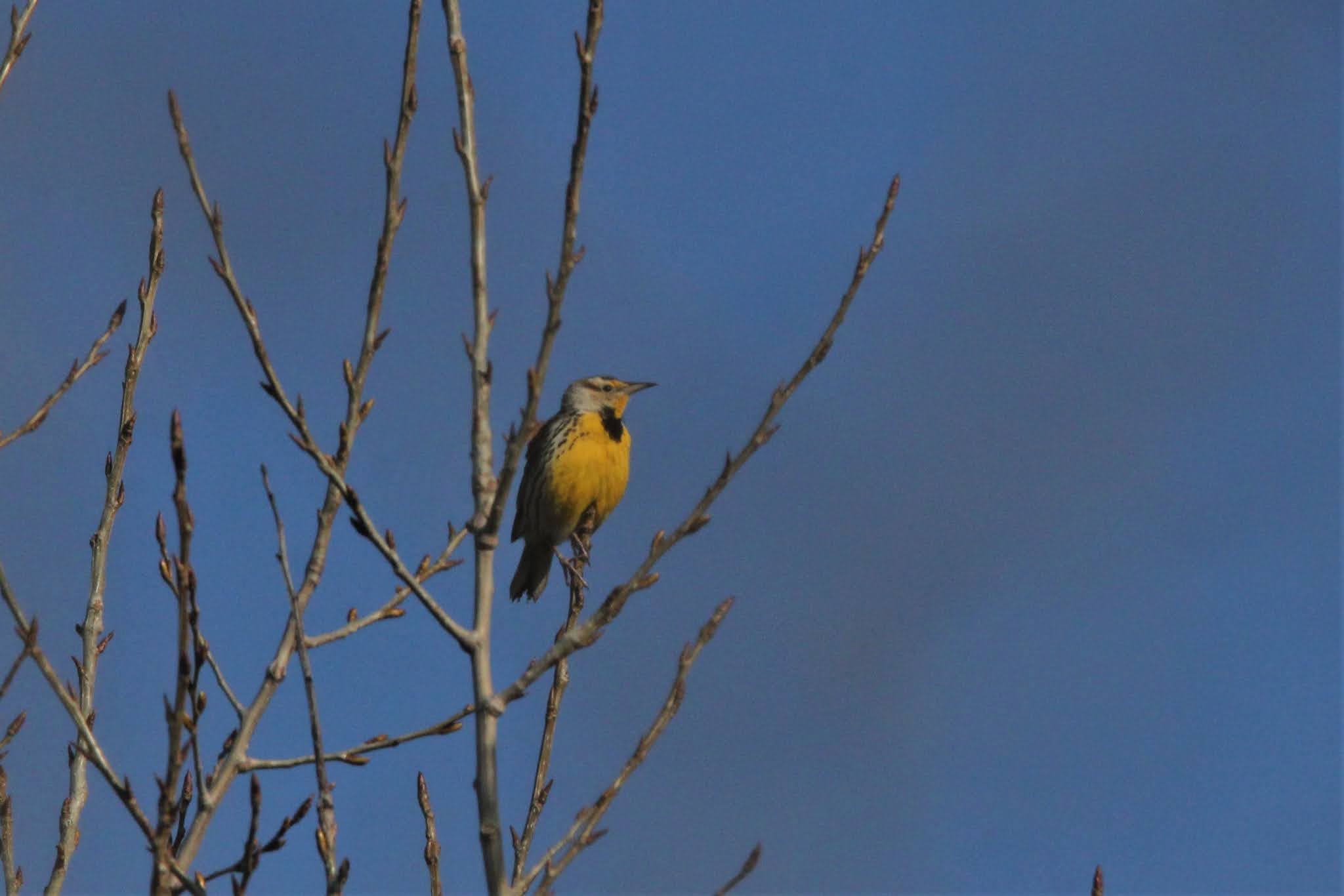
April 25th was a pretty good day for a yard watch. I saw my first Eastern Meadowlark for my patch list, which landed in a tree for a moment. It was also my first big loon day of the year, with 124 recorded.

The first of year birds kept coming throughout the end of April, with highlights being Fox Sparrow, Wood Thrush, Eastern Towhee, Blue-headed Vireo, Warbling Vireo, Black-throated Green Warbler, Yellow Warbler, Rose-breasted Grosbeak, Brown Thrasher, and my first Great Black-backed Gulls for my neighbourhood, which flew over my yard on April 28th. April 28th also marked the first day of my daily early morning (starting before sunrise) walks of the spring, which I continued for the better part of three weeks. I certainly got my exercise in with these walks, and I estimated I walked a total of 10-15km every morning!

Fox Sparrow


Finally it was May, but unseasonably cold weather was really putting a damper on the arrival of spring migrants. I had a high count of migrating loons with 299 on May 5. We got a thin trickle of birds, including Sora (May 2), Great Egret, Savannah Sparrow, Lincoln's Sparrow, Baltimore Oriole, Ovenbird, and Palm Warbler (all May 3, the first "good" day), and Solitary Sandpiper (May 6). On May 9th, the global eBird big day, we got snow! It wasn't until May 10th I got my first Blackburnian Warbler and Least Flycatcher. May 12th brought Lesser Yellowlegs.

Palm Warbler

Lincoln's Sparrow


Then, on May 14th, the weather changed, and the floodgates opened. Warblers! Thrushes! WARBLERS! I found my first  Yellow-throated Vireo and Scarlet Tanager for my neighbourhood list. The vireo in particular was quite awesome, as it completed my set of all the regularly occurring vireos in Ontario for my patch. In the evening, I found a Gambel's White-crowned Sparrow in my yard, a somewhat rare subspecies in this area of Ontario. I had made it my goal to find one that spring!


Black-throated Blue Warbler

Yellow-throated Vireo

Gambel's White-crowned Sparrow


I spent May 15th in Rondeau, the first day it was open to the public after being closed all spring. Although apparently it was a great day for birds in London, I am glad I spent it here!

I didn't seem to go out in the patch on May 16th, I assume it was because of rain. I remember hearing about the Kirtland's Warblers that had been found at Rondeau that day, but being quit bummed as I wouldn't be able to go down to see them! 

When my alarm went off on May 17th, I was hoping it was raining outside so I would have an excuse to go back to bed. I looked out my window, and found it dry. I debated about going back to bed anyways, but I reasoned that if I didn't go out, I wouldn't find anything. I was outside by 5:30am to begin my 10 minute walk to the place I started in the morning. I thought of all the rarities I could see, including Kirtland's Warbler, which was on my mind after the ones in Rondeau the day prior. When I arrived to the park, I began to regret my decision to go outside, as there were basically no birds. I had seen one warbler. As I was walking along, I heard a chip note, and saw a warbler at the top of a tree. I raised my binoculars and my jaw hit the ground. Now, I can't repeat here exactly what came out of my mouth, but bottom line, not only was it a patch bird, but my full out lifer Kirtland's Warbler. My observation lasted for no more than two minutes, and the bird wasn't very cooperative, but it was undoubtedly the highlight of my year.

Kirtland's Warbler


Oh, and I saw my first Cliff Swallows and Eastern Kingbird of the year that day too, but they are but a footnote...

That day was the last of my almost daily morning walks. I was feeling quite tired, and my other interests like bugs and plants were starting to get the best of me! I added six more species to my neighbourhood year list over the rest of May, bringing my total up to 124 species.

The summer months are often quiet, but I added a few more species here and there. My biggest highlight of the summer was a pair of Black Vultures on June 6th, a new neighborhood and Middlesex bird for me. I was out looking for dragonflies, so I didn't have a good camera lens or even my binoculars! Thankfully, I managed to get some record photos that managed to confirm the identification. 

Black Vultures


July came around, and with it some of the first southbound shorebirds. I was pretty excited to find that I had good shorebird habitat this year, however this excitement was short-lived, and with a period of heavy rain, it all flooded and was useless by early August, before the bulk of the "good" shorebirds would come through. I never had anything crazy, but Least Sandpiper and Lesser Yellowlegs were highlights.

Also during July, while out counting dragonflies, I found my first Marsh Wrens for the neighbourhood. 

At the end of August, I began once again to make near daily visits out to one of my favourite migrant traps. In short order I added Olive-sided Flycatcher, Eastern Wood-Pewee, Blue-gray Gnatcatcher, and several warblers to my year list. I added one new patch bird, Black-billed Cuckoo. Purple Finches began to move through, a sign of things to come.

Olive-sided Flycatcher


I did a couple hawk watches in early September, with my best day topping 600 Broad-winged Hawks.

By late September, many of the neotropical passerines had passed through. I found some Wilson's Snipes, a species that I hadn't seen for a couple years in the neighborhood. After being strangely absent for awhile, the Green-winged Teals finally showed up.

Wilson's Snipe


Late September gave way to early October, and with that, Winter Wrens, American Pipits, and more ducks showed up. Pine Siskins arrived, and I finally saw some Greater Yellowlegs. Later on in the month, I did a lot of hawk watching, and scored a Red-shouldered Hawk. I never could get a Golden Eagle though!

Northern Pintail and Green-winged Teal


Early November came around. A highlight in the first few days was a Vesper Sparrow, a new neighbourhood bird. Number 160 for the year was a Common Redpoll on the same day, the first of many. By mid November, we were getting crossbills, and I had both Red Crossbill and White-winged Crossbill fly over my yard. I never could connect with an Evening Grosbeak, although someone else did spot some!

My last two new birds of the year came just a few days apart, Snow Bunting (November 16) and Rough-legged Hawk (November 23). Although I did go out some more here and there over the next month, the quiet of winter had settled in.

So there you have it, a short(ish) recap of some of the highlights of my year in my neighbourhood. I certainly wrote a lot (I have been plugging away at writing this post for three days!), but there was so much more I could have included! For an area that is mostly subdivision with only a few greenspaces, I think I did pretty good! Just goes to show what can be seen once you look for it!


Saturday, 15 August 2020

Neighbourhood Odonate Count: Round Two

 A month ago (July 14), I did an odonate count around my neighbourhood (results and comments here), so yesterday (August 14), I decided to do one again, to see how much has changed in a month's time. I followed roughly the same route, and conditions were more or less the same (it was quite windier yesterday though). The biggest difference between the two dates (other than the results) was the change in habitat. One location which was a pond last time was now all dried up, with only a small stream running through. I was actually able to walk across what was once the bottom of the pond! There is some Phragmites management/wetland improvement going on here, so will be interesting to see how that changes over time. On the flip side, a wetland that I was able to easy walk around due to low water levels, has completely flooded because of recent rain. The increased water level resulted in a loss of shorebird habitat, but wasn't completely bad. 

Prior to this count, I had recorded 43 species in my neighbourhood, and that number still stands. I managed to find 26 species on this day (compared to 27 on July 14). The numbers of individuals was also down in comparison to July, with 917 individuals recorded, compared to 1388 individuals last month. This difference in individuals is not entirely surprising however. It can be hypothesized we are past the peak of the odonate season for the neighbourhood. 

Anyways, the results, and some notes. The total from the July 14th count are included in parentheses. 

Broad-winged Damsels (Calopterygidae)
Ebony Jewelwing - 1 (33)
    - one individual in an odd place, zero individuals in the ravine I usually see them, so perhaps they have dispersed? 

Spread-winged Damsels (Lestidae)
Slender Spreadwing - 11 (147)
    - surprisingly low numbers, I wasn't able to access the area where I had the bulk last time, but still way fewer individuals in accessible areas than last time

Narrow-winged Damsels (Coenagrionidae)
Familiar Bluet - 167 (101)
Azure Bluet - 4 (0)
    - recent addition to the neighbourhood list when I found a couple individuals on August 8th. This is a species that is quick to colonize new areas, and I think that perhaps the recent flooding contributed to their arrival. The individuals found on the count were throughout the wetland, indicating they are spreading out. 
Marsh Bluet - 1 (6)
Stream Bluet - 2 (2)
    - pair in copula, as opposed to two males on July 14, indicates breeding
Skimming Bluet - 1 (0)
Orange Bluet - 1 (42)
    - starting to get late, higher water levels resulted in less emergent vegetation for this species to perch on, where they are conspicuous 
Enallgma sp. - 3
Fragile Forktail - 71 (118)
Eastern Forktail - 211 (420)

Darners (Aeshnidae)
Lance-tipped Darner - 1 (0)
Shadow Darner - 1 (0)
Common Green Darner - 46 (14)

Skimmers (Libelluidae)
Halloween Pennant - 2 (0)
    - second record for the neighbourhood, first for location
Eastern Pondhawk - 39 (68)
     - with one location having next to no water, skimmer numbers were down
Widow Skimmer - 46 (25)
    - only one location with this species, making the count excellent
Twelve-spotted Skimmer - 66 (45)
Blue Dasher - 87 (89)
Wandering Glider - 1 (0)
Eastern Amberwing - 23 (57)
Common Whitetail - 47 (80)
White-faced Meadowhawk - 10 (2)
Ruby Meadowhawk - 19 (8)
Band-winged Meadowhawk - 16 (68)
     - no evidence of large numbers like in July, still a few individuals and pairs
Autumn Meadowhawk - 12 (7)
Black Saddlebags - 28 (14)

Total Species: 26 (27)
Total Individuals: 917 (1388)

I once again divided the checklist into the four locations. Quite a striking difference to last time!

Virginia Park
Species: 7 (14)
Individuals: 81 (138)

Northbrook Park (decreased water level)
Species: 18 (24)
Individuals: 244 (620)

Uplands North Wetland (increased water level)
Species: 22 (17)
Individuals: 587 (621)

Uplands Trail
Species: 3 (4)
Individuals: 3 (9)

Misses from the first count:

Emerald Spreadwing - not all that surprising, as I don't normally see this species during the summer. The individual in July was in a part of the wetland that is now inaccessible.
Violet Dancer - I'd consider the individual from the first count accidental.
Tule Bluet - another apparently accidental individual on the first count.
Sedge Sprite - it is late for this species, I checked several areas where they were in July with no luck.
Unicorn Clubtail - late for this species
Dot-tailed Whiteface - this is a seemingly rare species in the neighbourhood, the location where I had an individual in July is now dried up.
Four-spotted Skimmer - uncommon to rare species in Middlesex. The spot I had three in July is now dry. I had one individual at another location on August 8th, but could have just been stopping in.

Other notable misses:

Northern Spreadwing - not sure where this species is this year, have not seen one since July 13th.
Spotted Spreadwing - I have only ever seen one in the neighbourhood (August 4th, 2018), but this is a later season species, so could easily occur, and I just haven't found it (since I was gone for all of August 2019). I have seen several individuals in a park directly to the north of the neighbourhood.


There really weren't all too many surprises. A species I was quite pleased to see was Halloween Pennant, which represents only the second record for the neighbourhood. I am still on the lookout for Calico Pennant!


I was expecting to see more meadowhawks than I did. Numbers of three species (Ruby, White-faced, and Autumn) were up, but Band-winged was down drastically. I suspect that they were done breeding and have since dispersed. 


As mentioned prior, Azure Bluet was a new addition to the list last week. I am hoping this attractive species sticks around and gets a little population going.


I was expecting to see more Wandering Gliders, but still happy I got one.


Unsurprisingly, Common Green Darner and Black Saddlebags numbers were up. These species congregate in numbers before migrating in the fall. The darners were swarming in the evening while feeding. I didn't have much mixed in, save for a Shadow Darner.


Overall, a pretty good day. Any day out looking for odes is a day well spent! I think it was quite interesting to see the contrast between the two dates. I think the biggest surprise was how many species I saw, since I had been expecting quite a few less than in July. I will have to see what I'm up to in mid-September!

Tuesday, 14 July 2020

Neighbourhood Odonate Count

For the last couple of years, I've been throwing around the idea of establishing an odonate (dragonflies and damselflies) count in London. While when you think of odonates, you may not think of London as a good area, it can be surprisingly good! This is obviously not the year...perhaps next year, we'll see.

I decided to focus on a smaller area this year, one I know quite well, my neighbourhood. I have had quite a lot of luck here, everything a ten minute or less walk from home! I planned out a route, and so from about 9:45 am until 7:15 pm, I counted odes! 

Twelve-spotted Skimmer

I had recorded 40 species in my neighbourhood prior to my count, 27 of which I recorded on my count. I managed to add two species to the cumulative list, bringing the total up to 42. As such, I recorded 64% of my total list on my count, which I think is quite good (considering I was only expecting 18 or 19 species)! Of those 42 species, a few of those were accidental (Citrine Forktail, Northern Bluet, Beaverpond Baskettail, Red Saddlebags), and for some others, we are outside the flight period for, such as Shadow and Lance-tipped Darner, which I see more so in August and September. 

Without any further ado, the results.

Broad-winged Damsels (Calopterygidae)
Ebony Jewelwing - 33

Spread-winged Damsels (Lestidae)
Emerald Spreadwing - 1
Slender Spreadwing - 147
Lestes sp. - 1

Narrow-winged Damsels (Coenagrionidae)
Violet Dancer - 1
Marsh Bluet - 6
Familiar Bluet - 101
Orange Bluet - 42
Stream Bluet - 2
Tule Bluet - 1
Eastern Forktail - 420
Fragile Forktail - 118
Sedge Sprite - 33

Darners (Aeshnidae)
Common Green Darner - 14

Clubtails (Gomphidae)
Unicorn Clubtail - 1

Skimmers (Libelluidae)
Dot-tailed Whiteface - 1
Black Saddlebags - 14
Widow Skimmer - 25
Twelve-spotted Skimmer - 45
Four-spotted Skimmer - 3
Blue Dasher - 89
Eastern Pondhawk - 68
Common Whitetail - 80
Eastern Amberwing - 57
Ruby Meadowhawk - 8
White-faced Meadowhawk - 2
Band-winged Meadowhawk - 68
Autumn Meadowhawk - 7

Total Species: 27
Total Individuals: 1388

I divided the checklist so I could calculate totals for each of the four locations I visited (Virginia Park, Northbrook Park, Uplands North Wetland, and Uplands Trail). I found the totals somewhat interesting. The bulk of the individuals at the Uplands wetland were Eastern Forktails (319)...I never want to look at one again.

Virginia Park
Species: 14
Individuals: 138

Northbrook Park
Species: 24
Individuals: 620

Uplands North Wetland
Species: 17
Individuals: 621

Uplands Trail
Species: 4
Individuals: 9

Okay, now some commentary...

So, what were some notable misses? I'd say my most surprising one is Skimming Bluet. They aren't super abundant in my neighbourhood, but I definitely expected at least one. The only other miss of note is Northern Spreadwing. They aren't terribly common, but usually you can find them by sorting through the Slender Spreadwings in this one area of the north wetland. I had my first of the year the previous day. I'm almost positive I did have a Northern on the count, but I couldn't get close enough to get a good look or catch it. As such, it is left as Lestes sp.

Northern Spreadwing (July 13, 2020)

As I noted earlier, I added two new species to my neighbourhood list. These were Steam and Tule Bluets. I had a hunch on where I might see some Stream Bluets, and sure enough, there was one there. The other was mixed in with a bunch of Familiar Bluets along the edge of a storm pond. The Tule Bluet was a complete surprise. I netted a blue type bluet, just to confirm it was a Familiar Bluet, but once I pulled it out I realized "Hey, that's a Tule!". My first for Middlesex county too.

Stream Bluet

Tule Bluet

So, some surprises? I had a bunch! One of the most notable is the numbers of Band-winged Meadowhawks, with 68 tallied. This is only the third occurrence I have noted in the 'hood, and the first involving more than one individual. I had all four Middlesex (and neighbourhood) meadowhawks today, with White-faced being another surprise, as I hadn't had any previously this year.


Four-spotted Skimmer is apparently uncommon in the county, I've only seen them in one other spot, in Dorchester Swamp. I had three today in a spot I haven't really visited in July before. 


Dot-tailed Whiteface is oddly rare in my neighbourhood, and I have only seen it once before. I found one male today.


Another species I had only seen once prior is Sedge Sprite. I found a good number today! I had hoped that with a concerted effort I'd be able to turn up some, but I didn't expect to see so many. The one pictured was actually my first ode of the day.


I've seen Violet Dancer once prior as well, when a male landed on the deck in my yard. I was very pleased to find a female, certainly unexpected.


One last surprise to mention would be Unicorn Clubtail. I didn't see them in the usual spot, but did catch a male in a new location. I've now seen this uncommon species on all three ponds in my neighborhood (sick of that word yet?).


A non-insect surprise was finding a couple singing Marsh Wrens. New for my patch! I've been hoping for this species for awhile, and they were right where I thought they'd be if they showed up.

I'll leave you with this Common Green Darner, a species I don't catch very often. Officially the first ode to draw blood.


A tiring day, but an excellent one. Certainly worth the bad sunburn! 

I guess I have to do a butterfly count now...

Common Sootywing