Tuesday, 13 June 2017

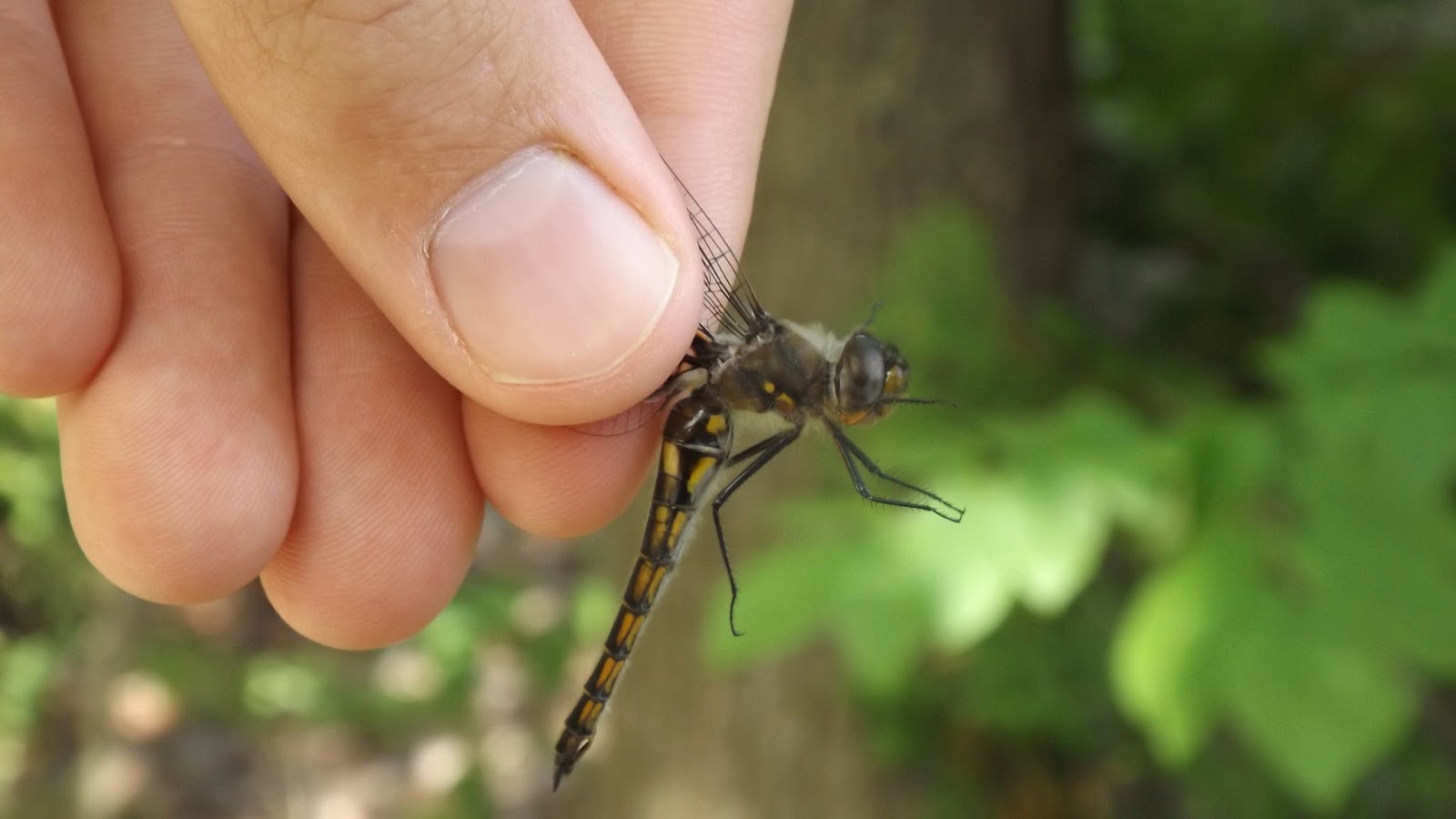
In the Hand: Dot-tailed Whiteface

This is the Dot-tailed Whiteface. It is a relatively common dragonfly if you are in the right place at the right time. Both sexes can be identified by their white "face" and a single yellow dot near the end of their tail. Males (pictured below) of this species tend to be darker.


Saturday, 10 June 2017

In, On, and Around Lake Huron

In...

You didn't think that I'd live up to this title...

Today we took a trip out to visit Kettle Point. It was the kind of day where your ears came in more handy than your binoculars or camera, so there aren't too many photos.

Driving in, I saw a Vesper Sparrow. In the marshes, many different birds could be found, including Marsh Wren, American Redstart, Mute Swan, and Alder Flycatcher.

This Red Fox was content to hang out near the road.


Speaking of red things, there were a couple Northern Cardinals around.


We went out on my uncle's boat...not to much out in the water but a few Mallards.


I checked out the dunes along the public beaches...a few swallowtails (Black and Eastern Tiger), and what I assume to be a skipper of some sort.


To finish off the day, I quickly checked into Ipperwash Dunes and Swales to look for butterflies, dragonflies, and damselflies.

This appears to be a Racket-tailed Emerald (thanks Blake!).


This is still unidentified. I think that it is a spreadwing of sorts, but I am unsure of what species. What really stands out is that the end of the abdomen (S8, S9, S10) are unmarked. Usually if a damselfly is of the "Black Type" (the abdomen is mostly black) it will have blue markings near the tip of it's tail. If anyone has a suggestion of what it may be, please comment! If it helps, the underside of the abdomen appears to also be blue. (EDIT: This is an Aurora Damsel...thanks Chris) 


Northern Crescents are fairly easy to find.


These are Juvenal's Duskywings. I was hoping that maybe it was a Sleepy, but alas it was not to be. I'll have to come back out this way and check out some other spots for them.


Final dragonfly of the day was Common Baskettail. There were at least half a dozen in one little area. Fairly easy to capture in the net, but I had to take a few swings before I caught one.


If this is just the beginning of the Ode and Lep season, then we are in for a treat this year!

Dragonfly and Damselfly ID Help

I am having trouble identifying these two odes from Ipperwash today. Does anyone know what they are? Thank-you for helping me out! (EDIT: Both have been identified...thanks to Blake and Chris)

Racket-tailed Emerald

Aurora Damsel

Friday, 9 June 2017

In the Hand: Eastern Forktail

Eastern Forktails are one of the most common damselfly species. Females, like this one, come in many different colour morphs. Males have a bright green abdomen and a black tail until S8 and S9 (the very end of the tail), which is a bright blue.


Wednesday, 7 June 2017

In the Hand: Common Ringlet

 I think I'm going to make a mini-series out of "In the Hand"

Here is a Common Ringlet. It can be identified by it's dull brownish-grey colour with some orange highlights. The upperside, which is really only seen when the butterfly is flying or when it is captured, is a nice orange. As the name suggests, there is usually a small dark ring on the forewing. This is a common butterfly of open areas.


Tuesday, 6 June 2017

In the Hand: Common Whitetail

I was trying out my new insect net down at the local pond today. The only dragonfly that I saw was a female Common Whitetail. To catch her I didn't even need my net! She was sitting nice and still, probably due to the recent rain.


Saturday, 3 June 2017

The Transition Period

Sad as it is, spring migration is virtually over.

But there is hope...this is the time of year that butterflies/moths (leps) and dragonflies/damsels (odes) start to appear in large numbers. These groups will entertain us until fall migration starts in a couple months. Today, I made my first trip of the year to look specifically to find some flying insects.

I started in my favourite spot to look for leps, a large open field adjacent to Sunngingdale Rd. and at the start/end of Uplands Trail. I can often find many skippers here. Today, I only saw a glimpse of one skipper, but there was quite a large number of Common Ringlets.


There was a tagged Monarch, but I was unable to get a photo or the tag number. A Virginia Ctenucha also didn't want it's picture taken.

An Eastern Tailed-Blue made an appearance.


There were a couple bluets, including Eastern Forktail.


Heading into the woods, I saw numerous larger species of dragonfly, such as Common Whitetail and what looked like a meadowhawk of some sort.


Heading deeper in the woods, there was a White-stripped Black moth.


Also see was one of my favourites, the Ebony Jewelwing.


Although things are still a bit slow, hopefully they will soon pick up!